Home Login Register Inquiry Sitemap

Travel Packages | India Tours | Hotels & Motels | Travel Agents | Advertisment


India >> NORTH ZONE >> Uttaranchal >> Dehradun

About Dehradun

Dehradun, nestled in a wide and thickly forested valley of the Shivalik ranges, Uttar Pradesh is known for its salubrious climate. Legend has it Guru Dronacharaya, a Brahmin teacher of warfare, considered the place fit for meditation & worship and therefore, the valley of Doon was christened Drona Ashram, meaning "The Abode of Drona". During British Raj, It was the summer base of the Viceroy's Bodyguard and at present, the base of the Indian Military Academy.

Area: 30 sq km
Best Time to Visit: Throughout the year
Climate: Due to its location in the hilly part of the state, the climate of Dehradun is salubrious.
Main Languages: Hindi, English, Garhwali
Population: 5,20,000
Temperature: Summer - Max: 36 Min: 16.7

Winter - Max: 23.4 Min: 5.2

Attractions In & Around

Dak Pathar

It is the Site of a hydel project situated on Dehradun-Chakrata road, which has been developed into a picnic and recreation center. It is connected by regular bus service from the Parade Ground and Highway Bus Stand near Railway Station.
Under the Yamuna Hydel Scheme, Dak Pathar has emerged as a tourist spot, boasting of lush green lawns and blooming gardens..

Excursions around : Kalsi ----- It is located 6 kms. from Dak Pathar enroute Chakrata, on the banks of the confluence of two rivers, Tons and Yamuna. Here exists an Ashokan edict, inscribed on a sizeable rock, preserved by the Archeological Survey of India.
Information for tourists : It is situated on Dehradun - Chakrata road and is connected by regular bus service.
A tourist bungalow and few hotels are available.
Interesting Recreation Centre : Located on the foothills of Shivaliks, this is the newly developed recreation center of GMVN (Garhwal Mandal Vikas Nigam). It is a tourist complex with spacious lawns and gardens, and has a full standard size swimming pool. It offers water sport facilities, which include water skiing, sailing, boating, canoeing, and hovercraft ride.
Lakha Mandal : Lakha Mandal is 80 kms on Kalsi-Yamunotri Road, where there are hundreds of idols scattered that are of archaeological importance. According to a legend, the Kauravas made a shellac house here and conspired to burn the Pandavas alive.
Location : 11 kms. from Dak Pathar
Poanta Saheb : 16 kms from Dak Pathar across the Yamuna River is Poanta Saheb, where we get to see the beautiful gurudwara of Guru Govind Singhji. Devotees and tourists come here in large numbers to worship and see the beauty of the place.

TOP

Forest Research Institute

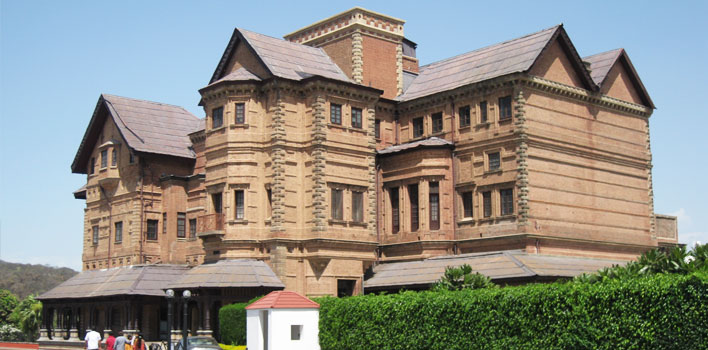
Established by the British the Institute is one of the finest of its kind in the world. All Forest Officers in India are trained here. This thickly forested sanctuary spreads all the way to Dehradun.
Most of the forest officers are a product of this institute. The FRI with its majestic building also houses a Botanical Museum.
It is one of the finest institutions in the world and stands in extensive grounds amongst fine plantations of many species of forest wealth. The Institute maintains six museums, covering various disciplines, which are open to public.
Across the six galleries of the museum are laid out some of the best collections of specimens of flora and fauna..

Timings : The museums are open from 0930-1300 hrs and 1330-1730 hrs.
Objectives : The Institute caters, in particular, to the research needs of the Indo-Gangetic plains of Punjab, Haryana, Chandigarh, Delhi and Western Uttar Pradesh, as Well as the U.P. Himalayas. Forestry research at the FRI is organized under fourteen divisions.
Organization : Established in 1906, the Forest Research Institute, Dehradun, is one of the oldest institutions of its kind, and acclaimed the world over. The Institute's history is virtually synonymous with the evolution and development of scientific forestry, not only in India, but also over the entire Indian sub-continent.
Set in a lush green estate spread over 450 hectares, with the outer Himalayas forming its back drop, the Institute's main building is an impressive edifice, marrying Greco-Roman and Colonial styles of architecture, with a plinth area of 2.5 equipped laboratories, library, herbarium, arboreta, printing press and experimental field areas for conducting forestry research, quite in keeping with the best of its kind anywhere in the world.
Research : Since its establishment, the Institute has rendered Yeoman service to the forestry sector, not only within the country, but internationally as well. Valuable scientific knowledge has been generated and documented on the silviculture of over 550 species of trees; classification of forest types of India, Pakistan, Bhutan, Bangladesh and Myanmar; silvicultural systems for tropical forests; successful introduction of exotics, Eucalyptus, poplars, Tropical Pines and Acacias; seed technology of over 80 important forest tree seeds, and management of bamboos. Over 2000 sample plots, established over the years, have provided data for compiling yield and volume tables for over 120 tree species. Preservation plots established throughout the country since 1929, have helped gain a better understanding of forest ecology, biodiversity and the environment. The Institute's achievements in forest products research, particularly during the world wars, have contributed valuably to the development of forest-based industries in the country. The Arsenic-Copper Chromate treatment for wood preservation, developed by the Institute, is now widely adopted throughout the world and it has also pioneered the process of pulping bamboos for papermaking.
Over thirty five tools, developed by the Institute's Forest Operations Division, have proved a boon to workers engaged in field forestry operations, such as logging and tending, vastly improving efficiency levels, and simultaneously contributing valuably towards the conservation of precious timber resources.
Study and development of termite control measures and control of insect pests of Sal, Shisham, Teak and Babul, rank among the foremost achievements of the Entomology Division of the Forest Research Institute. Similarly, many pioneering works have been accomplished in the field of Forest mycology and pathology. Forest nurseries over the country nave benefited immensely, producing quality seedlings using insect-pest and disease control practices pioneered at this Institute.
Research in Non-wood Forest Products (NWFP) at FRI has led to several noteworthy achievements of immense industrial importance, such as the development of Rill method of tapping pines for resin extraction, perfection of techniques for katha extraction from khair, extraction of oxalic acid from bark of Terminalia tomentosa and T. Arjuna and cultivation and utilization practices of a number of exotic aromatic and drug yielding plants.
The herbarium maintained by the Institute houses 330.000 authenticated plant specimens, the best in the East. Its Xylarium, with a collection of over 18,000 wood specimens from India and abroad, qualifies the Institute as the best source of reference for wood identification.
Its museums are a major attraction for tourists in addition to being a valuable source of scientific information.

TOP

Rajaji National Park

This Park is distinct for its pristine scenic beauty and rich biodiversity spread over a large area. Rajaji is a magnificent ecosystem, rich in faunal wealth existing in the reserve. The wildlife of the park is blessed with elephants, tigers, leopards, deer and ghorals as its best-known life forms.

This park was founded in 1966. A spread over an area of 820 sq. kms, the park is nestled in the lush valley of Shivalik ranges. It represents the flora of several zones of the forest, reverine, broad leaf mixed forest, chirping forest, scrubland and grassy pasturelands..

Flora : The forest in the park is deciduous, with Sal (Shorea Robusta) as the principal constituent. Due to abundant rainfall, favourable conditions are created for diverse forest types like (1) Moist Shiwalik Sal, (2) Moist Bhabar Dun Sal, (3) Western Gangetic Moist Mixed Deciduous, (4) Low Alluvial Sevannah Woodland, (5) Dry Shiwalik Sal, (6) Northern Dry Mixed Deciduous, (7) Khair Sissoo Forest, and (8) Lower Shiwalik Chir Pineforest.

The main species of plants include the Sal (Shorea Robusta), Baki (Anogeissue latifolia), Sain (Terminalia Tomentosa), Haldu (Adina Cordifolia), Bachera (Terminalia Ballerica), Jhingan (Lannea Coromandelica), Kharpat (Garuga Pinnata), Phauri (Lagerstromia Parviflora), Bula (Kydia Calycina), Badal (Stereospermum chelonoides) etc.

The under-wood is light and often absent, consisting of Rohini (Liollotus philippinensis), Amaltas (Cassia Fistula), Sandan (Ougeinia Oojeinensis), Pipal (Bauhienia Lazan), Mahal (Pyrus Pashla), Chamaror, (Ehretia Laevis), Aonia (Emblica Officinalis), Kachnar (Bauhienia Variegata), Ber (Ziziphus Mauritiana), Chilla (Casearia tomentosa), Bel (Aegle Marmelos), etc.
Information for tourists : This park is gaining popularity attracting large crowds.
Best time to visit is between November and mid June.

It is an ideal holiday resort with its many picnic spots and excursion sites for the nature lover.
Other Attractions : About 49 species of fish fauna have been recorded from the wetlands of the Park, including a small loach Nemacheilus Doonensis, and another species Berilius Dimorphicus to science (ZSI, 1995). Hymenopterous insects mainly refer to the Scolid wasps of the Park and as many as 13 species have been recorded. Out of these, five species are not only new to the area, but also to the whole of the U. P.

The butterfly fauna of the Park is very rich and represented by as many as 60 species under eight families.
Reptiles : About 28 species of snakes, 12 species of turtles and tortoises and 9 species of lizards among Reptilia are being recorded from the park. Ten species under six genera and four families belonging to order Anura (toads and frogs) with their developmental stages have also been recorded. Uperodon Systoma, Polypedates maculatus and Rana crassa are recorded for the first time from the park.
Faunal Wealth : The Rajaji National Park is rich in faunal wealth because of the varied types of ecological niches existing in the reserve. The main groups found are mammals, birds, reptiles (snakes and lizards), amphibians, butterflies and fishes. The invertebrate groups are, the Scorpions, Centipedes, Odonata (dragon and damselflies), Hymenoptera (Wasps, Bees, etc.) Isoptera (termites) and Lepidoptera, which comprises more than 60 species. India's National Bird Peacock is found here in abundance.

Several important herbivores like Asian Elephants, Spotted Deer, Sambhar, Barking Deer, Blue Bull (Neel Gai), Hog Deer, Wild Boar, Rhesus Monkey and common Langur occur in the park. Among the important carnivores are Tiger and Leopard, the smaller carnivores as predators are Leopard Cat, Jungle Cat, Civet Cat and Yellow Throated Martin.
Avifauna : About 315 species of birds are reported to occur in the park. Birds like Ducks, Teals, Cormorants, Egrets, Lapwing, Pond Herons, Pea Fowl, Jungle Fowl, various species of Partridges and Pheasants, Crows, Owlets and Nightjars, Birds Of Prey, etc, are quite common.
Did you know? : There are 23 species of mammals and 315 of avifauna here. The Rajaji National Park is named after Late Shri C. Rajgoplalachari, popularly known as Rajaji.

Three sanctuaries in the Western U.P., Shivaliks-Rajaji, Motichur and Chilla were amalgamated into a large protected area and named Rajaji National Park in the year 1983. This area is the northwestern limit of Asian elephants.

TOP

Robbers Cave

Popularly known as Guchhu Pani, it is situated 8 kms. from Dehradun and is an ideal picnic spot surrounded by hills. Water vanishes underground only to reappear after a few yards in the form of a stream..

Location : It is situated 8 kms. from Dehradun.

TOP

Tapkeshwar Temple

Dedicated to Lord Shiva, this cave temple is beside a stream on the banks of a seasonal river where water falls on a shivling drop by drop from a rock and hence the name Tapkeshwar. It is 5.5 kms. from the city bus stand.

Tapkeshwar Shiv temple is an ancient place of worship. This is the venue for the Shivratri mela each year.
The temple is situated on the banks of a rivulet, in the Garhi Cantt. People in large numbers participate in the fair organized on the occasion of Shivratri and pay their obeisance to the deity. Cool sulphur springs around the temple make excellent bathing spots for pilgrims..

Location : It is 5.5 kms. from the city bus stand.

TOP


Related Cities