India >> West Zone >> Maharashtra >> Nashik
About Nashik Situated about 200 kms. from Mumbai, Nashik stands on the banks of the holy river Godavari. It has a personality of its own due to its mythological, historical, social and cultural importance. It is also the site for the triennial Kumbh Mela, held every 12 years. It is known for best quality Grapes. Temples and ghats on the banks of Godavari have made Nashik one of the holiest places for Hindus all over the World.
| Area: | 220 sq. kms
|
| Best Time to Visit: | October to February
|
| Climate: | Nashik has a pleasant climate, warm in summer and slightly humid during the rainy season.
|
| Main Languages: | Marathi, Gujarati, Hindi and English
|
| Population: | 10,76,967
|
| Temperature: | Summer - Max: 42.5oC Min: 21.5oC Winter - Max: 28.3oC Min: 6oC
|


Other Attractions In & Around


|
Kala Ram Mandir
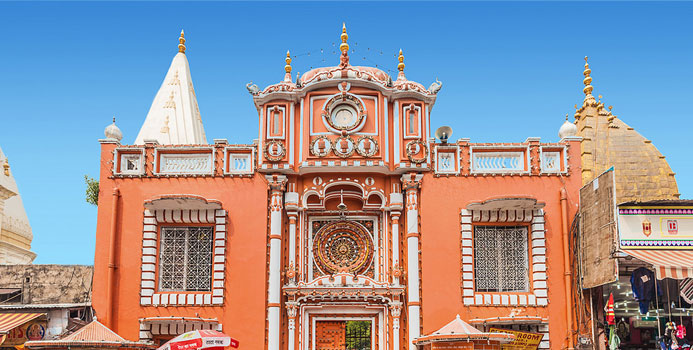
The largest and simplest of the temples is Kalaram Mandir, built in 1790 by Sardar Odhekar of Peshwa. It houses a black stone image of Rama, hence the name. The temple is made by complete black stones, which has four doors facing East, West, South and North and the apex made up of 32 tons of gold. In 1930, Dr. Ambedkar performed Satyagraha, to allow the entry of Harijans into the temple.. The Temple : The building stands in the middle of a walled enclosure with 96 pillars and entered on the east through an arched portal.
The temple got the name Kalaram Mandir as the idol of lord Ram is of black colour and the ‘Kalash’ is made of 32 tons of gold. The stones were brought from Ramshej about 200 years ago and it took Rs. 23 lakhs and 2000 workers to build the temple in 12 years. This 70 feet high structure was built with black stone extracted from the mine of Ramshej Hill. The copper peak of the temple is gold-plated and looks ravishing by day and night as well. Festival : There are great processions and Utsav on festivals like Ramnavami, Dasara and Chaitra Padwa (Hindu new year day). Idol : The devotees worship idols of Lord Ram, Lakshmana and Sita here, which are sandy black decked with ornaments. Nearby is the ‘Sita gumpha’ where Devi Sita is said to have stayed during her exile. There is a grove of large Banyan trees near the cave. Various small temples dedicated to Lord Vithala, Lord Ganesha and Lord Hanuman surround Kalaram temple. Location : It located in the Panchavati area, Nashik. Significance : The most significant temple is the Kalaram temple located in the Panchavati area, Nashik. This temple is an architectural grandeur, with the motif, pretty much analogous to that of the Trimbakeshwar Temple. TOP
|


|
Pandu Lena
About 8 kms. south of Nasik, is a group of 24 Hinayana Buddhist Caves dating from around the 1st century BC to the 2nd AD. The most important in this group are number 18 and 20. Except caves no. 18, the rest of the caves are Viharas or Monasteries. This group of caves is one of the most important and intriguing in western India.
The oldest historical place in Nashik is Pandav caves which are also known as Trirashmi Leni. The famous Dadasaheb Phalke Smarak and Buddhasmarak are soon to be opened for public, which are known for their creativity and only of their kind.
Cave 3 is a large vihara with some interesting sculptures. Cave 10 is also a vihara and almost identical in design to cave 3, although it is much older and finer in its detail. It is thought to be nearly as old as the Karla Cave near Lonavala. Cave 18 is a chaitya believed to date from the same time as the Karla Cave and is well sculptured. Its elaborate facade is particularly noteworthy.
The cave houses the idols of Buddha, Jain Teerthankara Vrishabhdeo, the icons of Bodhisatva, Veer Manibhadraji and Ambikadevi. The interiors of the caves were popular meeting places for the disciples, where sermons were conducted. There are attractive water tanks very skillfully chiselled into the rock.
The 2000-yr-old Pandavleni caves, built by the Jain kings, are located on a tableland atop the Trivashmi Hill, close to the Mumbai Road.. Information for tourists : Excavated in Trirashmi Hill, it is also called the caves of the Pandavas. A renovation drive by the Archaeological Survey of India and the State tourism department promises the construction of a stairway from the base to the top of the caves.
Pandulena caves are rich in inscriptions throwing light on the history of the Satavahana and Kushana dynasties. Some of the finest caves or viharas are the GuatamiputraVihara, Nahapana Vihara and Mahayana Vihara, which must be visited for their interesting sculptures. Location : About 8 kms. south of Nasik How to get there : Nashik is well connected by road and rail with all the major places within and outside the state.
It also has got a railway station.
State transport ply buses regularly connecting Nashik with major cities of Maharashtra like Nagpur, Mumbai, Pune, and Aurangabad etc. TOP
|


|
Trimback
The village Trimbak, 36 kms from Nashik, is famous for the Trimbakeshwar Temple. It enshrines one of the 12 jyotirlingas dedicated to Lord Shiva and is considered to be the main jyotirlinga. It s famous for the major Poojas Narayan Nagbali, Tripindi and Kalsarpa done only at Trimbakeshwar in India.. : The village Trimbak, 36 kms from Nashik, is famous for the Trimbakeshwar Temple. It enshrines one of the 12 jyotirlingas dedicated to Lord Shiva and is considered to be the main jyotirlinga. It s famous for the major Poojas Narayan Nagbali, Tripindi and Kalsarpa done only at Trimbakeshwar in India. The temple structure : The temple is in the Indo Aryan style and the temple structure with excellent adornments of idols and sculptures, is surrounded by a massive stonewall. There is a huge bull in front of the temple and another marble Nandi is seen on the inside. The sculptural adornments continue even to the garbagriha with human, animals and yakshas carved. From the Jyotirlingam at the centre of the garbagriha, trickles the Ganges continuously throughout the year.
Triyambak is the place of "jyotirlinga" - Trimbakeshwar. It is an important place where Kumbh mela takes place every twelve years, like Nashik.
Triyambak kumbhamela takes place for Shaivas, i.e. people worshipping Lord Shiva.
The extraordinary feature of this Jyotirlinga is that it has three faces embodying Lord Brahma, Lord Vishnu and Lord Mahesh (Shiva). All other Jyotirlingas have Shiva as the main deity. The temple is known for its appealing architecture and sculpture and is at the foothills of a mountain called Brahmagiri. Godavari River originates on Bramhagiri Mountain. Nearby there is the 'Gangasagar bathing tank' into which the Godavari River dribbles in, from its source. A bath in these waters is supposed to wash away sins. From this tiny start the Godavari eventually flows down to the Bay of Bengal, clear across India.
960 steps from near the tank lead up to the source of the river.
The temple has beautiful carvings. Anyone visiting this temple is believed to attain salvation. It is considered to be the holiest place to perform Shraddha ceremony as mentioned in 'Nirnaya Sindhu' - a religious book of Hindus. Non-Hindus are not allowed inside the temple but one can get a clear view from outside.
The Trimbakeshwar (Tri meaning three and Ambak meaning eyes) Temple is dedicated to Lord Shiva. Baji Rao Peshwa built the temple in 1730. There is an impressive Maratha Fort about 550 meters above the city. TOP
|


|


Related Cities

|