|
Introduction
Janmashtmi is observed on the birth anniversary of Lord Krishna. The festival falls on the eighth day (Ashtami) in the month of Sravana. According to the Gregorian calendar, Janmashtmi is often celebrated in the month of August - September. According to the Hindu lunar calendar Krishna was born on the eighth day of the second fortnight in Sravana, when the moon entered the house of Vrishabha in Rohini Nakshatra. The festival is celebrated for two days. The first day is called Krishnashtami and second day is known as Kalashtami.
Legend of Janmashtmi
Lord Krishna is one of the most popular Gods of Hindus. He is considered to be the folk hero. According to the Hindu Mythology, Krishna was the eighth and last son of Princess Devki and King Vasudev. He is said to be the eighth incarnation of Lord Vishnu on the earth. Devki was the beloved sister of Prince Kansha of Mathura. Kansha was a hard hearted man though he loved his sister very much. He married his sister to one of his friends Vasudev who was on the upper rank in the army of Mathura. On the day of marriage, when Devki was being escorted to her husband’s home, a heavenly voice warned Kansha that Devki’ s eighth child would kill him. The furious Prince in order to negate this heavenly foretell imprisoned his sister Devki and her husband Vasudev. He decided to kill every child that his sister would give birth to. The life of Devki and Vasudev was full of atrocities as Kansha killed all their children on the same day of their birth. But the last child of Devki was the special one. He was to be saved for any cost as he was to be incarnated for the good of Human of the earth. The birth of Krishna is full of dramatic events. Just after the birth of Krishna at the mid night, by a sheer miracle, all the guards of the prison fell asleep and the gates and chains opened themselves. Knowing the importance of the child, Vasudeve smuggled it out of the prison. The night outside was extremely harsh as the wind was blowing in full swing and it was raining cats and dogs. River Yamuna was swollen with water, but with the touch of Krishna’s toe the water receded. The child was being protected by the fang of Shesnag from the heavy rain. Finally, Krishna was handed over to Nand a dear friend of Vasudev and the chief of Gokul village.
Celebration
The celebration of Janmashtmi is performed with keeping fasting in the reverence to Lord Krishna. Bhajan, Singing, chanting of Hymens, Pooja are done with elaborate ceremony all over the country. Devotees visit the temples of Krishna and seek his blessing to fulfill their desires. In the morning of the day the idol of Bal Gopal (Krishna) is given bath with Gangajal, ghee, water, honey and curd. The idol is adorned with shining clothes and jewelry. The idol of Krishna is then put on the altar or cradle. 56 kinds of Bhog i.e. offerings are served to the God like Fruits, Kheer, Pedha, Milk and milk products and so on. The cradle of the Krishna is rocked by the devotees throughout the day.
The actual festival begins at the midnight when Krishna was born. The hymens, Aarti, Bhajan and Kirtan intensify at the peak hour. The birth of Krishna is announced with the blowing of Sannkh (Conch). The Prasad and Panchamrit are distributed among the devotees with the birth of the Lord. The devotees break their fast with the Prasad after the Pooja.
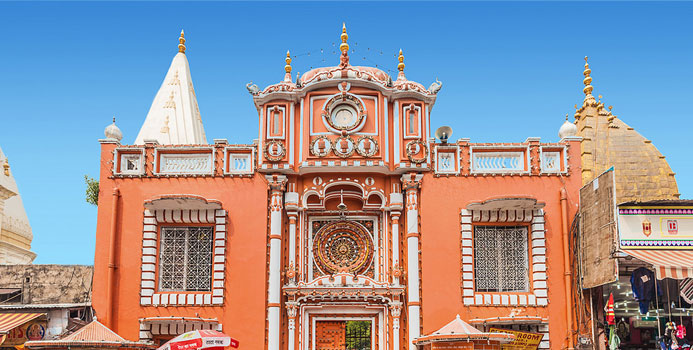
The celebration of Janmashtmi is special in the Mathura, Vrindavan, Dwarka and ISKON temple and other places related to Krishna. “Ras Lila” is organized in these cities which is the folk dace form in which Krishna is shown to be dancing with his consort Radha along with Gopis.
|