|
|
| |
| |
| About Mussoorie
|
The queen of hill stations is about 89 kms from Haridwar and the salubrious climate and deep woods make it an ideal hill station. The name, Mussoorie, derives its name from plants of ‘Mussoorie’, found in abundance here. After its discovery, this place gradually developed as a center of education, business, tourism and beauty.
The hill station of Mussoorie came into being around the 1830s. What began as a small settlement grew into a large station to turn into a hill station of today overlooking the sprawling Doon valley and the city of Dehradun. Mussoorie was not named after a place in England. The British were content to follow the name given by the hill-folk.
Mussoorie, at a height of around 7000 ft above the sea level, straddles a ridge in the Garhwal Himalayas, developing into a major tourism destination.
|
| History of Mussoorie
|
Mussoorie, as a hill station has quite an intriguing past. Its history dates back to 1827 when Captain Young, an adventurous military officer, explored the present site, laying the foundation of this holiday resort, which has few rivals now. The holy and mighty river Ganga is visible from one end of the ridge.
It was due to the conquest of the Garhwal and the Dehra in 1803 by the Gurkhas, under Umer Singh Thapa that Mussoorie came into being indirectly.
Before the British came, there were only shepherds whose animals grazed on the 'Mansur' shrub, which gives the town its name. It is natural to suppose that the officers locate the hills and eventually climb them here and there in search of sport and recreation.
|
| Did you know?
|
The first house erected on the ridge of Mussoorie was a small hut built on the Camel's back as a shooting box by Mr. Shore, the then Joint Magistrate and superintendent of revenues of the Doon and Captain Young of the Sirmur Rifles. Soon Captain Young built his large residence called 'Mullingar' as his residence. The splendid climate and the good sport obtainable gradually attracted other Europeans and as the Doon and the hills to the north became better known in 1827, the Government established a convalescent depot for European soldiers at Landour. The town gradually grew and a hundred years on it had grown into a major settlement of the home. Social life had also become hectic.
|
| Attractions - Camel's back road
|
This is a 3 km stretch, enjoyable for walking and horse ridding. One can get a spectacular view of the sunset in the Himalayas from here. The road passes through an old British graveyard and is named after a rock resembling the back of a sitting camel.
|
| Gun Hill
|
This is the second highest peak in Mussoorie, offering an astounding view of the Himalayas, a bird's eye view of Mussoorie and ofcourse the entire Doon Valley. This spot may be reached through a Ropeway ride or a 20-minute trudge up a bridle path. During pre-independence days a gun mounted on this top used to be fired heralding mid-day to enable people to adjust their watches and hence this name.
|
| Kempty Fall
|
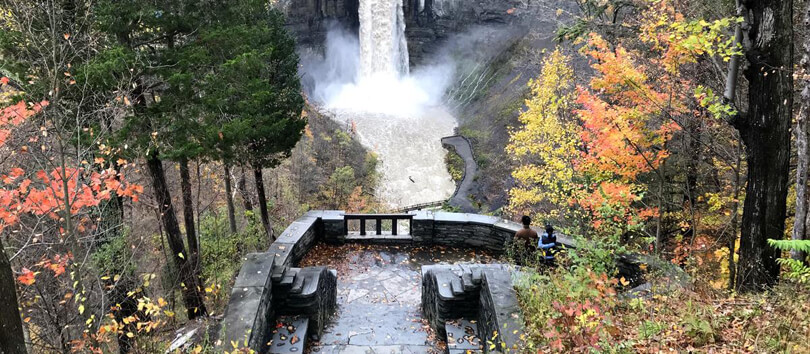
The Kempty fall is a huge waterfall located in a valley, about 20 minutes drive from Mussoorie enroute Yamunotri. Bath at the foot of the falls is refreshing and enjoyable for children and adults alike.
|
| Municipal Garden
|
This is a picnic spot with an artificial lake and boating facilities. A huge variety of Himalayan trees and shrubs are on display and about 4 km from Mussoorie, the garden is half-an-hour's pleasant walk!
|
| Childer's Lodge
|
This is the highest peak in Mussoorie, about 5 Kms from the Tourist Office. One can walk or go on a horse back for a glimpse of snow-clad mountains. It is fascinating to get the glimpse and never lets you go back home.
|
| Cloud End
|
The resort is surrounded by thick deodar forest, ideally suited for foreigners and honeymooners. The bungalow built in 1838 by a British major was one of the first four buildings of Mussoorie has now been converted into a hotel. The place provides peace and calm and is full of flora and fauna.
|
| Nag DevtaTemple
|
This is an ancient temple situated on Cart Mackenjie Road and is about 6 kms from Mussoorie. Vehicles can go right up to the spot. It provides a charming view of Doon Valley as well as of Mussoorie.
|