India >> West Zone >> Gujarat >> Ahmedabad
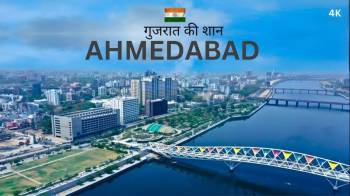
About Ahmedabad One of the most liveliest cities in India. A visit to Ahmedabad is a great way to discover Gujarat.
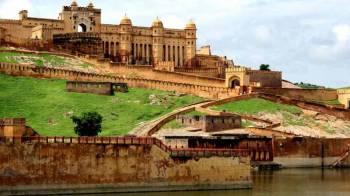
Ahmedabad was built by Sultan Ahmed Shah to serve as his capital in 1411 A .D. While returning from one of his campaigns the young Sultan Ahmed Shah impressed with the scenic surroundings and climate of the town of Ashawal undertook the building of his new capital with a fort and twelve gates and named it Ahmedabad. While you can only see the ramparts of the 600 year old Bhadra fort, almost all the twelve gates with the exception of one have withstood the ravages of time and man.
If you have been to Ahmedabad before you will want to come again. If you are coming soon, Welcome. Ahmedabad has something for everyone. You will be glad you made it.
Variety is its fascination
From the hustle and bustle of C. G. Road in the heart of Ahmedabad to the quite retreat of Sabarmati Ashram. From the mute grandeur of the Shaking Minarets to the noisy prosperity of the country’s largest textile empires, Ahmedabad’s fascination is its variety. Old and new stand side by side. The modern and ecclectic mix with history and tradition offering something for everyone. There is nothing like a perfect time to visit Ahmedabad. Starting with Makar Sankranti’s kite flying in January, the masti continues only to peak at the nine day long Navratri with Dandiya and Ras Garba in November followed by the dazzle and glitter of Diwali festivities which last a whole month.
No matter what time of the year you come, there is so much to see and so much to do.
| Area: | 92.98 Sq. kms
|
| Best Time to Visit: | October to March
|
| Climate: | Ahmedabad has a very hot and humid type of climate. The temperatures vary greatly between day and night.
|
| Main Languages: | Gujarati, Hindi and English
|
| Population: | Approx. 3,515,361
|
| Temperature: | Summer - Max: 42 Min: 23 Winter - Max: 36 Min: 14
|
| Transport: | Ahmedabad is well connected by air, rail and road to major Indian cities.
By Air-International and Domestic airlines connect Ahmedabad to Bombay, Delhi and major cities of India. The city is also linked to Muscat, London and Newyork.
By Rail-Ahmedabad is linked to Bombay, Delhi, Calcutta, Chennai and other major cities in India by rail.
Road-Ahmedabad is connected by National and State Highways to major cities in India.
|


Other Attractions In & Around


|
Adalaj Wav
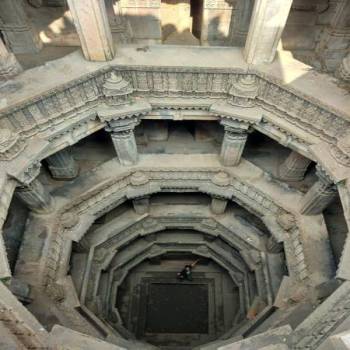
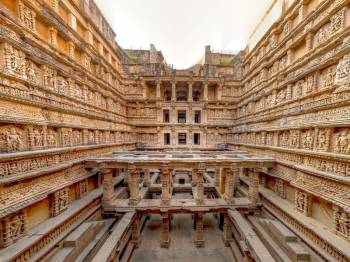
About 19 kms north of Ahmedabad this stepwell is an architectural wonder built by Queen Rudabai and is certainly one of the finest monuments of Gujarat. It is a seven-storied structure in the form of a well with chambers one behind the other.
The Vavs or stepped wells of Gujarat were used as meeting and resting-places during summer since their cool interiors offered unbelievable respite from the scorching sun outside. In the summer people warmed themselves on the spacious sunny corridors while wide verandahs offered shelter during the rains.. Well-planned structure : The 'Vav', laid out in the north-south direction, the stepwell with the well in the north and the entrance in the south, has a total length of 75.3 metres. It is the only major monument of its kind, having three entrance stairs leading to the stepped corridor. The stepwell has five storeys and three gates to enter in. It is full of artistic sculptures.
The platform rests on 16 pillars, eight on the corners, and two in front of each main side. Four built-in shrines, with doors, windows and balconies, mark the four corners of the platform. The stepped corridor begins from this square platform. The corridor is entirely surrounded by a one-metre high parapet wall with a rounded topping. It descends with four pavilion towers for five storeys. The walls of the 'Vav' are veritable showcases of sculptures and ornamentation. Significance : The stepwell at Adalaj has been preserved by the archaeological department and developed into as a tourist spot.
It provides a cool and secluded retreat during the hot summer months.
The construction of a stepwell reflected the artistic sense of its promoter. There are hundreds of stepwells in Gujarat, each being unique in its construction. Most of them are simple. The prime purpose behind them could be to serve the people.
These step wells attract lots of tourists every year. The carvings, construction and the architecture amaze many experts, since it was built during those days when sophisticated and meticulous engineering techniques had not developed upto the recent standards. History : Adalaj is a village to the north of Ahmedabad. The 'Vav' (step-well) at Adalaj derives its name from the lady patron, Ruda, wife of the Vaghela chief, Virsinh. There is an inscription in Sanskrit, which gives the entire history with exact dates.
Stepwell perhaps is a unique feature of Gujarat, which speaks of the history, culture, and architecture. It was also considered to be a religious obligation.
Kings, rulers, umraos and the rich people of Gujarat spent huge money for constructing these. These step wells used to be frequented by travellers and caravans as stopovers along their trade routes. A unique characteristic of step wells was that they not only conserved water but were also cool chambers where one could rest during hot summer months. In times of drought and scarcity these wells were of great use to common man. TOP
|


|
Akshardham
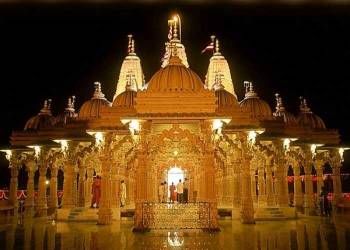
Akshardham, the highlight of Gandhinagar houses a beautiful Swaminarayan temple, with a theme park containing tableaux of the Ramayana and Mahabharata. The village Pethapur outside Gandhinagar is known for its woodcarving and traditional textile block printing.
It is a unique cultural complex. Inspired by H. D. Pramukh Swami Maharaj, Akshardham is a miracle worked by the service and devotion of thousands of volunteers. The entire monument was built without the use of steel. Besides a 7 feet gold leafed idol of Lord Swaminarayan and his holy relics, there are three exhibitions on Indian Culture with light and sound shows, a multimedia show and an animatronics show. Games, rides and food refreshments are other attractions of Akshardham.. Location : It is set in the multi-acre garden, Sahajanand van, with intricate sculpture of Hindu Gods, beautifully landscaped garden, cafeteria and amusements.
A visit to this place is worth it. Structure : The temple is built in traditional Indian architectural style from 6000 metric tons of long lasting pink sandstone, from Rajasthan, and carved by expert artisans from Bansipahadpur. The first floor galleries are a museum portraying the 500 parahansas, a letter to his guru, Ramanand, a piece from an old tree from Chapaya, recreation of his old home, a diorama of the lord on a horse and other displays. The galleries outside, have a state-of-the-art exhibition using Chez Integrovision shows, audio-visuals, multi-media, dioramas of the life of Lord Swaminarayan and from the Hindu epics, fibre optics etc to introduce readers to the concept of the Akshardham movement. TOP
|


|
Ambaji
Situated on the Arasur hill near Mount Abu, Ambaji is one of the most important places of pilgrimage in Gujarat, built of the finest quality of marble. It is the principal shrine of the goddess-Amba and is recognised as one of the original Shakti Pithas.
It attracts pilgrims in numbers beyond comprehension and large number of devotees assemble at this temple on the occasions of four purnima fairs held every year on the full moon day of Kartik, Chaitra, Bhadrapad and Aso. In the vicinity of Ambaji are the well-known Jain temples of Kumbhariya and Gabbar, a steep hill on the peak of which are footprints of Goddess. During the holy month of Bhadrapad, devotees trek hundreds of miles on foot to reach the temple.. Special Attractions : During the 9 days of Navratri, prayers are performed and dances can be witnessed in the forecourt.
Agriculturists from all over Gujarat go to the temple for this festival along with members of their family. There is a large fair on this occasion while in the evening, performances of Bhavai are held, and Garba programs are organised. The devout attend readings of the Saptashati, the seven hundred verses in praise of the goddess.
As the devotees come to this temple on the Bhadrapadi Purnima, there is a tradition to visit a nearby place called Gabbargadh, a small hill two miles west of Ambaji. There is a pipal tree, at the top of the hill, which pilgrims circumambulate to show their respect to nature.
The Gujarat type of dolling up the deity with colorful flowers etc., bends the head of every visitor invariably.
On the full and new moon Ashtami days of every month, several kinds of special Pujas are offered to the Mother. So, every day is a special day, rather every moment an auspicious moment in this holy shrine, which is only to be seen and enjoyed than clothed in words. Construction : The deity in the temple is represented not by an idol but by a triangular Vishwa Yantra, inscribed with figures and the syllable 'Shri' in the centre. Legend : Built of the finest quality of marble, this is recognised as one of the original Shakti Pithas where, according to the ancient scriptures, the heart of the Goddess Ambaji fell to earth when her body was dismembered.
It is the principal shrine of the Goddess in Gujarat whose actual origins are still unknown. The fact that this temple does not have an idol is indicative of it antiquity, since the worship of images of deities became popular much later. Significance : It is one of the most important places of pilgrimage in Gujarat and is also known as Amba Bhavani or Arasuri. Arasur is the seat of Ma Ambaji. Almost all communities believe in Ambaji.
It is one of the many important places of pilgrimage for Jains. The temple is very old and there is no idol in the main hall. The seat of the deity is there. The dress and ornaments are arranged in such a way that an illusion of total 'Darshan' is created. The atmosphere is live with the chanting of 'Jay Ambe'.
It is this Goddess whose grace enabled Rukmini to secure Krishna, as her Pati (husband). It is also believed to be the site where the tonsorial ceremony of Lord Krishna was performed.
Ambaji is also a famous trade centre for forest products like honey, wax and timber. There are marble mines near Ambaji. Copper is also found among some other minerals
Round the year, on every Purnima the town Ambaji celebrates a spontaneous religious fair Lok Melo as a huge gathering of devotees reach there to worship Ma Ambaji.
Mighty rulers and renowned saint-singers are drawn towards her feet, since time immemorial and that made this holy kshetra one of the most visit-worthy shrines both by Sakteyas and bhaktas of every sect and brand. TOP
|


|
Baroda
Baroda, the City of Palaces has often been called the cultural capital of Gujarat and is filled with relics of it princely past.
It is also one of the corporate capitals with IPCL, ONGC and other major industries. There are numerous national and multi-national projects also coming up.. History : Archaeological findings indicate that human habitations existed in the city since prehistoric times. Vadodara passed through the hands of the Guptas, Chalukyas, Rashtrakutas, Solankis, the Sultans of Delhi and the Mughals before passing on to the Marathas. It owes its present day grandeur to Maharaja Sayajirao, a great patron of art, architecture and music.
It is situated on the banks of the river Vishwamitri. Baroda is the western derivative of the term; 'Vadodara' meaning 'City of Banyan Trees'. It is also known as the garden city of Gujarat. It is a graceful city of palaces, parks, temples, and museums. Places to visit are: Nazarbaug Palace - Built in old classical style, the Gaekwads used the palace on ceremonial occasions. Lakshmi Vilas Palace - The Royal Family's residence is an extravagant building in Indo- Saracenic style. Pratap Vilas Palace - Built as the residence of the royal family, this is a magnificent building in the Indo - Sarcenic style, housing a collection of old armory and sculptures in bronze, marble and terra cotta. The Baroda museum and art gallery and the Maharaja Fateh Singh Museum boast of an excellent art collection of works by Indian artists and European Masters, of Mughal miniatures and valuable palm leaf manuscripts of Buddhist and Jain origin.
About 50 kms. from Vadodra is Dakor, famous for its Temple of Ranchodrai and is a sacred place for the followers of Lord Krishna. Another interesting place worth visiting is Kirti Mandir - a majestic monumental building also known as Temple of Flame. TOP
|


|
Calico Museum
Ahmedabad houses one of the finest textile museums in the world in one of Gujarat's famous carved wooden havelis. The museum displays a magnificent collection of rare textiles dating back to the 17th century. There is also an excellent reference library on textiles.
Located in the Sarabhai Foundation, in Shahibagh the Calico Museum of Textiles, widely regarded as one of the finest textile museums in the world was constructed in 1949 AD. It has the finest collection of not just textiles and clothes but also furniture, temple artifacts and crafts in the country.
It has no less than five centuries of the finest fabrics spun, woven, printed and painted in different parts of India. It has a collection of marble, sandstone and bronze icons and busts split in two thematic sections- gallery for religious textiles and historical textiles. An excellent reference library on textiles is found here.. Fabulous collection : There are colourful embroidered wall hangings depicting Krishna legends hanging from the second floor right to the ground level. Cloth decorated with tie-dye, glinting mirror work, screen prints, block prints and intricate embroidery are also seen. There is an embroidered tent and the robes of Shah Jahan, along with elaborate carpets and plump cushions that once furnished Muslim palaces. Jain Section : The Jain section features statues housed in a replica Haveli Temple, along with centuries-old manuscripts and 'mandalas' painted on palm leaves. Specialties : Among exhibits are Kashmiri shawls, Kullu embroidery, glittering silk brocades from Varanasi, folk art from the Punjab and masks and large wooden temple cars (processional vehicles) from Tamil Nadu.

Tribal crafts such as, Kachchhi silk and cotton 'mashru' weaving are displayed in spectacular wooden 'havelis' from Patna and Siddhpur. There are clear and labelled models and diagrams explaining the weaving, dyeing and embroidery processes. The collection also includes some of the best examples of the Patola saris woven in Patan as well as the extravagant Zari work that gilds saris in heavy gold stitching which weigh almost nine kilos. TOP
|


|
Chorwad Beach
: Chorwad is a quaint little beach village about 66 kms. from Junagadh and the only beach in India where one can live in the timeless splendour of a palace built by the former Nawabs of Junagadh. It is ideal for weekend getaways and family picnics.
Chorwad, a small fishing village is a great place to enjoy views of rocky shores and boat riding. It is also a base to visit places like Porbandar, Somnath etc. There is a resort which was previously a palace built by Nawab Saheb Mohabbat Khan as a vacation spot on hot summer days. He held weddings of his dogs, royal banquets and processions amidst cool breezes from the sea.
It is a holiday resort with an isolated beach and is away from bazaars, crowds etc.
Though the sea here is not always calm, the pleasant climate invites a host of tourists every year. It is perfect for long beach walks and a quiet holiday.. Location : 66 kms from Junagadh, Gujarat. Attractions nearby : Porbandar - the historic princely state on the shores of the Arabian Sea is famous as the birthplace of the Father of The Nation, Mahatma Gandhi. His old residence Kirti Mandir is now a memorial museum having a series of memorabilia and library.
The Daria Mahal Palace facing the sea is a delightful work of architecture. TOP
|


|
Dada Hari Vav (Stepped Well)
Gujarat step wells or baolis are strange and unique and the Dada Hari Well built in 1499 is a magnificent masterpiece representing the typical Gujarati style of architecture Entirely underground, they were built to overcome heat and dust. Behind the well is the tomb of Dada Hari.
Northern Gujarat abounds in remarkable step-wells, with elaborately carved walls and broad flights of covered steps leading to the shaft. Dada Harini Vav, in the northwest of the city, is one of the finest. While it is a Muslim construction, built in 1500 for Bai Harir Sultani, superintendent of the royal harem, the craftsmen were Hindu and their influence is clear in the lavish and sensuous carvings on the walls and pillars.
A lady of Sultan Mahmud Begara court built one such step well in 1501. It is a fascinating place, though has signs of neglect today. It has a series of steps leading down to lower platforms terminating at a small, octagonal well. The depths of the well are cool, even on the hottest day, and it must once have been quite beautiful.. Significance : Necessity is the mother of invention. This is perhaps best illustrated in the step wells of Gujarat, an extraordinary form of underground water conservation, advanced with elaborate stone carvings. Art and utility go hand - in - hand in these magnificent specimens by master craftsmen. The sidewalls of the well shaft have spiral staircases and the whole step well is richly decorated.
The best time to visit and photograph the well is between 10 and 11 am. when the sculpted floral patterns and shapely figurines are bathed in the light of the sun. TOP
|


|
DakorDakor
Dakor is a temple town dedicated to Lord Krishna, about 50 kms. from Vadodara. The temple with a striking image of Lord Krishna is the temple of Ranchodare, belonging to the golden period of Dwarks. The temple houses a tank containing several species of turtles regularly fed by the pilgrims.
Originally known as DankaPur, it is here that the Lord Shri Dwarkadhishji migrated to get away from the increasingly decadent temple priests of Dwarka. It is said that a devotee brought the image from Dwarka and installed it in Dakor. On the silvery night of the full moon in October-November, a fair is held in the temple compound attracting thousands of pilgrims.. Location : Dakor is 47 kms. from Vadodara and 90 kms. from Ahmedabad.
It is situated on the banks of river Shedhi in Thasra Taluka of Gujarath District. Present temple : In its earlier phases as pilgrimage center in Gujarat, Dakor, was famous for the Danknath temple, a place of shiva worship. In the later phases it developed into a Vaishnavite center with the growing fame of Ranchorji temple. Today this place is known not only as a pilgrimage center but also a trading center where one can get the articles related to puja, and other rituals. The small shrine of the original temple is now encased in a large temple complex, which has grown up around it.
The actual temple is set on a high platform in a complex, set in the style of medieval temples from the region. The form of Lord Ranchorji is that of the Lord Vishnu with four arms. He bears the conch, lotus, discus and the mace in his hands.
Every morning at 6:45 am Mangala-arati is held, and Ranchorji is dressed and decorated in public. The temple is closed in the early afternoon. Ranchorji is fond of moga laddus. Saffron-flavored milk is offered in the morning. Information for tourists: : Visit Dakor on Sharad Purnima night (full moon night in the month of November), to enjoy the grandeur of the festivals. Historty of DakorDakor : Ranchor is the name given to Lord Krishna when he fled from the battlefield in Mathura while fighting against Jarasandha and his army. Ranchor means “one who gives up the battlefield. This Deity was installed and worshiped in Dwarka up to 800 years. This present temple was built in 1772.
The Deity of Sri Ranchorji is similar to the Deity of Dwarkadish in Dwarka, both being made from black stone.
This is Gujarat most beloved Krishna Deity.
After the death of Kamsa, the soldiers of Kalayavana and Jarasandha besieged Mathura. At that time, Krishna fled from the city and thus the name Ranchor. In order to prevent a further massacre of soldiers and to attend to other business, Lord Krishna left the battlefield. He had to attend to another task mentioned in a confidential letter sent by Rukmini, his future wife. TOP
|


|
Gandhi Ashram
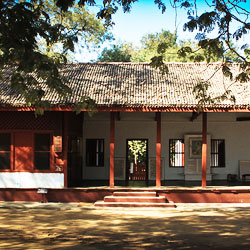
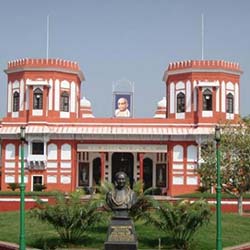
The Gandhi Ashram situated alongside the Sabarmati River, was the nerve center for the Indian Freedom movement. The beautiful ashram complex with it's shady trees offers a refuge from the loud streets of the city. There is a museum inside the Ashram complex.
During the lifetime of Mahatma Gandhi it was known as Satyagraha Ashram.. Significance : Mahatma Ganghi fondly known as Bapu lived here from 1917 until 1930. It was a human laboratory where the Mahatma could test his moral and spiritual hypotheses.The Ashram at Sabarmati displays the Mahatma's letters and other possessions and collection of photographs of his years of India's freedom struggle.
It is a peaceful, serene stretch on the banks of the Sabarmati river which is a national monument today, and it is here that one gets a glimpse into the simplicity of the great man. It was from here that the Mahatma and his band of followers led various Satyagrahas, the most notable being the historic Dandi March– a journey that ultimately culminated in the ending of the British rule.
The light and sound show in the evening is an added attraction for visitors to this place. Location : Ahmedabad, Gujarat. Selection of place : After Gandhiji’s return from South Africa, he decided to settle in Ahmedabad. It was for four reasons that he selected this place - In his own words "being a Gujarati, I'll serve my country best through the use of Gujarati language. As Ahmedabad was the centre of handloom in early days, the work of spinning wheel (charkha) could be done in a better way, I believed. Being the capital of Gujarat its wealthy persons will also make larger contribution, I hoped." And in none of this he was disappointed during his sixteen years stay in Ahmedabad.
His first ashram was set up at Kochrab near Paldi of the present day Ahmedabad, which was a bungalow of his barrister friend Jivanlal Desai. This place had to be abandoned after two years in the wake of a plague epidemic. The choice now fell on a site on the bank of Sabarmati River, not far from saint Dadheechi's temple and in the vicinity of a Prison House. Laying down the objective of the Ashram, Gandhiji wrote: "To take training for the national service which is not contrary to universal well being and constantly endeavouring for such national service is the aim of this Ashram."
Few dwelling units were built gradually and the Ashram soon started humming with activities. The units were simple in style but very functional. Gandhiji first stayed in the Vanatshala-a place where handlooms were installed-but later on moved to `Hridaykunj', so named by Kakasaheb kalelker as it was the pulse of the Ashram. This Spartan accommodation was to witness Gandhiji's evolution from Mohandas to Mahatma, who rose to be the Father of the Nation. Achievements : The first struggle that he spearheaded from Sabarmati Ashram was that of textile mill workers. On the third day of his fast the mill-owners came to terms and the establishment of Textile labour Association was the far-reaching consequence of this encounter. This struggle also brought Vallabhbhai Patel, Shankerlal Banker and Ansuyaben Sarabhai as close associates of Gandhiji.
What distinguished Gandhiji's struggle was its penetration into social spheres of life. His activities were not merely confined to political awakening but also targeted to social rejuvenation. His charkha and untouchability abolition campaign brought the majority of the deprived masses of India into the national mainstream.
After his release from jail, Gandhiji returned to the Sabarmati Ashram where he was soon occupied with his constructive activities. Publishing of his autobiography "My Experiments with Truth" with the help of Mahadevbhai and Miraben unravelled the strength of Bapu's character. During the same time he also performed the Opening Ceremony of Gujarat Vidyapith - "an act of a rishi" in his words.
The most glorious chapter of Sabarmati Ashram is the way in which he bid farewell to it. It galvanised the country into hitherto unknown sense of unity and national spirit. The moment arrived when the genesis of salt duties was unearthed. Bapu gave a call to break the Salt law and embarked on a 240-mile march with seventy-nine followers. On 12th March 1930 Bapu commenced on this trail setting nation ablaze with the spirit of defiance. TOP
|


|
Gandhinagar
Gandhinagar, the modern capital of Gujarat, was named after the father of the Nation. It is the second planned city in India after Chandigarh lying on the banks of river Sabarmati. The famous Swaminarayan temple is also built in Gandhinagar.
When the old Bombay state was partitioned in 1960, into Maharashtra and Gujarat, the city of Bombay went to Maharashtra. It was then decided to construct a new capital for Gujarat. Thus came into being the second planned city in India – Gandhinagar. It presents a spacious, well-designed look of an architecturally integrated city. It has 30 sectors with each sector having its own shopping, health, and community centers and housing colonies. Extensive planting of trees and large recreational areas along the Sabarmati River, gives the city a fresh, green garden city atmosphere.
There is a generous provision for wide-open green parks.. Location : 32 Kms. north east of Ahmedabad, Gujarat TOP
|


|
Hatheesing Jain Temple
A rich Jain merchant built this temple outside Delhi Gate in 1850. It is built of pure white marble and profusely decorated with rich carvings, dedicated to Dharamnath, the 15th Jina or Jain apostle.. Construction : Built outside Delhi Gate by Sheth Hatheesing, this is the best known of Ahmedabad's many ornate Jain Temples. Built of pure white marble, it has a paved courtyard surrounded by an imposing row of cloisters containing 52 shrines, each with an image of a tirthankara, profusely decorated with rich carvings, one containing the marble image of the 15th tirthankar. The temple is a two-storied structure with elaborate porches on three sides and front porch crowned by a large dome. It was designed by Premchand Salat and is dedicated to Dharmanath, the fifteenth Jina or Jain apostle. It was built at a cost of Rs 10 Lakhs, a sum unimaginable in those days. TOP
|


|
Hussain-Doshi^s Gufa
Popularly known as Amdavad ni Gufa it is an underground art gallery housing the collaborative effort of artist M. F. Hussain and the architect B. V. Doshi. This marvel of contemporary architecture was constructed using computer aided design and tribal initiative, adding a new dimension to viewing art.
For the lovers of art and architecture this gallery is worth a visit.
Art and architecture fuse to become a unique experience, both complementing each other magnificently. The Gufa is a configuration of cave-like structures buried under the ground. This marvel of contemporary architecture is a fusion of the modern and ancient ideas.. Location : Opposite Gujarat University, in the campus of the Center for Environment Planning and Technology. TOP
|


|
Jami Masjid
The Jami Masjid of Ahmedabad is one of the biggest and oldest mosques of India, built by a Bahmani ruler Ahmed Shah I (1411-1442), the founder of Ahmedabad, in 1423. One of the major tourist attractions of Gujarat, Jami Masjid is known for its fine and amazing architecture. The Mosque has a total of 260 pillars supporting 15 domes at different elevations. The Jami Masjid also had tall minarets, which were destroyed in an earthquake.
Centered on a spacious 75 x 66 meters marble courtyard with entrances on three sides - west, south and north, the Jami Mosque is regarded as one of the most superb and imposing structures of its class in the world. The architecture of the Jami Mosque shows distinctive Hindu and Jain influence, clearly visible on the decorations of walls and the niches of the mosque. One of the distinct features of this Mosque is its royal gallery with beautiful and intricate stonework. There is also a long rectangular ablution tank in the center. The prayer hall of the mosque is a rectangular area with five symmetrical domes. The central Mihrab (position indicating the direction of the Holy Mecca) of the mosque has inscriptions commemorating its completion on January 4, 1424, by Sultan Ahmad Shah I.. TOP
|


|
Mahudi
This is a small village near Kalol 78 kms from Ahmedabad famous for Jinalaya of Ghantakarna Mahavir and Kotyark temple. There are thousands of people from different religions offering prayers besides Jain devotees. The temple's prasad-Sukhadi is not allowed to be taken outside the temple.
It is a centre of pilgrimage for the Jains devotees and Khadayata Banias. Jain temple is dedicated to Vir Ghantakarna. Jain Muni Buddhisagarji had observed a long period of penance here and had inspired the construction of new temple.
Devotees offer `sukhadi', (assorted varieties of food) which after offering, is eaten within the temple complex. Tradition forbids the carrying away of such offering. Large and clean sarai offers comfortable stay to the pilgrims.
The Sun temple of Kotyark attracts the Khadayata community. The mother and child idol of this temple dates back to Gupta period. The temple was originally on the bank of river Sabarmati. But as the time passed, the riverbank moved away. The temple was on the verge of breaking away. So the idol was taken away and placed at the new place where the temple is built today.. Information for tourists : Both these temples of Mahudi provide accommodation and food to tourists and pilgrims. TOP
|


|
Modhera
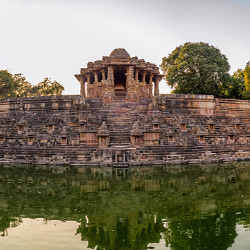
The Sun Temple (dedicated to the Sun God) of Modhera is one of the finest examples of Indian temple architecture, built in 1026 A.D. It has spectacular carvings, fine architecture and traditional erotic sculpture. Modhera, sometimes called Mundera is situated on the banks of the River Pushpavati about 25 kms. from Mehsana
The beautiful and partially ruined Sun Temple of Modhera was built by King Bhimdev I of the Solanki Rajput clan and bears some resemblance to the later, and far better known, Sun Temple of Konark in Orissa. It was designed so, that the dawn Sun shone on the image of Surya, the sun god, at the time of the equinoxes. The main hall and shrine are reached through a pillared porch and the temple exterior is intricately and delicately carved. As with the Temple of Somnath, this fine temple was ruined by Muhammad of Ghazni.
Every inch of the edifice, both inside and outside is magnificently carved with Gods and Goddesses, birds, beasts and flowers.. Temple timings : The temple is open daily from 8 am to 6 pm.
Modhera is famous for its Sun Temple, the best example of Solanki temple architecture in the state and one of the most magnificent monuments in Gujarat. Reaching Modhera : Modhera is 102 kms. north-west of Ahmedabad. There are direct buses, or one can take the train to Mehsana and then catch a bus for the 26 kms. trip to Modhera. Structure : The building work was commissioned to the Silvat stonemasons who had the ability to make the hardest stone take on the quality of the delicate woodcarvings. Within the main grounds, the Surya Kund is an extraordinary baoli containing over 100 shrines. Shrines to Ganesh, Vishnu and an incarnation of Shiva surround the tank on three sides while the main temple completes the rectangle and displays 52 intricately carved pillars depicting scenes from the Ramayana and the Mahabharata.
The outer facades have a string of friezes and above that is the mandovara with excellent carvings of gods and goddesses. Between the Sabha Mandapa and the sanctum sanctorum is a hall with pillars and arches and the walls have 12 niches showing showing the different aspects of the Sun God in each month. The outer walls are filled with sculptures of Surya and other gods. Unlike Konark, which rests on 12 wheels of a chariot, Modhera has built on the petals of a lotus, which runs the whole length of the temple. Elsewhere in the complex, there are extensive panels of erotic sculpture.
The first view of the sun temple is breathtaking, with the pillared portico of the sabhamandap (assembly hall) reflected in the massive tank. Covered with lavish sculptural decoration, these pillars are examples of the perfect craftsmanship of the Solanki artisan. These pillars are geometrically arranged to create an octagonal space at the centre of the hall used quite frequently for ritualistic dance performances.
The sabhamandap is a small independent structure. The four entrances have ornamental toranas (decorative hangings over the entrance), which have a marvelous quality of intricate and precision craftsmanship. At the centre of the hall is the walnut shaped ceiling, with its numerous folds of floral girdles, upheld by two aisles of pillars arranged on diagonals of the square plan. Even at its dimly lit height, the astounding splendor of stone craft shines brightly. It is a visual delight to stand under the 23 feet high ceiling. The structure containing the sanctum is modest in size but a rare gem.
The entire structural complex is aligned to the east, to the rising sun. Kama Kunda, the water tank, meant for ritualistic ablution before offering worship, is one of the most perfectly designed structures of its kind in the country. A regular well-patterned lateral formation of stone steps descends upto the bottom of the tank. The geometrical configuration of steps allows a direct or diagonal descent from all the four sides. Legend : This is an ancient township, traceable to the Puranic age, when it was known as Dharmaranya. These Puranas mention that after defeating Ravana, Lord Rama asked Muni Vasistha to show him a place of pilgrimage where he could go and purify himself from the sin of 'Brahma-hatya' (the sin of killing a Brahmin.) Muni Vasistha showed him a Dharmaranya, which was near the modern town of Modhera.
It is believed that Lord Rama performed here a sacrifice to purify himself of the sin of having killed a Brahmin - Ravana, the king of Lanka. Rama built "Modherak" which subsequently came to be called "Modhera". It became a pilgrimage centre for hordes of people who thronged to the place to pay homage to Surya. Location : 60 kms. south-west of Ahmedabad Nal Sarovar Bird Sanctuary : About 60 kms from Ahmedabad, is the delightful bird sanctuary visited by millions of magnificently coloured birds in winter and spring. It harbours over 250 species of wetland birds. Winter migrants from the north including Rosy Pelicans, Flamingoes, White Storks, Brahminy Ducks and Herons visit Nal Sarovar.
Between November and February, this 116 sq km lake, is home to vast flocks of indigenous and migratory birds. Ducks, geese, pelicans and flamingos are best seen early in the morning and in the evening and the sanctuary is best visited as a day excursion by taxi, as buses are infrequent and there is no convenient accommodation.
Migrating Bharwad shepherds populates the islands of the lake and on the banks are the Padhars, who are excellent folk dancers, artisans and boatmen. One can hire country boats on the lake for bird viewing, and picnic at shacks the on the islands. If you are making the trip to Nalsarovar you can lunch at the KP farm at Sanand, which has a swimming pool, children's amusement park and other facilities, and enjoy the Goyal waterpark.
It tends to get crowded on Sundays. The sanctuary mainly comprises a huge lake and ambient marshes. TOP
|


|
Nal Sarovar Bird Sanctuary
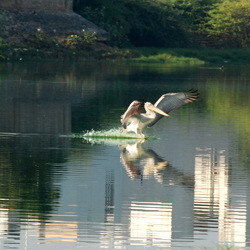
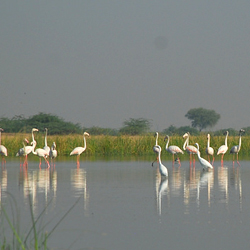
About 60 kms from Ahmedabad, is the delightful bird sanctuary visited by millions of magnificently coloured birds in winter and spring. It harbours over 250 species of wetland birds. Winter migrants from the north including Rosy Pelicans, Flamingoes, White Storks, Brahminy Ducks and Herons visit Nal Sarovar.
Between November and February, this 116 sq km lake, is home to vast flocks of indigenous and migratory birds. Ducks, geese, pelicans and flamingos are best seen early in the morning and in the evening and the sanctuary is best visited as a day excursion by taxi, as buses are infrequent and there is no convenient accommodation.
Migrating Bharwad shepherds populates the islands of the lake and on the banks are the Padhars, who are excellent folk dancers, artisans and boatmen. One can hire country boats on the lake for bird viewing, and picnic at shacks the on the islands. If you are making the trip to Nalsarovar you can lunch at the KP farm at Sanand, which has a swimming pool, children's amusement park and other facilities, and enjoy the Goyal waterpark.
It tends to get crowded on Sundays. The sanctuary mainly comprises a huge lake and ambient marshes.. Location : 60 kms. south-west of Ahmedabad TOP
|


|
Patan
Patan located around 130 kms. from Ahmedabad, is rich in architectural marvels like the 11th century Rani-ki-wav step well and numerous temples, and textiles like the Patola silk sarees and Mushroo weaving, originating from the time of royalty.
Patan was an ancient Hindu capital before Mahmud of Ghazni sacked it in 1024. Now a pale shadow of its former self, it still has more than 100 jain temples.
There is also the renovated Rani-ki-vav, a baoli that boasts some of Gujarat's finest carvings. The baoli is the oldest in Gujarat and is remarkably well preserved - a product of the restoration work completed in the 1980s to redress centuries of silting. The waters in the baoli once provided a natural air-cooling system in its chambers for members of the royal family who sought refuge here from the summer heat. It's very impressive and certainly warrants a visit.
Originally known as Anhil-Vad-Pattan, it flourished during the Solanki dynasty and has some interesting monuments. The streets of its older quarters present an interesting look with a melange of carved balconies, lintels of Muslim havelis, marble domes and the canopies of the over 100 Jain temples. Patan's most famous personality is Kalikal Sarvagna Hemchandracharya, the man responsible for giving Gujarati language its first grammar.
Patan is celebrated world over for its exquisite Patola silk saree woven here.. Location : The historic town of Patan founded in 1796 A.D. is situated on the river Saraswati, 130 kms. from Ahmedabad. Places to visit : Rani ki vav (step-well) and Sahastraling lake are also interesting places to visit in Patan. TOP
|


|
Pavagadh
It is a beautiful excursion from Ahmedabad with the historic fortress on a mountain, the holy Hindu and Jain temples on the pinnacle and the medieval Islamic citadel of Champaner in the plains. It also offers fine hilly sceneries, lakes, the picturesque cable car ride and opportunities for trekking and rock climbing.
It is about 190 kms from Ahmedabad, situated in the Halol on Panchmahal district, having historical connection with the Chavda and Chauhan King's Era. The hills of Pavagadh rise in three stages from Champaner. The plateau at an altitude of 1471 fits is known as Machi Haveli. The two points on the hill are named after goddess Bhadrakali and Mahakali. Considering the natural beauty and fresh atmosphere, the Gujarat government has developed Pavagadh as a hill resort. It is also the birthplace of a famous musician Baiju, who preceded Tansen.. Location : It is about 190 kms from Ahmedabad and about 50 kms. from Baroda (Vadodra) Significance : Pavagadh is one of the biggest attractions in the Dynamic State of Gujarat, which attracts lakhs of pilgrims and tourists every year and tops the list of educational institutions excursion programs.
Champaner has rich rare and little known history. It goes back to early Stone Age on the basis of pre-historic stone tools recovered from the area. The entire area is declared as protected area by the Archeological survey of India.

On the hilltop, is located the ancient famous temple of Mahakali. The right toe of Goddess Kalika fell here. Goddess Kali visited by Hindus and on the roof of the building is a Mazar of a Peer, visited by Muslim devotees. TOP
|


|
Pols
Pol (pronounced "pole") is derived from the Sanskrit word pratoli meaning entrance to an enclosed area. It is a housing cluster comprising many families of a particular group, linked by caste, profession, or religion.
Pols are an integral part of old Ahmedabad. It nurtures in its folds, pages of history, a breath of harmony and a showcase of exquisite architecture.. Pols of old city : The old city comprises many pols in which some of them are virtually small villages, traversed by narrow streets with community wells and chabutras for feeding birds. A Pol is a residential precinct with labyrinthine streets. Gates and secret passages protected these pols. A Pol would have only one, or at the most two entrances (apart from the secret ones), one main street with crooked lanes branching on either side, and walls and gates, which were barred at night. To some extent the house property in the Pol was held in common.
The Pols, of old Ahmedabad are residential units dating back to 1714 with intricately carved facades, which line the streets. Notable in the present day Pols are Mhurat Pol, Mandvi-ni-Pol, and Lakha Patel-ni-Pol.
Pols are densely populated and are like a maze with winding narrow lanes. Some of them contain old beautiful houses with carved wooden facades in traditional Gujarati architectural style. Changing times : In earlier times chabutras were an important element of urban design and served to enhance the utilization of space judiciously and aesthetically in pols i.e. traditional urban settlements in Gujarat. Even now, old chabutras in villages and pols are located very prominently in the centre—the place where most community interactions and the celebration of festivals take place.
One can imagine that in the days when community life in the pols was much more vibrant than it is now, chabutras would have had great relevance. But now, as the human population is increasing in size, people are living in box shaped housing colonies in the newer parts of the town. Naturally, everything that was in vogue traditionally is now also going out of favour including chabutras. TOP
|


|
Rajkot
The Rajput Chief Kunwar Vibhuji founded Rajkot, the former Capital of the princely state of Saurashtra in the 16th century. It is famous for its Bandhani Sarees, mirror-work, patchwork, beadwork and silk embroidery.. Location : It is about 193 Kms. from Porbandar, and 216 Kms. from Ahmedabad. Modern Rajkot : Rajkot has a fine museum and some old colonial architecture. Handicrafts like silver and textiles are a highlight of Rajkot, which has the National Weaving Institute, working to promote traditional weaves. Rajkot is one of the most important commercial and industrial cities of Saurashtra.
It is a very pleasant provincial town and is also district capital. Rajkot has become one of India's fastest growing middle rank cities, its population nearly doubling in the last 20 years. That growth has been based on a rapid industrialization, especially the processing of agricultural products such as groundnuts. Attractions nearby : Kaba Gandhi No Delo: Gandhiji's ancestral home, which houses the Gandhi Smriti, a permanent exhibition.
Watson Museum And Library: Located in the pleasant Jubilee Garden, this is a good introduction to Saurashtra's cultural heritage.
The Rajkumar College: The state had become known (as early as 1870), for it’s Rajkumar College, built for the education of the princes of the Indian state.
Rashtriya Shala: Famous for the center of 'Patola' weaving, Rashtriya Shala was founded by Mahatma Gandhi.
Jagat Mandir: It is a beautifully carved temple of Shri Ramkrishna Paramhansa, built of red stones.
Lal Pari Lake And Randerda: This is a picturesque picnic spot, 5 kms from Rajkot.
Ajit Dam: It is situated 8 kms from Rajkot and is responsible for supplying water to whole of the town.
Wankaner: About 50 kms from Rajkot on the way to Kachchh is the palace of Wankaner, now converted into a Heritage Hotel. Great background : Mahatma Gandhi did his schooling from Alfred High School, now known as Mohandas Karamchand Gandhi High School.
It was also the headquarters of the British Government. Rajkot is famous for its jewellery market. Places of interest are Ram Krishna Paramhamsa Temple and Race Course.
Today, it is best known as the town where Mahatma Gandhi spent the early years of his life when his father was a 'Diwan' or Prime Minister to the king of Saurashtra. Even today, their family home here houses a permanent exhibition of Gandhiji's personal belongings. TOP
|


|
Sarkhej Roza
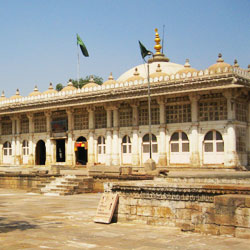
The Sarkhej Roza is an elegant architectural creation remarkable for the use of pierced stone trellises and complete absence of arches. This monument houses the tombs of Saint Ahmed Khattu Baksh and also that of Emperor Mehmud Shah Beguda and his queen.
The peaceful atmosphere makes it an ideal retreat.
The suburb of Sarkhej, about 8 kms. southwest of Ahmedabad is noted for its elegant group of buildings, including the Mausoleum of Azam and Mu'assam, built in 1457 by the brothers who were responsible for Sarkhej's architecture. The architecture here is interesting because the style is almost purely Hindu, with little of the Saracenic influence so evident in Ahmedabad.
As you enter Sarkhej, you pass the Mausoleum of Mahmud Begara and, beside the tank and connected to his tomb, that of his queen, Rajabai. Also by the tank is the Tomb of Ahmad Khattu Ganj Buksh, a renowed Muslim saint and spiritual adviser to Ahmed Shah. He was the revered saint whose blessings were invoked while founding Ahmedabad. The palace, with pavilions and a harem, is also around the tank. The Dutch established a factory in Sarkhej in 1620 to process the indigo grown here.. Location : Sarkhej is about 8 kms. southwest of Ahmedabad Architecture : The Roza of Sarkhej is very famous. It is on the bank of a small pond. The architecture of the Roza is so beautiful and the history of Roza is associated with Ahmedabad in such a way that any tourist visiting Ahmedabad would certainly like to visit the Roza. The main and big roza of Saint Ahmed Khatu Ganjbux is in the middle of the complex. There are beautiful carvings on the walls and tombs. Traceries have been carved out in marble stones. The sunlight reflections create beautiful pictures.
The buildings are remarkable for the complete absence of arches and the use of pierced stone trellises. From the archaeological point the most important group of buildings are the tombs and mosques with a palace around the tank of Sarkhej.
The mausoleum is roofed by a large central dome supported by a range of thirteen pillars on each side. The walls are broken up into two storeys and perforated stonework of great variety fills up the space above and below. A porch leads from the dargah into the court of the mosque which has neither the arched facade, nor the minars but a roof of uniform height which is supported by 120 pillars. The chamber housing the sultan Mahmud Begda has a balcony window which projects into the tank. The complex has also preserved the hand written copy of Kuran by Shaikh Ahmed Khattu. TOP
|


|
Siddi Bashir Mosque (Shaking Minarets)
It is also known as Shaking Minaret or Jhulta Minar, as when one minaret is shaken the other one begins to vibrate. What causes this vibration is still a mystery.. Location : It is a kilometer away from the Ahmedabad city railway station. Information for tourists : To see the miracles of Ahmedabadi architecture, called Shaking Minarets one must head for Sidhi Bashir mosque, where when one minaret is moved with force, the other shakes in sympathy. Unfortunately, after the Qutab Minar tragedy during which many were crushed, climbing up the Minaret to feel the 'shaking' has been barred. Interesting facts : Each minaret is three storied tall with delicately carved stone balconies around each storey. These minarets are about 21.34 meters high. If either of the minarets is shaken the other too vibrates after a few seconds. The vibrations at the base of the tower multiply and get transmitted through air tunnels between the two towers. Amazingly, the connecting passageway between the two minarets, however, remains free of any vibration!
The mosque at Raj Bibi once had a pair of shaking minarets. But the Britishers, who were ruling India that time, dismantled one minaret in order to study the secret of its construction and the mystery behind the swinging effect. The other such shaking minarets are at the mosques of Jami-Masjid amd Bibi-ki-Masjid.
Opposite Sarangpur Darwaja, Sidi Bashir's minars are all that remain of the mosque popularly named after one of Ahmed Shah's favourite slaves. These are the best existing example of the "shaking minarets" - built on a foundation of flexible sandstone. History behind : It is believed that a slave of the Sultan Siddi Bashir built the mosque and the minarets in 1461. In fact, there was no specific reason to build the minarets to shake, but people say that it was built so in order to avoid damages during earthquakes. It was in the 19th century, Monier M Williams, a European Sanskrit scholar who first noticed the minarets shaking. TOP
|


|
Sidi Sayed Jhali
The most famous mosque in Ahmedabad is Sidi Sayed Mosque, acclaimed for it's splendid Jhali screen, framed, in the ten semi-circular windows. It is a superb example of delicate carving that transforms atone into filigree.
The Mosque of Sidi Sayed, near Lal Darwaja is world famous for its exclusive stone tracery. The Jali screen windows are one of the best examples of Indo-Saracenic architecture. You get miniature models of this, which will remind you of the mesmerising experiences in Ahmedabad.
A part of the wall in the old citadel (Bhadra) of the mosque built by Ahmed Shah's slave, Sidi Sayyid, is celebrated all over the world for its exquisite stone window tracery - a superb example of delicate carving that transforms stone into filigree.. Bhadra : The solid fortified citadel, built of deep red stone in 1411 AD, Bhadra - Ahmedabad's first Muslim structure, is relatively plain in comparison to later mosques.
The palace with its huge arches, ornate balconies and jalis, is a part of the historic Bhadra fort founded by sultan Ahmed Shah.
It is believed Goddess Laxmi had appeared in this fort, and blessed Sultan Ahmed Shah, that the city would be always prosperous," and since then the people of Ahmedabad have been very rich and the city has been a major centre of trade and commerce.
In front of the citadel is a small public garden and Alif Shah's Mosque, gaily painted in green and white. Further east, beyond the odoriferous meat market in Khas Bazaar, is Teen Darwaja, a thickset triple gateway built during Ahmed Shah's reign that once led to the outer court of the royal citadel. A trio of pointed arches engraved with Islamic inscriptions and detailed carving spans the busy road below sheltering cobblers and peddlers. Exquisite Work : A prominent feature on the front of glossy city brochures, Sidi Sayyid's Mosque, famed for the magnificent 'jali' screens lining its upper walls sits in the centre of a busy traffic circle in the northwest corner of Bhadra. The two semicircular screens high on the western wall are the most spectacular, with floral designs exquisitely carved out of the yellow stone so common in Ahmedabad's mosques. TOP
|


|
Somnath
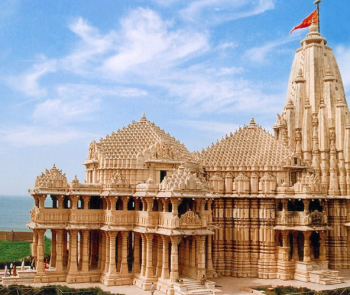
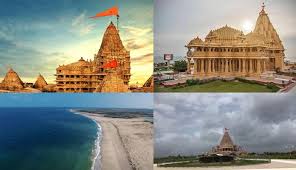
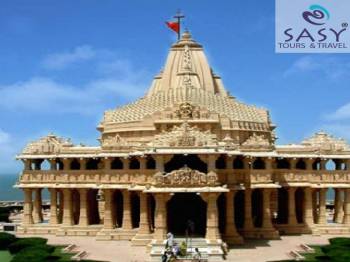
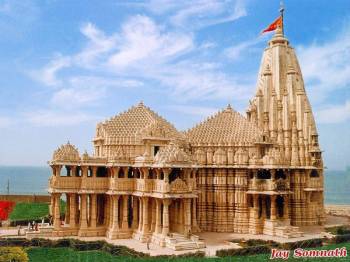
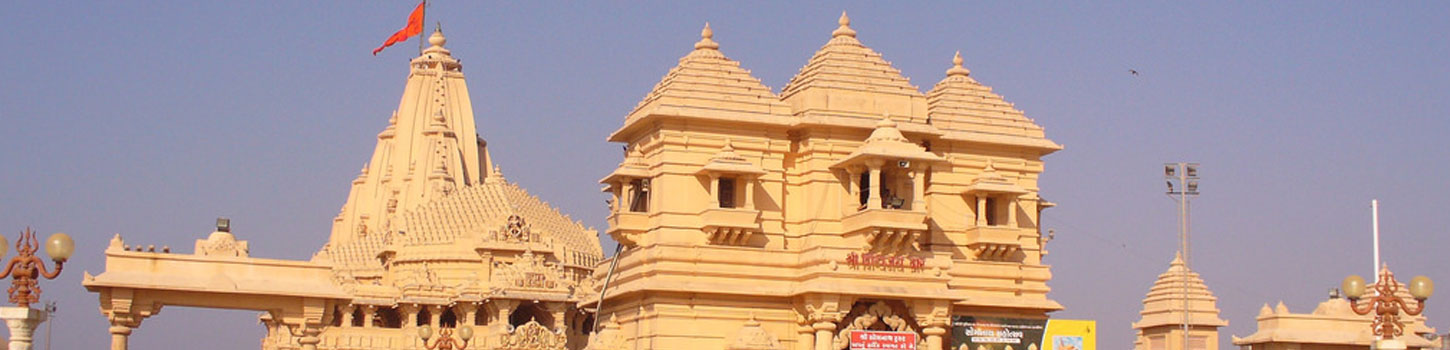
Somnath is one of the 12 jyotirlingas of lord Shiva, offering a holy pilgrimage, a beach holiday and a number of places of historic, religious or scenic importance. The temple has imposing architecture, a 50-meter high shikara tower and a pretty Nandi.. Location : 25 kms. From Chorwad, Gujarat. Present temple : Constantly washed by the Arabian Sea, the temples of Somnath were destroyed seven times but were rebuilt each time. The majestic monument as it stands today is a replica of the earlier construction. The present temple Maha Meru Prasad was recently rebuilt on the exact location of the original shrine in accordance with the ancient plants. Legend : Legend has it that Somraj, the moon god, originally built the Somnath Temple out of gold. Later it was rebuilt by Ravana in silver and then again by Krishna in wood and yet again by King Bhimdev Solanki in stone in the 10th century.
Mahmud of Ghazni, upon hearing the description of the temple by an Arab traveler - Al Biruni, raided the temple in 1024 AD and looted it, carrying away camel loads of jewels and gold.
Somnath was destroyed six times and rebuilt on every occasion. After the 1706 AD demolition by the Mughal Emperor Aurangzeb, it was rebuilt the seventh time in 1950 AD with the support of Sardar Vallabhbhai Patel
The temple was so rich that it had over 300 musicians, 500 dancing girls and even 300 barbers - just to shave the heads of pilgrims. TOP
|


|
Surat
Situated on the banks of river Tapi, Surat is a major industrial center with many textile mills. It was a great port city during the Mughal region from where pilgrims sailed to Mecca. It is famous for zari and brocades and is an important diamond-cutting center.
Since the earliest times, the ancient port of Surat has been renowned for its fine silks and exquisite brocades and its trade in spices. Surat has been one of the most prosperous of India's cities in the 17th and 18th century.
Some of the places that are of interest are The Old Fort, The Textile Market the main reflection of Surat’s famous occupation and Dumas - a sea- side health resort 16 kms from Surat. Hajira is a holiday home Beach resort and Tithal is another choice for Beaches with cottage accommodation.. Popular Textile City : Since the earliest times, the ancient port of Surat has been renowned for its fine silks and exquisite brocades and its trade in spices. Surat, the city of commerce was an important port that first attracted the Europeans to the riches of India.
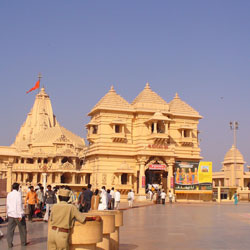
Even today, Surat is a premier industrial city of India. It is a city of riches, of gems and diamonds. Times may have changed but Surat remains and continues to grow. Location : 140 kms. From Vadodara, Gujarat. Attractions Around : The Old Fort: Built by Mohammad Tughlak in the 14th century, as a defense fortification against the Bhils.
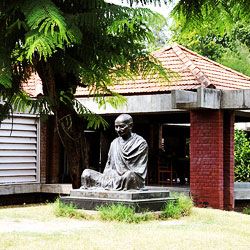
Hajira: It is situated 28 kms from Surat. The pleasant Hajira Beach is fringed by feathery 'Casurina' trees and has a comfortable holiday home for visitors. Facts : Parsi refugees founded Surat in the 12th century, and it emerged as a minor trading post during the 1500s when it was plundered and razed numerous times by the Portuguese. In 1592, after a protracted siege, the town fell to Akbar, under whose patronage; it became one of India's most prosperous mercantile capitals, as well as a key transit point for Muslims heading to Mecca.
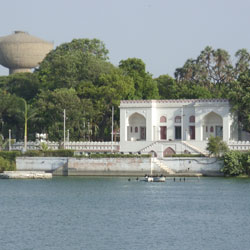
The East India Company established its first warehouses in Surat in 1612. It was at Surat that Sir Thomas Roe landed when he came as King James Ambassador to the Court of the Emperor Jehangir. Today, Surat is a major industrial centre with many textile mills. TOP
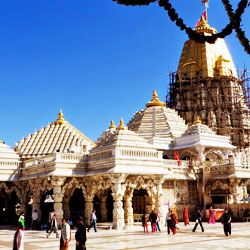
|


|
The Baroda Museum And Art Gallery And The Maharaja
The Baroda museum and art gallery and the Maharaja Fateh Sigh Museum have excellent artwork collections by Indian artists and European Masters of Mughal miniatures and valuable palm leaf manuscripts of Buddhist and Jain origin.
This museum is located in Sayaji Bagh, a garden that is popular with the inhabitants of Baroda, who picnic and stroll there.. Location : This museum is located in Sayaji Bagh The collection : Founded by the Gaekwad in 1894, it has impressive collections of art and
archeology, natural history, geology and ethnology. The adjoining art gallery has great collection of European old masters, Veronese, Giordano, Zurbaran, some Flemish and Dutch school paintings, and Turner and Constable. It has an excellent collection of art objects and paintings, including the famous Akota bronzes dating from 5th Century A.D. Other treasures include a full-fledged gallery of Tibetan Art.
The collection in the museum belongs largely to the former ruler of the state, Maharaja Sayaji Rao Gaekwad III. During British rule it was the fashion for Indian rulers to take a keen interest in European art. On their travels and holidays abroad they collected paintings and sculpture as well as acquired many Western habits and customs. The outcome of these royal pastimes was a random collection of strange and peculiar) art objects from all parts of the world. Fabulous collections : This museum was opened in 1921 and additions and changes have been made periodically, but the 'cluttered look' continues to dominate the museum galleries.
On the ground floor are rooms with the European Art collection, where Greek and Roman sculpture rub shoulders with paintings of a variety of European schools. There are galleries with displays of Asian Art from Burma, Sri Lanka, Cambodia, China and Japan - bronzes, ivory and pottery, and a painted gilt wooden statue of the Bodhisattva. There are samples of art objects, especially manuscripts from Persia, Turkey and Japan.
The Indian Art Section has one part devoted to prehistoric artifacts. One of the prized possessions of this museum is a bronze roman jar of the second century. The Indian Painting Gallery has a noteworthy sample of Indian painted manuscripts from Rajasthan and the Hill schools, portraits of various maharajas, a Ragamala series, illustrations to the Bhagavad Purana and others.
The museum also has special galleries for its natural history, geological and zoological collections.
The museum also houses famous 11th century Shiva Natraj, exquisite 9th century Shiva Natraj, exquisite 9th century ivory box from Nagina, U.P., Ganj -e- Shahid inscription of Qazzaq Khan, Mughal Governor of Dabhoi (1635 AD) 32 miniatures from Razm Nama, a Persian version of the Hindu epic Mahabharata commissioned by Emperor Akbar, 109 miniature paintings donated by Jagmohandas Modi, etc. TOP
|


|


Related Cities

|