Home Login Register Inquiry Sitemap

Travel Packages | India Tours | Hotels & Motels | Travel Agents | Advertisment


India >> East Zone >> West Bengal >> KOLKATA

Building & Centre

Calcutta High Court

The landmark Gothic building constructed in 1872- West Bengal High court is one of the oldest located near Eden Gardens.

It is the highest seat of judiciary in West Bengal. An extension was added later, retaining its architectural symmetry.

Designed on Gothic lines by Walter B. Grenville, the Calcutta High Court is reminiscent of the colleges in Oxford. On the eastern side is the original sandstone courthouse..

The Court Rooms : Portraits and busts of legal luminaries adorn the courtrooms and the corridors and the Bar Library is a treasury for the legal tomes. Browsing is permitted with the librarian's permission.
The Judges Library contains interesting legal documents.

Visitors are allowed inside the court premises.
Centre Of International Modern Art (Cima)

Situated near Birla temple, close to Ballygunge Phari, CIMA features Indian contemporary art, which is renowned worldwide.

This gallery is India's most avant-garde art centre, spread over ll, 5OOsq.ft. of floor area in central Calcutta housing a 9000sq.ft. state of the art gallery. It was begun in 1993 under the auspices of a leading publishing house, and CIMA was conceived with an ambitious agenda - to create and establish an internationally, recognised art institution, promoting on a globally significant scale the finest in contemporary Indian art..

Timings : From 2 pm to 8 pm, except Mondays

Indian Museum

This museum was built in 1875,which was originally founded by Nathaniel Wallich, known as Jadughar, located at the corner of Sudder Street and Chowringhee Road, containing fossil skeletons of prehistoric animals, art collections, rare antiques, mummies, Armour etc. which is probably one of the best in Asia. It certainly the largest and probably the best Museum in India, and one of the best in Asia..

Timings : The museum is open daily except Monday from 10 am to 5 pm.
Location : Situated on J L Nehru Road.
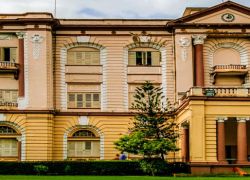
The Structure and Architecture : The oldest institution of its kind in the Asia-Pacific region, the Museum was originally established on 2nd February 1814, at the Asiatic Society. Dr. Nathaniel Wallich, a botanist, was the founder-curator. The palatial building housing the Indian Museum follows the Italian style of architecture, which was transferred to the present building in 1878 with just two galleries. At present, the Museum has over 60 galleries for the Art, Archaeology, Anthropology, Geology, and Zoology and Botany sections. It is spread out over an area of 930 sq. m. A multipurpose and multidisciplinary institution of national importance, the museum is the largest repository of artefacts in India.
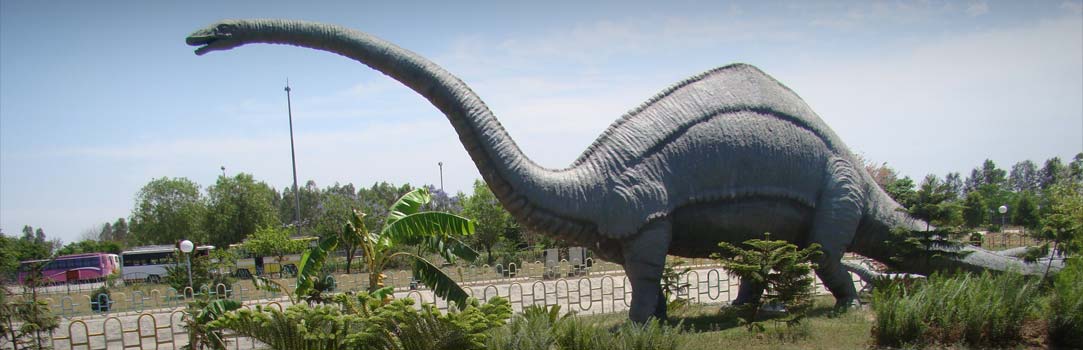
It is particularly famous for its zoological and geological collections. The sections dealing with fossil and taxidermy are also notable. Star attractions are a 4,000 year-old mummy and an enormous dinosaur skeleton. Also notable among the collection are 50,000 antique coins, precious stones and 414 meteors.
Priceless items such as Shahjahan's emerald goblet and an urn containing Buddha's ashes add variety.
The Museum Directorate has seven co-ordinating service units: Preservation, Publication, Photography, Presentation, Modelling, Education and Library. Photography is not allowed without prior written permission from the authorities.
Collections : There are a number of unique fossil skeletons of prehistoric animals, among them giant crocodiles and an amazingly big tortoise. The art collection has many fine pieces from Orissan and other temples, and superb examples of Buddhist Gandharan art.

National Library

Housed in the former residence of the Lieutenant Governor of Bengal popularly known as Belvedere Estate, The Calcutta public library and Imperial Library amalgamated in 1903 to become National Library, which is supposed to be India's largest library.
The erstwhile sprawling residence of the Lieutenant Governor of Bengal, at Belvedere, is a depiction of the Italian Renaissance style. The building that houses the National Library was originally constructed as the Vice regal House around 1700. Meant as a symbol of imperial power, it was built on a grand scale with a high arched gateway, sprawling lawns and ornate halls..

History : Originally it was the summerhouse of Prince Azim-us-Shan, grandson of Aurangzeb, and Viceroy of Bengal and Bihar, which was subsequently acquired by Warren Hastings and sold to Major Tulley in 1778. In 1854, it became the official residence of the Lieutenant Governor of Bengal.

Lord Curzon officially inaugurated the Imperial Library on 30th January 1903, at the Metcalfe Hall.
At present, the library contains almost 2 million books and ½ million documents. The reading room - a huge hall with galleries - attracts almost a thousand readers every day. The newspaper and magazines division of the National Library is located at Esplanade.
The northern entrance or gateway of the National Library lies on Belvedierre Road – a little south of the famous Alipore Zoo. There is a statuette of a lion atop the main entrance or gateway crossing the gate. A road of gravels leads one inside. Here are two cannons, once used by the East India Company.

After the Battle of Plassey, Vanceytart got charge of this Bhawan. He was an Italian who named this mammoth building 'Belvedierre'. The word connotes 'the queen of beauty'. Lady Hastings was also the owner of this house for a short while. She sold it to Major Tulley in 1780. However, this building was put to auction after the demise of Major Tulley in 1802. In 1850, the Govt. took charge of this palatial house. Some believe that Nawab Meer Zaffar had once stayed in Belvedierre Bhawan.

In 1923, the Library was shifted to 6, Esplanade East from Metcalfe Hall. The erstwhile department for old papers still lies in this building. Again in 1953, the Library was reshifted to Belvedierre Bhawan. It was then named as The National Library or Jatiya Granthagar. After many discussions, finally in 1953, its doors were opened for public use.
Do You Know? : The number of reader-members in this library at present is a whopping 18 thousand. The collection comprises about 20,00,000 books and 5,00,000 manuscripts. Its gigantic campus encompasses 130 acres of land.

At present, the National Library is the 2nd largest public library in Asia for which several notable persons have donated their invaluable collections at different times. Sadar – Ud-ddin, the Zaminder of Buhor, Sir Ashutosh Mukherjee, Surendra Nath Sen etc. are some famous donors. These have added to the value and content of books in this prestigious institution.

Nehru Children^s Centre

This is a perfect educational center for children, with a collection of models depicting Hindu epics, the Ramayana and Mahabharatha besides housing a huge library.
Dedicated entirely to children, this museum is also a learning centre as the great Indian epics are depicted here in clay models. Multicoloured fish play around in an aquarium educating them about water world. The doll collection is very popular, with exhibits from 88 countries on display.

There are many other interesting features, including a computer centre with games. Various events are also organised from time to time, designed to capture the imagination of kids and adolescents. A visit to the museum is a childhood experience, which cannot be missed..

Location : This small museum is conveniently situated at 94/1 Chowringhee Rd.

Netaji Indoor Stadium

Venue for the International Table-tennis Tournament in the seventies, Netaji Indoor Stadium is located in front of the High court, beside the Eden Gardens and is a fully air-conditioned indoor stadium of world standards..

History : This was founded in 1975 and inaugurated by Siddharta Sankar Roy, former Chief Minister of West Bengal, for indoor games and sports like Table Tennis, Basket Ball, Volley Ball, Badminton etc. Cultural Functions and different programmes are also held here.
Total capacity of the Stadium is almost 1,20,000.

Royal Calcutta Turf Club

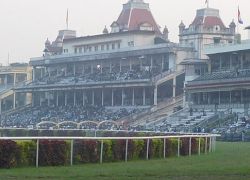
A remnant of the British era, this is one of the largest horse racing turfs in India. Many important and prestigious racing events are held here regularly.
It is regarded as one of the best racecourses in India. It started off in 1819 organised by the Royal Turf Club. Apart from horse races, this ground was also used for playing polo..

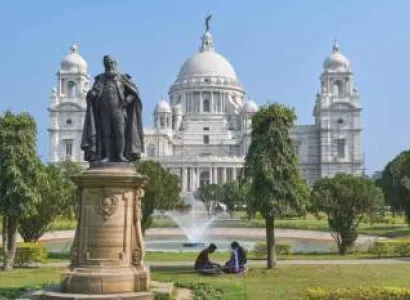
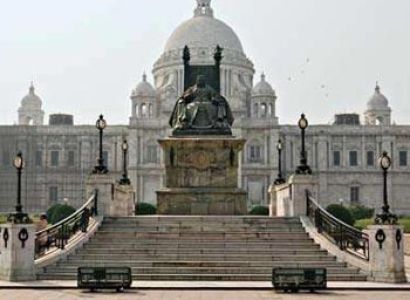
Location : It is situated on the western side of the Victoria Memorial.
Time Period : The horse race starts in the month of July and continues till September. It starts again in November and concludes in March. The race generally held’s on Saturdays, however, it is also held on important holidays and some special occasions.

Salt Lake Stadium

Located in Calcutta peripheral Salt Lake City, this is a relatively newer and bigger stadium, which can house more than one lakh spectators.
It is a huge 3-tier stadium on the periphery of Calcutta's satellite Salt Lake City.

Salt Lake Stadium is also known as the Yuva Bharati Krirangan. It is situated approximately 10 kms. from the heart of the city..

Features Of The Stadium : It is elliptical in shape. The roof is made of strong tubes and aluminum sheets. There are two electronic score boards and control rooms. The lighting is uniformly distributed to facilitate nocturnal sports along with special arrangements for Television broadcasting.