India >> South Zone >> Karnataka >> Mysore


|
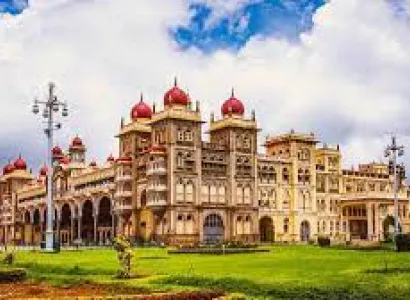
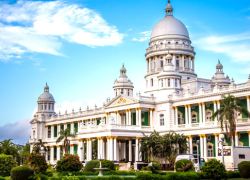
Jayalakshmi Vilas
Maharaja Chamaraja Wodeyar of Mysore had three daughters and two sons. The two sons of the Maharaja, Krihsanraja Wodeyar IV and Narasimharaja Wodeyar lived in the Main Palace; the King constructed three mansions for his three daughters. These three mansions were built in three different corners of Mysore on top of small hillocks that gave an excellent view of the city. The three mansions were named after the three princesses.
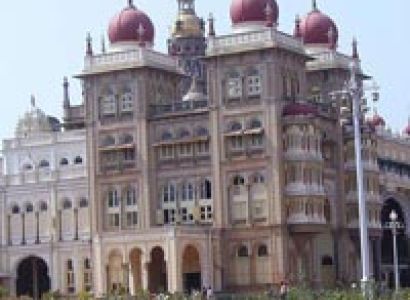
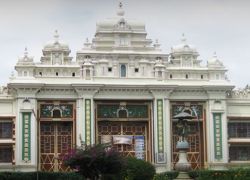
Jayalakshmi Vilas Mansion is about a century old and is one of the five royal mansions built by Maharaja Chamaraja Wodeyar and it was built for his oldest daughter. It was built in 1905 and was renovated in 2002. When the mansion was built at a cost of Rs.7 lakhs and was restored at a cost of Rs.1.17 crores. Restoration work began on April 21,2000 and was completed in about 18 months. The mansion now is the property of the Mysore University. This mansion today houses the Folklore Museum and is a research center of the Mysore University. The Museum exhibits a rare collection of things related to folklore, archaeology and geology collected from different parts of India.
The prominent features of this magnificent three-wing building include a series of twin Corinthian and ionic columns, regal pediments on the first floor on top of the north and east porches, pilastered window-sets in variegated ensembles of flat arches, pediments and oval ventilators all richly moulded. The interior of the mansion is extensively decorated in Indian style. A small over-bridge connects the north and south portion of the three-wing structure. The other important portions of this mansion are the dancing hall, Kalyana Mantap, and the richly decorated residential rooms.
The dancing hall has a wooden floor with a viewers' gallery and a first floor. The roof at the center is at a height of 40 feet and is decorated with painted glasses that provide ventilation. The Kalyana Mantap has a 12-pillar square. The Mantap has an eight-petal shaped dome with glass windows and on top of it is a gold -plated 'Kalasha" or tower. In fact the Kalyana Mantap is the most beautiful portion of the mansion. The north side pediment of the mansion has a sculpture of the Goddess Lakshmi and the south side has a sculpture of Goddess Bhuvaneswari under a domed canopy. Arched colonnades connect the different wings of the building. The interiors of the mansion have rich carvings and mouldings in masonry and wood and are the best examples of ancient Indian design.
The front of the quadrangle is carved from above, thus creating an excellent reception hall about 40 feet high and the back portion known as the Bhuvaneswari, is elegantly covered by a dome with a gilt finial on top. The Bhuvaneswari has some exquisite carvings. The doors, windows, pillars supporting the dome are all have beautiful filigree work. The mansion is built of brick, mortar, timber and iron. Stone was not used, as it would lead to delays in the construction. The mansion has been provided with separate drainage for rainwater and used water. The total area of the mansion is 1.20lakh square feet.
The mansion was initially called the First Rajkumari Mansion or Palace of the first princess Jayalakshmi Devi or the Kebbekatte Bunglow, it is about 3kms from Mysore City Bus Stand. The mansion is elevated and is opposite the Kukkarahalli Tank. After the marriage of the princess to her maternal uncle, his house was considered inadequate for the both of them. So the new mansion was built after acquiring 800 acres in the west of Mysore city. It was called the Jayalakshmivilas Mansion..
|


|
Lalitha Mahal Palace
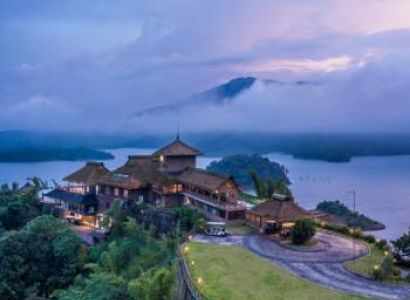
The Lalitha Mahal Palace is situated 11kms from Mysore city on top of a small hillock. This Palace is set in the middle of sprawling terraced gardens. Maharaja Krishnaraja Wodeyar IV commissioned this two-storied Palace in 1921. This Palace was built to exclusively to accommodate the Viceroy of India. E.W. Fritchley from Mumbai designed the Palace in the Renaissance style and included designs concepts from the Italian palazzo and English manor. This Palace meant for special royal guests has now been converted into a heritage category five-star hotel of India Tourism Development Corporation of the Government of India. The Palace has been maintained very carefully to keeps its grandeur intact.
The central hall is decorated with life size portraits of the royalty of Mysore, lithographs portraying Tippu Sultan's battles with the British. The walls and ceilings have beautiful motifs, the wooden shutters are intricately carved, and the wall panels are beautifully decorated too. Most of the old Palace furniture is being used in the hotel to this day, like four-poster beds, carved wooden cupboards, deep velvet covered armchairs and gilt framed Belgian mirrors. The viceroy room, banquet hall, dancing floor and an Italian marble staircase have been carefully maintained. The sprawling gardens have been reduced in size, as they are difficult to maintain. The hotel has maintained the Palace well and its splendour is intact to this day..
|


|
Mysore Palace
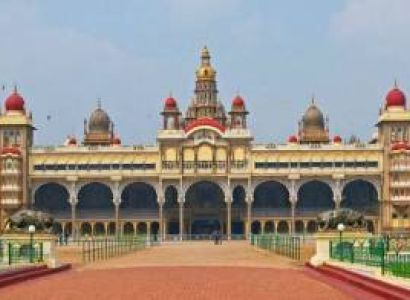
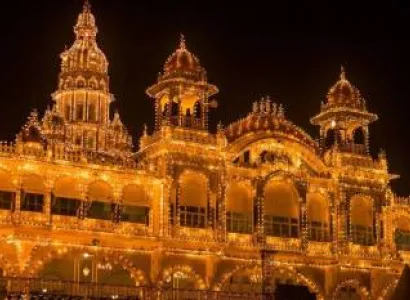
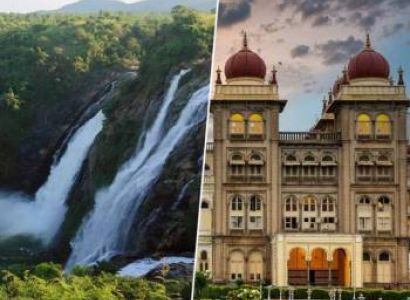
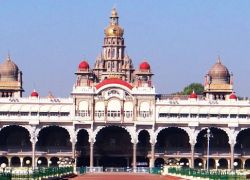
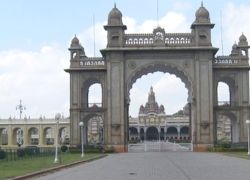
The Mahrajah's Palace is a magnificent three-storied structure with a five-storey tower designed by the English architect Henry Irwin, built out of local material. The colourful Dasara procession starts from the precincts of the Palace.
The famous Mysore palace also known as the Amba Villas Palace is one of the largest palaces in the country.
The palace was originally built of wood, which got burnt down in 1897 and was rebuilt in 1912. Henry Irwin, the architect of the Viceregal Lodge at Shimla, designed the Mysore Palace. It is a healthy combination of Dravidian, Indo-Sarcenic, Oriental and Roman styles. Once the residence of the erstwhile rulers of Mysore, this imperial palace is one of the largest in the country. It is managed by the Department of Archaeology and Museums of the Government of Karnataka.
It is beautifully restored and maintained.
|


|
The Jaganmohan Palace
Jaganmohan Palace is one of the oldest buildings in Mysore and is over a century and half old. Built in 1861, it housed the royal family when the old wooden palace was gutted in a fire in 1897..
|


|


Related Cities

|