India >> West Zone >> Madhya Pradesh >> Khajuraho
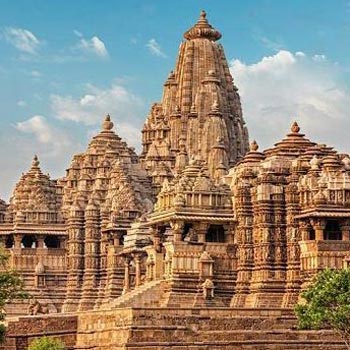
About Khajuraho Khajuraho derives its name from the Khajur tree (the date palm tree) found in abundance in the area. The temples are superb examples of Indo-Aryan architecture, built in the short span of a hundred years, under the generous and artistic patronage of the Chandela Rajput kings of Central India in a truly inspired burst of creativity. In the temple architecture of India, the Khajuraho complex remains unique. Khajuraho is located in the forested plains of Madhya Pradesh in the Bundelkhand region.
| Area: | 21 sq km
|
| Best Time to Visit: | October to March
|
| Climate: | The climate of this region is tropical. The place has a typical continental type of climate with summers being hot and winters cold.
|
| Main Languages: | Hindi and English
|
| Population: | Approx. 7000
|
| Temperature: | Summer - Max: 47 Min: 21 Winter - Max: 32 Min: 4
|


Other Attractions In & Around


|
Bandhavgarh National Park
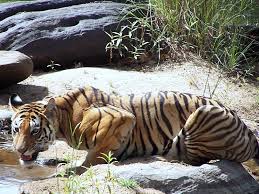
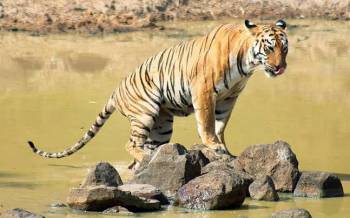
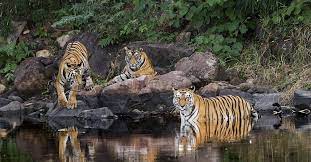
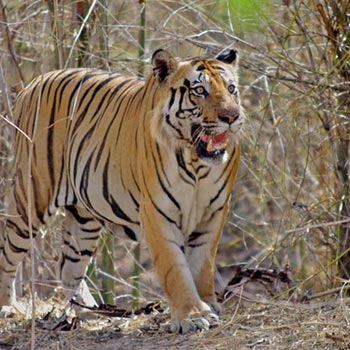
Bandhavgarh national park is set amidst the Vindhya ranges with a series of ridges running through it and with the highest known density of tiger population in India. Initially this park was the royal hunting ground for the rulers of Rewa but in 1968 it was declared a park. This is also known as White Tiger territory but the other species found in abundance are the gaur or Indian bison, the Sambar, the barking deer and the Nilgai.
At present, the Bandhavgarh Park covers 448 sq km.. Getting There : Air: The most convenient route to Bandhavgarh is by air to Khajuraho from where it is a five-hour drive (about 237 kms.).
Rail: The nearest railway stations are Jabalpur (164 km), Katni (102 km) on the Central Railway and Umaria (35 km) on the South Eastern Railway.
Road: State/Private transport buses ply between Katni, Umaria Satna and Rewa. Taxis are also available. Information for tourists : The park is closed from 1st July to 31st October. These are monsoon months. Park Population : The vegetation of the park is dry deciduous. About half of the park is covered with sal trees. There are mixed forests in the higher reaches of the hills. Stretches of Bamboo and grasslands extend to the north of the park and the park sustains all those species, which are typical to Central India. Attractions Nearby : The most fascinating and most popular excursion from the national park is to the Bandhavgarh fort, adding grace to the park. To get a bird’s view of the park, climb the fort. One should not miss the small population of naughty black bucks that live here, protected from the predators below.
This fort is in ruins now but the strong high walls of the fort tell a saga of valour and splendour. The fort blends with the wilds of the park and has become a part of the park. No one knows when the fort was constructed but scripts as old as Shiv Purana have mention about the fort which is believed to be almost 2000 years old.
The signs of early habitation can be seen in the caves excavated from the cliffs to the north of the fort. Brahmi inscriptions here date back to the 1st century BC.
It is an amazing diversity of flora and fauna, which certainly makes a trip to this wildlife, preserve utterly worthwhile. Best time to visit : The best season to visit this park is between November and June. The best time to visit the park is early in the morning or after 4 p.m., as it is during this time that the animals are most active and can be easily spotted.
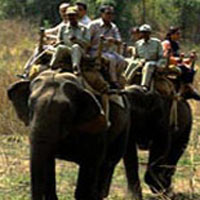
The park can be entered on elephant back or in a jeep or by car. A forest department guide always accompanies you, directing and telling about the flora and fauna of the park. Do you know? : The tigers once roamed freely here but due to extensive hunting (Maharaja Venkat Raman Singh shot 111 tigers by 1914), their population came down drastically. Numerous steps were taken to conserve the wildlife here without spoiling the natural beauty of the park. Even today, this national park has retained its unspoilt look.
The last known capture of the white tiger was in 1951. He is believed to have fathered many a cub in Indian zoos and outside. 'Mohun' is now stuffed and on display in the palace of the Maharaja of Rewa.
This is where Rudyard Kipling found inspiration for his famous Jungle Book and this is where the tiger still roams- although now protected by dozens of laws, some effective, some not.
Bandhavgarh is densely populated with other animal species too. The great gaur, Indian bisons can be easily spotted when they come to graze on the meadows at dusk. There are 22 species of mammals, which include langurs and rhesus macaque as the primary group. The jackal, bangal fox, bears, ratel, mongoose, hyena, jungle cat, leopard and tiger form the core carnivore population. The animals frequently sighted are wild pig, spotted deer, dhole, the small Indian civet, palm squirrel and lesser bandicoot rat are seen occasionally.
Among the herbivores, the gaur is the only coarse feeder.
The national park holds some 250 odd species of birds along the streams and marshes. Reptilian fauna include cobra, krait, viper, rat snake, python, turtle and a large number of lizard varieties, including varanus. Accommodation : The forest department and the PWD arrange good accommodation facilities here and are sufficient to fulfill the needs of the visitors. The Madhya Pradesh Tourist department maintains the White tiger Forest Lodge. TOP
|


|
Brahma Temple
Built in circa AD 900 dedicated to Lord Vishnu, the temple stands on an 11 feet high 'jagati' (platform) on the east bank of the Ninora Tal, the largest tank in Khajuraho. The temple is actually a small square shrine resting on twelve pilasters of granite.. The structure : The 'jagati' is plain with 12 prominent offsets and its lower courses remain submerged in the water of the tank for some months of the year. The Khajuraho group of temples are noted for lofty terraces (jagati) and functionally effective plans.
The roof is made of sandstone, while the structure below it is made of granite, almost in entirety. Externally, the shrine is cruciform with a cardinal projection on each side. The more prominent projection of the vestibule on the east shows a doorway forming the entrance. The west is pierced with a small sham doorway, while the lateral projections on the north and south contain latticed windows. Location : It stands on the east bank of the Ninora Tal, Khajuraho. TOP
|


|
Chaunsath Yogini Temple
Chaunsat Yogini is the oldest of the surviving temples of Khajuraho, dedicated to goddess Kali. This is the only temple in Khajuraho built in granite. The name chaunsat (sixty-four) comes from the cells of 64 attendants of Goddess Kali, while one belongs to the goddess herself.
This temple is in the western group and is also unique in being quadrangular in plan. Only 35 of the original 65 cells remain and no image of Kali has survived not surprisingly, since this is the earliest surviving shrine of the group dated to 900 AD.
Built in late 9th century, situated about three furlongs south of the Kandariya Mahadeva Temple, this monument belongs to a very rare class of temples, dedicated to the sixty-four Yoginis, which represented innumerable aspects or manifestations of 'Shakti'.
The temple is built on a low rocky ridge and stands on a Cyclopean 'jagati' (platform), from 14 to 18 feet high, made of rough dressed boulders of coarse local granite.. Distinguishing Features : This temples is the only one not aligned East to West.
This is the only temple at Khajuraho, which is not oriented north south but is oriented northeast to southwest. This temple has many notable features. This is the only temple at the site, which is made entirely of granite, while most of the Khajuraho temples are made of a fine variety of buff or pink sandstone. Further, this structure is extremely simple in plan and design, with hardly any carvings or ornaments and has no pretensions for architectural elegance. TOP
|


|
Chitrakoot
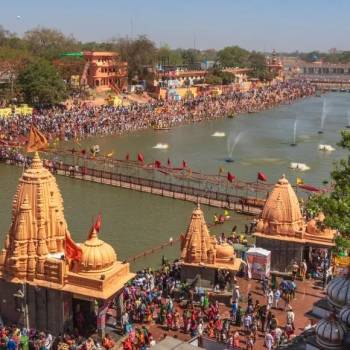
This large sprawling town stands on the banks of the Mandakini River about 132 km from Khajuraho and it was here that Brahma, Vishnu and Siva are believed to have been born and taken on their incarnations. Bathing Ghats line the Mandakini River. Both Madhya Pradesh Tourism and Uttar Pradesh Tourism have Tourist Bungalows here.. Location : It is on the banks of the Mandakini River. Spiritual attachment : Chitrakoot, 'the hill of many wonders', nestles peacefully in the northern spurs of the Vindhyas, a place of tranquil forest glades and quiet rivers, and streams where calm and repose are all pervading. This lovely Nature's gift is also hallowed ground, blessed by the gods and sanctified by the faith of pilgrims. For Chitrakoot's spiritual legacy stretches back to legendary ages: it was in these deep forests that Rama and Sita spent eleven of their fourteen years of exile and here that the great sage Atri and Sati Anusuya meditated.
Sufferers and seekers, poets and visionaries, princes and noblemen have, sought and found solace here, drawn inspiration from its sublime natural beauty, gained spiritual strength from its serene temples and in turn, become part of the hallowed legend that is Chitrakoot. TOP
|


|
Devi Jagadambi Temple
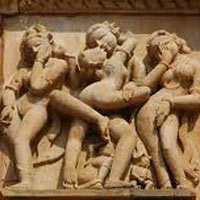
This temple is considered by many to be the most erotic temples of Khajuraho. The temple houses the image of mithuna and the sensuously carved figures. It is not clear until today as to which deity this temple is dedicated to, but it was probably originally dedicated to Parvati and then Kali.. Matter of debate : It houses Khajuraho's most talked about image, the mithuna, sensuously carved figures. Whether this temple is dedicated to Vishnu, Parvati or Kali has remained a matter of much debate. It is said that the Devi Jagdamba temple was dedicated to Vishnu, but then rededicated to Goddess Kali. The temple is smaller in size. It has a long porch, a big hall. The balconies of the mahamandap are bigger than those of the other temples and five columns support the roofs over them.
This temple essentially resembles the Chitragupta Temple in respect of design, dimensions and decorative scheme. Therefore, the two temples are quite close to each other in time as they are in space. TOP
|


|
Duladeo Temple
Dedicated to Shiva, the apsara and ornamented figures are the temple's most striking features.
This Dhuladeo Mandir is also known as the Bridegroom Temple. Though it is a beautiful erotic image of Khajuraho that this one represents, it is still a very new temple which seems to have been built after the creativity of Khajuraho was on its way to a new era and well down its peak. It has more wooden sculpture that takes away its authenticity somewhat.. Location : South of the Khajuraho village. The Kunwar Math : Built in circa AD 1100-1150, this Shaiva Temple, traditionally known as the temple of Duladeo or 'Kunwar Math', stands about a kilometre south of the Khajuraho village. It is situated about half a mile south of the Ghantai Temple and the same distance southwest of the Jain group of temples including the Parsvanath temple.
Rightly said, if erotica can turn into sublime, it is at Khajuraho.
The temple is incompletely preserved and has been extensively repaired and restored.
While some figures are of exceptional artistic merit on this temple, the plastic treatment has on the whole become stiff and in many cases lacks depth of relief, which is evident on a majority of the figures of nymphs of the exterior. The iconography of this temple also shows some distinctive traits. The Ashtavasu figures are invariably depicted here with a crocodile mount in place of the usual bull, while the 'dikpalas', 'yama' and 'Nirriti' wear their raised curls in a stylised fan shape. The facades of this temple carry tedious repetitions of the images of standing Shiva and Shiva-Parvati. TOP
|


|
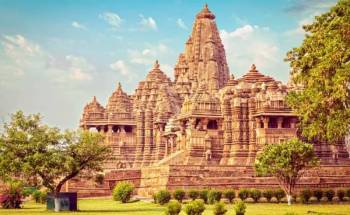
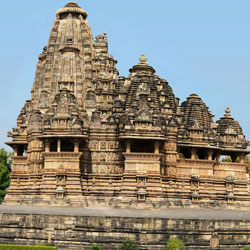
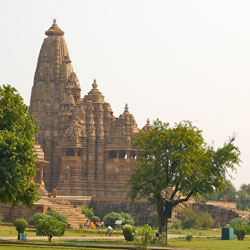
Kandariya Mahadev Temple
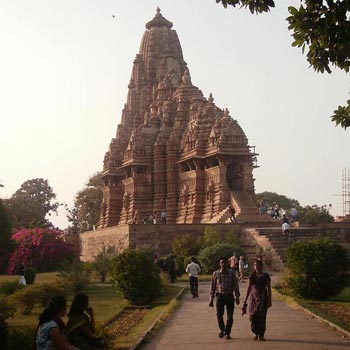
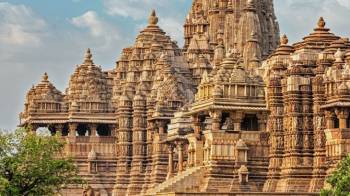
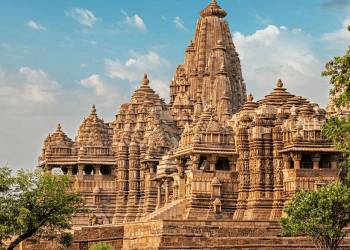
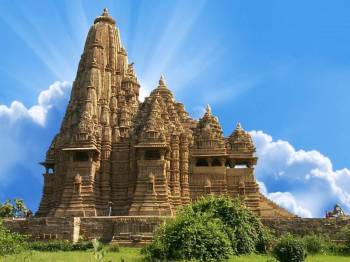
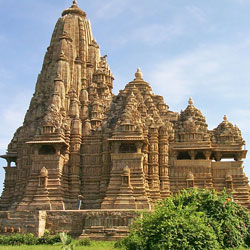
This temple dedicated to Shiva is the largest in Khajuraho dating back to the 11th century. The sanctum sanctorum enshrines a lingam. Particularly noteworthy are the entrances arc, the ceilings and pillars of the interior compartments. The sculptures on this temple are conspicuously slender and tall.
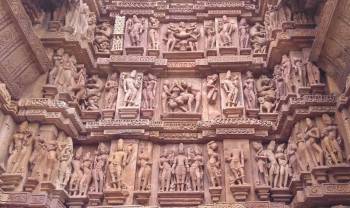
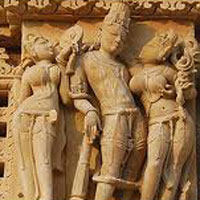
There are about 900 statues. Dedicated to Lord Shiva, it soars 31 m high. The main shrine is ornately carved and depicts various gods, goddesses, apsaras (heavenly maidens) in elaborate detail. The entrance arch, the massive pillars and ceilings are adorned with exquisite carvings that leave the visitor spellbound. Beyond the archway of the Kandariya Mahadev, lie the six interior compartments; the portico, main hall, transept, vestibule, sanctum and ambulatory. The transept's outer walls have three horizontal panels showing deities of the Hindu pantheon, and groups of lovers, a pageant of sensuousness, vibrantly alive.
The very stone seems to have taken on the living, breathing quality of the carved figures.. The Prime Shaiva Temple : Built during the reigns of Vidyadhara and Vijaipal, this Saiva Temple enshrining a marble Shiva-linga is the loftiest monument of Khajuraho.
Its mature plan, design, grand dimensions, symmetrical proportions, superb sculptural embellishment and architectural elaborations mark this magnificent temple, dedicated to Lord Shiva. It is one most evolved and finished achievement of the central Indian building-style and one of the most sublime creations of Indian architecture.
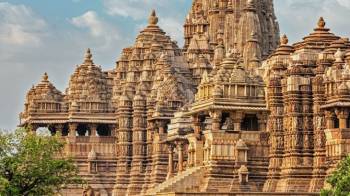
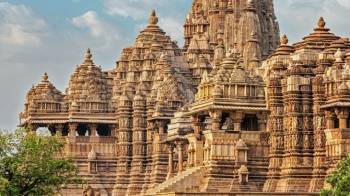
Decorated with graded and ascending series of smaller replicas of itself, the grand 'shikhara' of the Kandariya is a lofty and intricately ornamented pile. Though it is restless in movement it is but unified in theme and design. The structures : The name of the Kandariya Mahadev temple also echoes the Puranic description of Siva the ascetic as 'the great lord who resides in a mountain cave'. This is the only temple of Khajuraho where the platform shows projections on the lateral sides and the rear, corresponding to the projections of the transepts.
The largest number of sculptures of alluring beauty appears on the three bands of its wall and represents an animated array of gods and goddesses, 'mithunas' (couples) and 'sura-sundaris' (nymphs) on projections and mythical lions in recesses. The interior of the Kandariya Temple is largely similar in design to that of the developed local temples, but is more spacious and gorgeous and is replete with a lavish wealth of carvings and sculptures. It is the only local temple, which has preserved two exquisitely designed 'toranas' (festooned arches) both of exquisite design, in the interior.
Kandariya Mahadeva temple, dedicated to Lord Shiva has a high shikhara or spire. Here we see an attempt to reconstruct the image of Shiva's home in Mount Kailasha. Giant reliefs also portray various manifestations of Shiva, who is both a destroyer and a savior. Conclusion : Though one cannot come to conclusions, once here in Khajuraho, yet we could say that the sculptures on this temple are conspicuously slender and taller showing the richest variety of the nymphs in lively postures. These sculptures represent the highest watermark of the characteristic art diction of Khajuraho. Impressive temple : The Kandariya Mahadeva temple is one of the largest and architecturally and sculpturally the most impressive of all the temples at Khajuraho. It represents the culmination of temple architecture in central India. Art critics have applauded its magnificence, perfection of design and sculptural profusion. The word 'Kandariya' means a cave and 'Mahadeva' is one of the numerous appellations of Shiva. The shrine is 102 feet long, 67 feet wide, with a tower 118 feet high. It has a 5-part plan with an ardhamandapa, mandapa, a mahamandapa supported with pillars, the garbagriha and the pradakshina around it.
View the ornately carved temple, which depicts various gods and goddesses in elaborate detail. TOP
|


|
Khajuraho
Each temple here is dedicated to a different deity, and architecturally these temples are unique. Most temples are dedicated either to Vishnu, the premium god of the Vaishnavist sect or to Shiva, the premium god of the Shaivite sect. But this small one is dedicated to Shiva's wife, Parvati.
There is pure beauty and no perversion in these temples. The beauty is in the eyes of the beholder and the same object may appear differently to different people and so if indeed these temples represent the social life at the time, one must be proud of the land of abundance that was India.
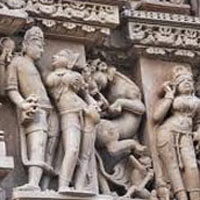
. The beauty of the temples : The temples of Khajuraho are an enigma for art historians. The contradiction is created by the fact that these temples, despite being places of worship, are adorned with explicit sculptures. The architectural harmony and beauty of the Khajuraho temples are unlike any other in the country.
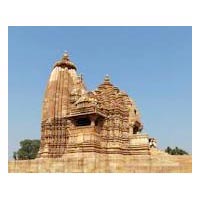
The tranquil town of Khajuraho, boasts of the best medieval temples in India, known all over the world for their sculptures. These glorious temples are the state's most famous attraction.
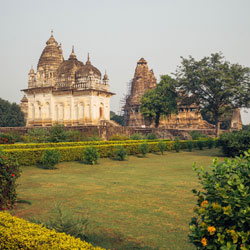
Amid green lawns and brilliant pink flowers is a complex of temples, glowing with the warmth of sandstone and ornamented with the sinuous curves of sculpture unparalleled in their beauty. The site was forgotten for centuries before it was rediscovered in 1838. The temples were restored and attract visitors from all over the world.
The sculptures include statues of gods and goddesses, warriors, celestial dancers and animals. The Hindu philosophy of Yoga and Bhoga (physical pleasure), the two paths leading to final liberation, seem to be the underlying theme of these sculptures. A different perception : All life was seen as an expression of divinity, including human love. The other sculptures in these temples depict the daily lives of the people in the 10th and 11th centuries AD.
The temples of Khajuraho display a wealth of sculptural beauty, evoking the grandeur of the snow-capped Himalayas as well as the earthly pleasures of life.
The place is a world heritage site famous for the exquisite sculptures adorning the temples there. Khajuraho temples are a rare gift to the world. These temples were erected in a span of 100 years. TOP
|


|
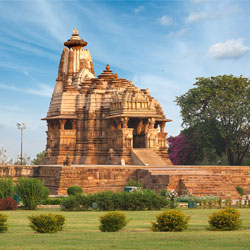
Lakshmana Temple
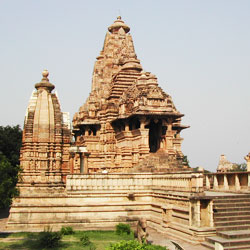
This is one of the oldest and most impressively designed temples of the western group of temples dedicated to Lord Vishnu. The lintel over the entrance of this beautiful Vaishnavite temple shows the trinity of Brahma, Vishnu and Shiva with Lakshmi, Vishnu's consort. The finely carved sanctum has a three-headed idol of Vishnu’s incarnations, Narsimha and Varaha.
Emperor Lakshavarma is credited with building the Lakshmana-Chaturbhuja temple at Khajuraho. The image enshrined is said originally to be from Tibet and was gifted to Lakshavarma by the Pratihara ruler Devapala.. The temple plan : The plan of the temple has the main shrines at the centre surrounded by four subsidiary shrines at the four corners. Each of the corner shrines is complete in itself with a garbhgriha and an ardh mandap supported by two pillars. A flight of steps leads to a high terrace that opens to the east. This terrace is profusely ornamented showing scenes of everyday life.
Around the base of the temple is a continuous frieze with scenes of battles, hunting and processions. Inside, one enters through a simple Makara-Toran flanked on either side by gladiators. The circular ceiling of the porch is carved in the design of a Lotus in four concentric circles. The raised platform in the hall is used as a dance floor or for rituals. The pillars on each corner depict Apsaras on carved brackets and among the finest of sculptures, these eight figures, on each column, represent each sect of the Tantras. The Pancha-Ratha has a three heads and four arms as Lord Vishnu at Vaikuntha, apart from 10 incarnations and 14 forms of Vishnu. The Best Preserved Structure : Built during the reign of Yasovarman, this temple dedicated to the Vaikuntha form of Vishnu, stands in the heart of a large cluster of ancient temples, situated to the west of the present Khajuraho village. The deity of the temple is variously known as Lakshmana, Ramachandra or Chaturbhuja attesting its Vaishnava dedication. Location : It is situated to the west of the present Khajuraho village. Significance : Lakshmana Temple is the earliest, best preserved and most typical of the evolved variety of Khajuraho temples. This is the only temple, which preserved the subsidiary shrines and the platform terrace (jagati) with their essential features and decorations intact.
This is the only temple, which has conserved bits of the parapet wall of the platform, representing ornate balustrade and linking all the subsidiary shrines in a common enclosure, with a conspicuous projection in front. This temple is a 'panchayatana' - a complex of five shrines.
Architecturally, this temple has some remarkable features. The roofs of its 'maha-mandapa', 'mandapa' and the entrance porch are of the 'phamsana' type and show a pyramidal superstructure of a straight contour, which is crowned by a prominent chime.
Only two temples at Khajuraho, namely the Lakshmana and the Parsvanath, display on the door-lintel two bold sculptured friezes, of which one represents the Nine Planets with a large figure of Rahu. TOP
|


|
Matangeswara Temple
Dedicated to Lord Shiva, situated outside the ASI compound it boasts of an eight-feet-high lingam and draws large crowds during Mahashivratri. It has one of the largest lingams in North India, made in highly polished yellow sandstone. Morning and evening aarti hours are a good time to visit this temple.
The Matangeshvara or Mrityunjaya Mahadeo (The great Lord who has conquered death) is one of the earliest temples to be built at Khajuraho. The exterior and interior of the temple, as well as the pillars are without carvings but the ceilings is formed of overlapping concentric courses. The matangeshvara is one of the holiest temples of Khajuraho.
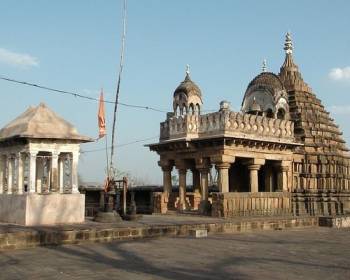
Standing next to the Lakshmana Temple, this temple is not within the fenced enclosure because it is still in everyday use, unlike all the other old Khajuraho temples. It may be the plainest temple here but inside it sports a polished lingam, 2.5m high.. Location : It stands on the north bank of the Shivasagar Tank and faces east. Legend : It is believed, that Lord Shiva, lived as an ascetic in the Himalayas, dressed only in animal skin with his body smeared with ash and as a favour from the gods, Parvati, the beautiful daughter of the mountains, was permitted to serve him during his prayers. The other gods meanwhile were eager for Shiva to marry and father a son to protect the world from powerful demons. In order to do so, the gods approached Kamadev, the god of love, and sought his help. Kamadev, with his wife Rati and Vasanta travelled to the place where Shiva was praying and filled the earth with the colours and fragrances of spring. While Parvati was serving her Lord, Kamadev struck Shiva with his flower tipped arrows of love.
For an instant, Shiva opened his eyes, saw Parvati and immediately fell in love. However, Shiva opened his third eye and reduced the God of Love to ashes, as he was angry that his meditation had been disturbed. The world was immediately filled with a mournful darkness, for love had died. Then Shiva, to reaffirm his omnipotence, power and wonder caused a great linga to appear before them, which is the image in the Matangesvara temple.
This myth only adds weight to the theory that the temples at Khajuraho were built to celebrate certain episodes in the marriage of Shiva and Parvati and also helped explain why Khajuraho was venerated as sacred to Shiva and why devotees continued to worship this particular Shivalinga long after the other more monumental temples were abandoned. This linga is the manifestation of a powerful sustaining myth and is the reason, mythologically speaking, for Khajuraho's importance. Some writers also view Khajuraho as a depiction of wedding celebrations of Lord Shiva and Parvati.
To look at the groom is a very big cultural ritual in India and it is an apt metaphor for the longing of the soul for god. It has brought the whole Khajuraho temple complex back into the mainstream of Indian religious evolution, rather than being a tantrik aberration. TOP
|


|
Panna National Park
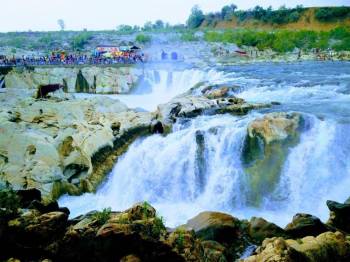
Panna National Park, 32 kms. away from Khajuraho spreads along the river Ken. The jungles harbor many species of wildlife. The tiger can be glimpsed here, with other rare species such as the Leopard, Wolf, Gharial, Herds of Bluebull, Chinkara and Sambar. On the road to Panna are the spectacular Pandav Falls. This is an ideal place for wildlife watchers.
It is one of the best in the region.
You can see tigers, sloth bear, march crocodile, cinkara, sambhar and chital. Bird life in this park is extremely rich and varied.
You can view wildlife in jeeps, boats or on foot. It is close to Khajuraho and forms an ideal halt for people going to Bandhavgarh and Kanha national parks.
This region, which is famous for its diamonds, is also home to some of the best wildlife species in India and is one of the better Tiger Reserves in the country. The park is known worldwide for its wild cats, including tigers as well as deer and antelope. Due to its closeness to one of the best-known Indian tourist attraction in India, Khajuraho, the park has the potential of becoming a major tourist attraction.. Location : 32 km from Khajuraho
Access to the park is from the village of Madla, 22 km from Khajuraho. Information for tourists : Best time to visit: November to April
Nearest Town: Khajuraho
Tree houses and tourist lodges are available in the vicinity of the Panna National Park to accommodate the visitors.
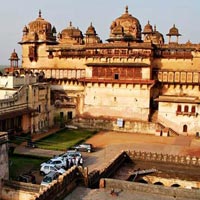
It contains large areas of unspoilt forest and a variety of wildlife. The numerous waterfalls in this area are popular picnic spots. Day trips often also take in a visit to the diamond mines at Majhgawan, the Rajgarh Palace and the temples of Panna town. Legend : Legend has it that the Pandavs of Mahabharat spent a good part of their seclusion here in the forests of the Panna National Park. Even now the park region attracts every sort of visitors. The park was the private hunting region of the royal family of Panna. After independence, the park was declared a wildlife sanctuary. It is in the year 1981 that this park was declared a National Park and now it attracts the attention of wildlife enthusiasts in large numbers. Attractions : Panna is famous for its diamond mining industry and this makes it an interesting place to visit. Pandav falls is a major attraction with its lake fed by a waterfall. Another attraction in this region is the Rajgarh Palace, a magnificent piece of architecture overlooking the valley. Fauna : Apart from the tiger, it also includes wolf, chital, sloth bear, chinkara, and sambar. Tiger sightings are not very common here and to watch a wild cat in action needs a lot of patience along with luck. The Ken River that flows from here towards the north harbours both the major Indian species of crocodiles i.e. the mugger and long snout gharial. Flora : This region has mixed deciduous forests. The landscape of this rocky and uneven terrain is covered by scrubby vegetation and grass. TOP
|


|
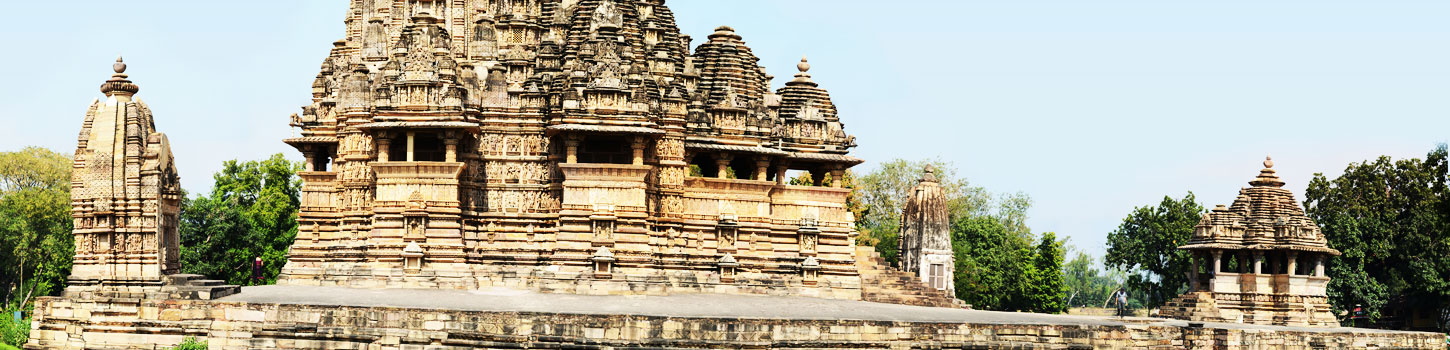
The Western Group
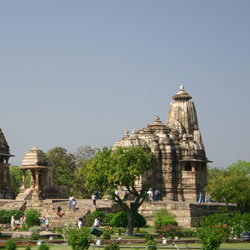
The western group is near the tourist part of town containing the Varaha Temple dedicated to Lord Vishnu, in the form of a boar, the best-preserved Lakshmana Temple, the Kandariya Mahadeva Temple dedicated to Lord Shiva and the Chitragupta dedicated to the Sun God, Surya. The white-plastered temple built by Maharaja Pratap Singh of Chhatarpur state, rests on the platform of an ancient temple, dedicated to Shiva.. Under western group : Varaha Temple: This small rectangular temple, supported on 12 pillars, is built on a rock foundation and has a pyramidal roof of receding tiers. In the middle of the shrine stands a colossal monolithic image of Varaha (Boar), one of the ten incarnations of Lord Vishnu, in glossy yellow sandstone.
The Varaha Temple dates back to the 10th Century. According to mythology, the Rat-Demon Hiranyaksha stole the earth, pulled it under the waters to his abode and created 1000 replicas of him to confuse his pursuer. Vishnu, on the request of the other Gods, incarnated himself as a boar, and retrieved the earth from the clutches of the Demon and saved the world. The huge sandstone polished Varaha is shown, along with hundreds of deities flanked about his and the three worlds-water, earth and heaven, perched on the serpent Shesha, with the broken figure of Prithvi of his feet. Remarkable temples : Most of the temples in Khajuraho are dedicated to one of the holy trinity of the Hindu Gods (Brahma the creator, Vishnu the preserver and Shiva the destroyer)
The western group of temples, which the visitor encounters, first, is situated along the main approach road to Khajuraho. This is the largest and most important group with most of its constituent temples laid out roughly in two rows.
The Kandariya Mahadev, perfectly symmetrical, soars 31 km high. The very stone seems to have taken on the living, breathing quality of the carved figures. The outer walls have three horizontal panels showing deities of the Hindu pantheon, and groups of lovers, a pageant of sensuous imagery vibrantly alive.
Also in the western group is the Chaunsat Yogini, the only granite temple in the Khajuraho group. Dedicated to Kali, it is also unique in being quadrangular in plan. This has the earliest surviving shrine of the group dated to 900 AD. Another Kali Temple is the Devi Jagadambe Temple. North of it facing eastward to the rising sun, is the Chitragupta Temple, dedicated to the Sun God, Surya - driving a seven-horsed chariot. The group scenes depicted are equally spectacular: royal processions, elephant-fights, hunting scenes, and group dances.
The Lakshmana Temple, the Matangesvara Temple and the Varaha Temple form one complex and the Visvanatha and Nandi temples are not far from this complex. These temples form an irregular row running north-south, while the Chitragupta, Jagadambi and the Kandariya Mahadeva temples form a more regular, parallel row, about a furlong to their west.
The Archaeological Survey of India amidst a setting of green lawns, colourful shrubs and flowerbeds best maintains this group of monuments.
The Western group has the most remarkable temples, set around a beautiful park, and takes the longest to visit. TOP
|


|
Vaman and Javari Temples
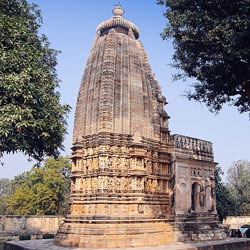
Standing amidst green barley fields, behind Khajuraho village, the temple presents a pretty sight, dedicated to Vaman (dwarf) incarnation of Vishnu. It has a single spire shikhar with chaitya arches.. Javari Temple : Again dedicated to Vishnu, this is a small, well-proportioned shrine. The temple is a gem of architecture and is remarkable as much for its ornate entrance, as for the slender soaring outline of its spire. Location : It is situated north of the Khajuraho village. The Dwarf Incarnation : This temple belongs to the eastern group of temples and is situated north of the Khajuraho village, about a furlong east of the Ninora Tal and almost the same distance north of the Javari Temple.
Dedicated to the 'Vamana' (dwarf) incarnation of Vishnu, this temple consists on plan of a sanctum without ambulatory having a mono-spired 'shikhara', a vestibule, a 'maha-mandapa' with lateral transepts and a porch, of which only the plinth has survived. In all other respects, this temple is broadly akin to the other developed temples of Khajuraho.
Another noteworthy feature of this temple is that the top or third row of the 'jangha' (wall) shows framed niches containing diamonds in the place of sculptures, an early feature shared by the subsidiary shrines of the Lakshmana Temple. TOP
|


|
Vishwanath Temple
A three-headed image of Brahma is enshrined in this temple. The approach is equally impressive, with lions flanking the northern and elephants the southern steps leading up to it. A Nandi bull guards the Shivalinga enshrined within, facing the shrine.. The exteriors : Women depicted in this temple draw the most attention. Both the interior and exterior carving are magnificent. The women carved on the brackets inside and the charming apsaras outside add enormously to the beauty of the temple. With a shrine of Shiva that finds expression as the bull Nandi, it is quite a complete temple and is truly impressive and also commonly photographed.
The exteriors are profusely carved, and facing the shrine is a Nandi Temple with a massive, 6 ft high Nandi bull. The structure : This is one of the most important of the Shiva temples. It closely resembles the Kandariya Mahadeva Temple in its style and composition. The temple measures about 27.4 metre x 13.7 metre.
The Vishvanatha temple is in the northeast corner of the western group of temples. Now, only two subsidiary shrines of the original four remain.
Though quite spectacular in its own right, temple is only a smaller copy of the largest and most impressive of the temples of the western group at Khajuraho. TOP
|


|


Related Cities

|