- By Theme
-
Destinations
-
Indian Destinations
-
International Destinations
-
- Best Places to Visit
- Packages
- Search Agents
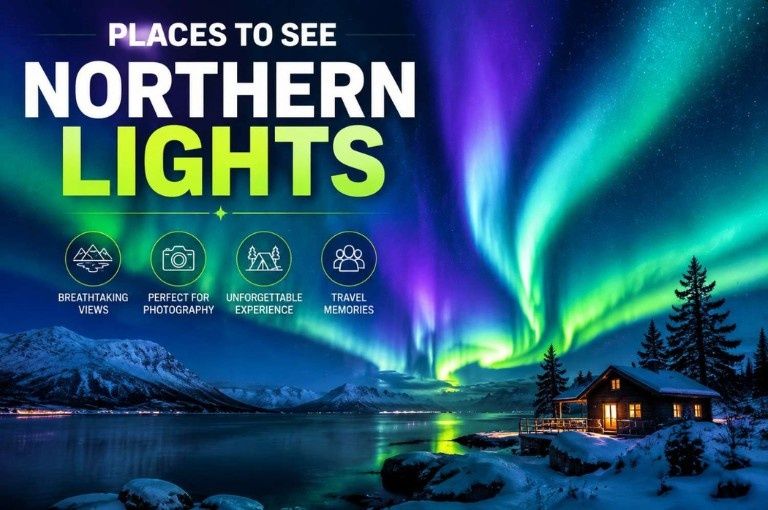
The northern lights, also called aurora borealis, rank among the most awe-inspiring natural light shows on Earth. Green, pink, and violet waves ripple across dark polar skies, and travellers from India and around the world plan entire trips just to witness this phenomenon once. This guide covers the best place to see northern lights, the best time to view the northern lights, and a complete breakdown of aurora destinations so you can plan a trip with confidence.
Whether you are searching for the best aurora borealis location for a honeymoon, a solo bucket-list trip, or a family adventure, this guide lists every major northern lights country, explains why each location works, and gives practical details to help you choose the right place to visit to see the northern lights. Each destination below includes three highlight points covering accessibility, scenery, and practical viewing conditions, so you can compare options quickly before booking.
Aurora borealis forms when charged particles from the sun collide with gases in Earth's atmosphere near the magnetic poles. This collision releases energy as light, producing the swirling green, purple, and red patterns visible in the night sky. Because this activity is concentrated near the Arctic Circle, the best place to see aurora is almost always a high-latitude region with dark, clear winter skies.
Timing matters as much as location. Aurora activity is visible only during dark hours, so the best time to view the northern lights falls between late August and early April in most northern destinations. Clear, moonless nights between 9 PM and 2 AM typically offer the strongest visibility. Solar activity also follows an 11-year cycle, and forecasts for the mid-2020s suggest strong aurora activity, making this an excellent window to plan a trip.
Below is a detailed list of the best places to view northern lights across the Arctic Circle and beyond, with highlights for each destination so you can match the location to your travel style.
Tromso sits comfortably inside the Arctic Circle and is widely regarded as the best place for northern lights in Europe thanks to its accessible airport, mild coastal climate, and consistently high aurora activity between October and March.
Easy access via direct flights from Oslo, with a compact city centre that puts aurora tours, fjord cruises, and dog-sledding within short reach.
The Gulf Stream keeps temperatures milder than other Arctic locations, making Long nights outdoors are more comfortable for first-time aurora hunters.
Surrounding fjords and mountains create dramatic foregrounds for aurora photography, and local guides track real-time forecasts to maximise sighting chances.
Tromso works best for first-time aurora hunters who want a balance of city comforts and genuine Arctic wilderness within a short drive.
Iceland is one of the best northern lights destinations because the entire country sits under the auroral oval, and even short trips from Reykjavik open up dark countryside skies within an hour's drive.
Minimal light pollution just outside the capital allows visible auroras without long-distance travel into remote wilderness.
Combination trips are easy, since travellers can pair aurora hunting with the Golden Circle, Blue Lagoon, and South Coast waterfalls in a single itinerary.
Iceland's Aurora Forecast website gives one of the most reliable activity and cloud-cover predictions in the world, helping travellers plan the right night.
Reykjavik suits travellers who want to combine aurora chasing with a wider Iceland sightseeing itinerary in a single trip.
Abisko is frequently cited by scientists as having one of the clearest skies in the Arctic due to a unique microclimate that keeps clouds away, making it a strong contender for the best place to watch northern lights.
The Aurora Sky Station, reachable by chairlift, sits above the treeline and away from cloud cover created by nearby mountains.
Abisko records aurora visibility on a significantly higher percentage of clear nights than most other Arctic towns.
The park offers structured viewing platforms and astronomy guides, ideal for travellers who want an organised, low-effort viewing experience.
Abisko is the right choice for travellers who prioritise sighting reliability above all else and are comfortable with a more remote, no-frills setting.
Finnish Lapland blends Arctic wilderness with family-friendly infrastructure, making it one of the best places to visit to see the northern lights alongside other snow activities.
Glass igloos and aurora cabins in Rovaniemi and Saariselka allow guests to watch the sky from a heated bed, a unique experience not widely available elsewhere.
Rovaniemi is also marketed as the home of Santa Claus, giving the trip strong appeal for families travelling with children.
Long polar nights between November and January provide extended dark hours, increasing the overall chances of a sighting.
Finnish Lapland is best suited to families and travellers who want comfortable, structured aurora viewing alongside other snow activities.
Yellowknife in the Northwest Territories is often ranked among the best places in the world for aurora viewing due to its dry climate, flat terrain, and position almost directly under the auroral oval.
The dry, continental climate produces far more clear nights than coastal Arctic locations, raising the odds of visibility on any given evening.
Dedicated aurora viewing camps with heated teepees make extended outdoor sessions comfortable even in deep winter.
Yellowknife has built a tourism industry specifically around aurora chasing, with experienced local guides and photography-focused tours.
Yellowknife is ideal for travellers focused specifically on maximising sighting odds through a dry, stable Arctic climate.
Fairbanks sits directly beneath the auroral oval and is statistically one of the most reliable northern lights locations in North America, visible on average more than 200 nights a year.
Local lodges such as those near Chena Hot Springs combine aurora viewing with natural hot spring soaks, a rare pairing for cold-climate destinations.
Fairbanks offers reliable road access and well-developed tourist infrastructure compared to more remote Arctic outposts.
The University of Alaska runs a respected aurora forecast tool, giving visitors science-backed timing guidance.
Fairbanks appeals to US-based travellers and anyone wanting strong aurora odds without leaving North America.
Greenland offers a wilder, less crowded alternative for travellers seeking the best place to see aurora away from major tourist circuits, with icebergs adding a dramatic backdrop.
The UNESCO-listed Ilulissat Icefjord provides a striking foreground of floating icebergs beneath active aurora displays.
Greenland sees far fewer tourists than Iceland or Norway, appealing to travellers who want a quieter, more remote experience.
Long, dark Arctic winters between October and March give extended viewing windows each night.
Greenland suits adventurous travellers who prefer a quieter, less commercial aurora destination with dramatic natural scenery.
The Kola Peninsula near Murmansk is one of the most active aurora zones globally due to its high latitude and proximity to the magnetic pole, making it a strong northern lights location for dedicated aurora chasers.
Polar night conditions from December to January provide near-continuous darkness, maximising the viewing window.
The region records some of the highest aurora frequency rates in the world due to its location under the auroral oval.
Travellers can combine aurora trips with reindeer sledding and Sami cultural experiences in nearby Lapland-adjacent areas.
The Kola Peninsula appeals to dedicated aurora chasers seeking extended polar darkness and high sighting frequency.
Svalbard is one of the few inhabited places where the aurora can be seen even during daylight hours in deep winter, making it a unique entry among the best northern lights destinations.
The archipelago experiences full polar night from late November to late January, allowing round-the-clock aurora potential.
Svalbard combines aurora viewing with rare wildlife encounters, including polar bears and Arctic foxes.
Its extreme northern latitude places it directly beneath the auroral oval more consistently than mainland Norway.
Svalbard is best for travellers seeking a rare, extreme Arctic experience that combines aurora viewing with wildlife spotting.
Kiruna, Sweden's northernmost town, is gaining popularity as an alternative to Abisko, offering similar dark skies with the added appeal of the ICEHOTEL.
The ICEHOTEL, rebuilt annually from ice and snow, gives travellers a one-of-a-kind overnight stay paired with aurora chances.
Kiruna's location above the Arctic Circle means dark skies are available from early autumn through early spring.
Snowmobile and husky sledding tours are widely available, often combined directly with evening aurora excursions.
Kiruna suits travellers who want a memorable overnight stay paired with reliable aurora viewing conditions.
The Lofoten Islands combine dramatic mountain-and-sea scenery with strong aurora visibility, making them one of the most photogenic places to see the northern lights anywhere in the world.
Jagged peaks rising straight from the ocean create unmatched foregrounds for aurora photography.
Fishing villages such as Reine and Hamnoy offer cosy, low-light-pollution bases for evening viewing.
The islands remain relatively uncrowded compared to mainland Norway, giving a quieter aurora-hunting experience.
The Lofoten Islands are ideal for photographers and travellers who want the most visually dramatic aurora backdrop available.
Whitehorse offers an accessible Canadian alternative to Yellowknife, with strong aurora activity and a growing range of dedicated viewing tours.
Hot spring resorts near Whitehorse let visitors watch auroras from outdoor mineral pools, even in sub-zero temperatures.
The region's low humidity and minimal cloud cover create consistently clear viewing conditions through winter.
Whitehorse is more budget-friendly than several other major aurora hubs, appealing to value-conscious travellers.
Yellowknife is ideal for travellers focused specifically on maximising sighting odds through a dry, stable Arctic climate.
These remote Lapland villages sit deep inside the Arctic Circle and are considered among the best places to go for northern lights due to extremely low light pollution.
Inari Lake and the surrounding wilderness provide vast open skies with almost no artificial light interference.
The Siida Sami Museum nearby adds cultural depth to a trip otherwise focused on nature and aurora chasing.
Saariselka offers fell-top viewing points that rise above valley clouds, often improving sighting odds on partly cloudy nights.
Saariselka and Inari suit travellers who want maximum darkness and minimal crowds away from more commercial Lapland towns.
North Iceland's largest town, Akureyri, gives travellers a quieter alternative to Reykjavik with equally strong aurora activity and easier access to remote countryside.
Its northern position results in slightly higher aurora frequency than Reykjavik on comparable nights.
Nearby Lake Myvatn offers geothermal baths paired with some of the darkest skies in Iceland.
Akureyri serves as a convenient base for exploring North Iceland's waterfalls and volcanic landscapes by day.
Akureyri is well suited to travellers wanting a quieter Iceland base with easy access to both aurora viewing and daytime sightseeing.
Selecting the best country for northern lights depends on travel priorities. Norway and Iceland suit travellers wanting easy access and varied scenery. Canada and Alaska suit those prioritising clear, dry skies and higher sighting odds. Finland suits families and travellers wanting structured comfort, such as glass igloos. Greenland and Svalbard suit adventurous travellers seeking remote, less-crowded experiences.
Since every traveller has different priorities, it helps to group the destinations above by what matters most on the trip rather than by geography alone.
For first-time visitors wanting convenience: Tromso and Reykjavik offer airport access, short transfer times, and well-established tour operators.
For the highest statistical sighting odds: Abisko and Yellowknife benefit from dry climates and unusually high percentages of clear winter nights.
For families with children: Rovaniemi pairs aurora viewing with Santa Claus Village and gentle snow activities suited to younger travellers.
For photographers: the Lofoten Islands and Ilulissat provide dramatic mountain, fjord, and iceberg foregrounds for aurora images.
For remote, off-the-beaten-path travel: Svalbard, Greenland, and the Murmansk region offer fewer crowds and a more expedition-style experience.
For budget travellers: Whitehorse and Akureyri tend to cost less than premium hubs like Tromso or Svalbard while still offering strong aurora activity.
A successful aurora trip depends on more than just choosing the right northern lights location.
Check real-time aurora and KP-index forecasts before heading out each evening.
Choose nights with minimal cloud cover and little to no moonlight for the clearest views.
Move away from city lights to rural or elevated viewing spots whenever possible.
Allow at least three to five nights at your destination to account for weather variability.
Dress in layered, wind-resistant clothing, since most viewing happens outdoors in sub-zero temperatures.
Capturing a clear photo of the aurora requires slightly different settings than typical night photography, and a little preparation goes a long way toward bringing home usable images rather than blurry streaks of colour.
Use a camera that allows manual control over shutter speed, aperture, and ISO, since automatic modes rarely expose aurora correctly.
Mount the camera on a sturdy tripod, as exposures typically run between three and fifteen seconds to capture faint light bands.
Set a wide aperture, such as f/2.8 or lower, paired with an ISO between 800 and 3200 depending on aurora brightness.
Manually focus on a distant light or star rather than relying on autofocus, which often fails in low-light Arctic conditions.
Bring spare batteries, since cold temperatures drain camera batteries far faster than in normal conditions.
Arctic winters demand specific gear, and being underprepared is the most common reason travellers cut outdoor viewing sessions short before the aurora appears.
Insulated, waterproof winter boots rated for sub-zero temperatures, ideally with good grip for icy ground.
A thermal base layer, mid-layer fleece, and a windproof, insulated outer jacket for layered warmth.
Insulated gloves or mittens, a warm hat covering the ears, and a neck gaiter or scarf for added wind protection.
Hand and foot warmers, which make a noticeable difference during long stationary viewing sessions outdoors.
A headlamp with a red-light setting, which preserves night vision and avoids interfering with long-exposure photography.
Planning an aurora trip involves coordinating flights, accommodation, local transport, and timing around solar activity, which can be overwhelming without local expertise. TourTravelWorld helps travellers design custom international itineraries that combine the best place to see northern lights with comfortable stays, reliable local guides, and well-paced travel schedules. From choosing between Norway, Iceland, Finland, and Canada to building a complete winter holiday around aurora viewing, TourTravelWorld's travel experts handle the planning so you can focus on the experience itself. Explore curated Northern lights tour package with TourTravelWorld and turn your aurora bucket-list trip into a well-organised reality.
Several misconceptions persist around aurora viewing, and clearing them up helps set realistic expectations before booking a trip.
The aurora is visible every clear night.
You need extremely expensive camera gear to see results.
The northern lights only appear in the dead of winter.
City travel and aurora hunting cannot be combined.
Ans: Tromso in Norway, Abisko in Sweden, and Fairbanks in Alaska are consistently ranked among the best places to see the northern lights due to their high latitude, clear skies, and reliable aurora activity. Each location combines strong sighting statistics with established tourism infrastructure, making them dependable choices for first-time aurora travellers.
Ans: The best time to view the northern lights is between late August and early April, with peak visibility typically occurring on clear, moonless nights between 9 PM and 2 AM. Solar activity cycles also influence intensity, so checking a destination-specific aurora forecast before travel improves planning accuracy.
Ans: Norway, Iceland, Finland, Canada, and Greenland are widely considered the best countries for northern lights, each offering different combinations of accessibility, scenery, and sighting reliability. The right choice depends on whether a traveller prioritises convenience, statistical sighting odds, family-friendly facilities, or remote wilderness.
Ans: Travellers should plan at least three to five nights at their chosen destination, since cloud cover and solar activity vary night to night, affecting visibility. Shorter trips of one or two nights carry a meaningfully higher risk of missing a display entirely.
Ans: Yes, the northern lights can be seen independently in many destinations, though guided tours improve the odds of a sighting through real-time forecasting, optimal location knowledge, and transport to dark-sky areas away from light pollution.