- By Theme
-
Destinations
-
Indian Destinations
-
International Destinations
-
- Best Places to Visit
- Packages
- Search Agents
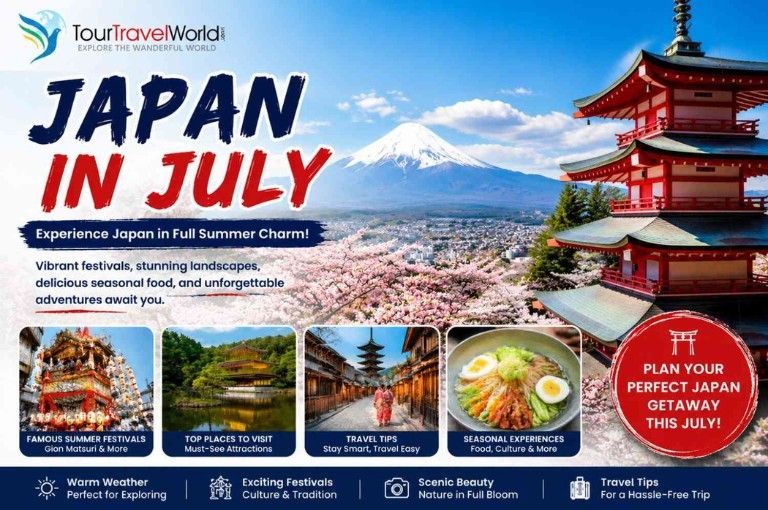
Most travellers dream of Japan during cherry blossom season — and for good reason. But if you want to experience the country at its most alive, plan a trip to Japan in July. The country transforms in ways that few guidebooks fully capture. Ancient festival floats the size of buildings roll through UNESCO-protected streets. Lavender farms in the north turn hillsides into purple paintings. Mountaintops that are off-limits for most of the year finally open their gates. Fireworks choreographed to music explode over rivers that run beside thousand-year-old shrines.
July is also one of the most diverse months to travel in Japan. The northern island of Hokkaido enjoys mild, refreshing summer temperatures ideal for outdoor exploration, while cities like Kyoto and Osaka pulse with a cultural energy that peaks exactly during this period. Tokyo’s summer nightlife, open-air food stalls, and rooftop bars come fully alive. And for those who prefer quieter, nature-driven travel, Japan’s mountains, national parks, and coastlines reveal a completely different face from the tourist trail.
This guide walks you through everything you need — the weather, the best places, seasonal activities, practical logistics, and how to reach key destinations — so that your Japan summer trip is planned with clarity and confidence.
Understanding the japan july season is the first and most important step in planning a summer trip. July sits at a fascinating weather crossroads: it is the tail end of the monsoon-like rainy season (known as Tsuyu or Baiu) in central and western Japan, and the beginning of full-blown summer across the archipelago. These two phases overlap differently across regions, which means the experience of July in Japan varies dramatically depending on where you are.
Early July (first two weeks) across the main island of Honshu is still influenced by tsuyu. Expect overcast skies, intermittent rain, and high humidity in cities like Tokyo, Kyoto, and Osaka. However, these rains are rarely all-day affairs — they typically come in short, intense bursts, leaving the rest of the day warm and bright. By mid-to-late July, the rainy season officially ends (a national announcement called tsuyu-ake), and the real Japanese summer begins: blue skies, intense sunshine, sizzling heat, and the unmistakable sound of cicadas.
The temperature in Japan in July is one of the most searched travel questions about summer travel in Japan — and for good reason. The country spans roughly 3,000 km from north to south, meaning the temperature gap between Hokkaido and Okinawa in July can exceed 15°C. Here is a detailed regional breakdown:
What to pack for Japan in July: Light, moisture-wicking clothing is essential for mainland Japan. Linen, cotton, and synthetic fabrics work best. For Hokkaido, add a light fleece or jacket for mornings and evenings. A foldable umbrella, a small hand towel (hankachi), and a personal fan are all considered normal accessories in Japan and can be bought cheaply at any convenience store.
Japan in July offers an extraordinary range of destinations. Each region reveals a different character during summer — from ancient festival cities to misty mountain shrines, from tropical island coral reefs to fields of purple lavender. Below are the most rewarding destinations to explore this month, along with everything you need to plan your visit.
The island of Hokkaido is located in the north of Japan, separated from Honshu by the Tsugaru Strait. It is Japan’s largest and least densely populated prefecture — and in July, it becomes arguably the most spectacular. While the rest of the country bakes in summer heat, Hokkaido in July is a cool, light-filled escape with some of the most dramatic landscapes in East Asia.
Hokkaido has a distinctly different character from the rest of Japan. Its history as a frontier island, colonised primarily in the Meiji era (1868–1912), means it lacks the deep temple culture of Kyoto or the dense urban energy of Tokyo. Instead, it offers space: wide skies, volcanic mountains, glacial lakes, dairy farms, and flower fields that seem to go on forever. In July, all of these come together in a season that locals call the island’s finest.
No destination in Japan is more emblematic of July than the Furano Valley in central Hokkaido. From early to mid-July, the farm fields around the town of Furano — particularly Farm Tomita, the most famous lavender farm in Japan — burst into full bloom. Rows upon rows of French lavender, in shades from deep violet to pale lilac, stretch across gentle hillsides with the Tokachi mountain range as a backdrop. The scent is remarkable: warm, sweet, and calming in a way that photographs simply cannot convey.
Farm Tomita is free to enter and open year-round, but the lavender peaks between July 10th and July 25th. Alongside lavender, the farm grows poppies, lavender sage, baby’s breath, and sunflowers in adjacent fields — creating a patchwork of colour that is extraordinary for photography. Arrive before 9 AM to experience the fields without crowds.
Biei, a short drive north of Furano, offers a different kind of landscape: rolling patchwork hills of wheat, soy, sunflowers, and wildflowers, dotted with lone trees that have become iconic through landscape photography. The Blue Pond (Aoiike) near Biei, a naturally occurring pond with a striking electric-blue colour due to aluminium hydroxide, is one of Hokkaido’s most photographed natural wonders and is open year-round.
With a population of nearly 2 million, Sapporo is a well-planned, modern city that serves as Hokkaido’s main transport hub and urban cultural centre. In July, the city is pleasantly warm, and its broad tree-lined avenues, covered shopping arcades, and beautiful parks make it an enjoyable base. Odori Park, the city’s central green spine, hosts the Sapporo Summer Festival in late July and August, with beer gardens set up under the trees where local breweries and international brands serve cold pints to thousands of visitors each evening.
The Sapporo Beer Museum is one of Japan’s best brewery museums, charting the history of Japan’s oldest beer brand with free tours and a tasting hall. Ramen Yokocho (Ramen Alley) in Susukino is a narrow lane lined with small ramen shops specialising in Sapporo-style miso ramen — rich, buttery, and deeply satisfying. The Hokkaido University campus in the north of the city is beautifully green in July, with tree-lined paths popular with locals for cycling and picnics.
About 90 minutes south of Sapporo, Noboribetsu is Japan’s most celebrated hot spring resort. The town sits above Jigokudani (Hell Valley), a steaming volcanic crater where sulphurous gases rise from orange and grey rock formations. The visual drama of Hell Valley is remarkable even in summer, with wisps of steam curling above the valley floor against clear blue sky.
Noboribetsu is home to nine distinct types of mineral spring, each with different therapeutic properties. The large resort hotels along the main street all have access to these springs. A night in Noboribetsu typically includes a kaiseki dinner (traditional multi-course Japanese meal), yukata robes, and access to multiple indoor and outdoor onsen baths. It is one of the most distinctively Japanese overnight experiences available in the country.
For those who prefer raw, remote nature, the Shiretoko Peninsula in eastern Hokkaido is extraordinary. Designated a UNESCO World Heritage Site in 2005, Shiretoko is one of the few places in the world where temperate rainforest meets pack ice (in winter). In July, the peninsula is in full green bloom. Brown bears (Ussuri brown bears, among the largest in the world) are commonly spotted along the Shiretoko Five Lakes trail and along coastal cliffs. Sika deer wander the roadsides without concern. Sea eagles circle the headlands.
Boat tours departing from Utoro port travel along the coast to Kamuiwakka Falls, where hot spring water cascades directly into the sea, and to the sea caves and cliffs of the Cape Shiretoko. These tours, available in July and August, offer the best wildlife viewing on Hokkaido.
By Air: New Chitose Airport, located 40 km south of Sapporo, is Hokkaido’s main international gateway. From India, the journey involves a connection at Tokyo (Narita or Haneda) or Osaka (Kansai). Total travel time from Delhi, including layover and domestic flight, is approximately 12–14 hours. Domestic flights from Tokyo to New Chitose depart frequently (every 30–45 minutes) and take approximately 90 minutes.
By Shinkansen: The Hokkaido Shinkansen connects Tokyo to Shin-Hakodate-Hokuto station in southern Hokkaido in approximately 4 hours via the Seikan Tunnel — the world’s longest undersea railway tunnel (53.85 km). From Shin-Hakodate-Hokuto, limited express trains continue to Sapporo (further line extensions are planned). Note: this route is scenic but slower than flying to Sapporo.
Distance from Tokyo: Sapporo is approximately 830 km northeast of Tokyo by rail, or 1.5 hours by air from Haneda Airport. From Sapporo, Furano is approximately 100 km southeast (2.5 hours by limited express train or 90 minutes by car). Noboribetsu is 130 km south of Sapporo (90 minutes by limited express). Shiretoko is 350 km east (approximately 5 hours by train + bus or 4 hours by car).
Kyoto in July is a study in contradictions: unbearably hot, yet hauntingly beautiful. The city, Japan’s imperial capital for over a thousand years, became the stage for the Gion Matsuri — widely considered Japan’s greatest festival and one of the most important cultural events in all of Asia. Gion Matsuri is not a single event but an entire month-long celebration, with rituals, ceremonies, street fairs, and processions filling every weekend of July.
The focal event is the Yamaboko Junko float procession on July 17th (with a second procession on July 24th). Enormous wheeled floats — some standing over 25 metres tall and weighing up to 12 tonnes — are pulled through Kyoto’s central streets by teams of men in traditional dress. The floats, called yamaboko, are decorated with tapestries, carvings, lacquerwork, and antiques collected over centuries. Some of the decorative tapestries on display are 400-year-old Flemish and Chinese silk weaves. The evenings before each major procession (July 15th–16th and July 23rd–24th) are called Yoiyama, when the floats are illuminated with paper lanterns and the surrounding streets become outdoor markets crowded with people in yukata.
Outside the festival, Kyoto’s many dimensions remain rewarding in July. The Arashiyama Bamboo Grove is at its most verdant in the summer humidity. The moss gardens of Saihoji Temple (also called Koke-dera) are extraordinarily lush. The vermilion torii gates of Fushimi Inari Taisha climb up the mountain for over 4 km, and hiking the upper trail in early morning — before the heat builds — rewards with quiet forest paths and mountain-top views. Nishiki Market, Kyoto’s covered food market, offers summer-specific produce: fresh hamo (pike conger, a Kyoto summer delicacy), salt-pickled plums, and yuzu-flavoured sweets.
Gion District — heart of Gion Matsuri, best explored in the evenings during Yoiyama
Arashiyama Bamboo Grove — arrive before 7 AM for an almost crowd-free experience
Fushimi Inari Taisha — begin the mountain trail at dawn for the best light and fewest people
Nishiki Market — Kyoto’s covered food street, best visited mid-morning
Kinkaku-ji (Golden Pavilion) — surrounded by lush summer gardens; go early
Philosopher’s Path — a quiet canal-side walk lined with hydrangeas in bloom
Kurama Onsen — a mountain hot spring village north of Kyoto, refreshingly cool in July
From Tokyo: Tokaido Shinkansen (Nozomi or Hikari) from Tokyo Station to Kyoto Station — 2 hours 15 minutes (Nozomi) or 2 hours 40 minutes (Hikari). Distance: approximately 450 km. The Nozomi is the fastest but not covered by the standard JR Pass; the Hikari is JR Pass eligible.
From Osaka: Kyoto and Osaka are only 75 km apart. JR Biwako Line or the Kintetsu Railway from Osaka to Kyoto takes 30–45 minutes, making it easy to base yourself in one city and day-trip to the other.
From India: Fly into Kansai International Airport (KIX), which serves the Osaka-Kyoto-Nara region. From KIX, the Haruka Limited Express train reaches Kyoto in approximately 75 minutes (no transfer needed). Several airlines connect India to KIX via Singapore, Kuala Lumpur, or Bangkok.
Tokyo in July is like a city that has removed all restraint. The Japanese summer transforms one of the world’s most disciplined and structured urban environments into something festive, sensory, and joyful. Summer yukata replace business suits in evening street scenes. Beer garden terraces appear on department store rooftops. Neighbourhood shrine festivals (mikoshi processions) fill side streets with drumming, dancing, and laughter. And in late July, one of the world’s great fireworks festivals — the Sumida River Hanabi Taikai — turns the sky above Tokyo into something extraordinary.
The Sumida River Fireworks Festival, held on the last Saturday of July, is one of Japan’s oldest fireworks events, dating to 1733. Over 20,000 fireworks are launched from two sites along the Sumida River in Asakusa, watched by an estimated 900,000 spectators. The fireworks are hand-crafted by competing pyrotechnic workshops, with highly technical designs — Kamuro (weeping willow effect), peony bursts, and precisely timed synchronized sequences — that represent generations of craftsmanship.
For those considering a Tokyo tour package in summer, the city’s range of experiences is extraordinary. Museums, traditional neighbourhoods, ultra-modern entertainment districts, world-class dining, and nature escapes are all within reach. Shinjuku Gyoen — Tokyo’s most beautiful park — has lush summer greenery. The Edo-Tokyo Open Air Architectural Museum in Koganei showcases traditional buildings from the Edo, Meiji, and Showa eras amid forest gardens. Yanaka, one of Tokyo’s last intact pre-war neighbourhoods, has a quiet, old-fashioned charm that feels worlds away from Shibuya’s neon intensity.
By Air: Tokyo is served by Narita International Airport (NRT) and Haneda Airport (HND). Air India operates nonstop flights from Delhi (DEL) to Narita; All Nippon Airways (ANA) and Japan Airlines (JAL) fly the same route. Flight time is approximately 8–9 hours. From Mumbai, connecting flights via Singapore (Singapore Airlines), Dubai (Emirates), or Bangkok (Thai) are typically 12–14 hours total.
Distance from India: Delhi to Tokyo: approximately 5,840 km by air. Mumbai to Tokyo: approximately 6,750 km by air.
Airport to City Centre: From Narita: Narita Express (N’EX) to Shinjuku takes 85 minutes; cost approximately 3,070 JPY. From Haneda: Tokyo Monorail to Hamamatsucho takes 13 minutes; Keikyu Line to Shinagawa or Asakusa takes 20–30 minutes. Haneda is significantly closer to central Tokyo and is often the better choice for first-time visitors.
Osaka has always had a different energy from Kyoto or Tokyo. Known for its bluntly warm residents, insatiable street food culture, and a civic pride in good eating (the city has the highest number of Michelin-starred restaurants per capita in Japan), Osaka in July combines two of its greatest strengths: extraordinary food and spectacular festival culture.
The Tenjin Matsuri, held on July 24th and 25th, is one of Japan’s three greatest festivals alongside Kyoto’s Gion Matsuri and Tokyo’s Kanda Matsuri. The festival honours Sugawara no Michizane, a 9th-century scholar-statesman deified as the god of learning, at the Osaka Tenmangu Shrine. The highlight is the evening river procession on July 25th: over 3,000 participants in Heian-era (794–1185) court dress travel by boat along the Okawa River, with dozens of illuminated wooden vessels gliding past ancient riverside neighbourhoods. A fireworks display over the river follows, watched by over 1.3 million spectators.
Beyond the festival, Dotonbori — Osaka’s famous entertainment and dining canal district — is vivid and energetic any time of day. The canal is lined with restaurants, neon signs, and the giant mechanical crab and blowfish that have become Osaka’s unofficial symbols. Nearby Kuromon Ichiba Market is where professional chefs and passionate home cooks source the city’s finest ingredients — fresh uni (sea urchin), live lobster, premium wagyu beef, and seasonal summer vegetables. Osaka Castle, surrounded by a massive moat and broad summer-green park, provides one of Japan’s best castle museum experiences inside its reconstructed tower.
By Shinkansen: Osaka (Shin-Osaka Station) is approximately 500 km from Tokyo. The Nozomi Shinkansen takes 2 hours 30 minutes; the Hikari takes 3 hours. The Nozomi is not covered by the standard JR Pass.
By Air: Domestic flights from Tokyo (Haneda) to Osaka (Itami or Kansai Airport) take approximately 1 hour 15 minutes. Given check-in time, the Shinkansen is often faster city-to-city for this route.
From Kyoto: Osaka is 75 km from Kyoto. Local JR trains take 15–20 minutes. The two cities are easily combined in a single itinerary.
Nikko is one of Japan’s most dramatic and rewarding day trips from Tokyo, and in July, it is at its most lush. Located in the mountains of Tochigi Prefecture, 150 km north of central Tokyo, Nikko sits within a forested national park at 600 metres altitude — enough to take the edge off Tokyo’s summer heat by several degrees.
The centrepiece of Nikko is the Toshogu Shrine, the lavish mausoleum of Tokugawa Ieyasu, the shogun who unified Japan in 1603 and established the Edo period of relative peace that lasted over 250 years. The shrine complex is extraordinary: 55 buildings decorated with some of the most intricate woodcarving in Japanese history. Thousands of panels are painted in gold, red, blue, and green, depicting Chinese mythological animals, Buddhist iconography, and natural scenes. The famous carving of the Three Wise Monkeys (Mizaru, Kikazaru, Iwazaru — see no evil, hear no evil, speak no evil) is located here on the Shinkyo stables.
Beyond Toshogu, the Nikko area includes the Kegon Waterfall — one of Japan’s three most celebrated waterfalls, dropping 97 metres into a gorge below Lake Chuzenji. In July, the waterfall runs at full power from snowmelt, and the surrounding forests are an intense green. Ryuzu Falls, a series of tiered cascades feeding into Lake Yunoko, and Yudaki Falls are other scenic highlights accessible by local bus.
Distance from Tokyo: 150 km north of central Tokyo. Nikko is approximately 2 hours from Asakusa (Tokyo) via the Tobu Nikko Line limited express (Revaty Kegon), or 2 hours from Ueno via JR lines with transfer at Utsunomiya. The Tobu route is generally more convenient and less expensive for direct Nikko access.
The official Mount Fuji climbing season opens on July 1st and closes on September 10th. July is the first month travellers can legally and safely ascend Japan’s most iconic peak, and it marks one of the most physically and spiritually rewarding experiences Japan offers. At 3,776 metres, Fuji is Japan’s highest mountain and an active stratovolcano that last erupted in 1707.
The most popular climbing route is the Yoshida Trail, beginning at Fuji Subaru Line 5th Station at approximately 2,305 metres altitude. Most climbers do a night climb — ascending through the evening to reach the summit for sunrise (called goraiko), which has been regarded as sacred since the mountain became a centre of Shinto mountain worship in the medieval period. The ascent takes 5–7 hours; the descent 3–4 hours. The path is rocky and volcanic, and temperature at the summit in July can drop to 5°C or below, with strong winds. Layers, trekking poles, and adequate water are essential.
The Fuji Five Lakes region (Fujigoko) at the mountain’s base offers spectacular close-range views of Fuji, particularly from Lake Kawaguchiko and Lake Yamanakako. In July, the lakes reflect the mountain’s perfectly symmetrical cone on calm mornings. The area has good ryokan (traditional inn) accommodation, cycling paths around the lakes, and several excellent museums including the FUJISAN World Heritage Centre.
Distance from Tokyo: The Fuji Subaru Line 5th Station is approximately 100 km west of central Tokyo. Buses from Shinjuku Station (Chuo Highway Bus) run directly to the 5th Station in approximately 2 hours 30 minutes. No private vehicles are allowed above the 5th Station during climbing season.
Japan in July is built for experience-driven travel. The country’s seasonal awareness means July brings activities, events, foods, and cultural encounters that simply do not exist at any other time of the year. Here is a comprehensive seasonal activity guide:
Japan has tens of thousands of registered festivals, and the majority of the major ones fall in July and August. A matsuri is not just a street fair — it is a community’s living connection to its Shinto religious heritage, its local history, and its social identity. The three tier of matsuri worth planning your trip around in July:
Grand National Matsuri: Gion Matsuri (Kyoto, all of July) and Tenjin Matsuri (Osaka, July 24–25) — both require advance planning, as accommodation nearby fills months ahead.
City-Scale Matsuri: The Sumida River Fireworks (Tokyo, late July), the Nebuta Matsuri preparations (Aomori, late July into August), and Kangensai water festival at Miyajima (Hiroshima, early July in lunar calendar years).
Neighbourhood and Local Matsuri: Every Tokyo ward, every Kyoto district, and virtually every town in Japan holds its own local shrine festival in July. These smaller matsuri are often more authentic and far less crowded than headline events. Hotel staff or tourist information offices can point you toward local celebrations.
The full experience of a matsuri involves wearing a yukata (a light, informal summer kimono made of cotton or polyester, available to rent at most major festival sites for 2,000–4,000 JPY), eating from festival stalls (yakitori, takoyaki, grilled corn, kakigori, chocolate bananas), joining the circle dance (bon-odori) if one is happening, and watching the mikoshi — the portable shrine — being carried through the streets by teams of bearers.
Japanese fireworks (hanabi, literally ‘flower fire’) are unlike fireworks anywhere else in the world. They are created by certified hanabi artisans, many of whom work in family workshops that have operated for generations, using techniques developed in the Edo period (1603–1868). Japanese fireworks are judged not just on visual effect but on the quality of the sound, the symmetry of the burst, and the uniqueness of the design. Major hanabi competitions attract professionals from across Japan.
In July, several world-class fireworks events are held across Japan:
Sumida River Fireworks (Tokyo) — last Saturday of July; 20,000 fireworks from two launch points over the river
Adachi Fireworks (Tokyo) — mid-July; 13,000 fireworks over the Arakawa River
Naniwa Yodogawa Hanabi (Osaka) — last Saturday of July; 10,000 fireworks along the Yodo River in the heart of the city
Lake Suwa Fireworks (Nagano) — one of Japan’s most technically advanced competitions, held in late July
Nagaoka Fireworks (Niigata) — technically in early August but preparation events begin in July; famous for the Phoenix firework, a 2 km-wide burst
This is an experience unique to July in Japan and to Hokkaido specifically. The lavender harvest season in Furano runs from late June to late July, with the peak bloom window typically between July 10th and July 25th. Farm Tomita, the anchor farm of the region, is the most photographed location — but it is far from the only option.
Hokusei no Oka Panorama Park in Biei offers elevated views across entire hillsides planted with alternating rows of lavender, salvia, marigold, and sunflower — a broader, more landscape-scale experience than the intimate rows of Farm Tomita. Lavender Bus tours run from Asahikawa and Furano stations throughout July, covering multiple farms in a half-day circuit. Many farms also offer lavender ice cream, lavender oil distillation demonstrations, and dried flower workshops.
Japan has over 27,000 hot spring sources, making it the most onsen-rich country in the world. Soaking in an onsen in July might sound counterintuitive in summer heat — but the Japanese have long understood that the rotenburo (outdoor bath) experience, where warm mineral water contrasts with cool mountain air and open sky, is uniquely restorative even in warm months.
The best onsen experiences in Japan for July include:
Noboribetsu, Hokkaido: Nine spring types, including sodium chloride (warming), hydrogen sulphide (skin-softening), and iron-rich (rust-red healing baths). The ryokan surrounding Jigokudani are large and luxurious.
Kusatsu, Gunma (near Tokyo): One of Japan’s three most famous onsen towns, with the yubatake (hot spring field) at its centre — a wooden latticed pool where 4,000 litres of boiling spring water emerges every minute, cooling naturally as it flows.
Kinosaki, Hyogo (near Kyoto): A beautifully preserved onsen town where guests stroll in yukata between seven public bathhouses, each with different mineral properties and architectural character.
Beppu, Oita (Kyushu): The most concentrated onsen resort in Japan, with eight distinct ‘hells’ (Jigoku) — boiling, coloured hot spring pools, including the blood-red Chi no Ike Jigoku and the brilliant cobalt Umi Jigoku.
The Yoshida Trail from the 5th Station is the most popular and well-supported route, with mountain huts (yamagoya) open for rest, food, and overnight stays from July 1st. A typical summit plan for Indian travellers: depart the 5th Station around 10 PM, hike through the night with headlamp and walking poles, reach the summit for sunrise around 4:30–5:00 AM, explore the crater rim, begin descent by 7 AM, and return to the 5th Station by 11 AM.
Key logistics: Book mountain hut accommodation in advance if you plan to rest mid-climb (huts at the 8th Station are most popular). The 5th Station has restaurants, equipment rental, souvenir shops, and basic medical facilities. Altitude sickness (acute mountain sickness) can affect some climbers above 2,500 metres; acclimatise at the 5th Station for 1 hour before beginning the ascent. Sturdy hiking shoes, gloves, a warm outer layer, and sunscreen are essential even in July.
Japanese cuisine has a strong seasonal dimension, and July brings a distinctive set of flavours and ingredients that define the country’s summer table. Some of the most important summer foods to seek out:
Kakigori: Shaved ice flavoured with natural syrups — matcha, strawberry, mango, ujikintoki (matcha with sweet red bean). High-end kakigori shops (like those in Nara and Kyoto’s Higashiyama district) use snow-white ice shaved to a powdery texture completely unlike granular Western shaved ice.
Hiyashi Chuka: Cold ramen, served with thin noodles under a colourful arrangement of cucumber, egg strips, ham or chicken, pickled ginger, and sesame sauce. A staple of summer lunch menus across Japan.
Unagi (Grilled Eel): Eaten specifically on Doyo no Ushi no Hi (the midsummer day of the ox in late July), when Japanese tradition holds that unagi gives stamina through summer heat. Quality unaju (eel over rice in a lacquered box) is one of Japan’s greatest culinary experiences.
Edamame: Young soybeans in the pod, boiled and salted, are the quintessential Japanese summer snack, served at every beer garden, izakaya, and festival stall.
Hamo (Pike Conger): A Kyoto summer speciality, almost impossible to find outside the Kansai region. The fish is extraordinarily bony, and preparing it requires the skill of cutting through all 120+ pin bones without separating the flesh — a technique mastered only by trained Kyoto chefs.
Festival Food Stalls: Yakitori (grilled chicken skewers), takoyaki (Osaka-style octopus balls), corn on the cob roasted in soy sauce, chocolate-covered bananas, and fresh watermelon are all matsuri essentials.
Obon (also called Bon) is Japan’s most important ancestral remembrance period, typically falling across mid-August. However, the preparations and early Bon events begin in July in many regions. The associated Bon Odori folk dance — performed in circles around a central elevated stage (yagura) in parks, temple grounds, and community plazas — is one of the most participatory cultural traditions in Japan.
Unlike many cultural events that visitors can only observe, Bon Odori welcomes participation. The dances are slow, repetitive, and easy to follow, with specific movements varying by region. In Asakusa (Tokyo), Bon Odori events begin in mid-July at the grounds of Senso-ji Temple. In Kyoto’s Miyagawacho geisha district, more formalised performances are staged. Joining in is encouraged.
Summer is an excellent time to take a traditional Japanese cooking class, particularly in Kyoto or Tokyo. July-specific classes focus on seasonal techniques: preparing cold soba, making kakigori from scratch, crafting wagashi (traditional Japanese sweets) with summer motifs like hydrangeas and morning glories, or learning the art of making somen (cold wheat noodles, which are served by floating them down bamboo channels in a tradition called nagashi somen). Classes range from 2-hour tourist experiences (around 5,000–10,000 JPY) to full-day professional workshops.
Mainland Japan (Tokyo, Kyoto, Osaka): Lightweight, breathable fabrics only. Linen, cotton, and moisture-wicking synthetics are ideal. Darker colours absorb heat; lighter colours are cooler. Slip-on shoes help at temples where shoes are frequently removed.
Hokkaido: Add one fleece or light jacket for evenings and early mornings, even in July.
Rain gear: A compact, foldable umbrella fits in any bag and is essential for early July on the mainland. Waterproof sandals or shoes are useful.
Yukata: Available to rent at most major festival locations for 2,000–3,000 JPY including dressing assistance. Wearing one to a matsuri is welcomed and encouraged for visitors
Japan is still largely a cash economy, particularly at festivals, smaller restaurants, rural areas, and traditional shops. Carry at least 10,000–20,000 JPY in cash at all times.
7-Eleven, Lawson, and Japan Post ATMs accept international Visa, Mastercard, and Maestro cards reliably. Many other ATMs do not.
IC Cards (Suica or Pasmo, purchased at major train station ticket machines) are reloadable transit cards that also work for convenience store purchases and lockers. They are far more convenient than buying individual train tickets.
Japan Rail Pass (JR Pass): Excellent value for multi-city itineraries. The 14-day or 21-day pass covers most Shinkansen (excluding Nozomi and Mizuho), all JR local and express trains, and select ferry routes. Must be purchased in India before departure.
IC Cards: For local transport within cities, an IC card (Suica, Pasmo, ICOCA) is essential. Load money at station machines and tap in/out at ticket barriers.
Taxis: Available but expensive — flag fall starts at approximately 730 JPY. Use taxis mainly for short trips late at night or with heavy luggage. Ride apps like GO (Japan’s leading taxi app) work well in major cities.
Renting a car: Excellent for exploring rural Hokkaido, where train connectivity is limited. International Driving Permit (IDP) based on an Indian licence is accepted. Roads are extremely well-maintained and traffic rules are strictly observed.
Heat management: Heatstroke (Nettaibyou) is a genuine risk in July on the mainland. Carry water constantly, use pharmacies’ cooling sprays (available everywhere), take midday breaks in air-conditioned spaces (convenience stores, museums, department stores), and watch for dizziness or nausea.
Pharmacies (yakkyoku): Highly stocked and available in every neighbourhood. For basic ailments, most pharmacies carry English-language packaging and some staff speak functional English.
Emergency: Japan’s emergency number is 110 (police) and 119 (ambulance/fire). Japan’s public hospital emergency care is world-class. Travel insurance with medical evacuation coverage is strongly recommended.
Pocket WiFi: Rental units are available at major airports (Narita, Haneda, KIX, New Chitose). They provide WiFi for multiple devices and cost approximately 300–500 JPY per day.
SIM Cards: eSIM and physical tourist SIM cards (IIJmio, Rakuten, NTT Docomo tourist plans) are widely available and provide fast 4G/5G data without calls. Data-only SIMs start from approximately 2,000 JPY for 30 days.
Japan has no direct land or sea connection to India, so air travel is the only route. The good news is that the India-Japan air route has improved significantly in recent years.
Direct / Nonstop Flights: Air India operates nonstop Delhi (DEL) to Tokyo Narita (NRT) flights. All Nippon Airways (ANA) similarly covers the same route. Flight time: approximately 8 hours 30 minutes to 9 hours.
One-Stop Connecting Flights: The majority of Indian travellers connect through Singapore (Singapore Airlines, IndiGo, Scoot), Dubai (Emirates, flydubai), Bangkok (Thai Airways, Thai AirAsia X), Kuala Lumpur (Malaysia Airlines, AirAsia X), or Hong Kong (Cathay Pacific). Connections add 3–6 hours to overall journey time but often offer better pricing.
Departure Cities in India: Direct or well-connected routing is available from Delhi, Mumbai, Bengaluru, Chennai, Hyderabad, Ahmedabad, and Kolkata. Delhi and Mumbai have the broadest choice of airlines and connection options.
Best time to book: For July travel, book by April at the latest. Fares spike sharply from May onward as the July-August season approaches.
Indian citizens require a Japan Tourist Visa. As of mid-2025, Japan does not offer visa-on-arrival for Indian passport holders. The application process is straightforward:
Apply at the Embassy of Japan in New Delhi, or at Japan Visa Application Centres (managed by VFS Global) in Delhi, Mumbai, Bengaluru, Chennai, Hyderabad, Kolkata, Ahmedabad, and other cities.
Standard documents: Valid passport (at least 6 months validity), completed visa application form, recent passport photographs, flight itinerary, hotel bookings for all nights, 3 months’ bank statements showing sufficient funds, income tax returns or salary slips (last 3 months), and a covering letter explaining the purpose of the visit.
Processing time: 5–7 working days in normal conditions; apply at least 3–4 weeks before travel.
Multiple-entry visas: Available for travellers with a previous clean Japan visit record. These allow re-entry within 3 or 5 years on a single visa.
The Japanese Yen (JPY) is the only currency accepted in Japan. As of 2025, the approximate exchange rate is 1 INR ≈ 1.6–1.8 JPY (or 1 USD ≈ 150–157 JPY). Exchange currency either in India before departure (competitive rates at banks and authorised exchange centres) or withdraw JPY from ATMs in Japan using your Indian debit/credit card.
Planning a Japan trip from India involves more moving parts than most other international destinations: a complex train network, a language barrier that can be significant in rural areas, advance booking requirements for popular festivals and accommodations, visa logistics, and a culture with many unspoken customs that are easy to navigate once explained but initially confusing.
TourTravelWorld offers curated Japan tour packages from India designed specifically for Indian travellers, covering Tokyo, Kyoto, Osaka, and Hokkaido with options for 7, 10, and 14-night departures. Packages include return airfare, all accommodation, JR Pass, airport transfers, English-speaking guided excursions, and dedicated in-trip support. Customised itineraries are also available for those who prefer specific experiences — a festival-focused trip around Gion Matsuri, a Hokkaido lavender and onsen itinerary, or a Mount Fuji climbing package combined with Tokyo city exploration.
There is no month quite like July in Japan. The country arrives at its cultural, seasonal, and natural peak simultaneously. The great festivals that define Japanese identity — Gion Matsuri in Kyoto, Tenjin Matsuri in Osaka, the Sumida River Fireworks in Tokyo — all happen now. The lavender fields of Hokkaido reach their peak. Mount Fuji opens its gates. The food is at its most seasonal and distinctive. And across the country, from northern wilderness to tropical islands, July offers something extraordinary for every kind of traveller.
The japan july season is not without its challenges — the heat and humidity of central Japan are real, and July is peak domestic travel season, meaning popular accommodations and attractions require advance planning. But with the right itinerary and preparation, these are minor logistical considerations compared to the experiences on offer.
The temperature in japan in july ranges from the refreshing cool of Hokkaido’s lavender valleys to the vibrant heat of Kyoto’s festival streets — and that range is part of what makes Japan in July so compelling. You can design a trip that stays entirely in the mild north, or one that embraces the summer energy of Japan’s ancient cities, or one that does both. India to Japan is no longer the long, complex journey it once was. Direct flights, a streamlined visa process, and the availability of expert-planned Japan tour packages from India options mean that a July trip to Japan is well within reach for Indian travellers of all kinds.
Start your planning early. Book accommodation and festival viewing spots as soon as your dates are confirmed. And then prepare for a summer that will stay with you long after you return.
Yes, July is one of the most vibrant months to visit Japan. It is festival season, lavender blooms in Hokkaido, and Mount Fuji opens for climbing. The heat in central Japan can be intense, but it is very manageable with the right planning.
Weather varies by region. Tokyo and Kyoto are hot and humid (30°C–36°C), while Hokkaido stays pleasantly cool at 17°C–23°C. Early July still sees some rain from the tsuyu (rainy season), which clears by mid-July on most of the mainland.
Pack lightweight, breathable clothing, a compact umbrella, sunscreen, and comfortable walking shoes. If visiting Hokkaido, carry a light jacket for evenings. A personal fan and small hand towel are widely used in Japan and very practical.
Absolutely. July is Hokkaido's best month. The lavender fields in Furano peak between July 10th–25th, temperatures are mild, and national parks like Shiretoko offer excellent wildlife experiences.
Yes, Indian passport holders require a Japan Tourist Visa. Applications are submitted through the Embassy of Japan or VFS Global centres across India. Processing typically takes 5–7 working days.
A standard 7-night Japan trip from India costs approximately 1.2–1.8 lakhs per person, including flights, accommodation, and transport. Kyoto and Tokyo tend to be pricier; Hokkaido offers relatively better value for accommodation.
Japan is consistently ranked among the safest countries in the world for tourists. Solo travellers, women, and families all travel comfortably. English signage is available at all major stations and tourist areas, and locals are known for being helpful and courteous.