- By Theme
-
Destinations
-
Indian Destinations
-
International Destinations
-
- Best Places to Visit
- Packages
- Search Agents
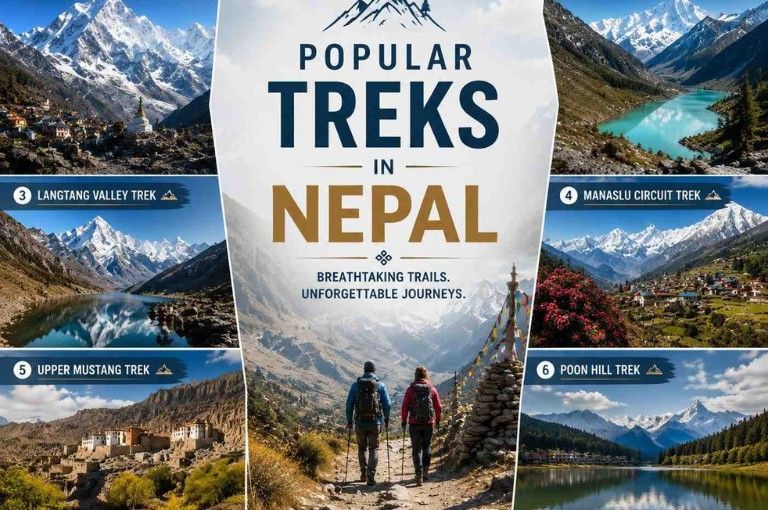
Nepal sits at the crossroads of altitude and culture like no other country on earth. Eight of the world's fourteen 8,000-metre peaks rise from its ridgelines — and between those giants, hundreds of trails wind through rhododendron forests, ancient villages, high alpine passes, and remote river valleys that few travellers ever reach.
Whether you are a first-timer looking for a teahouse trail or a seasoned mountaineer chasing a technical peak, treks in Nepal offer something that is genuinely hard to find elsewhere: raw wilderness within reach of a flight to Kathmandu.
This guide covers every major route in detail — region, difficulty grade, distance, altitude, approximate cost, and the best season to go. Read it once and you will have everything you need to choose the right trail and start planning.
Grade: Moderate
Distance: 110 km
Max Altitude: 4,130 m
Cost: $800–$1,200
Best Season: Mar–May, Oct–Nov
Grade: Moderate–Hard
Distance: 130 km
Max Altitude: 5,364 m
Cost: $1,200–$2,000
Best Season: Mar–May, Oct–Nov
Grade: Moderate
Distance: 85 km
Max Altitude: 3,660 m
Cost: $600–$900
Best Season: Mar–May, Oct–Nov
Grade: Moderate–Hard
Distance: 160–230 km
Max Altitude: 5,416 m
Cost: $900–$1,500
Best Season: Mar–May, Oct–Nov
Grade: Hard
Distance: 177 km
Max Altitude: 5,106 m
Cost: $1,000–$1,800
Best Season: Mar–May, Oct–Nov
Grade: Hard–Technical
Distance: 130+ km
Max Altitude: 6,119 m
Cost: $1,800–$3,000
Best Season: Apr–May, Oct
Grade: Moderate
Distance: 68 km
Max Altitude: 4,984 m
Cost: $700–$1,100
Best Season: Mar–May, Oct–Nov
Grade: Hard–Technical
Distance: 100+ km
Max Altitude: 6,476 m
Cost: $1,500–$2,800
Best Season: Apr–May, Oct–Nov
Grade: Very Hard
Distance: 200+ km
Max Altitude: 5,360 m
Cost: $2,500–$4,000
Best Season: Jun–Sep
Grade: Moderate
Distance: 180 km
Max Altitude: 3,840 m
Cost: $2,000–$3,500
Best Season: Mar–Nov
Grade: Moderate–Hard
Distance: 90 km
Max Altitude: 4,919 m
Cost: $800–$1,200
Best Season: Apr–May, Oct–Nov
Grade: Moderate–Hard
Distance: 160 km
Max Altitude: 5,416 m
Cost: $900–$1,500
Best Season: Mar–May, Oct–Nov
Grade: Moderate
Distance: 80–100 km
Max Altitude: 3,867 m
Cost: $700–$1,000
Best Season: Mar–May, Oct–Nov
Grade: Moderate–Hard
Distance: 120 km
Max Altitude: 3,611 m
Cost: $1,500–$2,500
Best Season: May–Jun, Sep–Oct
Grade: Easy–Moderate
Distance: 50 km
Max Altitude: 2,800 m
Cost: $400–$700
Best Season: Mar–May, Oct–Nov
Grade: Easy
Distance: 50 km
Max Altitude: 3,210 m
Cost: $400–$700
Best Season: Mar–May, Oct–Nov
Grade: Hard
Distance: 130 km
Max Altitude: 5,545 m
Cost: $1,500–$2,500
Best Season: Mar–May, Oct–Nov
The Annapurna Base Camp Trek is the most visited alpine route in South Asia — and for very good reason. The trail carries you through sub-tropical forests thick with bamboo and rhododendron, across terraced hillside farms, past the Gurung village of Chhomrong, and finally into the legendary amphitheatre ringed by Annapurna I, Hiunchuli, Machapuchare, and Gangapurna.
Duration sits between 7 and 12 days depending on acclimatisation stops and the starting point you choose. Pokhara serves as the gateway, reachable in 25 minutes by flight or around 6 hours by road from Kathmandu.
The final approach to base camp follows a narrow gorge — the landscape shifts dramatically within a single hour of walking
Sunrise from Poon Hill (an optional add-on) paints Annapurna South and Fishtail in shades of gold that no photograph fully captures
Teahouse accommodation is reliable throughout the route — no camping equipment required
TIMS card and Annapurna Conservation Area Permit (ACAP) are the only permits needed
No trekking list is complete without it. The Everest Base Camp Trek is the one route that every serious hiker keeps on a mental bucket list. The flight from Kathmandu to Lukla (one of the world's most dramatic short-haul arrivals) sets the tone immediately — from the moment you land, the Khumbu glacier system, the Sherpa villages of Namche Bazaar and Dingboche, and the towering silhouette of Lhotse and Nuptse dominate every horizon.
The classic route takes 12–14 days return. Most trekkers add an ascent of Kala Patthar (5,545 m) for a direct sightline to Everest's summit — the base camp itself sits below a ridge that blocks the view of the peak.
Namche Bazaar — the Sherpa capital — is a proper mountain town with bakeries, gear shops, and a thriving arts scene at 3,440 m
Tengboche Monastery at 3,867 m sits against a backdrop that is arguably the finest mountain panorama in the Himalaya
Sagarmatha National Park is a UNESCO World Heritage Site — wildlife spotters may see Himalayan tahr, musk deer, and red pandas
Requires a Sagarmatha National Park entry permit and a local area permit
Khopra Ridge is the Annapurna region's best-kept secret. Far fewer trekkers walk this trail compared to ABC or the Annapurna Circuit, making it ideal for anyone who values solitude over convenience. The ridge itself sits above the treeline at 3,660 m and delivers unobstructed views of Dhaulagiri, Annapurna South, and Nilgiri.
The 6–8 day loop from Nayapul or Tikhedhunga passes through oak and rhododendron forests before opening onto sweeping grassland ridges. Khair Lake (4,500 m) is a short extension often added to the route — a high-altitude sacred lake with an atmosphere unlike anything on the standard trails.
Far lower foot traffic than neighbouring Poon Hill or ABC routes
Community homestay lodges rather than commercial teahouses — more authentic cultural interaction
Khair Lake is considered sacred by local communities and sees relatively few visitors
The Annapurna Circuit Trek — often called ABC Trek Nepal in a wider sense — is one of the great long-distance walks on earth. The full loop circumnavigates the entire Annapurna massif, crossing from the lush subtropical south to the arid Tibetan plateau landscape of Upper Mustang territory in the north.
The crux is Thorong La Pass at 5,416 m, the world's highest trekking pass that sees regular foot traffic. Completing it requires an early morning start (typically 3–4 AM from Thorong Phedi) and sound acclimatisation. Manang is the usual stop for a rest day before the crossing.
Passes through seven distinct climate and vegetation zones in a single circuit
The descent into Muktinath — a Hindu and Buddhist pilgrimage site — after the pass crossing is deeply moving
Road construction has shortened the eastern section; the classic start is now typically Dharapani or Chame
Can be combined with a detour to Tilicho Lake, one of the highest lakes in the world
Manaslu — the world's eighth highest peak at 8,163 m — watches over this entire circuit from the north. The Manaslu Circuit Trek has grown steadily in reputation over the past decade as trekkers seek a less crowded alternative to the Annapurna Circuit while still accessing high-alpine drama.
The route takes 14–18 days and crosses Larkya La Pass at 5,106 m. A restricted area permit is required (approximately $100 per week from September to November, $75 for the rest of the year), and trekkers must be accompanied by a licensed guide. This makes it naturally less busy than permit-free routes.
Restricted area permit keeps commercial traffic low — you will meet far fewer trekkers than on Annapurna or Everest routes
The Tsum Valley (spiritual homeland of the Tsumba people) is a side trip of extraordinary cultural depth
Views of Manaslu's southern face from Samagaon village are among the most dramatic close-up Himalayan panoramas anywhere
Lobuche Peak sits directly on the Everest approach corridor, making it the most accessible technical climbing objective in the Khumbu. The trek to base camp follows the standard EBC route through Lukla, Namche, and Dingboche before diverging towards Lobuche village at 4,940 m.
The climb itself involves glacier travel, crampon work, and fixed-rope sections on the final summit ridge. It is graded as a trekking peak by the Nepal Mountaineering Association, though that classification understates the technical demands on the east ridge. Prior experience with crampons and ice axe is strongly recommended.
Summit views take in Everest, Lhotse, Makalu, Cho Oyu, and the entire Khumbu glacier — arguably the finest high-altitude panorama in the range
Shares approach logistics with EBC, making it a natural extension of the classic trek
A climbing permit from the Nepal Mountaineering Association is required
The Langtang Trek Nepal route is the closest major trekking destination to Kathmandu — the trailhead at Syabrubesi is only 7–8 hours by road from the capital. Despite that proximity, the Langtang Valley delivers high-altitude wilderness, Tamang cultural villages, and glacier approaches that rival any route in the country.
The valley was devastated by the 2015 earthquake and subsequent avalanche. The communities have rebuilt with remarkable resilience and today welcome trekkers warmly. Visiting carries a direct economic benefit to families who lost much during the disaster.
Kyanjin Gompa at 3,870 m is a thriving monastic village — the cheese factory here produces excellent yak cheese
Tsergo Ri (4,984 m) is a day hike from Kyanjin offering a 360-degree panorama of Langtang Lirung (7,227 m) and Gangchenpo
Gosaikunda Lakes (4,380 m) can be added as a southern extension — a sacred Hindu and Buddhist pilgrimage site
Mera Peak is the highest trekking peak in Nepal open to non-technical climbers and stands as one of the finest high-altitude objectives on the planet. The summit at 6,476 m puts you above almost every other trekking destination in the Himalaya and delivers a panorama that takes in five of the world's fourteen 8,000 m peaks simultaneously — Everest, Lhotse, Makalu, Cho Oyu, and Kangchenjunga.
The approach follows the Hinku Valley from Lukla — a remote, wild route that sees far less traffic than the Khumbu corridor. The climb is technically straightforward (glacier travel, fixed ropes) but altitude and physical conditioning matter enormously at this height.
Accessible to climbers without prior technical mountaineering experience — provided they are physically strong and well acclimatised
The Hinku Valley approach is one of Nepal's most remote and scenically rewarding wilderness corridors
Five 8,000-metre peaks visible from the summit — nowhere else in Nepal offers this count from a single non-technical high point
Upper Dolpo is the most remote trekking region in Nepal and one of the last inhabited Tibetan Plateau landscapes accessible to outsiders anywhere in the Himalaya. Access requires a special restricted area permit (approximately $500 for 10 days) and a licensed guide — regulations designed to protect both the ecosystem and the fragile traditional culture of the Dolpo people.
The region inspired Peter Matthiessen's celebrated book The Snow Leopard and was the setting for Eric Valli's documentary Caravan. The landscape is starkly beautiful: mineral-red cliffs, turquoise glacial lakes, ancient Bon monasteries perched on ridgelines above treeless valleys.
Shey Phoksundo Lake — the deepest lake in Nepal at 145 m — sits within the route and is visually extraordinary
Crystal Mountain and Shey Gompa are remote pilgrimage sites of deep cultural significance
Among the best remaining habitats in South Asia for the snow leopard
The Bon religion — pre-Buddhist shamanic tradition — survives here in near-pure form
Nepal Upper Mustang trek is one of the rare Himalayan treks that works during the monsoon months. Because the region lies in the rain shadow north of the Annapurna and Dhaulagiri massifs, July and August see clear skies even as the rest of Nepal drips.
The kingdom of Lo — a Buddhist enclave that remained sealed to outsiders until 1992 — has preserved a way of life rooted in Tibetan tradition more completely than many parts of Tibet itself. The walled capital of Lo Manthang (3,840 m) is the focal point: a medieval city of whitewashed buildings, ancient thangka paintings, and monasteries where monks still conduct ceremonies unchanged for centuries.
Restricted area permit required — around $500 for 10 days — keeping visitor numbers genuinely low
Ancient cave monasteries carved into red sandstone cliffs along the Kali Gandaki gorge
One of the few Himalayan destinations reachable by jeep track — riding options available for those who prefer not to walk the full distance
Tiji Festival (May) in Lo Manthang is among the most dramatic Himalayan ceremonies still performed today.
Tilicho Lake sits at 4,919 m in the shadow of the Annapurna massif and is widely considered one of the highest lakes in the world accessible on a trekking route. The approach from Manang — typically a side trip within the Annapurna Circuit — crosses a steep landslide-prone traverse before arriving at the lake's shore, where the views of Tilicho Peak (7,134 m) reflected in near-frozen water are genuinely breathtaking.
One of the world's highest lakes at an accessible altitude
Can be combined seamlessly with the Annapurna Circuit for a longer route.
The traverse above Khangsar is exposed — hiring a local guide for this section is strongly advised
Thorong La Pass at 5,416 m is the highest trekking pass in the world open to regular foot traffic and the dramatic centrepiece of the Annapurna Circuit. The crossing typically takes 7–8 hours from Thorong Phedi to Muktinath — a long day at altitude that demands solid acclimatisation from the nights spent in Manang and High Camp.
Weather on the pass changes rapidly. November crossings can see snow and ice. Starting before first light is standard practice — by mid-morning, afternoon winds can make the descent uncomfortable.
Highest accessible trekking pass in the world — a genuine achievement for any trekker
The descent into Muktinath reveals a completely different landscape — arid, ochre, and Tibetan in character
Tea houses at Thorong Phedi and High Camp allow for a pre-crossing overnight at altitude
Tengboche Monastery at 3,867 m is the spiritual heart of the Sherpa community and one of the most photographed locations in the entire Himalaya. The monastery sits on a promontory with a direct view of Everest, Lhotse, Ama Dablam, and Thamserku — a mountain panorama that consistently leaves first-time visitors at a loss for words.
Many trekkers reach Tengboche as part of the EBC route, but a shorter 8–10 day trek from Lukla that ends at Tengboche is a viable option for those with limited time who still want the Khumbu experience without committing to the full base camp approach.
The Mani Rimdu festival (October/November) at Tengboche draws monks from across the Khumbu for masked dances and ceremonies
Ama Dablam (6,812 m) is arguably Nepal's most beautiful mountain — Tengboche is the finest ground-level viewing point
Shey Phoksundo Lake is Nepal's deepest lake at 145 m and one of the most visually striking natural features in the entire Himalaya. The water shifts from deep cobalt to turquoise to jade depending on angle and time of day. The lake sits within Shey Phoksundo National Park — Nepal's largest national park by area.
The standard approach flies into Juphal airstrip in Dolpo and walks in via Dunai and Chhepka. The lower Dolpo permit is considerably cheaper than the Upper Dolpo permit, making this lake route accessible to a wider range of budgets without compromising on the wilderness experience.
The Pokhara Ghandruk loop is the ideal introduction to Himalayan trekking. Starting from Pokhara (or Nayapul by taxi), the trail climbs through terraced hillside farms to the large Gurung village of Ghandruk at 2,800 m — the second-largest village in the Annapurna Conservation Area and one of the best preserved traditional communities in Nepal.
The 4–5 day loop can be done without a guide by confident independent travellers. Annapurna South, Hiunchuli, and Machhapuchhre fill the northern sky from the upper village, and the community museum in Ghandruk gives real cultural depth to the walking experience.
Nepal Poon Hill Trekking is the most accessible Himalayan viewpoint trek in the country. The 4-day loop from Nayapul (near Pokhara) to Ghorepani and up to Poon Hill for sunrise is so well-established that families with children and first-time trekkers complete it regularly without guides.
The sunrise view from Poon Hill at 3,210 m takes in Dhaulagiri (8,167 m), Annapurna I (8,091 m), Annapurna South, Hiunchuli, and Machhapuchhre (Fishtail) in a single unbroken mountain wall — widely regarded as one of the finest accessible mountain sunrise viewpoints anywhere in Asia.
Low altitude — altitude sickness is very rare
Well-marked trail with reliable teahouse accommodation throughout
Rhododendron forests in March–April bloom in shades of red, pink, and white along the entire route
The Three Passes Trek Nepal is Khumbu's most challenging and rewarding non-technical long-distance route. The circuit crosses three high passes — Kongma La (5,535 m), Cho La (5,420 m), and Renjo La (5,360 m) — while also touching Everest Base Camp and Kala Patthar.
The full route takes 18–21 days and should only be attempted by trekkers with prior high-altitude experience. Each pass demands an early start, good physical conditioning, and attention to acclimatisation. The reward is a complete circumnavigation of the Gokyo Glacier system, Cho Oyu base camp, and three separate valley systems — Khumbu, Gokyo, and Hinku.
Gokyo Ri (5,357 m) on the second pass circuit offers one of the finest panoramic views in the entire Himalaya
Gokyo Lake system — a cluster of high-altitude turquoise glacial lakes — is a Ramsar-listed wetlanz
Combines EBC, Gokyo Lakes, and three high passes in one continuous circuit — the most complete Khumbu experience possible
The popular treks in Nepal span every level of experience, every type of landscape, and every budget — from the Rs.30,000 Poon Hill weekend to the multi-week Upper Dolpo expedition. What they share is an altitude, a scale, and a cultural depth that you cannot replicate anywhere else on earth.
Pick the route that matches your fitness level and the time you have. Sort your permits early. Hire a local guide who knows the trail. Start with shorter days. Drink more water than you think you need. And go.
For a fully organised Nepal tour package that handles every logistical detail — from your Kathmandu hotel to your base camp teahouse — explore the Nepal trekking options at TourTravelWorld and let the team take care of everything while you focus on the walk.
Ans: Poon Hill Trek (4 days, 3,210 m) is the best starting point. The trail is well-marked, teahouse accommodation is reliable throughout, altitude sickness is rare, and the sunrise panorama of the Annapurna range justifies the modest effort entirely.
Ans: From April 2023, the Nepal government officially mandates that trekkers hire a licensed guide for all trekking routes — including popular trails like EBC and ABC. This regulation protects trekker safety and supports local livelihoods. Some restricted-area permits (Manaslu, Upper Mustang, Upper Dolpo) have always required guided groups.
Ans: All-inclusive costs — Kathmandu flights from Delhi, permits, guide, teahouse accommodation, and meals on trail — typically range from INR 75,000 to INR 1,40,000 per person for a 14-day trip. International flights, personal gear, and travel insurance are additional. TourTravelWorld packages bundle most of these components for a single quoted price.
Ans: Yes, and it should be taken seriously. Altitude sickness can affect anyone regardless of fitness level. The standard mitigation is ascending slowly (no more than 300–500 m of altitude gain per sleep), taking rest days, staying hydrated, and never ascending if symptoms are present. Diamox (acetazolamide) can be used as a preventive measure on medical advice. Helicopters provide emergency evacuation from most trekking regions if conditions deteriorate rapidly.
Ans: Upper Mustang, Upper Dolpo, and the Manaslu northern valley all sit in the Himalayan rain shadow and remain clear during the monsoon. These routes are more expensive due to restricted area permits, but visitor numbers in July and August are a fraction of the spring and autumn peaks — ideal for trekkers who genuinely want solitude.