- By Theme
-
Destinations
-
Indian Destinations
-
International Destinations
-
- Best Places to Visit
- Packages
- Search Agents
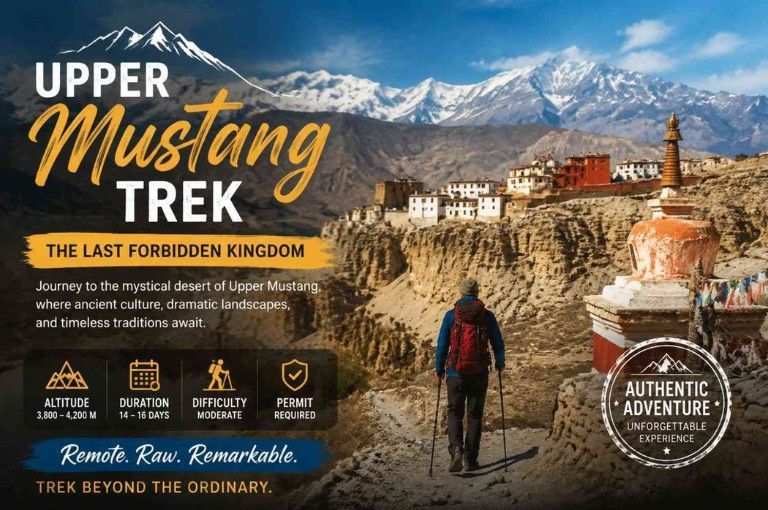
The Upper Mustang trek is one of the most unique and historically rich treks in the entire Himalayan region. Known for centuries as the Forbidden Kingdom, Upper Mustang was closed to the outside world until 1992. Even today, it remains one of the most restricted trekking destinations in Nepal, which is exactly what makes it so special.
This is not your typical green-forest Himalayan trail. Upper Mustang is a high-altitude desert plateau that looks and feels more like Tibet than Nepal. Ancient cave monasteries carved into red-and-white cliffs, walled mud-brick villages that have barely changed in 500 years, Buddhist chortens lining the wind-swept paths, and the legendary walled city of Lo Manthang — all of this awaits you on the ghost trek.
Whether you are an experienced trekker looking for something beyond the usual Annapurna or Everest Base Camp routes, or a traveller who wants to experience living culture and Himalayan history up close, Upper Mustang delivers an experience unlike anything else.
| Detail | Information |
| Trek Type | Restricted Area Trek (Permit Required) |
| Main Keyword | Upper Mustang Trek / Ghost Trek |
| Total Distance | Approximately 180–210 km (round trip) |
| Duration | 10 to 14 days (standard: 14 days) |
| Maximum Altitude | Lo Manthang at 3,840 m (Thorong La variant: 5,416 m) |
| Difficulty | Moderate to Moderate-High |
| Best Season | March to November (April–June & Sep–Oct ideal) |
| Start & End Point | Jomsom (fly from Pokhara) |
| Trek Region | Mustang District, Gandaki Zone, Nepal |
| Permit Required | Yes — ACAP + Restricted Area Permit (RAP) |
Suitable For | All nationalities including Indians |
Timing your Upper Mustang trek correctly makes a massive difference to your experience. Unlike most Himalayan treks that shut down during the monsoon, Upper Mustang is one of the very few places in Nepal that is actually great to visit during June, July, and August. This is because the Annapurna and Dhaulagiri ranges act as a natural barrier, blocking most of the monsoon rain from reaching the Mustang plateau.
Spring (March to May): This is one of the two peak seasons. Temperatures are comfortable, the skies are clear, and wildflowers bloom across the lower valleys. March can still be cold at night, but April and May offer some of the best trekking conditions. Lo Manthang's Tiji Festival (usually in May) is a three-day masked dance ceremony and one of the most spectacular cultural events in the Himalayas.
Monsoon (June to August): Surprisingly good for Upper Mustang. Because the rain shadow effect keeps this region dry, trekking in July and August is possible and often pleasant. The landscape turns a shade greener than usual, and the trails are far less crowded. This is the best time to avoid tourist rush.
Autumn (September to October): The second peak season. Post-monsoon skies are crystal clear, offering stunning mountain views. October especially offers near-perfect trekking weather with stable temperatures and excellent visibility. This is when most Indian trekkers plan their trip.
Winter (November to February): Not recommended. Snow blocks the higher passes, temperatures at Lo Manthang can drop to -20 degrees Celsius, and several teahouses close for the season. Experienced high-altitude trekkers may attempt it, but it requires extra preparation.
Recommended best time: April, May, September, and October. The Tiji Festival window in May is especially worth timing your trip around.
The total Upper Mustang trek distance (round trip, Jomsom to Lo Manthang and back) is approximately 180 to 210 kilometres depending on your exact route variations and side trips. Here is a rough per-day distance breakdown:
| Day | Route | Distance(Approx) |
Day 1 | Fly Pokhara to Jomsom, trek to Kagbeni | 8–10 km |
Day 2 | Kagbeni to Chele | 16 km |
Day 3 | Chele to Syangboche | 16 km |
Day 4 | Syangboche to Ghami | 18 km |
Day 5 | Ghami to Tsarang (Charang) | 14 km |
| Day 6 | Tsarang to Lo Manthang | 10 km |
| Day 7 | Explore Lo Manthang (rest day) | 5–8 km walking |
| Day 8 | Lo Manthang to Drakmar | 16 km |
| Day 9 | Drakmar to Ghami (alternate route) | 15 km |
| Day 10 | Ghami to Kagbeni | 22 km |
| Day 11 | Kagbeni to Jomsom | 8 km |
| Day 12–13 | Buffer / Muktinath side trip | Varies |
| Day 14 | Fly back to Pokhara | ---------- |
Note: Distances are approximate and can vary based on trail conditions and individual pace. Most days involve 5 to 7 hours of walking.
Understanding the altitude profile of the Upper Mustang trek is important for planning your acclimatisation properly. Unlike Everest Base Camp or Annapurna Circuit, Upper Mustang does not push into extreme altitudes, but it is still a high-altitude trek that requires proper adjustment.
The maximum altitude on the standard route is Lo Manthang at 3,840 metres. This is well within safe trekking range for most healthy adults, but altitude sickness is still a real concern. The key risk areas are the passes between Kagbeni and Lo Manthang, particularly Nyi La (4,010 m) and Marang La (4,230 m) on some alternate routes.
Important altitude advice: Ascend slowly, drink at least 3 to 4 litres of water per day, avoid alcohol at high altitude, and carry Diamox (acetazolamide) as a precaution after consulting your doctor.
This is one of the most important sections to understand before you book anything. Upper Mustang is a Restricted Area, which means you cannot trek here independently without a special government permit. All trekkers, regardless of nationality, must have the following:
This is the main permit unique to Upper Mustang. It is officially called the Upper Mustang Restricted Area Permit and is issued by the Department of Immigration, Nepal.
Cost: USD 500 per person for the first 10 days
Additional days: USD 50 per person per day beyond 10 days
Mandatory: You MUST be accompanied by a registered Nepali trekking guide at all times
Minimum group size: 2 people (solo trekkers need to join a group or hire a partner)
This permit covers the area beyond Kagbeni, up to Lo Manthan.
Cost: NPR 3,000 per person (approximately USD 22-25)
This covers the lower Mustang area and is required alongside the RAP
Available at ACAP offices in Kathmandu, Pokhara, or Jomsom
Cost: USD 20 for individual trekkers, USD 10 for trekkers via an agency
Required for all trekkers in Nepal
Obtainable in Kathmandu or Pokhara
| Permit | Cost (Per Person) | Validity | Where to Get |
| Restricted Area Permit (RAP) | USD 500 (first 10 days) | 10 days minimum | Dept.of Immigration, KTM or Pokhara |
| ACAP | NPR 3,000 (~USD 22)
| Trip duration | ACAP offices Jomsom |
| TIMS Card | USD 10–20 | Trip duration | TAAN offices,Kathmandu/ |
Important: All permits must be checked at multiple police checkposts along the route. Keep your documents in a waterproof pouch at all times. The permit process requires passport-size photos (carry at least 4-6 copies).
The Upper Mustang trek is one of the more expensive treks in Nepal, primarily because of the high Restricted Area Permit fee. Here is a detailed breakdown of all costs involved:
Note: These figures are per person estimates. Costs can vary based on group size, travel dates, season, and the trekking operator you choose. Flying into Jomsom is strongly recommended over driving, as the flight significantly reduces travel time and physical fatigue.
Good news for Indian travellers: Indians do not need a visa to enter Nepal, which saves approximately USD 30 to 100 compared to trekkers from other countries. However, all permit costs remain the same — the Restricted Area Permit, ACAP, and TIMS are not discounted for Indian nationals.
No visa required — Indian passport holders enter Nepal on their Indian passport or voter ID card
Direct flights from Delhi, Mumbai, and Kolkata to Kathmandu or Pokhara are available
From Pokhara, take the 25-minute mountain flight to Jomsom to begin your trek
Carry sufficient Indian currency — exchange to Nepali Rupees in Kathmandu or Pokhara (1 INR = approx. 1.6 NPR)
ATMs are not available beyond Jomsom — withdraw enough cash before you leave
Indian mobile SIM cards may not work in remote areas — buy a local SIM in Kathmandu.
| Category | Estimated Cost (INR approx.) |
| Delhi–Kathmandu/Pokhara flights (return) | 15,000–30,000 |
| All trekking permits combined | 45,000–50,000 |
| Guide + porter charges | 40,000–55,000 |
| Jomsom flight (return) | 20,000–25,000 |
Accommodation + food(14 nights) | 25,000–35,000 |
| Total (Approximate) | 1,45,000–1,95,000 per person |
These are rough estimates and will vary significantly based on when you book, your choice of operator, group size, and personal spending habits.
Understanding the Upper Mustang trek map helps you visualise how the trail flows through this extraordinary landscape. The entire route follows the Kali Gandaki River valley northward from Jomsom, climbing through increasingly arid terrain until you reach the walled city of Lo Manthang.
Jomsom to Kagbeni: The gateway. Kagbeni sits at the confluence of the Kali Gandaki and Jhong rivers and marks the official entry point into the restricted Upper Mustang zone. The landscape here begins its dramatic shift from green valley to ochre desert.
Kagbeni to Chele: The trail climbs through wind-eroded cliffs and enters the arid Mustang landscape. Jharkot and Khinga villages are passed en route.
Chele to Samar and Syangboche: This middle section features some of the trek's most dramatic terrain — deep gorges, narrow ridgelines, ancient cave dwellings carved into cliff faces, and the village of Samar with its famous juniper grove.
Syangboche to Ghami: Crosses the Nyi La Pass (4,010 m), one of the high points of the route. The large white chorten at Ghami is one of the most photographed spots on the trek.
Ghami to Tsarang: Tsarang (also called Charang) is a medieval village with a 15th-century fortress and a monastery library containing ancient Tibetan manuscripts.
Tsarang to Lo Manthang: The final approach to the walled capital. The white-walled city of Lo Manthang, home to the King of Lo, is visible from a ridge before you descend to its gates. It is genuinely one of the most remarkable sights in the Himalayan world.
Most trekkers return via the same route (Jomsom to Lo Manthang reversed), which takes 5 to 6 days. Some operators offer alternate return trails via Luri Gompa, Drakmar, and Nyamdo, which add variety to the experience. A circuit route connecting to Muktinath is also available for those with extra days.
The 14-day Upper Mustang trek itinerary is the most popular format, giving you enough time to acclimatise properly, explore Lo Manthang thoroughly, and include a Muktinath side trip. Here is a complete day-by-day plan:
Day 1: Kathmandu / Pokhara — Travel Day (820 m) | No walking
Day 2: Fly Pokhara to Jomsom → Trek to Kagbeni (2,720–2,810 m) | 2–3 hrs
Day 3: Kagbeni to Chele (2,810–3,050 m) | 5–6 hrs
Day 4: Chele to Samar (3,050–3,530 m) | 5–6 hrs
Day 5: Samar to Syangboche (3,530–3,800 m) | 4–5 hrs
Day 6: Syangboche to Ghami via Nyi La Pass (3,800–3,520 m) | 6–7 hrs
Day 7: Ghami to Tsarang (Charang) (3,520–3,560 m) | 4–5 hrs
Day 8: Tsarang to Lo Manthang (3,560–3,840 m) | 5–6 hrs
Day 9: Lo Manthang Exploration Day (3,840 m) | 4–5 hrs
Day 10: Lo Manthang to Drakmar via Chhoser (3,840–3,810 m) | 5–6 hrs
Day 11: Drakmar to Ghami (alternate route) (3,810–3,520 m) | 5–6 hrs
Day 12: Ghami to Kagbeni (3,520–2,810 m) | 6–7 hrs
Day 13: Kagbeni to Muktinath and back to Jomsom (2,810–3,800–2,720 m) | 5–6 hrs
Day 14: Fly Jomsom to Pokhara — Return Journey (2,720 m) | No walking
Days 1–2: Arrival and logistics. Use Day 1 to rest in Kathmandu or Pokhara and sort your permits. The 25-minute Pokhara-Jomsom flight over the Annapurna and Dhaulagiri ranges is breathtaking. Kagbeni is a charming medieval village — explore the Kag Chode Thupten Sampheling Monastery.
Days 3–5: The trail enters increasingly alien terrain as you climb toward Samar and Syangboche. Watch for fossils in the Kali Gandaki riverbed (one of the world's oldest river gorges), and visit the cave complexes above Chele.
Days 6–7: The crossing of Nyi La Pass offers panoramic views of Nilgiri North, Tilicho Peak, and Bhrikuti. Ghami village has an enormous white chorten that spans the entire path. Tsarang's 15th-century dzong (fortress) is a highlight.
Days 8–9: Arriving at Lo Manthang is a moment you will not forget. The walled city is home to around 1,000 residents and contains the Jhampa, Thugchen, Choede, and Chodak monasteries, and the Royal Palace of the King of Lo. A full exploration day is essential.
Days 10–12: The return via alternate trails through Chhoser and Drakmar reveals spectacular cave monasteries including Luri Gompa (14th-century cave shrine with Tibetan-style murals) and Ghyakar village.
Days 13–14: The Muktinath Temple — sacred to both Hindus and Buddhists — is a powerful concluding stop. The 108 water spouts, eternal flame, and Budhanilkantha Temple here attract pilgrims from across South Asia. Return flight from Jomsom.
Upper Mustang sits in the northern reaches of the Mustang District in Nepal, bordering Tibet. It forms part of the greater trans-Himalayan trekking corridor that includes some of Nepal's most iconic routes.
| Trek | Max Altitude | Duration | Permit Required | Unique Feature |
| Upper Mustang Trek | 3,840 m (LoManthang) | 10–14 days | Yes (USD 500) | Forbidden Kingdom, Tibetan culture |
| Annapurna Circuit | 5,416 m (Thorong La) | 14–21 days | ACAP only | Diversity of landscape and culture |
| Everest Base Camp | 5,364 m (EBC) | 12–16 days | Sagarmatha NP permit | Iconic, Sherpa culture |
| Langtang Valley | 3,870 m | 7–10 days | LANP permit | Closest to Kathmandu |
Manaslu Circuit
| 5,106 m (Larkya La) | 14–18 days | Restricted Area | Remote,undeveloped |
Upper Mustang is distinctive because it offers a genuinely restricted and preserved experience that the more popular routes cannot. The combination of Tibetan Buddhist culture, ancient fortified villages, cave monasteries, and a high-altitude desert landscape makes it a one-of-a-kind route in the Nepalese Himalayas.
Here are practical, experience-based tips to help your Upper Mustang trek go smoothly:
Book your Restricted Area Permit well in advance, especially for May (Tiji Festival period) and October — these dates fill up quickly
Hire a guide through a licensed and reputable trekking agency — it is mandatory, and a good guide dramatically improves your experience
Train physically for 4 to 6 weeks before departure — the daily walks are 5 to 7 hours long on rough terrain
Get a comprehensive travel insurance policy that covers high altitude (at least up to 4,500 m) and emergency helicopter evacuation
Carry all necessary prescription medications from home — pharmacies in Lo Manthang are limited
Warm sleeping bag rated to at least -10 degrees Celsius
Layered clothing system — temperatures swing from 20 degrees C during the day to below zero at night
Sturdy, broken-in trekking boots with ankle support
High-quality sunscreen (SPF 50+) and UV-blocking sunglasses — the sun at altitude is intense
Trekking poles — highly recommended for the steep passes and descents
Portable solar charger or power bank — electricity is unreliable in remote villages
Water purification tablets or a quality filter — always treat water beyond Jomsom
Dust mask or buff — Mustang is extremely windy and dusty, particularly in spring
Always register at police checkposts — there are 5 to 6 along the route and your permits will be checked at each one
Do not photograph locals, monasteries, or religious artefacts without asking permission
Respect the clockwise circumambulation rule around chortens and mani walls (always pass with the stone on your right)
Walk slowly, rest frequently, and do not try to cover too much distance on the first three days
Tell someone your daily plan — mobile connectivity is extremely limited or nonexistent for much of the route
Muktinath is considered one of the 108 Vishnu Kshetras and is deeply sacred — dress and behave respectfully
Carry sufficient Nepali Rupees in cash — the last ATM is in Jomsom
Budget an extra 15,000 to 20,000 NPR for emergencies
Ncell SIM cards offer the best (though still limited) network coverage on this route
Some teahouses now have WiFi, but expect it to be slow and unreliable
Absolutely, without question. The Upper Mustang trek is one of the most rewarding and genuinely rare trekking experiences available anywhere in the world. The combination of permit restriction, preserved culture, extraordinary landscape, and historical depth makes it a trek that stays with you long after you return home.
Yes, the Upper Mustang Trek Permit cost is higher than most Nepal treks. Yes, logistics require more planning. But what you get in return — a living medieval kingdom, sky-blue skies over red-cliff desert, and monasteries that feel untouched by time — is simply not available anywhere else.
Whether you are travelling for 10 days or choosing the full 14-day Upper Mustang trek itinerary, this is a trek that rewards patience, preparation, and curiosity. Go in May for the Tiji Festival, or in October for the best mountain views. Either way, you will not be disappointed.
Plan Your Upper Mustang Trek with TourTravelWorld
If you are looking to explore this extraordinary destination with a trusted operator, TourTravelWorld offers well-crafted Nepal Tour package options that cover every aspect of the Upper Mustang experience — from permit processing and guide arrangements to accommodation bookings and airport transfers. With deep expertise in Himalayan travel and a dedicated team for Indian travellers, TourTravelWorld takes the complexity out of restricted-area trekking so you can focus entirely on the journey.