India >> South Zone >> Tamil Nadu >> Kanyakumari
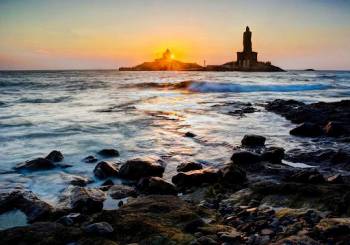
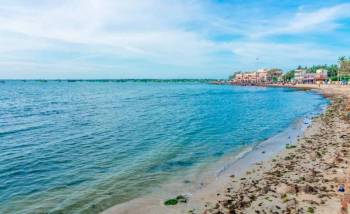
About Kanyakumari Kanyakumari the 'Land's End ' of India is at the confluence of the Indian Ocean, Bay of Bengal and Arabian Sea. It is famous for its peaceful and stunning natural environment and the multicoloured sand is a unique feature of the beach. It is also famous as a pilgrimage for Hindus. The sight of Sunrise and Sunset at Cape Comorin is an unforgettable experience.
| Area: | 25.89 sq.kms.
|
| Best Time to Visit: | Throughout the year; preferably October to March
|
| Climate: | Being close to the sea and the Equator, the temperature does not vary much. Summers are hot and winters warm.
|
| Main Languages: | Tamil, Malayalam and English
|
| Population: | Approx. 20,000
|
| Temperature: | Summer - Max: 34.8 Min: 21.6 Winter - Max: 33 Min: 20.4
|


Other Attractions In & Around


|
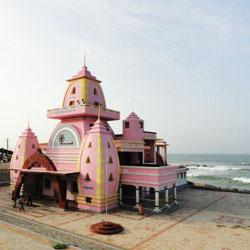
Gandhi Memorial
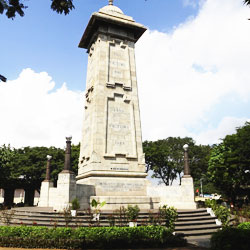
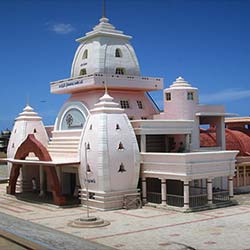
Built in memory of Gandhiji, the memorial is a good example of modern architecture. Every year on Gandhiji's birthday 2nd October, the sun's rays fall at the exact spot where the urn was displayed before immersion. It resembles an Orissan temple.
Built in memory of Gandhiji, the memorial is good example of modern architecture. Here, the last remains of Gandhiji are kept for public viewing. Next to the Kumari Amman Temple, this striking memorial stored the Mahatma's ashes until they were immersed in the sea.. Timings : It's open daily from 7 am to 12.30 pm and 3 to 7 pm. TOP
|


|
Kumari Amman Temple
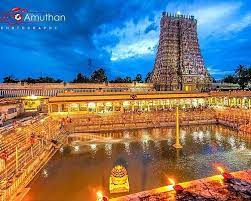
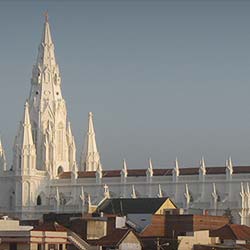
Picturesquely situated overlooking the shore this temple is dedicated to Parvathi as Devi Kanya- the Virgin Goddess-- who did penance to obtain the hand of Lord Siva. The bright diamond nose ring of the Goddess is world famous.
The temple is situated on the beach and there are long queues to enter this temple. Picturesquely situated overlooking the shore, this temple and the nearby ghat attract pilgrims from all over India to worship and to bathe. Only Hindus are allowed in this temple.. The Legend : The legend of this temple is as romantic as the place itself. According to legend, Devi did penance here to secure Lord Siva's hand in marriage. When she was unsuccessful, she vowed to remain a virgin (kanya).
In one of her incarnations, Parvathi Devi was born as Kanyakumari Devi. She performed penance to wed Lord Siva. The asura king Bana, had gained the boon that only a virgin girl could kill him and this was the reason for this incarnation of Devi. Arrangements were made for the wedding and Siva had started from the nearby Thanumalayan Temple at Suchindram. The Devas had to stop the wedding from taking place, if the Devi was to kill the asura. So they tricked Lord Siva by crowing like a cock and believing that the auspicious time had passed He returned to Suchindram. The Devi vowed to remain a virgin and thus was able to kill the asura Bana.
At one time the shifting sands at the shores of Kanyakumari were believed to be multi-hued as a result of the coloured rice that was sprinkled by approving gods over the couple at their wedding.
Equally fascinating is the story about the diamond nose stud worn by the goddess. It was a naga mani (from a cobra) and was so bright that some ships were misguided and shipwrecked near the shore. So great was the threat of the reflected light from the nose-stud to the unsuspecting ships that the door on the side facing the sea had to be closed for ensuring the safety of the ships.
The eastern gate to the temple is still closed except during festival days. Devotees enter the temple through the northern gate. Two diamond nose rings donated by the Maharajah of Trivandrum adorns the idol of the Devi now who is covered in sandal paste. TOP
|


|
Suchindram
13 kms. from the city, this temple town is famous for its musical pillars and huge Hanuman statue. The Thanumalayan temple is dedicated to the Lords Siva, Vishnu and Brahma and is a repository of art treasures.
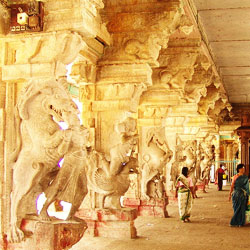
This temple, at suchindram, is noted for its 'musical' columns and its impressive 3 m tall statue of Hanuman, the monkey god. Musical pillars and huge Hanuman Statue are the proof of the artistic skill of the time. Two chief attractions are the gigantic Hanuman and Vainayaki (Female Vinayaka) relief carving.
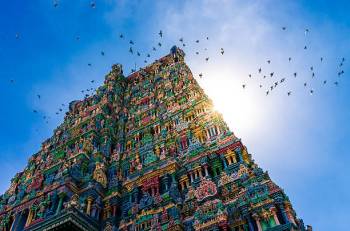
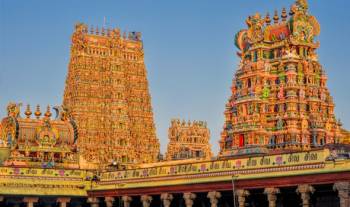
Thanumalayan temple is dedicated to a deity who is the representation of the combined forces of Siva, Vishnu and Brahma. The temple has a beautiful gopuram and inscriptions of the 9th century are found in this temple.
Lord Siva started from this place to wed Kanyakumari Amman, but returned when he heard the cockcrow.. Interesting story : Sage Atri lived here with his wife Anasuya, who was considered a chaste woman. Lords Siva, Vishnu and Brahma visited her once in the absence of her husband to test and prove her chastity to the world. They came as sanyasis asking alms and bade Anasuya to feed them, but without any dress. But Anasuya was not baffled and she just prayed to her husband and transformed the Lords into three small babies and fed them. As a result, Siva, Vishnu and Brahma are worshipped here. Location : 13 kms. from the city. TOP
|


|
Tiruchendur
The temple located on the shore of the Bay of Bengal is one of the six abodes of Lord Subramanya, drawing a perennial stream of devotees. It is about 85 kms. from Kanyamunari and is also connected by rail from Tirunelveli Junction.
The temple overlooking the singing sea is an inspiring sight.
It is situated on the Kanyamumari - Tuticorin - Rameswaram bus route. This temple is built close to the seashore. Lord Muruga vanquished the asura Surapadman, with his army in Veeramahendrapuram.
Tiruchendur is the Aarupadai veedu shrines of Murugan, enshrining Senthilandavar. It has been venerated by the Tamil Sangam Period work Tirumurugatruppadai and by 83 Tiruppugazh hymns of Arunagirinathar. It is one of the most visited shrines in Tamilnadu.
The temple tower and the sculptures of the temple are worth seeing. It is also ideal for see bathing. The temple is one among the six abodes. Lord Subramanya (or Lord Muruga) after defeating Soorapadma came to this place and offered his prayers to Lord Siva. That victory is still celebrated by the pilgrims during the Tamil Month Apiece as a festival.
Tiruchendur is a popular pilgrim centre. The temple here is built on a rock close to the seashore, which is a special significance. This is perhaps due to Lord Muruga's divine mission to vanquish the demon Surapadman and his mighty army who encamped in the mid ocean fortress off Veeramahendrapuram near Tiruchendur.
To commemorate the Lord's victory over the demon, a festival - Skanda Sashti is celebrated at Tiruchendur as well as in other shrines of Lord Muruga for six days. On the concluding day, the epic battle Surasamhara (annihilation of Surapadman) is re-enacted in all its true form witnessed and cheered by thousands of devotees.. The origin of Subramanya : It is interesting to know the origin of Subramanya, or Karttikeya or Muruga, or Shanmukha as his votaries differently call him. The Puranic account runs as follows:
Karttikeya desired to worship his father Siva. As there was no Siva shrine there, Maya, the celestial architect, constructed the temple of Siva in the sea front and Subramanya worshipped there. This is said to be the origin of this holy abode of Lord Kumara. Each temple has its own sanctity, yet there is difference in degree. This shrine of Tiruchendur is believed to be most liked by Subramanya and has been given the second place among His shrines in the Skanda puranam, no doubt the first being Palani.
According to the physiographical five-fold division of land, Muruga is assigned the hill country, Kurinji, and his shrines invariably situated amidst mountains or forests as such places are dear to him. The deviation from the usual, in this case, is due to the mission that he undertook on behalf of the devas.
Just as Surapadman was troubling the devas in the South, another demon named Tarakasura, brother of Surapadman, was troubling them in the North. Muruga killed Tarakasura at Cambay, situated between Mahe and Sabaramati rivers, known in olden days as Kambhat, and erected a pillar of victory (Sthamba) in commemoration of his success.
Similarly the Tiruchendur temple also may be considered as a commemoration of the defeat of Surapadman in the south. From here war started against Surapadman and his brother that lasted for five days, when all the sons, the brother and the mighty hordes of the demon gave battle to Subramanya at sea and in the air and were finally vanquished. To reach : It can be reached from Madras, Madurai, Tirunelveli, Courtallam and Kanyakumari by bus. Nearest airport is in Madurai or Thiruvananthapuram. Train can also reach it. Interesting facts : About 200 yards south of this temple, at the seashore, there is a rare natural phenomenon inside a square. It is a well 14 sq. feet in area with a flight of 34 steps. Inside this, there is another small well, one square foot in extent and seven feet deep. The water in the smaller well is crystal clear and sweet to taste whereas that in the bigger well is highly sulphurous in smell and brackish. It is said that when Shanmukha’s troops returned to the shore after vanquishing Surapadman at Mahendragiri, they felt thirsty and wanted fresh water. To quench their thirst, Shanmukha planted his Vel on this spot and caused fresh water to gush out. Do you know? : Originally the temple was of a very modest construction, but during the course of about 1000 years different Pandya and Chera kings, their vassals, and the wealthy people of the locality, as a result of which the present gigantic structure has grown up, made many additions and alterations. "Tiruchendur’ means a sacred and prosperous town of victory. The temple was originally constructed on the sandstone reefs of the beach, but due to corrosion by the sea, the stone began to disintegrate. A noble Sanyasin, Mouna Swami, took up the renovation work and it was followed tip by two others in succession for 72 years and the noble edifice of three prakarams was constructed anew in black granite stone.
The Gopuram is on the west (instead of being in the east as usual because of the sea) and is a gigantic structure of nine storeys with a height of 137 feet, commanding a good view of the surrounding area. History, states that the Desikamurtiswami, an Odukathu Tambiran of the then Head or Maha Sannidhanam of Tiruvaduturai Mutt, Tanjore District constructed the Gopuram. Information for tourists : The surging cool tides of the sea wash the foot of the temple. There is no other shrine in the State, with such a beautiful natural setting. The Gulf of Mannar is shallow and is safe for sea bath.
Before entering the temple pilgrims either wash their feet or take a bath in the sea. The bathing contains nine Teerthams according to the Sthalapuranam and a bath in any of these Teerthams is believed to confer miraculous benefits on a devotee. It is said that when Brahma lost one of his five heads, due to the anger of Siva, he came to this Teertha and took a holy dip in it and had his head restored. Similarly Angasundari, a Pandyan princess born with the face of a horse, was blessed with a beautiful face after a bath at Vathararamba Teertham. TOP
|


|
Vattakottai
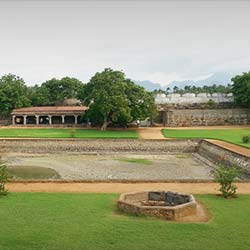
This circular 18th-century fort overlooking the sea is located about 6 kms. from Kanyakumari built by the Dutch. The sea here is calm and ideal for bath.. Location : 6 kms. from Kanyakumari. TOP
|


|
Vivekananda Memorial
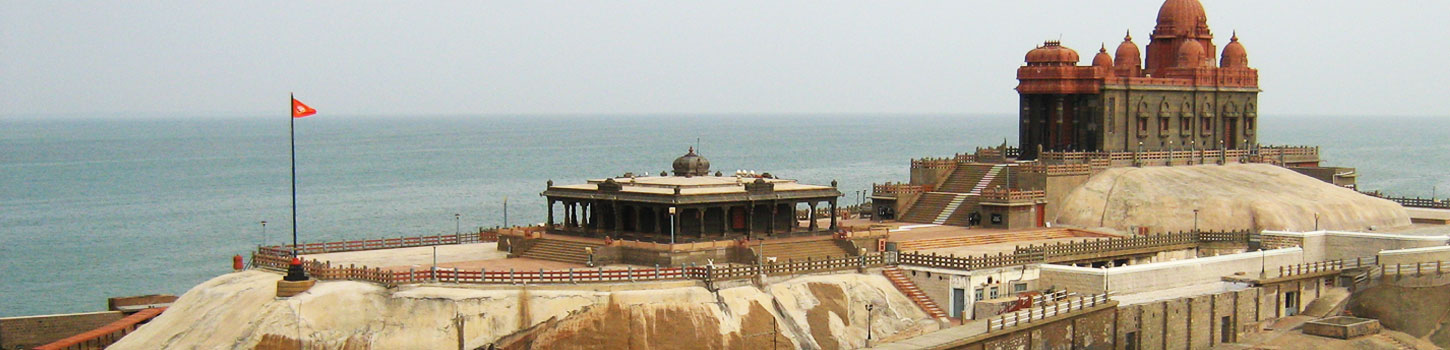
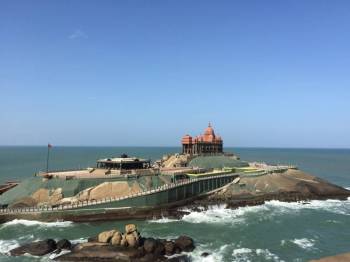
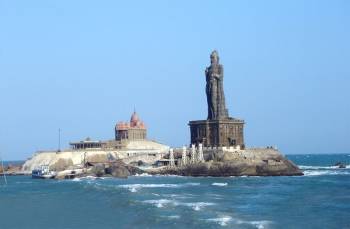
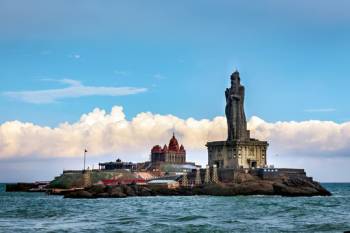
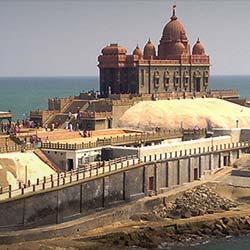
On the seaside is built a large, beautiful memorial dedicated to the Indian philosopher, Swami Vivekananda, who is said to have meditated here before setting out as one of India's most important religious crusaders. There is a Dhyana Mandapam for one to sit in a serene atmosphere and meditate.
This memorial is on two rocky islands projecting from the sea about 400 m offshore. The Indian philosopher Swami Vivekananda came here in 1892. The memorial has been built on the Vivekananda Rock where the great philosopher - guide Swami Vivekananda went into meditation that transformed him into one of the most charismatic spiritual leaders of this century. The mandapam, standing here in his memory, was built in 1970 reflecting architectural styles from all over India.
Kanyakumari is famous for Vivekananda's rock, a huge stone rising out of the sea. It now houses the statue of Vivekananda with his memorial. Not surprisingly, Kanyakumari is a popular destination for Vivekananda's followers, so there are many Bengalis here, and some Bengali hotels and restaurants too.. Timings : The Memorial is opened from 7 am to 5 pm and is closed on Tuesday. The rock and the memorial : Two rocks reach out of the ocean, southeast of the Kumari Amman temple.
Both these rocks are fine places from where one gets a view of the land's end of India. One of these is Sri Padaparai, where the footprints of the virgin goddess are seen. Swami Vivekananda sat in meditation on this rock before his journey to the West to spread Hinduism in 1892.
There is a meditation hall and its polished floors reflect the huge metal statue of Vivekananda. The sacred 'OM' glows in green on the wall.
Sri Padaparai (Padam-feet; Parai - rock) Mandapam is a shrine erected at the spot where the footprint of the Goddess is seen.
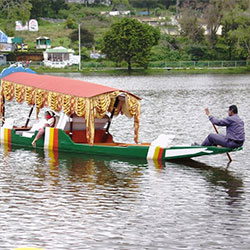
Poompuhar Shipping Corporation operates frequent ferry services from the shore to the rock memorial at regular intervals.
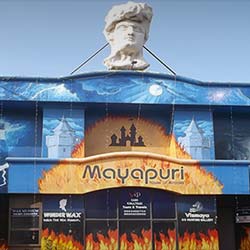
The merger of three seas- Bay of Bengal, Arabian Sea and Indian Ocean can be seen from these rocks. While looking at the horizon, one gets a feeling of nature spraying various colors on water. Though the structure is well constructed, it has been very badly maintained.
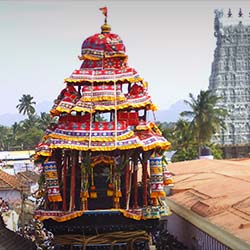
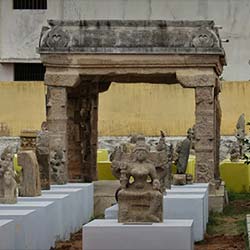
A museum quite close to the temple, by name Wondering Monk gives more details on the teachings of Swami Vivekananda. TOP
|


|


Related Cities

|