- By Theme
-
Destinations
-
Indian Destinations
-
International Destinations
-
- Best Places to Visit
- Packages
- Search Agents
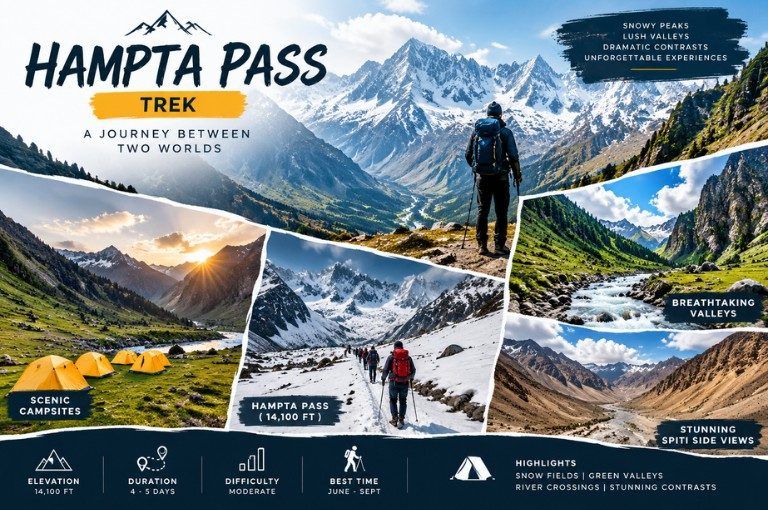
Somewhere between the pine-covered slopes of Kullu and the stark brown desert of Lahaul-Spiti, there is a single day of walking that changes everything around you. One morning you are pitching your tent among wildflowers and grazing sheep, and by afternoon the next day you are staring at a barren, moon-like valley that feels like a different planet altogether. That single transition is what makes this trek one of the most talked-about walks in the Indian Himalayas. It is short enough for a long weekend, dramatic enough to humble seasoned trekkers, and varied enough that no two days on the trail look the same. If you have been putting off your first proper Himalayan trek, this guide walks you through everything you need to know before you lace up your boots.
Part of the appeal lies in how accessible the whole experience is compared to other high-altitude crossings in the region. You do not need weeks of leave from work, you do not need mountaineering certification, and you do not need to travel to a remote corner of the country just to reach the starting point. A short drive from Manali, a well-marked trail, and four to five days on foot are enough to deliver an experience that feels genuinely remote and wild. That combination of accessibility and drama explains why this particular route consistently ranks among the most searched and most recommended treks for anyone based out of Delhi, Chandigarh or anywhere within a reasonable travel radius of Himachal Pradesh, and why so many first-timers choose it as their introduction to serious mountain trekking.
At its heart, Hampta pass is a mountain pass at roughly 4,270 metres (14,100 feet) that links the green, forested Kullu valley with the arid high-altitude terrain of Lahaul-Spiti. What sets it apart from most treks of similar difficulty is the sheer contrast packed into just four or five days. You begin in birch and maple forests, cross alpine meadows carpeted with wild flowers, camp beside a glacial stream, and then climb over a narrow, boulder-strewn pass before descending into a landscape of rock, scree and cold desert air. Few walks anywhere in the country compress this much visual drama into such a short distance, and that is exactly why a Hampta trek keeps appearing on every serious trekker's shortlist, whether they are attempting their first high-altitude crossing or their tenth.
The trail is officially classified as moderate, which makes it accessible to reasonably fit beginners while still offering enough of a challenge to keep experienced trekkers engaged. There is no technical climbing involved, but there is a genuine sense of achievement in standing at the pass itself, wind whipping around you, glaciers on one side and the Spiti desert unfolding on the other.
The starting point for most itineraries is the small settlement of Jobra, roughly a 45-minute drive from Manali, which itself is the easiest access town for this region of Himachal Pradesh. From Jobra, the trail follows the Rani Nala stream through dense forest before opening out into the meadows of Chika and then Balu Ka Ghera, a wide grassy plain that serves as the last major camp before the climb to the pass. Understanding the Hampta pass trek route in advance helps enormously with pacing, since the terrain shifts from gentle forest paths to steep moraine and loose rock in a fairly short span.
Choosing the right Hampta pass trek location for your base matters too. Manali functions as the logistical hub for almost every group heading out, offering last-minute gear rentals, acclimatisation time, and easy onward transport to Jobra. After crossing the pass, the descent leads down to Shea Goru and finally to Chatru in the Lahaul-Spiti region, from where many trekkers continue on to Chandratal Lake, a pristine high-altitude lake that pairs beautifully with this route as a combined itinerary. Anyone who wants to trek the Himalayas Hampta pass style, meaning to cover two dramatically different regions in one trip, will find this pairing hard to beat.
A well-planned Hampta pass itinerary typically runs across four to five days, and having a rough day-by-day structure in mind before you start makes the whole experience far less overwhelming.
Day 1: takes you from Manali to Jobra by road, followed by a moderate three to four hour walk through forest to reach Chika, the first campsite beside a rushing stream. This day is mostly about settling into trail life and adjusting to the altitude gain.
Day 2: covers Chika to Balu Ka Ghera, a longer stretch that gains noticeable elevation as the trail moves out of the tree line into open meadows. This is usually where the Hampta pass base camp is set up, since it sits close enough to the pass to allow an early start the next morning while still being at a manageable altitude for rest.
Day 3: the crossing day, is the heart of the entire Hampta pass trek itinerary. Trekkers leave the base camp before sunrise to reach the pass while the snow is still firm, spend a short but unforgettable stretch of time at the top taking in views of both valleys, and then make a steep, careful descent to Shea Goru on the Lahaul-Spiti side. The change in scenery on this single day is what most people remember years later.
Day 4: continues down to Chatru, a small transit point where the road to Manali or onward to Chandratal begins. Many groups use this day to either exit toward Manali or extend their trip with a side visit to the lake.
Day 5: when included, is reserved for the return journey to Manali via Rohtang or Atal Tunnel, closing the loop on the trek.
This structure is the backbone of most fixed-departure Hampta pass trek package options available through trekking operators, though the exact number of days, campsite names and route order can vary slightly depending on weather, snow conditions and the operator's own planning.
The pass itself sits below the shadow of the towering Deo Tibba and Indrasan peaks, both of which dominate the skyline for much of the trek. Trekkers eyeing the surrounding Hampta pass peak formations often extend their trip with a short acclimatisation walk toward Deo Tibba base camp before attempting the main crossing, since the extra altitude exposure genuinely helps with the final push. Standing at the top of the pass, with prayer flags snapping in the wind and glaciers visible in every direction, it becomes obvious why so many trekkers describe the crossing as close to a Hampta pass invincible feeling, a trail that seems to demand everything from you and then rewards you completely for the effort.
The descent from the pass toward Shea Goru is where the landscape transformation feels most dramatic, and it is often the part of the trek that photographs least prepare travellers for. Within a couple of hours of walking, the green meadows and glacier views give way entirely to the browns, ochres and pale golds typical of the Lahaul-Spiti side, with jagged rock faces replacing the forested slopes left behind on the Kullu side of the mountain. Many trekkers describe this stretch as feeling like stepping into an entirely different country, and it is this contrast, more than the altitude or the physical effort, that tends to stay with people long after the trip ends.
Timing shapes almost every part of the experience on this route, and choosing the right season matters as much as choosing the right operator.
Late June through July marks the start of the season, when the meadows are at their greenest and wildflowers are in full bloom, though river crossings can be tricky due to snowmelt. August, during the monsoon, sees fewer crowds but carries a higher risk of landslides on the approach roads.
Hampta pass in September is widely considered the sweet spot by most seasoned trekkers, since the monsoon has cleared, the skies are generally at their clearest, and the meadows still hold some of their late-summer colour before the browns of autumn set in.
Hampta pass in October offers a completely different character, with golden aspen and birch trees lining the lower valley, crisp cold mornings, and a real chance of early snowfall near the pass itself, which adds difficulty but also a striking visual payoff for well-prepared groups.
Hampta pass in winter is a different proposition altogether, since heavy snow typically closes the pass to regular trekking groups from late October through May, and only specialised winter expeditions with technical gear and experienced guides attempt a crossing during this period.
Because Hampta pass trekking involves sustained walking at altitudes above 3,500 metres for several consecutive days, a baseline level of cardiovascular fitness matters more than any specific technical skill. Building up stamina with regular jogging, stair climbing or cycling for four to six weeks before departure makes a noticeable difference on the steeper stretches near the pass. A good daypack, layered clothing for temperature swings between forest camps and the exposed pass, sturdy waterproof trekking shoes, a proper sleeping bag rated for sub-zero temperatures, trekking poles, and a headlamp for the pre-dawn summit push round out the essential gear list. Acclimatisation days built into the itinerary, along with staying well hydrated, go a long way toward preventing altitude-related discomfort.
Weather on this route can shift within a single afternoon, so packing for four seasons rather than one is standard advice from experienced trek leaders. Mornings at the higher camps often begin below freezing, midday sun at altitude can feel surprisingly intense, and a sudden squall near the pass is common even in peak season. Thermal base layers, a windproof and waterproof outer shell, a warm fleece or down layer, and quick-drying trekking trousers cover most conditions you are likely to encounter. Basic first-aid supplies, including medication for altitude-related headaches and blister care essentials, are worth carrying even on a guided departure, since small discomforts can otherwise turn a good day on the trail into a miserable one. Physical preparation matters just as much as gear: a mix of cardio, leg strength work and a few practice hikes carrying a loaded backpack in the weeks before departure will make the steep push to the pass feel manageable rather than punishing.
When researching Hampta pass trek cost, most travellers compare fixed-departure group trips against private, customised itineraries, since inclusions like camping equipment, meals, permits, a qualified trek leader and transport from Manali can vary significantly between operators. Group departures generally offer better value and a built-in community of fellow trekkers, while private trips allow more flexibility on pacing and dates, which suits families or smaller groups who prefer a slower rhythm.
Handling Hampta pass trek booking well ahead of your travel dates is worth the effort, particularly for the peak September and October windows, since permits, campsite space and experienced local guides can fill up quickly during the busiest weeks of the season. Working with an established Himachal-based operator also means someone locally is already tracking weather windows, river levels and pass conditions on your behalf, which removes a great deal of the guesswork from planning a first-time high-altitude trek.
One of the quiet advantages of this particular trek is that it sits right at the crossroads of two of Himachal Pradesh's most rewarding regions, which makes it easy to build a longer holiday around the walk itself. The Kullu valley, your starting point, is worth a few extra days on either end of the trek. Old temples, apple orchards, riverside cafes in Old Manali, and the paragliding hub of Solang Valley all sit within easy reach, and a broader Himachal tour package built around Kullu, Manali and Kasol lets travellers pair a physically demanding trek with a more relaxed few days of sightseeing and local food.
On the far side of the pass lies Lahaul-Spiti, a high-altitude cold desert district dotted with centuries-old monasteries, whitewashed villages clinging to cliff edges, and some of the starkest, most photogenic landscapes anywhere in India. Places like Chandratal Lake, Kaza, Key Monastery and the villages of Langza and Komic reward travellers who extend their trip beyond the trek itself, and a well-planned itinerary through the Lahaul-Spiti district can easily turn a five-day trek into a two-week journey covering some of the most remote and rewarding corners of the Himalayas. Combining both regions in a single trip, rather than treating the trek as a standalone activity, is consistently the choice past travellers say they are happiest with in hindsight.
Kullu itself deserves more than a passing mention on the way through. The valley is home to riverside camping spots along the Beas, the historic Naggar Castle, apple orchards that turn the hillsides red and gold by early autumn, and a laid-back café culture in and around Old Manali that suits trekkers looking to unwind after a demanding few days on the trail. Adventure options such as river rafting, paragliding over Solang Valley, and short day hikes around Manali make it easy to fill an extra two or three days on either side of the main trek without needing to travel far. For families or groups where not everyone wants to attempt the high-altitude crossing, Kullu and Manali alone can anchor a satisfying holiday while a smaller group heads out on the trek itself.
Further north, the Lahaul-Spiti district rewards a slower pace of travel. Winding mountain roads connect villages that still follow centuries-old Buddhist traditions, and the light in this cold desert landscape changes dramatically through the day, making it a favourite among photographers. Spending a few nights in Kaza as a base, with day trips to Key Monastery, Dhankar and the high-altitude villages nearby, gives travellers a much fuller picture of the region than a single crossing of the pass ever could. Taken together, a trip that threads through Kullu, over the pass, and on into Lahaul-Spiti offers a rare kind of variety within a single itinerary, moving from forested valleys to alpine meadows to high desert monasteries in the space of a week or two.
Few trails anywhere in Himachal Pradesh manage to pack this much contrast, challenge and reward into such a short stretch of days. Whether you are drawn by the meadows, the glacier crossing, or the promise of standing between two entirely different worlds at the top of the pass, this is a trek worth planning properly rather than rushing into. For a well-organised, guided experience covering permits, camping, meals and expert local support, explore the Hampta pass trek options curated by TourTravelWorld, and pair the walk with a broader tour through Kullu and the Lahaul-Spiti district for a complete Himalayan holiday.
Ans: It is rated moderate, meaning a reasonably fit beginner with some prior hiking experience can complete it comfortably, provided they train for a few weeks beforehand and follow a sensible acclimatisation schedule.
Ans: Most itineraries run four to five days from Manali and back, including a rest or buffer day for weather, with an optional extension of two to three additional days for those continuing on to Chandratal Lake.
Ans: The pass itself sits at approximately 4,270 metres, making it the highest point of the route, with several campsites along the way sitting between 3,000 and 3,800 metres.
Ans: Prior experience helps but is not mandatory. A good level of general fitness, comfort walking for six to seven hours a day, and a positive attitude toward basic camping conditions matter more than technical mountaineering skills.
Ans: Sun protection, including a high-SPF sunscreen and UV-protection sunglasses, is frequently underestimated given the intensity of high-altitude sun, along with a reliable pair of broken-in trekking shoes rather than brand-new ones.
Ans: Yes, extending toward Chandratal Lake or exploring more of the Lahaul-Spiti district afterward is one of the most popular ways to round out the trip, and many travellers also add a few relaxed days in Kullu or Manali before or after the trek.
Ans: Coverage is patchy at best once you leave Manali and disappears completely for most of the trail, so it is worth informing family or friends of your rough schedule in advance and treating the days on the trail as a genuine break from connectivity rather than relying on checking in along the way.
Ans: Most tour operators set a minimum age requirement, generally around twelve to fourteen years for guided family departures, and while there is no strict upper age limit, a reasonable level of fitness and prior hiking experience becomes more important for older participants attempting the pass crossing.