- By Theme
-
Destinations
-
Indian Destinations
-
International Destinations
-
- Best Places to Visit
- Packages
- Search Agents
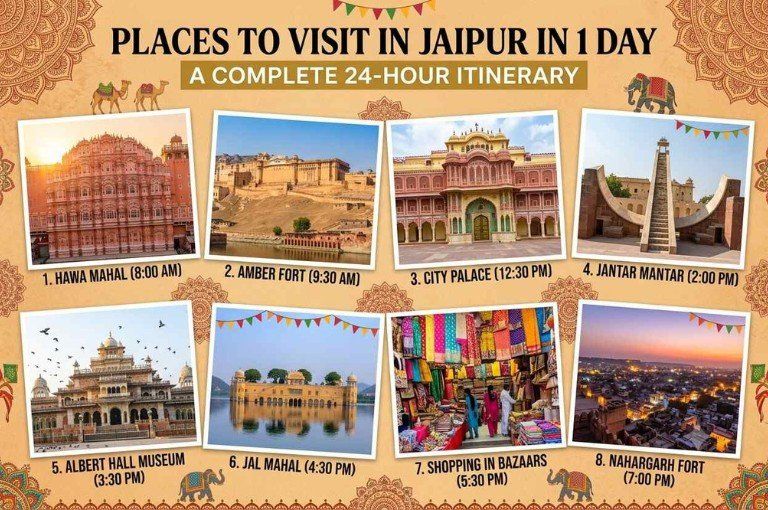
Jaipur packs three centuries of royal history into one compact, walled city, so a single day can feel like a week of stories. Rampart walls climb the Aravalli hills, pink sandstone bazaars hum below, and palace courtyards still look much as Rajput kings left them. This guide lays out the places to visit in Jaipur city in one day in a realistic order, with visiting hours, entry fees, history and practical tips for every stop. If you land on a morning flight or step off an overnight train, a well-planned one-day Jaipur trip lets you see Amber Fort, Hawa Mahal, City Palace and the Jantar Mantar observatory without rushing. Treat this page as your 1 day Jaipur tour planner, and adjust the route to match your pace, your budget and the weather.
Everyone sees a different Jaipur. Here are the best places to visit in Jaipur in 1 day for different travellers, grouped by interest.
Families with children: Choose Jantar Mantar for hands-on science, Jal Mahal for a short break, Albert Hall for the mummy and City Palace for armour and costumes. Skip the steeper climbs at Nahargarh if little ones are tired.
Couples: Plan sunset at Nahargarh, tea at a rooftop café opposite Hawa Mahal and a candlelit dinner in the old city.
History and architecture lovers: Give Amber Fort and City Palace extra time, hire a good guide and spend a full hour at Jantar Mantar. Add Jaigarh Fort if you have spare time; it holds one of the biggest cannons on wheels in the world.
Photographers: Shoot Hawa Mahal and Jal Mahal in the morning, capture the colour at Patrika Gate and finish at Nahargarh in golden light.
Foodies: Build the day around meals: kachori for breakfast, a thali for lunch, lassi in the afternoon and dal baati churma at night.
Senior travellers: Use a private cab, take the jeep up to Amber Fort and avoid long walks on hot afternoons.
Budget travellers: Share a tuk-tuk, use a composite ticket and walk between Hawa Mahal, Jantar Mantar and City Palace, which sit close together.
Start at Amber Fort at 8:00 AM, pause at Jal Mahal for photographs, drive into the old city for Hawa Mahal, Jantar Mantar and City Palace, then finish with a late-afternoon viewpoint at Nahargarh Fort or an evening in the bazaars. This covers the main places to visit in Jaipur in one day with about 45 to 55 km of road travel and roughly ten to eleven hours on the move, including lunch.
| Order | Stop | Best Slot | Time Needed | Approx. Entry Fee (Indian / Foreign) |
| 1 | Amber Fort | 8:00 to 10:45 AM | 2.5 to 3 hrs | 100 / 500 |
| 2 | Jal Mahal (viewpoint) | 10:50 to 11:10 AM | 20 mins | Free |
| 3 | Hawa Mahal | 11:30 AM to 12:15 PM | 45 mins | 50 / 200 |
| 4 | Jantar Mantar | 1:15 to 2:15 PM | 1 hr | 50 / 200 |
| 5 | City Palace | 2:15 to 4:15 PM | 2 hrs | 200 / 700 |
| 6 | Albert Hall Museum | 4:30 to 5:00 PM | 30 mins | 40 / 300 |
| 7 | Nahargarh Fort | 5:00 PM onwards | 1 to 1.5 hrs | 50 / 200 |
Entry fees are approximate and authorities revise them from time to time, so confirm the current rates at the ticket counter or on the official listing before you travel.
Jaipur is the capital of Rajasthan and a corner of the Golden Triangle circuit with Delhi and Agra. Maharaja Sawai Jai Singh II founded the city in 1727 and moved his court down from Amber, because the old capital had run short of water and room to grow. Vidyadhar Bhattacharya, a Bengali architect and scholar, laid out the new city on a grid, which is why the old city feels unusually orderly for its age.
The “Pink City” name dates to 1876, when the ruling maharaja had the old city painted terracotta pink to welcome the Prince of Wales, and the colour remains its signature. UNESCO has inscribed Jantar Mantar (2010), the Hill Forts of Rajasthan including Amber Fort (2013) and the Walled City of Jaipur (2019) on the World Heritage List.
A good Jaipur Rajasthan travel guide starts with one fact: distances inside the city are short, but traffic is slow. Plan stops by area, not by fame, and you will save an hour or more. Of all the things to do in Jaipur in one day, the most useful is protecting your energy: book your cab or tuk-tuk the night before, carry water and accept that you will skip a few sights.
The best time to visit Jaipur runs from October to March, when days stay dry and the forts feel pleasant even at noon. Summer, from April to June, pushes daytime temperatures to 40–45°C and turns open-air forts into hot plates by 11 AM. The monsoon from July to September brings green hills around Amber and fewer visitors, although short heavy showers can interrupt plans.
Jaipur weather in winter deserves a short note of its own. Daytime highs hover around 20–25°C, but nights drop to 5–10°C, and cold snaps in December and January can pull early mornings close to 4°C with fog over the roads. Pack a light jacket for the 7:30 AM start and peel layers as the sun climbs. The winter sun sets before 5:45 PM, which shapes the order of the route below.
Dress modestly for temples and palaces, with covered shoulders and knees, and wear closed, comfortable shoes because the forts involve ramps, steps and uneven stone.
By train: Jaipur Railway Station, officially Jaipur Junction (JP), sits on the main Delhi–Ahmedabad line and receives dozens of trains daily, including the fast Shatabdi and Vande Bharat services from Delhi that take around four and a half to five hours. The station is roughly 4 to 5 km from Hawa Mahal. Prepaid auto and taxi counters stand outside the main exit, and the station has a cloakroom where you can leave bags if you arrive before your hotel check-in time.
By air: Jaipur International Airport (JAI) in Sanganer lies about 12 to 14 km from the city centre. The Jaipur airport to city transfer takes 30 to 45 minutes depending on traffic, with prepaid taxis, app-based cabs and hotel pick-ups all available. Pre-book a driver if you land late at night.
By road: Delhi to Jaipur is about 270 km, a five-hour drive on NH48 and the newer expressways. Many Delhi-based travellers drive down early, spend the day in the city and return at night, though this makes for a very long day.
Time | Activity | Notes |
7:30 AM | Hotel or station pickup, quick chai and breakfast | Try a hot kachori if you are passing a sweet shop |
8:00 – 10:45 AM | Amber Fort | Arrive at opening to beat tour buses |
10:50 – 11:10 AM | Jal Mahal | Photo stop only; no entry inside |
11:30 AM – 12:15 PM | Hawa Mahal | Visit the small museum and the top-floor views |
12:30 – 1:15 PM | Lunch in the old city | Thali or dal baati churma |
1:15 – 2:15 PM | Jantar Mantar | Shadows are sharpest around midday |
2:15 – 4:15 PM | City Palace | Last entry is usually near 4:30 PM |
4:30 – 5:00 PM | Albert Hall Museum or Birla Mandir | Exterior photos are enough if you are short on time |
5:00 – 6:30 PM | Nahargarh Fort viewpoint | Check closing time on the day |
A Jaipur palace tour route map looks like a loop: north-east to Amber, back through Jal Mahal, into the old city for Hawa Mahal, Jantar Mantar and City Palace, then south to Albert Hall and up the western ridge to Nahargarh. Save the route in Google Maps the night before so you and your driver stay on the same page.
If you want Hawa Mahal in the soft morning light, swap the order and visit it at 8:00 AM before Amber. That trades a calmer Amber Fort for a better photograph, so pick the stop you care about more.
History: Raja Man Singh I began Amber Fort in 1592 on the site of an older Meena stronghold, and later rulers, especially Sawai Jai Singh I, added palaces, gardens and gateways. The fort remained the Kachwaha capital until the move to Jaipur in 1727. Its sandstone and marble walls follow the Aravalli ridge above Maota Lake.
What to see: Enter through the Suraj Pol and cross Jaleb Chowk, the main courtyard. Climb to the painted Ganesh Pol, then step into the Sheesh Mahal (Mirror Palace), where tiny mirrors turn a single candle into a field of stars. The Sukh Niwas, with its channels for cool water, shows how Rajput builders managed heat long before air conditioning.
Timings and tickets: Amber Fort normally opens daily from about 8:00 AM to 5:30 PM. A standard ticket costs around 100 for Indian visitors and 500 for foreign visitors, with student concessions on valid ID. An evening light and sound show runs on a separate ticket. Expect queues from about 10 AM.
Getting up: Jeeps run from the base to the Suraj Pol gate at a fixed fare listed at the counter, and many visitors walk the ramp in 15 to 20 minutes. Authorities have capped elephant rides because of animal welfare concerns, so a jeep or a walk is a better choice.
On your way back to the city, Jal Mahal appears in the middle of Man Sagar Lake like a pink-sandstone dream. The palace, built in the 18th century and renovated in recent decades, was used as a duck-shooting lodge by the royal family. Only the top floor rises above the water; the lower four floors sit submerged when the lake is full.
Visitors cannot go inside, but the roadside promenade is free and open from early morning until evening. Stop for 15 to 20 minutes, buy fresh coconut water or roasted corn from a hawker, and watch migratory birds in winter. Early mornings are the calmest.
Hawa Mahal, the “Palace of Winds”, is the building that most travellers picture when they think of Jaipur. Maharaja Sawai Pratap Singh built it in 1799 and the architect Lal Chand Ustad designed its honeycomb façade. The five-storey front carries 953 small windows (jharokhas) so that royal women could watch street festivals without being seen. The same small windows pull in cool breezes, which explains the name.
Timings and tickets: The monument opens daily, usually from 9:00 AM to about 5:00 PM. An entry ticket costs roughly 50 for Indian visitors and 200 for foreign visitors. The entrance is at the back of the building, which surprises many first-time visitors, so follow the signs on the side road.
What to do: Inside, you walk up gentle ramps, not steps, past small chambers and a mini museum with miniature paintings, armour and artefacts. The top floor gives close views of City Palace and Jantar Mantar. For the classic photograph of the façade, use one of the rooftop cafés across the road, where a cup of tea buys you a seat and a clear view.
City Palace is still the home of Jaipur’s royal family, so parts of it remain private while the rest operate as a museum. Sawai Jai Singh II began the complex in the 1720s, and later maharajas added courts, pavilions and gateways in a blend of Rajput, Mughal and European styles.
What to see: Start at the Mubarak Mahal, which holds a textile and costume collection of royal robes and shawls. Walk to the Diwan-i-Khas (Hall of Private Audience), where two giant silver urns stand on display; Guinness World Records recognises them as the largest sterling silver vessels. The four gates of the Pritam Niwas Chowk depict the four seasons, and the Peacock Gate is among the most photographed doors in India. Finish at the armoury, where swords, daggers and guns tell the story of palace life.
Timings and tickets: City Palace is typically open daily from 9:30 AM to 5:00 PM, with the last entry shortly before closing. A basic entry ticket costs around 200 for Indian visitors and 700 for foreign visitors. Special guided access to the Chandra Mahal, the royal residence, and audio guides cost extra, so decide at the counter. Allow two hours if you enjoy museums, or 75 minutes for a brisk walk through the main courtyards.
Right next to City Palace stands Jantar Mantar, an astronomical observatory that Sawai Jai Singh II built between 1724 and 1735. He was a keen astronomer who scaled instruments up in stone and marble to make readings more accurate. The site holds 19 instruments, each designed for a specific measurement of time, planetary position or celestial coordinates. UNESCO added the observatory to the World Heritage List in 2010 and calls it the most significant and best-preserved of India’s historic observatories.
The highlight. The Samrat Yantra, a giant sundial about 27 metres tall, tells local time to within two seconds. Its shadow moves a few millimetres every second, and you can watch it creep across the quadrant. Nearby, the Jai Prakash Yantra and the twelve Rashivalaya instruments for the zodiac signs repay a slow walk.
Timings and tickets. The observatory opens daily from about 9:00 AM to 4:30 or 5:00 PM. An entry ticket costs roughly 50 for Indian visitors and 200 for foreign visitors. A local guide adds real value here because the instruments make little sense without someone explaining them, and a short audio guide is available if you prefer to move at your own pace. Visit around noon when shadows are sharp and the demonstration of time reading works best.
Albert Hall Museum, also called the Central Museum, stands inside Ram Niwas Garden. Samuel Swinton Jacob designed the Indo-Saracenic building, the Prince of Wales laid the foundation stone in 1876 and the museum opened to the public in 1887. Inside, you will find miniature paintings, carpets, ivory carvings, musical instruments and a well-known Egyptian mummy.
Even if you skip the interiors, a stroll around the lit building at dusk makes a fine photo stop. Entry costs around 40 for Indian visitors and 300 for foreign visitors, and visiting hours are usually 9:00 AM to 5:00 PM, with an evening session at certain times of the year. Check the board at the gate.
Nahargarh Fort sits on the western ridge of the Aravallis, 15 km or about 30 minutes from the old city by road. Sawai Jai Singh II raised the fort in 1734, and Sawai Madho Singh II later added the Madhavendra Bhawan, a set of nine identical suites for his queens. The rooms connect by hidden corridors so that the king could visit any of them without meeting the others.
Most visitors come for the view. From the ramparts, the old city spreads out in a pink grid, with Jal Mahal shimmering in the distance. The fort usually opens around 10:00 AM and closes close to 5:30 PM, and entry costs about 50 for Indian visitors and 200 for foreign visitors. On winter evenings, the light turns golden by 5:00 PM, so you may catch it just before closing. In other seasons, sunset arrives later and you may need to watch it from the roadside viewpoints below the gate or from a rooftop restaurant on the hill.
If a stop on the main route is closed or crowded, replace it with one of these:
Birla Mandir (Laxmi Narayan Temple): A white-marble Birla Mandir Temple was built in 1988 below Moti Dungri. Entry is free, and the temple closes for a break around midday.
Patrika Gate: A colourful gateway at Jawahar Circle with painted arches. It is free, open at any hour and a favourite selfie location.
Galta Ji (Monkey Temple): Temples and sacred pools in a gap in the Aravallis, about 10 km east of the old city. Keep food hidden from the monkeys.
A Jaipur local experience starts with the bazaars. Johari Bazaar sells gold, silver and gemstones, Bapu Bazaar embroidered juttis and textiles, Tripolia Bazaar lac bangles and Chandpole marble handicrafts. Bargain politely, start at about half the first quoted price and avoid shops your driver pushes too hard, because commission shops can inflate prices sharply.
Food is a highlight. Sample a pyaaz kachori with mint chutney for breakfast, a thali with ker sangri and gatte ki sabzi at lunch and dal baati churma for dinner. Cool off with a thick lassi in a kulhad (clay cup) on MI Road, then finish with mawa kachori or a sweet from a mithai counter in Johari Bazaar. For a different evening, a village-themed dinner with puppet shows and folk dance offers a quick snapshot of rural Rajasthan; book ahead in peak season.
Travellers often search for Jaipur sightseeing timings Monday closed because many museums across India keep Monday as their weekly off. The headline sites in this guide currently open every day of the week, yet smaller museums, galleries and some state-run exhibits change their weekly closure from time to time. If your visit falls on a Monday, verify the schedule on the evening before and keep Birla Mandir, Patrika Gate and the old-city bazaars ready as backups.
Remember that many old-city shops close on Sundays, and public holidays can alter visiting hours at palaces and forts. Local festivals such as Teej, Gangaur and Diwali bring beautiful street scenes but also heavy traffic, so leave extra buffer time.
A single day in Jaipur rewards good planning: an early start, a route that follows geography, the right mix of forts, palaces and bazaars, and enough energy left for sunset. Use the timings, entry fees and tips above to build a day that fits your interests, and keep a buffer for traffic and tea breaks.
If you would rather leave the logistics to experts, TourTravelWorld offers a customisable Jaipur tour package built around the Places to Visit in Jaipur in 1 Day route, with a private cab, a driver who knows the city, help with tickets and flexible stops.
Ans: Yes, the main places to visit Jaipur in one day fit comfortably into a single day: Amber Fort, Hawa Mahal, City Palace, Jantar Mantar and a viewpoint. You will skip some museums and markets, but an 8:00 AM start and a tight route make the day satisfying.
Ans: Start at Amber Fort, stop at Jal Mahal, then visit Hawa Mahal, Jantar Mantar and City Palace. Finish with Albert Hall or Nahargarh Fort and dinner. This order groups stops by area and avoids backtracking.
Ans: Start between 7:30 and 8:00 AM. Amber Fort opens early, crowds are lighter and the weather is cooler.
Ans: Indian adults pay about 40 to 200 per monument, while foreign visitors pay about 200 to 700. A composite ticket can lower the total. Rates change, so check the counter.
Ans: Choose a taxi for comfort, hot weather and families. Choose a tuk-tuk for narrow lanes, a lower price and an open-air feel. Agree on the full-day price and stop first.
Ans: Yes. Take an early Shatabdi or Vande Bharat train, which reaches Jaipur in about five hours, pre-book a cab for the day and return by a late-evening train.
Ans: Jaipur is widely visited by solo and women travellers. Use licensed taxis or prepaid autos, avoid unsolicited guides and keep valuables close, as in any crowded tourist city.
Ans: Nahargarh Fort offers the widest city views, especially in winter when it is open at golden hour. Jal Mahal and rooftop cafés near Hawa Mahal are good alternatives.