- By Theme
-
Destinations
-
Indian Destinations
-
International Destinations
-
- Best Places to Visit
- Packages
- Search Agents
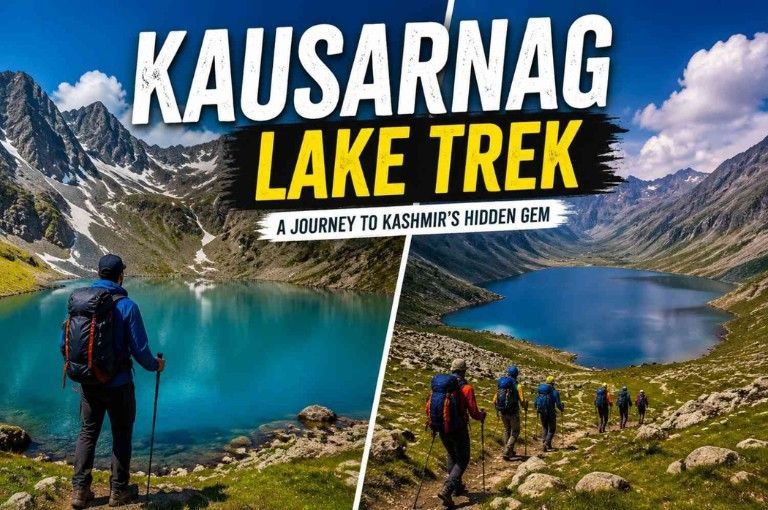
There are treks that tire you. And then there are treks that transform you. The Kausar Nag Lake Trek belongs firmly to the second category.
Tucked deep within the Pir Panjal range of Jammu & Kashmir, Kausar Nag — also popularly spelled as Kounsarnag — is a high-altitude glacial lake sitting at approximately 3,700 metres above sea level. It is one of the largest alpine lakes in all of Asia, and yet most travellers who visit Kashmir have never heard of it. That is precisely what makes it magical.
This guide covers everything you need to plan a successful Kausar Nag lake trek — from its precise location and distance to the trek route map, best time to visit, difficulty level, and insider travel tips. Whether you are an experienced trekker or an enthusiastic first-timer, this is the only resource you need.
Kausar Nag, derived from the Kashmiri words meaning 'Lake of the Master', is a sacred alpine lake revered by both Hindus and Muslims in the Kashmir Valley. Located in the Shopian district of South Kashmir, this stunning body of water remains frozen for several months each year and only becomes accessible during the brief summer trekking window.
The lake is fed by multiple glaciers and snowmelt streams from the surrounding peaks. Its deep turquoise waters, set against a wide mountain amphitheatre, create a visual spectacle that photographs simply cannot do justice to.
Local Name: Kounsarnag (also romanised as Kausar Nag, Konsarnag)
Altitude: Approximately 3,600 to 3,700 metres above sea level
Type: High-altitude glacial and alpine lake
Religious Significance: Considered sacred; associated with Shiva mythology and Sufi traditions
Size: One of the largest alpine lakes in Asia, stretching roughly 5 km in length
Kausar Nag is situated in the Pir Panjal Range, administratively falling under the Shopian District of Jammu & Kashmir. It lies south of the main Kashmir Valley and can be approached from multiple directions depending on the route you choose.
The lake sits at the head of a high-altitude meadow basin surrounded by peaks that exceed 4,500 metres. The area forms part of the catchment zone for multiple streams that eventually drain into the Rambiara River.
District: Shopian, Jammu & Kashmir
Mountain Range: Pir Panjal Range
Coordinates: Approximately 33.7°N, 74.6°E
Nearest Major Town: Shopian (from the south) and Dachigam/Pahalgam area (from the north)
Accessible Season: June to early October
One of the most searched queries about this trek is: how far is Kausar Nag from Srinagar? The answer depends on which trailhead you choose.
Srinagar to Shopian: Approximately 60 to 65 km, roughly 2 to 2.5 hours by car
Srinagar to Heerpora (primary trailhead village): Approximately 70 to 75 km, about 2.5 to 3 hours
Srinagar to Keller (alternate trailhead): Approximately 80 km
Once you reach the trailhead, the actual trekking distance varies by route:
Heerpora to Kounsarnag Lake: Approximately 22 to 26 km one-way
Keller to Kounsarnag Lake (via Nagdar Nar): Approximately 28 to 32 km one-way
Total round-trip trekking distance: 45 to 55 km depending on the route chosen
Most trekkers complete the journey as a 4 to 5 day round trip, covering 8 to 12 km per trekking day. However, experienced high-altitude trekkers have been known to complete the Heerpora route in 3 days.
Unlike heavily commercialised treks in Himachal Pradesh or Uttarakhand, the Kounsarnag trek does not have a single standardised route. There are two primary approaches, each offering a distinct experience.
This is the most commonly used route and the recommended one for first-time trekkers to this region.
Day 1 – Srinagar / Shopian to Heerpora (Drive) + Heerpora to Kanitar (Trek): Drive to Heerpora village and begin the trek. The trail initially passes through dense pine and fir forests. You gain altitude steadily. Camp at Kanitar meadow — a wide grassy expanse with a stream. Distance: 8 to 10 km. Altitude gain: ~800 metres.
Day 2 – Kanitar to Nagdar/Lidderwat Meadow: Today's trek passes through some of the most beautiful alpine meadows in South Kashmir. Wildflowers carpet the path in summer. You cross multiple rocky streams and gain significant altitude. Camp at Nagdar or one of the upper meadows. Distance: 10 to 12 km.
Day 3 – Nagdar to Kausar Nag Lake and Return to Nagdar: An early start is essential. The final push to the lake involves crossing a boulder field and a short scree section. The first sight of Kausar Nag is breathtaking. Spend time at the lake before returning to Nagdar for the night. Distance (round trip from camp): 12 to 14 km.
Day 4 – Nagdar to Heerpora + Drive back to Srinagar: Retrace your steps to Heerpora. A vehicle can be pre-arranged to pick you up. Return to Srinagar by evening.
This route approaches Kounsarnag from a different direction and is suited for trekkers with prior high-altitude experience. The trail is less defined in places and requires a local guide. The scenery, however, is even more dramatic — you pass through remote shepherd campsites and untouched ridgelines.
Starting point: Keller village, Shopian District
This route typically takes 5 to 6 days round trip
Involves a higher maximum altitude at some ridgeline crossing points
Better option if you want to combine with other South Kashmir trek extensions
Note: For both routes, hiring a local guide from Shopian or Heerpora is strongly recommended. The trails are not always clearly marked, and weather can change rapidly.
Difficulty Level: Moderate to Difficult
Maximum Altitude: ~3,700 metres (Kausar Nag Lake)
Total Trek Duration: 4 to 6 days depending on route and pace
Daily Walking Hours: 5 to 7 hours
The Kausar Nag lake trek is categorised as moderate-to-difficult for several reasons:
The altitude gain is significant and rapid in certain sections
River crossings (especially in early June when snowmelt is high) require care
The trail is not well-marked beyond the popular campsites
Weather is unpredictable; afternoon thunderstorms are common in July and August
The final approach to the lake involves bouldering and scree
That said, no technical climbing equipment is needed. A good level of cardiovascular fitness, proper trekking footwear, and an acclimatisation plan are sufficient for most healthy adults.
The trek is only accessible during the summer and early autumn months. Here is a month-by-month breakdown:
June: The route opens by mid to late June. Snow patches remain on the trail and near the lake. The landscape is vibrant green. River crossings can be tricky due to high snowmelt. Recommended for experienced trekkers.
July: Excellent month. Trails are clear, wildflowers are in full bloom, and weather is mostly stable. One of the best months to visit.
August: Good conditions continue. Higher possibility of afternoon rain showers. The meadows remain lush.
September: An ideal month for trekkers who prefer crisp air and quieter trails. The foliage begins to turn golden in the higher meadows. Arguably the most scenic month.
October: The season begins to close. Early October is possible but nights become very cold. Snow can return by late October.
Overall best window: Mid-June to Late September
As of current guidelines, the Kausar Nag area falls within a protected and ecologically sensitive zone. Trekkers should check the latest permit requirements with the Jammu & Kashmir Tourism Department or through a registered tour operator before heading out.
Indian nationals: Inner Line Permit may be required depending on current regulations
Foreign nationals: Must check with J&K Tourism for updated entry permissions for this specific route
Registration at Shopian district office is typically required
No plastic or non-biodegradable waste is permitted beyond the village trailheads
TourTravelWorld strongly recommends booking this trek through a registered Kashmir travel agents who can handle all documentation and ensure a safe, compliant experience.
Moisture-wicking base layers (at least 2 sets)
Insulating mid-layer (fleece or down jacket)
Waterproof and windproof outer shell jacket
Trekking trousers (avoid denim entirely)
Gaiters for snow and muddy sections
Sturdy ankle-support trekking boots (already broken in)
Woollen socks (4 to 5 pairs minimum)
Warm hat, sun hat, gloves, and buff/neck gaiter
35 to 45 litre trekking backpack
Sleeping bag rated to -5°C or lower
Trekking poles (highly recommended for descent)
Headlamp with extra batteries
Sun protection: SPF 50+ sunscreen, UV-blocking sunglasses
Basic first aid kit including altitude sickness medication (Diamox — consult your doctor before use)
Water purification tablets or filter
High-energy snacks: dry fruits, nuts, energy bars, dark chocolate
The Kausar Nag lake trek is a camping-based experience. There are no permanent tea houses, guesthouses, or lodges along the route. All camping is done in the open meadows.
Popular campsites: Kanitar, Nagdar Nar, and at the lakeside itself (one night recommended for sunset and sunrise views)
Tents, sleeping bags, and cooking equipment can be hired from operators in Shopian or through your trek organiser in Srinagar
Meals are typically simple but nourishing: dal, rice, roti, eggs, and tea
Potable water is available from mountain streams (always purify before drinking)
Campfires are permitted but use only fallen wood; never cut live trees
The Pir Panjal range around Kausar Nag is a biodiversity hotspot. The trek passes through multiple ecological zones, each with its own distinct character.
Dense forests of Blue Pine, Silver Fir, and Himalayan Cedar at lower altitudes
Birch woodland at mid-elevations
Alpine meadows (locally called Margs) carpeted with wildflowers including Himalayan Blue Poppy, Marsh Marigold, and wild Iris
Cushion plants and sedges near the lake at higher altitude
Himalayan Brown Bear (rare but present — maintain safe distance and make noise on the trail)
Himalayan Marmot (commonly spotted sunning on boulders)
Snow Leopard (extremely rare; signs are occasionally seen by guides)
Various high-altitude bird species including Himalayan Snowcock, Lammergeier (Bearded Vulture), and Red-billed Chough
Shepherd dogs from local Bakarwal herding communities
At 3,700 metres, altitude sickness is a genuine concern for trekkers who ascend too rapidly. Here are non-negotiable safety practices:
Acclimatise properly: Spend at least one night in Srinagar (1,585 m) or Shopian before beginning the trek.
Hydrate constantly: Drink 3 to 4 litres of water daily. Dehydration accelerates AMS symptoms.
Follow the golden rule: Never ascend more than 300 to 400 metres of sleeping altitude gain per day.
Know the symptoms of AMS: Persistent headache, nausea, dizziness, loss of appetite, and shortness of breath at rest are warning signs. Descend immediately if symptoms worsen.
Always trek with a guide: Solo trekking in this region is strongly discouraged, especially for first-timers.
Inform someone: Always let a contact know your itinerary and expected return date.
The nearest airport is Sheikh ul-Alam International Airport in Srinagar, which has regular flights from Delhi, Mumbai, Bangalore, and other major Indian cities. From the airport, the Heerpora trailhead is approximately 2.5 to 3 hours by road.
From Srinagar, take the National Highway 44 towards Shopian. From Shopian, local taxis and shared vehicles go to Heerpora village or the Keller area. It is advisable to hire a dedicated vehicle for the group to carry camping gear and supplies.
The nearest railway station is Banihal, connected to the Kashmir Railway network. From Banihal, taxis and buses are available to Shopian and onward to the trailhead.
India has no shortage of spectacular treks. Kedarnath, Roopkund, Hampta Pass, Markha Valley — the Himalayas offer a lifetime of exploration. So why choose Kausar Nag?
Isolation and solitude: Unlike Kashmir's more touristy treks near Pahalgam or Sonamarg, Kausar Nag sees a fraction of the footfall. You may go an entire day on trail without meeting another trekking group.
Scale of the lake: The sheer size of Kausar Nag lake — stretching for several kilometres — is genuinely awe-inspiring. Seeing it for the first time from the ridge above is a moment trekkers describe as life-changing.
Cultural depth: The route passes through villages where traditional Kashmiri pastoral life continues largely unchanged. Interactions with Bakarwal shepherds offer a window into a vanishing way of life.
Photography: The combination of reflective alpine water, snow-capped peaks, wildflower meadows, and dramatic sky makes this one of the most photogenic trails in India.
Low commercialisation: No plastics shops, no crowds, no Instagram-ready signboards. Just mountains, silence, and your own footsteps.
Most travellers visit Kausar Nag as part of a longer Kashmir holiday. Here is a suggested 8 to 10 day itinerary structure:
Days 1 to 2 – Srinagar: Arrive, stay on a houseboat on Dal Lake, visit Mughal Gardens, Shankaracharya Temple, and the old city. If you are booking a Srinagar tour package, ensure it includes at least one full day for local sightseeing.
Days 3 to 4 – Acclimatisation and Shopian: Drive through the apple orchards of Shopian. Visit the Kounsarnag base villages. Rest and prepare for the trek.
Days 5 to 8 – Kausar Nag Lake Trek: Complete the full 4-day round trip via Heerpora.
Days 9 to 10 – Pahalgam or Gulmarg: Extend your Kashmir experience with a visit to the meadows of Pahalgam or the ski slopes of Gulmarg before flying back from Srinagar.
If you are looking to book a well-structured Kashmir tour package that combines Srinagar sightseeing, valley highlights, and the Kausar Nag trek, TourTravelWorld offers customized itineraries designed for Indian travellers with flexible dates, group sizes, and budgets.
Kausar Nag is an ecologically fragile zone. The pristine condition of the lake and its surroundings is a direct result of its remoteness and relatively low visitor count. Every trekker carries a responsibility to keep it that way.
Carry out all waste — do not leave any non-biodegradable material on the trail or near the lake
Use eco-friendly toiletry products and maintain a minimum distance of 50 metres from water sources for any sanitation activity
Do not pluck wildflowers or disturb wildlife
Avoid playing loud music in the mountains — it disrupts wildlife and the experience for other trekkers
Pay fair wages to local guides and porters
Buy provisions from Shopian-based local vendors to support the local economy
At TourTravelWorld, we believe that Kashmir's finest experiences should be accessible, safe, and deeply memorable. Our Kausar Nag lake trek packages are designed with three core priorities: safety, authenticity, and environmental responsibility.
Every Kausar Nag trek through TourTravelWorld includes:
Expert local guide from Shopian with detailed route knowledge
All camping equipment — tents, sleeping bags, kitchen setup
All meals during the trek (breakfast, lunch, dinner)
Permits and documentation support
Vehicle transfers from Srinagar to trailhead and back
24/7 customer support
Pre-trek briefing and medical advice
Our packages can be customized to add Srinagar sightseeing, Pahalgam, Gulmarg, or other destinations to make it a complete Kashmir holiday.
There is a reason why trekkers who complete the Kausar Nag lake trek rarely stop talking about it. It is the kind of place that recalibrates your sense of scale and silence. Standing at the edge of a glacial lake that stretches further than the eye can see, with nothing but peaks and sky above you, is an experience that modern life rarely offers.
The trek demands respect — physical preparation, proper planning, and environmental mindfulness. But for those who invest in the experience, it returns something genuinely rare: a corner of the world that still belongs to itself.
If you have been thinking about exploring the alpine beauty of South Kashmir but have not known where to start, the Kounsarnag trek is your answer. And TourTravelWorld is here to help you get there safely, comfortably, and responsibly.
Ans: It is moderate-to-difficult and not recommended as a first trekking experience in India. However, if you have done at least one or two treks at altitude (above 3,000 m) and have reasonable fitness, it is achievable with a guide.
The one-way trekking distance from Heerpora to Kausar Nag Lake is approximately 22 to 26 km. The total round-trip trekking distance for the most popular route is 45 to 55 km.
The road distance from Srinagar to the nearest trailhead (Heerpora) is approximately 70 to 75 km, taking 2.5 to 3 hours. Kausar Nag Lake itself is a further 22 to 26 km of trekking beyond the trailhead.
Yes, with a registered guide and proper planning. The local communities along the route are welcoming. TourTravelWorld recommends trekking in groups for added safety and camaraderie.
Mobile connectivity is limited to the initial trailhead villages. Beyond that, expect no signal. Informing family members of your itinerary before you leave is essential.
No. Kausar Nag is inaccessible in winter due to heavy snowfall. The safe trekking window is mid-June to late September.
Permit requirements can change. As of the latest available information, Indian nationals should carry government-issued photo ID and may need to register at Shopian. Foreign nationals should consult J&K Tourism or a registered operator for current requirements before planning.