- By Theme
-
Destinations
-
Indian Destinations
-
International Destinations
-
- Best Places to Visit
- Packages
- Search Agents

Once every twelve years, the mountains of Uttarakhand become the stage for the world's largest Himalayan religious procession. The Nanda Devi Raj Jat Yatra is not just a pilgrimage — it is a once-in-a-lifetime spiritual experience that touches the heart of every person who witnesses it. If you have been waiting for a reason to visit the Himalayas, 2026 is that reason.
The Nanda Devi Raj Jat Yatra is a grand religious procession held once every twelve years in the state of Uttarakhand. It is dedicated to Goddess Nanda Devi, who is considered the presiding deity — the "royal goddess" — of the entire Garhwal and Kumaon region of Uttarakhand.
The word "Raj Jat" means "royal procession." In this Yatra, the goddess is sent off from her parental home in the mountains and taken toward her divine husband's abode in the higher Himalayas. This procession covers a distance of nearly 280 kilometres through some of the most beautiful and remote mountain landscapes in all of India.
Hundreds of thousands of pilgrims, devotees, and travelers participate in this Yatra. It is considered one of the most important religious events not just in Uttarakhand, but in the entire country.
The last Raj Jat was held in 2014. The next one is Nanda Devi Raj Jat Yatra 2026. After this, the next chance will only come in 2038. So if you want to be part of this extraordinary event, now is the time to plan.
The history of the Nanda Devi Raj Jat Yatra goes back more than 800 years. It is one of the oldest living pilgrimage traditions in all of South Asia. Goddess Nanda Devi is worshipped as the daughter of the mountains — the beloved child of the Himalayan region who must one day return to her husband's home in the heavens.
According to local tradition and religious belief, Goddess Nanda Devi is an incarnation of Goddess Parvati (also known as Shakti). The Yatra represents her farewell journey — leaving her parents' home in the villages of Garhwal and Kumaon and walking back toward the high Himalayas where her divine husband resides. This story of a daughter leaving home makes the Yatra deeply emotional for everyone who participates. People weep openly when the goddess's palanquin (Doli) passes through their village, just as a family weeps when a daughter leaves for her in-laws' home after marriage.
In earlier times, the kings of Garhwal and Kumaon used to personally organise and fund this Yatra — which is why it is called "Raj Jat," meaning the royal procession. Even today, the royal families of villages like Kansua, Nauti, and Kurund play an important ceremonial role in the Yatra. Their participation gives the event its traditional royal character.
The Raj Jat Yatra has been officially recognised as an important piece of India's living cultural heritage. Scholars, historians, documentary filmmakers, and spiritual leaders from across the country and the world visit Uttarakhand specifically to witness this event.
The history of the Nanda Devi Raj Jat Yatra goes back more than 800 years. It is one of the oldest living pilgrimage traditions in all of South Asia. Goddess Nanda Devi is worshipped as the daughter of the mountains — the beloved child of the Himalayan region who must one day return to her husband's home in the heavens.
According to local tradition and religious belief, Goddess Nanda Devi is an incarnation of Goddess Parvati (also known as Shakti). The Yatra represents her farewell journey — leaving her parents' home in the villages of Garhwal and Kumaon and walking back toward the high Himalayas where her divine husband resides. This story of a daughter leaving home makes the Yatra deeply emotional for everyone who participates. People weep openly when the goddess's palanquin (Doli) passes through their village, just as a family weeps when a daughter leaves for her in-laws' home after marriage.
In earlier times, the kings of Garhwal and Kumaon used to personally organise and fund this Yatra — which is why it is called "Raj Jat," meaning the royal procession. Even today, the royal families of villages like Kansua, Nauti, and Kurund play an important ceremonial role in the Yatra. Their participation gives the event its traditional royal character.
The Raj Jat Yatra has been officially recognised as an important piece of India's living cultural heritage. Scholars, historians, documentary filmmakers, and spiritual leaders from across the country and the world visit Uttarakhand specifically to witness this event.
The official Nanda Devi Raj Jat Yatra 2026 start date will be announced by the Uttarakhand government after consultation with local priests, royal family members, and the district administrations of Chamoli and Pithoragarh.
Based on the traditional twelve-year cycle and the Hindu calendar, the Yatra is expected to begin in August 2026, during the month of Bhadrapad. The Yatra traditionally starts after Nanda Ashtami — the eighth day of the bright fortnight in Bhadrapad, which is celebrated as Goddess Nanda Devi's birthday.
Small preparatory rituals and village ceremonies begin two to three weeks before the main procession leaves from Nauti village. So even if you arrive a few days before the official start date, you will witness meaningful pre-Yatra rituals.
The final confirmed dates will be announced by the government about three to four months before the Yatra begins. Keep checking the official Uttarakhand Tourism website for updates — they maintain a regularly updated page dedicated to Raj Jat Yatra 2026 news and travel information.
The full Nanda Devi Raj Jat Yatra lasts approximately 19 to 22 days from start to finish. The procession travels from Nauti village in Chamoli district all the way to the sacred lake of Homkund at an altitude of about 5,500 metres. This makes it one of the longest continuous religious processions anywhere in the world.
However, not every pilgrim or traveler needs to walk all 19 to 22 days. Many people join the Yatra midway — at villages like Mundoli or Wan — which are accessible by road. From Wan, the high-altitude trekking portion begins. If you plan to trek from Wan up to Homkund and back, budget at least 8 to 10 days, including time for acclimatisation stops along the way.
The core religious group — priests, royal family representatives, and the most devoted pilgrims — walk the entire route from Day 1 at Nauti to the final ceremony at Homkund. This is a deeply committed journey and requires good physical fitness and proper planning.
The Nanda Devi Doli Yatra is the soul of the entire Raj Jat. The word "Doli" means palanquin — a decorated wooden litter carried on the shoulders of devotees. This Doli represents Goddess Nanda Devi herself. It is beautifully decorated with flowers and cloth, and it travels the entire route of the Yatra, carried by rotating teams of devotees who consider this an honour.
Walking alongside the Doli — day and night — are priests performing rituals, musicians playing traditional instruments, and thousands of devotees singing Jagar, the traditional devotional songs of Garhwal. The sound of these songs echoing through the mountain valleys at night is something that people who have experienced it never forget.
The most magical and mysterious part of the Doli Yatra is the four-horned ram, known in local tradition as the Chaukhamb. A naturally born four-horned sheep is an extremely rare occurrence in nature. But it is believed that such a ram always appears at the time of the Raj Jat as a divine sign from the goddess. This sacred ram is decorated with silver jewellery, an embroidered ceremonial cloak, and ritual ornaments. It then walks at the head of the procession all the way from the villages to Homkund — the final sacred lake at 5,500 metres.
What happens next is the most emotional moment of the entire Yatra. At Homkund, the four-horned ram is released. It walks into the mist and snow of the high Himalayas — and it never comes back. Thousands of pilgrims watch in tearful silence as the ram disappears into the mountains. For believers, this is the moment the goddess herself departs for her divine home.
Even if you cannot do the full trek to Homkund, witnessing the Doli procession passing through a village like Nauti, Mundoli, or Wan is a deeply moving and unforgettable experience. The streets are decorated, the air smells of incense, and the singing of Jagar fills every corner.
The Raj Jat Yatra is filled with rituals from beginning to end. These rituals have been performed for centuries and give the Yatra its deep spiritual character. Here are the main rituals that every traveler should know about:
Kalash Sthapana (Setting Up the Sacred Pot): The Yatra formally begins with the installation of a sacred Kalash (a metal pot filled with holy water) at the Nanda Devi temple in Nauti village. This marks the official start of the divine journey.
Doli Puja (Worship of the Palanquin): Before the Doli begins its journey, an elaborate worship ceremony takes place. Priests perform Vedic rituals, flowers and fruits are offered, and the Doli is declared ready to carry the goddess.
Jagar (Devotional Night-Long Singing): Throughout the Yatra, devotees perform Jagar — night-long singing sessions where stories of the goddess are narrated through traditional folk songs. This is a distinctly Garhwali art form, and hearing it in the open mountain air is a rare and beautiful experience.
Village Puja at Every Stop: At each village the procession passes through, the local community performs their own puja. The village priest welcomes the Doli, offerings are made, and cultural performances take place. This is why the procession takes so many days — because every village on the route receives the goddess with a full ceremony.
Chaukhamb Ram Puja (Worship of the Four-Horned Ram): The sacred four-horned ram is worshipped formally at the beginning of the journey and at various stops along the route. It is garlanded, fed special foods, and treated with the same reverence as the goddess herself.
Bedni Bugyal Puja: At the magnificent alpine meadow of Bedni Bugyal, a major ritual ceremony is held. This is one of the most visually spectacular moments of the entire Yatra — thousands of pilgrims gathered in an open Himalayan meadow surrounded by snow peaks, performing puja under the open sky.
Roopkund Prayers: At the sacred lake of Roopkund, the priests perform special prayers for the souls of the thousands of ancient people whose skeletons were discovered at this lake, believed to be pilgrims from a previous age.
Homkund Vidai (Final Farewell): At Homkund — the final destination — the most important ceremony of the entire Yatra takes place. The goddess formally bid farewell. The four-horned ram is released into the wilderness. This emotional moment marks the end of the procession, and pilgrims begin the return journey.
The Nanda Devi Raj Jat Yatra route covers nearly 280 kilometres through forests, rivers, meadows, and glaciers. Here is the route stage by stage:
Stage 1 — Nauti (Starting Point, ~1,400 m) The Yatra begins here with grand ceremonies. Nauti is in Chamoli district, accessible by road from Haridwar or Rishikesh. The royal families and senior priests formally flag off the procession.
Stage 2 — Kulsari and Mundoli The procession moves through several Garhwali villages. Each village welcomes the Doli with flowers and puja. This section is road-accessible and is a comfortable entry point for late-joining pilgrims.
Stage 3 — Wan Village This is the last village accessible by motorable road. Most trekkers and independent pilgrims join the Yatra here. Government medical camps, check-posts, and supply depots are set up at Wan.
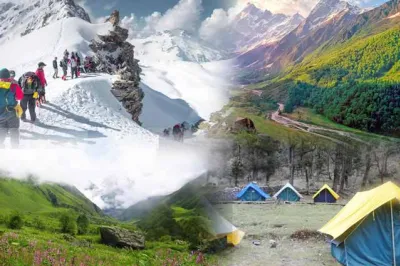
Stage 4 — Bedni Bugyal (~3,450 m) A breathtaking alpine meadow surrounded by Himalayan peaks. One of the most beautiful campsites in all of India. The overnight camping experience here during the Raj Jat — with thousands of pilgrims, bonfires, and singing — is unforgettable.
Stage 5 — Patar Nachauni and Kelu Vinayak (~4,000+ m) The trek gets steeper and the altitude rises sharply. At the Kelu Vinayak shrine dedicated to Lord Ganesha, the procession pauses for special prayers. From here, only those who are physically fit should continue.
Stage 6 — Roopkund (~5,029 m) The famous skeleton lake of India. Ancient human bones have been found preserved here for centuries. In the Raj Jat, this lake is a sacred stop where prayers are offered.
Stage 7 — Shila Samudra and Homkund (~5,500 m) The final destination. A high Himalayan glacial lake where the main farewell ceremonies take place, the sacred ram is released, and the Yatra officially concludes.
Route Quick Facts:
Total procession distance: approximately 280 km
Trek section from Wan to Homkund: approximately 60 to 70 km one way
Highest point: Homkund at 5,500 metres (18,040 feet)
Terrain: forest paths, river crossings, alpine meadows, rocky mountain slopes, and glacial trails
This is one of the most important sections of this guide — especially for anyone travelling from outside Uttarakhand.
Advance registration for the Nanda Devi Raj Jat Yatra is mandatory, particularly for pilgrims joining the high-altitude trekking sections from Wan onward. The government requires this for safety purposes — to maintain a headcount at remote locations, to deploy medical teams appropriately, and to manage camping sites at Bedni Bugyal and other high camps.
Who announces the registration? Registration details are expected to be officially announced by the Uttarakhand Tourism Development Board (UTDB) and the Garhwal Mandal Vikas Nigam (GMVN) by late 2025. These are the two main government bodies responsible for managing religious tourism in Uttarakhand.
A valid government photo ID (Aadhaar card, passport, voter ID, or driving licence)
A medical fitness certificate confirming that you are physically fit for high-altitude trekking
A filled registration form with your personal details and emergency contact number
A nominal registration fee (exact amount will be announced by UTDB/GMVN)
How to register:
Visit the official Uttarakhand Tourism portal or the GMVN website when registration opens — expected to open around late 2025 or early 2026
Fill in the online registration form with accurate personal and medical details
Upload scanned copies of your ID and medical certificate
Pay the nominal registration fee online
Download and save your registration confirmation — carry a printed copy during the Yatra
For those who find this process difficult: If you are travelling from another state, are unfamiliar with government portals, or are an international traveler, the easiest and most reliable option is to book through a trusted Uttarakhand travel specialist. TourTravelWorld.com handles the entire registration process on behalf of their clients, along with accommodation, permits, acclimatisation schedules, and local guides. They have been organising India pilgrimage Yatra and adventure tours for years and are a reliable partner for the Raj Jat Yatra 2026.
If you are already coming to Uttarakhand for the Raj Jat Yatra 2026, it makes complete sense to also visit Kedarnath — one of the most sacred temples in all of India and one of the twelve Jyotirlingas of Lord Shiva.
The Kedarnath temple sits at 3,583 metres in the Rudraprayag district and is reachable by a 16-kilometre trek from Gaurikund, or by helicopter if you prefer. The Kedarnath Yatra season runs from May to November, so it fits perfectly with a pre-Raj Jat trip in the same summer.
The travel route is also naturally connected — both Kedarnath and Chamoli (where the Raj Jat begins) are in the Garhwal Himalayan region, and both are accessible from Haridwar or Rishikesh via the same highway.
The ideal plan: arrive in Haridwar or Rishikesh, complete the Kedarnath Yatra in June or July, rest for a few days, and then head toward Chamoli for the Nanda Devi Raj Jat in August. TourTravelWorld.com offers a combined Kedarnath + Raj Jat Yatra 2026 package that handles both journeys together in one smooth, well-planned itinerary.
Uttarakhand is so much more than a single destination. Known as Dev Bhoomi — the Land of the Gods — this state has something extraordinary for every kind of traveler. Whether you are a devotee, an adventure seeker, a nature lover, or a culture enthusiast, Uttarakhand will leave a mark on your soul.
TourTravelWorld.com offers a wide range of Uttarakhand tour packages for 2026:
Raj Jat Yatra Guided Trek Package — Complete logistics with permits, campsites, meals, and expert local guides
Char Dham Yatra Package — Visit all four sacred shrines: Yamunotri, Gangotri, Kedarnath, and Badrinath
Roopkund Lake Trek — The famous skeleton lake, also a key stop on the Raj Jat route
Valley of Flowers Trek — A UNESCO World Heritage site blooming at its most beautiful in August
Kedarnath Helicopter Package — Darshan at the Shiva Jyotirlinga by helicopter, quick and comfortable
Rishikesh Yoga and Adventure Package — River rafting, bungee jumping, yoga, and meditation
Jim Corbett Wildlife Tour — India's oldest national park, home to Bengal tigers and rich wildlife
All packages include pickup from Dehradun or Haridwar airport or railway station, accommodation, meals, permits, and guide services. Visit www.tourtravelworld.com to see full package details and get a personalized quote based on your travel dates and group size.
By Air: The nearest airport is Jolly Grant Airport in Dehradun, about 220 km from Chamoli. Flights connect Dehradun to Delhi, Mumbai, and other major cities. From Dehradun, take a taxi or shared jeep to Chamoli or Karnprayag — about seven to eight hours by road.
By Train: Rishikesh (about 200 km) and Haridwar (about 240 km) are the nearest railway stations. Both are well connected to Delhi and other cities. From Haridwar or Rishikesh, regular buses and taxis run to Chamoli on National Highway 58.
By Road: The Badrinath Highway (NH-58) passes directly through Chamoli. Government buses (GMOU) run from Haridwar, Rishikesh, and Dehradun. Private taxis can also be hired for a comfortable direct journey to Nauti or Karnprayag.
About altitude: The biggest health challenge on this Yatra is altitude. You go from about 1,400 metres at Nauti all the way to 5,500 metres at Homkund. Spend at least two to three days acclimatising in Chamoli or Joshimath before you start the high-altitude trek. Never rush the ascent. Climb no more than 500 metres per day once you are above 3,000 metres. If you feel severe headache, nausea, or breathing difficulty, descend immediately and seek medical help.
What to carry: Even in August, nighttime temperatures at Bedni Bugyal can drop to -5°C or lower. Carry a good quality sleeping bag, waterproof trekking boots, a warm jacket, thermal inner wear, a rain cover, trekking poles, a water bottle with a purification filter, and a basic first-aid kit with common medicines.
Cash and phone: Beyond Wan village, mobile networks are very weak. Only BSNL may work in some spots. Carry enough cash (Indian Rupees) for the entire trek since there are no ATMs beyond Ghat or Tharali. Local dhabas (roadside food stalls) along the route accept only cash.
Behaviour and respect: The Raj Jat is a deeply religious event. Please dress respectfully — no sleeveless clothes or shorts. Do not carry or consume alcohol or non-vegetarian food during the Yatra. Always ask before taking photographs of rituals. Follow the instructions of priests, local organizers, and government officials. Treat the entire route as sacred ground.
Think about this for a moment. The bhajans and Jagar songs echoing across the Bedni Bugyal meadow at midnight. The sight of an entire village weeping as the Doli passes by their homes for the first time in twelve years. Thousands of people — young and old, city-bred and tribal, working class and royal — all walking the same Himalayan path together, with the same goddess in their hearts.
No five-star holiday can give you this. No Instagram reel can truly capture what it feels like to be part of this ancient procession. The Nanda Devi Raj Jat Yatra 2026 is a once-in-a-lifetime experience — and we mean that literally. The next one will be in 2038. If you miss 2026, you will wait thirteen more years.
Start planning today. Get fit. Get registered. And let the Himalayas do the rest.
For complete Raj Jat Yatra 2026 packages, registration support, Kedarnath Yatra add-ons, travel updates, and all your Uttarakhand travel needs, visit TourTravelWorld.com — your most trusted Himalayan travel partner.
Think about this for a moment. The bhajans and Jagar songs echoing across the Bedni Bugyal meadow at midnight. The sight of an entire village weeping as the Doli passes by their homes for the first time in twelve years. Thousands of people — young and old, city-bred and tribal, working class and royal — all walking the same Himalayan path together, with the same goddess in their hearts.
No five-star holiday can give you this. No Instagram reel can truly capture what it feels like to be part of this ancient procession. The Nanda Devi Raj Jat Yatra 2026 is a once-in-a-lifetime experience — and we mean that literally. The next one will be in 2038. If you miss 2026, you will wait thirteen more years.
Start planning today. Get fit. Get registered. And let the Himalayas do the rest.
For complete Raj Jat Yatra 2026 packages, registration support, Kedarnath Yatra add-ons, travel updates, and all your Uttarakhand travel needs, visit TourTravelWorld.com — your most trusted Himalayan travel partner.
Disclaimer: All dates mentioned in this article are tentative and based on the traditional twelve-year cycle. Official dates for the Nanda Devi Raj Jat Yatra 2026 will be announced by the Uttarakhand government. Always confirm the latest information through official channels and the Uttarakhand Tourism Department before making travel plans.
Nanda Devi Raj Jat Yatra 2026 is a sacred Hindu pilgrimage in Uttarakhand, held once every 12 years, dedicated to Goddess Nanda Devi and covering a long Himalayan trekking route.
The yatra is expected to be held between May and June 2026, though exact dates will be officially announced by the Uttarakhand authorities.
The route usually starts from Nauti village and passes through places like Sem, Koti, Bhagoti, Bedni Bugyal, Roopkund, Homkund, and ends near Nanda Devi Sanctuary.
The pilgrimage typically lasts around 18–22 days, covering approximately 250–280 km through challenging Himalayan terrain.
Yes, basic trekking experience and good physical fitness are recommended, as the route includes high-altitude trails and difficult terrains.
This yatra symbolizes the journey of Goddess Nanda Devi to her divine abode and is considered one of the most sacred and grand pilgrimages in Uttarakhand.
Prepare by improving physical fitness, carrying proper trekking gear, warm clothing, medical essentials, and staying updated with official guidelines.
Basic arrangements like tents, local lodges, and community kitchens are available along the route, but facilities are limited due to remote locations.