- By Theme
-
Destinations
-
Indian Destinations
-
International Destinations
-
- Best Places to Visit
- Packages
- Search Agents
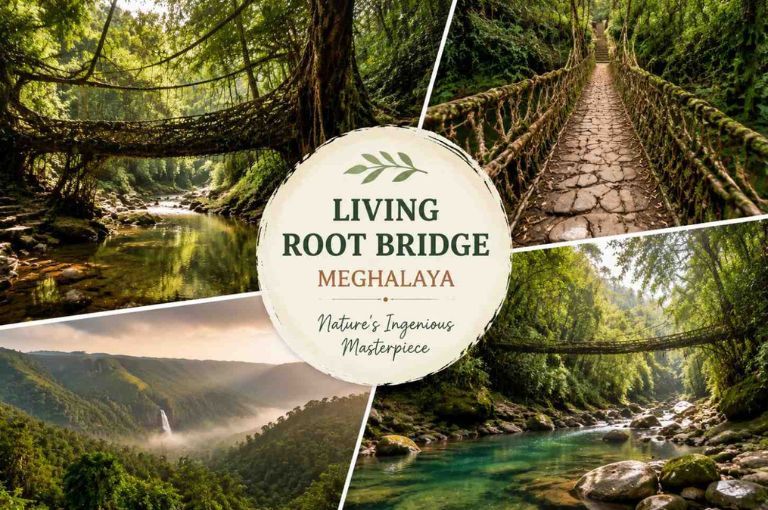
How a tree and 500 years of patience built something no engineer can replicate
Most bridges take months to build. The living root bridges of Meghalaya took generations. Not built with steel or concrete, these bridges are literally grown — woven from the aerial roots of rubber fig trees (Ficus elastica) over 15 to 30 years. Some are over 500 years old and still get stronger every season.
If you are planning a trip to Meghalaya and the living root bridge is on your list — good. It should be. But most travel guides tell you the same five things. This one goes deeper. You will find out where exactly these bridges are, how to reach them, what to expect on the trail, and the real story behind who built them and why they still stand.
A living root bridge is not a metaphor. It is a functioning bridge made entirely from the roots of a rubber fig tree. The Khasi and Jaintia tribes of Meghalaya developed this technique centuries ago. They discovered that the Ficus elastica tree sends out long, flexible secondary roots from its trunk. By guiding these roots across a river or stream — usually through hollowed-out betel nut trunks to direct their growth — and weaving them together over years, the roots eventually fuse and harden into a solid bridge structure.
The remarkable part? Unlike wooden or iron bridges that weaken over time, a living root bridge gets stronger as the tree keeps growing. The roots thicken, interlock more tightly, and become more stable with each passing decade. This is bioengineering done by hand, without any formal training — just observation, patience, and an intimate understanding of how trees grow.
There are around 100 known living root bridges in Meghalaya, spread across the East Khasi Hills and West Jaintia Hills districts. Most are in remote villages tucked away in deep forested gorges. Here are the ones worth knowing about:
This is the one on every Meghalaya travel poster — the iconic double-decker living root bridge near Cherrapunji (also called Sohra). Two bridges stacked on top of each other, both fully functional, both made from roots. It sits near the village of Nongriat and is estimated to be around 180 years old. The lower bridge is older; the upper one was grown later.
Getting there requires descending approximately 3,500 steps — a trek that takes 1.5 to 2 hours going down and 2.5 to 3 hours coming back up. It is not easy, but it is absolutely worth it. Near the bridge, you will also find the Rainbow Falls — a waterfall with a natural rainbow visible in the mist on sunny mornings.
How to reach: From Cherrapunji, drive to Tyrna village (about 6 km). The trek starts at Tyrna. There is an entry fee of Rs 50 per person. The mobile network disappears after the first few hundred steps, so download offline maps before you go.
Mawlynnong, about 90 km from Shillong, holds a well-deserved reputation as one of Asia's cleanest villages. But beyond that title, it is also home to a beautiful single-span root bridge and is surrounded by forest trails that lead to other smaller bridges. The root bridge in Mawlynnong is more accessible than the Nongriat one — no extreme stair descent required — making it a good option for travellers who want to see a living root bridge without a full day trek.
The village itself is worth exploring: clean pathways, bamboo dustbins, a sky walk (a bamboo platform built on a tree for viewing the Bangladesh plains), and welcoming Khasi families who run homestays. If you are looking for a quieter, more relaxed experience with the living root bridge Mawlynnong offers, this is a strong choice.
How to reach: Hire a cab from Shillong or take a shared cab to Dawki and ask to be dropped at Mawlynnong. The journey takes about 2.5 hours.
About 1 km from Mawlynnong lies the village of Riwai, which has one of the most photographed single root bridges in Meghalaya. It spans a shallow stream and sits in a particularly photogenic patch of jungle. Most visitors who go to Mawlynnong also walk over to Riwai — the trail between the two villages passes through paddy fields and forest, and takes around 20 to 30 minutes.
These are lesser-known root bridges near the Cherrapunji circuit. The Nongbareh bridge, in particular, is quite old and is used daily by local villagers. Visiting here means fewer crowds and a more authentic experience — you might find children crossing it on their way to school. Getting here requires a local guide, and that is part of the adventure.
No blog about the living root bridges of Meghalaya is complete without talking about Hally War. He is a farmer from Cherrapunji who spent decades growing and maintaining root bridges — not for tourism, not for recognition, but because he understood their value. Hally War was awarded the Padma Shri in 2020 by the Government of India for his contribution to preserving this traditional ecological practice.
He trained young people in his community to continue the work, documenting which bridges needed repair and which ones were newly planted. His work brought serious attention to the fact that these bridges are not just tourist attractions — they are living heritage, cultural infrastructure, and ecological assets that take generations to create and can be lost in a moment of neglect.
In 2023, UNESCO added the living root bridges of Meghalaya to its tentative list for World Heritage Site nomination — a recognition of both their cultural uniqueness and their engineering significance. When you walk across one of these bridges, you are walking on the work of people like Hally War, people who planted roots they would never see bear weight in their own lifetime.
Before you book your ticket to Meghalaya with the root bridge on your itinerary, here are the practical things you need to know that most travel blogs skip over:
October to April is the ideal window. The monsoon (June to September) makes the steps to Nongriat dangerously slippery, and Cherrapunji receives some of the highest rainfall in the world — up to 11,777 mm annually. That said, the bridges look spectacular after rainfall when the jungle is intensely green and the streams run full. If you do go during the shoulder months (May or late September), go with a local guide and expect the trail to be wet.
Trekking shoes with a strong grip — not sneakers, not sandals. The steps to the Nongriat bridge are steep, wet, and uneven. Wear quick-dry clothes. Carry at least 2 litres of water, energy snacks, and a light rain jacket even in winter. A trekking pole is not mandatory but genuinely helps on the ascent. Carry cash because there are no ATMs once you leave Cherrapunji town.
Nongriat village, right next to the double-decker bridge, has several basic guesthouses and homestays. Staying overnight is highly recommended. The morning light in the gorge is something that photographs cannot do justice to, and you get to experience the bridge before the day-trekkers arrive from Cherrapunji. A night at a Nongriat homestay costs between Rs 600 to Rs 1,200 per person including meals — simple food, warm hospitality, and one of the more unusual places you will ever sleep.
Shillong is the entry point for most travellers. The nearest major airport is Guwahati (about 100 km away). From Guwahati airport, hire a cab to Shillong — the drive takes 2 to 2.5 hours on a good day. Shillong to Cherrapunji is another 55 km, roughly 1.5 hours by road. From Shillong to Mawlynnong is about 90 km, which takes 2.5 hours.
Within Meghalaya, shared cabs and private taxis are the most practical way to get around. There is no direct rail connectivity to the root bridge areas, and bus schedules are infrequent. Renting a car or booking a cab for the duration of your trip gives you the most flexibility. Many travellers also combine the living root bridge trek with other nearby highlights like the Dawki river, Mawsmai Cave, and Nohkalikai Falls.
If you want a planned itinerary that covers the root bridges alongside other top spots in Meghalaya without the hassle of figuring out logistics yourself, TourTravelWorld offers a curated Meghalaya tour package that includes transport, accommodation, and guided treks — worth checking out if you prefer to travel stress-free.
The living root bridges are not separate from the communities around them — they are part of everyday life. The Khasi and Jaintia people built these bridges as practical infrastructure to cross rivers that flood heavily during monsoon. The technique was passed down through oral tradition and family practice, not written manuals.
The Khasi community is matrilineal — property and the family name pass through the mother's side. This also means it was often women who maintained knowledge about local resources, including how to nurture root bridges. When you visit these villages, this deep connection to the land is visible in how people talk about the bridges — not as attractions, but as part of the family.
Tourism has brought economic benefits but also pressure. Some of the more popular bridges now see heavy foot traffic, and conservationists have raised concerns about erosion of the stone steps, disturbance to the roots, and the environmental impact of more visitors. Travel responsibly: stick to marked trails, do not touch or climb on the roots, and support local guides and homestays.
If you are spending four to seven days in Meghalaya, the root bridges fit naturally into a broader itinerary. Here is how most travellers structure it:
Day 1-2: Arrive in Shillong. Explore the city — Police Bazar, Ward's Lake, Don Bosco Museum (one of the best cultural museums in Northeast India).
Day 3: Drive to Cherrapunji. Visit Nohkalikai Falls (India's tallest plunge waterfall at 340 metres), Seven Sisters Falls viewpoint, and Mawsmai Cave.
Day 4: Early start for the Nongriat trek and the double-decker living root bridge. Stay overnight in Nongriat.
Day 5: Morning at Rainbow Falls, ascend back to Tyrna. Drive to Mawlynnong.
Day 6: Explore Mawlynnong village, visit the root bridge in Mawlynnong, walk to Riwai, and head to Dawki for the crystal-clear Umngot River.
Day 7: Return to Shillong and onward journey.
This itinerary covers the most significant root bridges in Meghalaya and is achievable at a comfortable pace. If you have more time, consider hiring a local guide to explore some of the off-beat root bridges in Krang Suri and West Jaintia Hills — these rarely appear on mainstream travel lists but are equally stunning.
The Ficus elastica trees used to grow these bridges can live for several hundred years. Some bridges in Meghalaya are estimated to be between 180 and 500 years old. The longest known root bridge measures over 50 metres. These bridges can hold the weight of 35 or more adults simultaneously. The Indian Institute of Technology (IIT) has conducted structural studies on these bridges, confirming that they are biomechanically complex load-bearing structures that no modern bridge can replicate using biological materials. UNESCO added them to the tentative World Heritage list in 2023. There is currently a growing movement among young Khasi villagers to document and plant new root bridges — a project that means the next generation will be the beneficiaries 25 years from now.
For the Nongriat trek, a guide is not mandatory but strongly recommended for first-timers. The trail is straightforward once you are on the main steps, but the village paths near Nongriat can be confusing, and a guide will also tell you which roots are currently in the growing phase and should not be stepped on. For off-beat bridges beyond the tourist circuit, a local guide is essential — and it is money that goes directly into the community.
Guides can usually be arranged at Tyrna village at the start of the trek, or through your homestay in Cherrapunji or Shillong. Expect to pay around Rs 500 to Rs 800 for a half-day guided trek to the double-decker bridge.
Best time to visit: October to April
Nearest airport: Guwahati (LGB), approx. 100 km from Shillong
Nongriat trek: 3,500 steps, 1.5–2 hours down, 2.5–3 hours up
Entry fee at Tyrna (Nongriat trailhead): Rs 50 per person
Mawlynnong root bridge: Easier access, suitable for all fitness levels
Accommodation: Homestays in Nongriat (Rs 600–1,200 per night with meals)
Local guide fee: Rs 500–800 for Nongriat round trek
Notable fact: Hally War, Padma Shri 2020, is the most recognised keeper of this tradition
UNESCO status: On tentative World Heritage Site list since 2023
The living root bridge is one of those things you cannot really understand until you stand on it. The sensation of walking across roots that are alive, still growing, still becoming stronger beneath your feet — it changes how you think about time, about planning, and about what it means to build something for people who come after you.
The person who planted the seeds for the Umshiang double-decker bridge near Cherrapunji never got to walk across it. They did it anyway. That is the kind of thinking that built these bridges, and it is the kind of thinking Meghalaya will need to preserve them.
When you visit, walk slowly. Listen to the river below. Look at where the roots have fused, where new growth is coming in, where the bridge has bent and held for two centuries. You are walking on living infrastructure. There is nothing else quite like it on earth.