India >> West Zone >> Maharashtra >> Mumbai
About Mumbai On the west coast of India, the teeming metropolis Mumbai formerly known as Bombay, the capital of the Maharashtra is the biggest business center deriving its name from the patron goddess of the Koli fisher folk “Mumbadevi”. Its natural port is the largest and busiest port handling a major chunk of Indian foreign trade. The Mumbai Stock Exchange situated on Dalal Street is considered to be the third largest in the world and its film city-Bollywood made this city world-renowned for many dreamers of the celluloid world. Being a major financial center, with people coming from all over the world has made Mumbai a major International city.
| Area: | 437.7 sq. kms
|
| Best Time to Visit: | October & February
|
| Climate: | : Most of the year, Mumbai's climate is warm and humid. Between November and February, the skies are clear, and the temperature is cool.
|
| Main Languages: | Marathi, Hindi, English and Gujrati.
|
| Population: | 1,19,14,398
|
| Temperature: | Summer - Max: 35 Min: 23 Winter - Max: 29 Min: 19
|


Other Attractions In & Around


|
Afghan Church:
In Colaba Island situated at the southern end of the city, church of St. John the Evangelist is located. Work on this church began in 1847 commemorating the Afghan wars. East India Company had used this place as a military cantonment area due to the remoteness of this place.
At the southern tip of Mumbai, Afghan Church stands in a quiet army cantonment, an imposing basalt edifice with a lofty limestone spire that can be seen several miles away. In the old days it had a sizeable flock of British officers who turned up for the Sunday sermon.
At the entrance, there is a big black board, revealing that it is an Anglican church dedicated to St. John the Evangelist. It is impressive with the wide Gothic Arches and beautiful stained-glass windows.
It also commemorates different Indian regiments, including the Bombay Army, the Madras Army, and Ranjit Singh's army from Lahore.. Significance : This was the first church of the famous Victorian architect, William
Butterfield. Most of the important embellishments, such as the stained
glass windows and the encaustic flooring are of the finest quality and were
imported from England.
The most exquisite portion of the church - Great West window, was
designed by Wailles. It is the finest stained glass window to date in the
city, superior to both the Rajabai Tower and the Victoria Terminus. The
significance of the bell tower are the peals of eight bells that remain
unrivalled in western India. History : The Directors of East Insdia Company converted a part of the Colaba Island into a military cantonment area, by selecting the remotest part of the Island with a view that the area should be isolated from the rest of the city so that there was not much interaction between the army men and the civilians in order to enforce military discipline. There was a compound located here with some buildings called 'Sick Bungalows' for the invalid officers who required sea air and sun bathing. Nearby was a small chapel with thatched roof allowing the soldiers to perform Sunday services.
The conglomerate of 'Sick Bungalows', during those times, has now given place to a full-fledged hospital - 'INS Ashwini' - and the chapel gave way to the imposing church of St. Evangelist, commonly known as 'Afghan Church'. Few years later, the government provided the land for the building of the church
on a condition that its steeple could be seen as a landmark at sea to
guide ships navigating the Mumbai Harbour.
Henry Coney Beare, the City Engineer, prepared the designs and construction began in 1847. Mr. Henry Coney Beare was the same person who laid down the great scheme for the construction of the Vihar Lake and distribution of water supply by iron pipes to nearly all parts of Mumbai City.
These memorials take us back to the 'History of Afghan War'. Sind, which was the northwest gateway to the Indus valley, had always been a melting pot for many cultures that met and fused into the Indian culture forming a multi-coloured mosaic of the culture of modern India. Architecture : The church consists of the nave and aisles, fluted columns with Doric style capitals, a tower and a spire. The walls are made of rubble faced with coarse Kurla Stone (buff coloured basalt). The piers, arches, and dressings are of Porbunder Stone, very similar to the Caen Stone (cream coloured soft stone from Caen in Normandy) of the English churches; the roof is built of varnished teakwood with hammer beam style ribbing. The floor of the chancel is made of encaustic tiles (in-laid with coloured clay) imported from England.
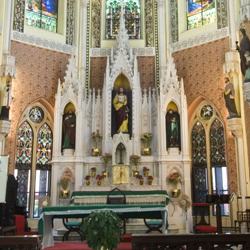
It has a beautiful altar, tall pinnacles, 21 lancet windows with exquisite stained glass fixed in the triangular apexes, on either side of the nave. The remaining portions of the nave windows were fitted earlier with venetians instead of glass, but during the years 1932 to 1937 quarried coloured glass windows have gradually taken its place.
The 'great west window', consisting of stained glass with five lights, has an intricate tracery design above and is one of Wailes's best works. Likewise, the 'great east window' is a large triplet lancet window filled with stained glass of a beautiful design. The baptistery window, with beautiful stained glass with triple lights, is situated at the East end of the south aisle. The inscription underneath reads: "To the memory of Philip Anderson, Pastor of Colaba, Bombay." A general memorial consists of series of white marble tablets bearing the names of 158 of its officers. Special memorials to officers, who died during the last Afghan War, were erected in 1882.
At the entrance of the church one finds plaque giving detailed information on the history of this church.
The friends of twelve officers of various corps have erected a reredos (ornamental screen covering wall at the back of altar). The altar was given in the memory of two officers and the marble pavement in the memory of those who had brethren in the Guild of the Holy Standard. The general memorial of all the officers, non-commissioned and the men of the Bombay Army was erected over the principle entrance in 1883. TOP
|


|
Ajanta Caves:
At about 400 kms northeast of Mumbai near to the city of Aurangabad, is located one of the most beautiful Buddhist caves of Ajanta. Carvings depicting the life of Buddha fill these breathtaking caves, which originally, date back to around 200 BC.
It was only in the 19th century, that the Ajanta group of caves, lying deep within the Sahyadri hills, cut into the curved mountain side, above the Waghora river, were discovered. A group of British officers on a tiger hunt, stumbled on these ancient works of art.. The beauty of the caves : The 29 caves were built as secluded retreats of the Buddhist monks, who taught and performed rituals in the Chaityas and Viharas, the ancient seats of learning, and nerve - centres of the Buddhist cultural movement. Using simple tools like hammer and chisel, the monks carved out the impressive figures adorning the walls of these structures. Exquisite wall - paintings and sculptures speak volumes of the India of yore. Many of the caves house panels depicting stories from the Jatakas, a rich mine of tales of the several incarnations of the Buddha. Images of nymphs and princesses amongst others are also elaborately portrayed. It was the foresight of Buddha himself that the ink would perish but not the rocks.
Cave 1 houses some of the best - preserved wall paintings, which include two great Boddhisattvas, Padmapani and Avalokiteshvara. Caves 2, 16 and 17 also contain amazing paintings, while Caves 1, 4, 17, 19, 24 and 26 boast of some of the most divine sculptures. The flying apsara, of Cave 17, and the image of Buddha preaching in Cave 17, are a couple of unforgettable works of art.
Ajanta, conjures before one's vision, a dream of beauty- of caves, hidden in the midst of a lonely glen with a streamlet flowing down below, caves that were scooped out into the heart of the rock so that the pious Buddhist monk, out on mission to spread the tenets of Buddhism could dwell and pray.
Of the thirty monuments at Ajanta, four caves No 9,10,26 and 29 are sanctuaries or Chaitya containing a stupa at the centre of their apses. The rest are monastic residences or Viharas.
The monks in ancient times were required to venture out to distant land to preach the gospels of Lord Buddha. They were to keep travelling without a transit except in the rainy season when they were to stay at Vihara. Later with the growth of cultural renaissance with the rule of Guptas in India and earlier during the reign of Maurayan king Ashoka, began architectural and sculptural activities in India. It was during the reign of Great Mouryan king Ashoka, that the sculptural activities began in the western India.
At Ajanta, the paintings on the walls, illustrate the events in the life of prince Gautama Buddha, the founder of Buddhism and in the more popular Jataka stories pertaining to Buddha's previous incarnation. According to the older conceptions, the Buddha wrought many deeds of kindness and mercy in a long series of transmigration as a Bodhisattava, before achieving his final birth as the sage of sakyas.
Incidentally they contain the scenes of semi-mythological history, the royal court and popular life of the ancient times, as told in romances and plays. Some pictures recall the Greek and Roman compositions and proportions, few late resemble to Chinese manners to some extent. However, majority belongs to a phase, which is purely Indian, as they are found nowhere else. These monuments were constructed during two different periods of time separated by a long interval of four centuries. The older ones were the product of last to centuries before Christ and belongs to Hinayana period of Buddhism in later part of 2nd century AD when Buddhism was divided into two sections, after the conduct of the fourth general council under another great king, Kanishka.
The new feature of Mahayana Buddhism was the concept of future Buddhas. The Buddha, himself probably thought that he was the last of the long succession of earlier Buddha's who lived before him. According to the Buddhist traditions, these former Buddhas were revered even in the historical Buddha's lifetime. When the stupas were constructed and beautified, the carvings were executed in a symbolic way. An inspired sculptor began to carve images of Buddha himself and within the few generations, all the Buddhist sects took to worshipping images. The universe of Mahayana contains numerous Bodhisattava, the chief of whom is Avalokitesvara with attributes of compassion. He is also called Padmapani or the lotus bearer. The Manjushri with a naked sword in one hand stimulates the understanding. The sterner Bodhisattava who is a foe of the sin and evil and bearing a thunderbolt in the hand is Vajrapani. The future Buddha, Maitreya will take birth to save the world.
The Ajanta caves and the treasures they house are a landmark in the overall development of Buddhism as such.
Though the teachings of four noble truths and eight-fold path were simple, yet it was not easy to communicate it in a gripping manner. Buddha himself once, had suggested to his disciple Ananda to set up memorial monuments such as stupas containing his relics and erect it at a place of his birth enlightenment, first sermon and final demises, for he had seen people visiting these places during his lifetime. To the motivated monks, it was a mission to fulfill this desire of their master. They began a search for a retreat from the world. They came to Ajanta valley, an ideal place for residence and meditation. It was located on an important trade route that connected the Pratisthana, an eastern capital of Satavahana kings. It was here, he realized, he could live, meditate and absorb the philosophy of Buddhism. Cave Timings : 9.00 am to 5.30 PM (Caves closed on Monday and National holidays.) Information for tourists : Many more, all masters in their own trade, painters, sculptors and carpenters joined the monks. It was simply a meaningful lot, each one telling the story of man's carvings. They were masters of their kind yet devotees to one, the Buddha.
With only six pigments in his hands, the Ajanta artist created the vocabulary of the entire colour ranges, each speaking its own language and giving meaning to the other. Though painted for religious purposes, the murals of Ajanta bear a secular rather than a religious message. We see whole of ancient India in panorama. Here are the princess in their palaces, coolies with loads slung over their shoulders, beggars, peasants and ascetics, together with all the many beasts and flowers of India. India witnessed all round development of art and architecture during the rule of Gupta Dynasty in 3rd AD. TOP
|


|
Asiatic Library:
The town hall which houses the Asiatic Library with its old parquet floor, spiral staircases and wrought iron loggias is perhaps the most elegant heritage building in Mumbai. It has a collection of 800,000 antique volumes, and ancient coins.
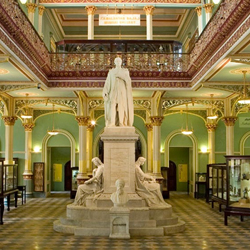
This pleasantly neo-classical building now houses the library of the Asiatic Society, as well as a small museum. The museum contains statues of some 19th century governors of Bombay, some British scholars and administrators and two Indian philanthropists and an Indian scholar.. The structure : The building is 200 feet long and 100 feet deep. The facade has three porticoes faced by Ionic columns. The plans called for a double row of columns, built out of material brought from England. Although these plans were curtailed, the final cost of the building came to about 500,000 pounds; far in excess of the initial estimates. The East India Company took on a major part of the expense. The building was completed in 1833, after the death of Cowper.
With its old parquet floors, spiral staircases, wrought iron loggias, and exquisite marble statues of forgotten city fathers, the colonnaded Town Hall is perhaps the most regal and elegant of Mumbai's heritage buildings. Collections : One of them is a priceless first edition copy of Dante's "Inferno." There is also an impressive numismatic collection of over 1,000 ancient coins and a rare gold mohur belonging to the Mughal Emperor Akbar. One needs permission to look at these treasures, but the public library is open to all and usually draws a large number of senior citizens who pore over the local newspapers in the fading grandeur of its reading room. Expensive investment worth it : In 1811, James McKintosh, then Recorder of Bombay and resident of the Literary Society of Bombay, revived an earlier suggestion of a Town Hall for the city. The society intended that this building should house not only the civic offices, but also a library and a museum along with civic offices. The Literary Society raised a fund of Rs. 10,000 through a lottery, but when this turned out to be insufficient, the government had to be persuaded to bear the costs of construction; a process that took ten years. TOP
|


|
Chor Bazaar:
This is the place where one can find curios and most of the wanted items at prices, which seem so unreal. Dont be carried away with its name. It is a good place to see many unusual goods on sale.. Location : It is located near Bhendi Bazaar. Interesting : No one is clear as to how this market got its name except that once a Queen called Victoria came to Bombay in her own steamer. Her luggage was carted down and the lady discovered, much to her dismay that her precious violin was missing. After a thorough search the instrument was finally found -- at one of the stalls in Mutton Street (next to Chor Bazaar) so the area came to be known as the Market of Thieves or Chor Bazaar.
The genesis of this dwelling can possibly be traced to the days post the World War when poverty stricken families had to hawk their priceless heirlooms for money. Great shopping : Behind the Raudat Tahera Mosque is a beautiful old Saifi mosque. Next to which is Gujjar Street where a heap of knick-knack and artifacts lie for anyone's bargaining. This is Chor Bazaar, where you can haggle and get a Gucci look-alike at an Indian price. Smuggled goods abound.
Chor Bazaar literally means "Thieves Market". The adventurer buyer may come across curios and quaint collector's items and may even chance upon a genuine antique.
This is Mumbai's famous Thieves Market where bargain-hungry tourists rummage for Ming vases at throwaway prices. The main avenue is Mutton Street, flanked by rows of small antique shops that look like musty attics and sell just about anything from old ship parts, grandfather clocks and gramophones, to crystal chandeliers and old English tea sets. Others offer authentic Victorian furniture, wonderful for browsers, antiquarians and restorers. Although bargains are sometimes staggering, most of the shop owners are pretty street smart, and could easily take a self - styled aesthete for a ride.
Mutton Street houses unremarkable wares from old English tea sets to antiques to crystal chandeliers. On Fridays owing to the Muslim Sabbath, the stalls shut down but the pavement vendors still abound. You can easily while away an hour or two browsing through these wares, though you need a practised eye to distinguish between the genuine and the spurious. TOP
|


|
Chowpatty Beach:
Chowpatty is a great place to witness the annual Ganesh Chaturthi Festival when large images of Lord Ganesha are immersed in the sea. A visit to this beach provides an interesting outing with many permanent little kiosks selling special typical mumbaish snacks. Snake charmers entertain the beach going public. The statues Lokamanya Tilak and Vallabhai Patel bring nostalgic memories of the freedom fighting.. The chowpatty colony : Apart from Juhu in the suburbs, Chowpatty is Mumbai's most famous beach. During the day, it is the hangout of the happily unemployed who snoozes under the shade of its stunted trees. But in the evening the atmosphere is more like a carnival. At one end is a row of bhelpuri shops hawking Mumbai's most popular snack: crisp puffed rice and semolina doused in pungent chutneys, all scooped up with a flat, fried puri. One might even catch a film shoot or a street play.
In short, for most tourists Chowpatty is where the action is.
It has rich historical links to the freedom movement; several important meetings were organized here during the freedom struggle. Though the beaches remain empty throughout the day, it is a hub of activity in the evenings. On the beach itself is a small colony of the original inhabitants of Mumbai, the Koli fishermen who can be seen drying their catch or mending their nets.
Chowpatty beach is in the heart of Mumbai. Children Attraction : Chowpatty developed as a sort of "base station" leading upto Malabar Hill as it is inextricably linked to adjoining areas of Malabar Hill, Girgaum, Gamdevi and Khetwadi. At the northern end of Marine Drive, this beach is a virtual carnival every day in the evenings when people come there with their children for recreation. The ferris wheels and merry-go-round hold attraction for the children as well as adults, with the array of food stalls selling golas, chat, kulfi and bhel. No doubt it is recommended only for those with a strong biology.
There are pony rides, snake charmers, self-styled gymnasts, monkey shows, eunuchs, astrologers and drug peddlers as well. The Chowpatty sea face has both residential and commercial buildings. Consequently, in the evenings the area is flooded with unsavoury elements, pickpockets and well-muscled masseurs offering their services.
Ahead, on the right across the road stands Wilson College. The recently opened "Nana Nani Park" along Chowpatty Beach serves good for the elderly to walk around in, sit and enjoy the sea breeze. TOP
|


|
Crawford Market:
Crawford Market was named after the city municipal commissioner Arthur Crawford. Built in Norman Gothic style, it provides an elegant covered shopping experience dominating the skyline with its clock tower and steeple, with cavernous spaces inside, where one can buy fruits, vegetables and meat under a single roof. It is now rechristened as Mahatma Jyotiba Phule Market.
Cowasji Jehangir donated the building, completed in 1869, to the city. Lockwood Kipling designed the friezes on the outside walls and the stone fountains inside.
It was the main wholesale market for fruits in Bombay until March 1996, when the wholesale traders were relocated to New Bombay.. Buy anything : Poised between what was once the British Fort and the local town, this market has elements of both. It's a blend of Flemish and Norman architecture with a bas-relief depicting Indian peasants in wheat fields. Crawford Market looks like something out of Victorian London, with its sweet smell of hay and 50 ft high sky lit awning that bathes the entire place in natural sunlight. Mountains of fruit and fresh vegetables are sold here at wholesale rates and next door there's also meat and poultry section along with stalls selling smuggled cheese and chocolate!
Named after Bombay's first municipal commissioner, Arthur Crawford, the Crawford Market is at the northern end of the old British part of the town, facing the crowded inner city. An elegant covered market, it dominates the skyline with its clock tower and steeple.
Crawford Market, also known as Jyotiba Phule Market, situated at the junction of Dadabhoy Naoroji Road and Carnac Road was built in 1871. The market is in the center of a whole network of lanes where the shopper can pick up almost anything. TOP
|


|
David Sassoon Library:
This yellow stone building with a distinct architecture houses a library named after the philanthropist who funded its construction.. The structure : The columns are of black (Deccan) trap and the dressing is in random rubble masonry. The ground floor facade of the three-storeyed building has pointed arches decorated in white and black stripes protecting the arcade, which is characteristic of the area. The foyer or entrance hall with its multicoloured Minton floor tiles, opens, at the back, into a garden. Above the entrance portico is a white stone head of David Sassoon. A winding wooden staircase reaches the first floor. Turrets at each corner and the central tower give the building a church-like air.
The building was designed by Scott McClelland and Company and built by the architects J. Campbell and D. E. Gosling at the cost of Rs. 125,000. David Sassoon donated Rs. 60,000 and the rest of the cost was borne by the government.
The idea of the library was mooted by twelve mechanics employed in the Bombay Mint. Sir Albert Sassoon - son of David Sassoon presented it to the city.
Looking on to the Kala Ghoda, on Rampart Row, this Romanesque structure, completed in 1870, is built from the same yellow Malad stone as the rest of the buildings in the row - Elphinstone College, the Army and Navy Building and Watson's Hotel. TOP
|


|
Elephanta Caves:
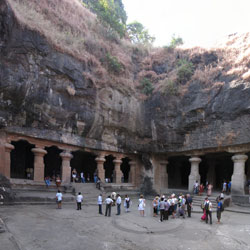
An interesting travel of about an hour by boat from the Gateway of India, passing the Mumbai harbour, and the Naval barges, takes you to Elephanta Caves where there are caves with carvings dedicated to Lord Siva. It is an UNESCO World Heritage site.
The Elephanta Island is the site of the magnificent Elephanta caves, containing beautiful carvings, sculptures, and a temple to the Hindu God, Lord Shiva. The island of Elephanta, being a commercial, military and religions centre for centuries has traces of early Buddhist culture.. The creation : No doubt the cave was the creation of an unknown genius, a master architect, who having thoroughly absorbed and assimilated the magnificent contribution of his predecessors in the dual traditions of the independent free standing sculpture and rock-cut architecture, produced a monument introducing a whole new world of form quite distinct from any previous achievement.
At the entrance to the caves is the famous Trimurti, the celebrated trinity of Elephanta: Lord Brahma the Creator, Lord Vishnu, the preserver and Lord Shiva the Destroyer. Travel information for tourists : The Elephanta Island is accessible only by boat from the Gateway of India, Mumbai. World of Lord Shiva : Its like spending a day outside the world. Elephanta is the place where the main events in the mythology of Lord Shiva are depicted. At Ellora though other Gods appear on the panel with Shiva, at Elephanta there is nothing but Shiva. Location : These caves are located at a distance of 11 kms from Mumbai. Lord Shiva in various forms : According to Hindu Mythology three Gods govern their world: Brahma-- the creator, Vishnu-- the Preserver and Maheshwara-- the Destroyer.
Here we find Lord Shiva practicing Yoga, meditating with snakes coiled around his neck, and at places He is in company of his wife, Parvati.
Panel 6 of the caves represents the wedding of Shiva with Parvati with the rites being performed by Brahma and scores of other Gods attending the grand ceremony. The coming of Ganga from heaven to Earth is described in panel 5 of the caves. As the great force of Ganga might have destroyed the Earth She lands in the hair locks of Shiva who then gently releases her. The wise and righteous Lord before whom the forces of evil and ignorance flee and are terrified into submission is carved on the 7th panel.
On the western end is the sanctuary of Linga denoting the essence of creative power, in which Lord Shiva is worshipped as the Lord of Fertility and Procreation. History : The Elephanta caves are thought to date back to the Silhara kings belonging to the period between 9th - 12th centuries. With the Brahminical resurgence during the reign of Gupta dynasty in 3rd century AD, these great caves exploded into existence at Elephanta. Legends and history suggest that the great warrior prince of Chalukya dynasty Pulkesin ll raised the shrine to celebrate his victory. Some historians also suggest that the Kalchuri king Krishnaraja built these caves in 6th century AD.
The island was the capital of the powerful coastal kingdom but later the Portuguese took possession of the island and as they first found a monolith elephant the island was named Elephanta.
As the worship of the figure of the Buddha began to be encouraged with rise of the Mahayana sect of Buddhism, a shrine was introduced to house Buddha's image, replacing the cells at the centre of the back wall. The Monasteries of Ajanta lead us directly to Elephanta. It appears that the same families of craftsmen and sculptors who were working on the Kailasa temple of Ellora and adjoining Buddhist caves at Ellora were employed at Elephanta. Elephanta Caves and Temples : Located on an island in Mumbai harbour, these are a complex of temples hewn from the rock, dated to between AD 450 and 750. The temples are adorned with intricate sculptures of Hindu gods.
The island rises in two conical hillocks. The architect sculptors carved out of solid basalt rock create a representation of the heavenly mountain residence of Lord Shiva. Opening out from three sides, the temple lets in light from many angles making the sculptures seem to move with the changing angles of light.
Inside the temple is a large hall, with nine sculptured panels representing Lord Shiva in different moods. The temple plan is symmetric with important focal points worked out in a geometric Mandala (the design representing the energy field).
Flights of steps, which can prove to be very daunting, take you to the caves. One can hire a chair to be carried up, but today the caves can be easily approached. The artisan has tried to create the cave similar to the one in which Shiva resides in the Himalayas.
The pillars inside the cave give an impression that these pillars support the roof. The pillars have been deliberately kept simple so as to attract the attention towards the exquisite carvings on the panels. There are three opening to the caves allowing light to enter from various angles in different seasons giving an expression that the images are moving with transition of light. Do you know? : It is believed that the caves were used as target practice after they constructed a fort and put a flag to ward off pirates. However, many of the sculptures have been desecrated. The Britishers captured the island from the Portuguese, and tried to find out who had built these caves, but failed. The Britishers planned to take the monolith elephant to England but they could not lift it. It is now kept in the Bombay Museum.
Hewn out of solid rock, the caves attract more visitors each year than the entire city of Mumbai. No wonder, this place resonates with the spiritual energy of India. The cave complex is a collection of shrines, courtyards, inner cells, grand halls and porticos arranged in the splendid symmetry of Indian rock-cut architecture. Unfortunately, iconoclastic Portuguese rulers who took potshots at Hindu Gods with their rifles have damaged many of the sculptures inside. And yet somehow, nothing has disturbed the sublime beauty of this place for centuries. TOP
|


|
Ellora Caves:
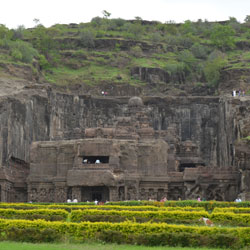
Parts of World Heritage monuments are the Ellora Caves located at about 400 kms from Mumbai. These cave monuments were patronized by Chalukya kings during 17th Century. The creative dynamism of the artists can been seen from the sculptures where they drew themes from the Hindu mythology and transformed the rocks into a cavalcade of God and Goddesses.
The Ellora caves lay in the lap of the Chamadari hills extending over a mile and a quarter in the north-south direction. They are situated 18 miles northwest of Aurangabad. Ellora represents some three hundred years of great experiments carried out by different faiths with their very different iconography and structural compulsions. Ellora first appears to the visitors as an irregular ridge of rock, rising vertically from the ground.. Jain Dedication : These caves show the beliefs of the Jains, and their strict asceticism that imbibed in them a spirit of non-violence towards all. They do not carry the high voltage drama of the Hindu or the Buddhist caves nor are they ambitious in size but they balance these with their exceptionally detailed work. The 32nd cave is a beautiful shrine with exquisite carvings of a lotus flower on the ceiling and an imposing yakshi seated on her lion under a mango-tree. The ceilings of this double-storied cave are also decorated with paintings. Paintings : Mural paintings in Ellora are found in 5 caves, but they are preserved only in the Kailasa temple. The paintings were done in two series - the first, at the time of carving the caves and the subsequent one was done several centuries later. The earlier paintings show Vishnu and Lakshmi borne through the clouds by Garuda, with clouds in the background. The sinewy figures have sharp features and pointed noses. The protruding eye typical of the later Gujarathi style appears for the first time in Ellora. In the subsequent series, the main composition is that of a procession of Shaiva holy men. The flying Apsaras are graceful. Very few murals in the Jain temples are well preserved. Hindu Outlook : The Hindu caves exhibit a totally different league in terms of style, creative vision and execution skills. These temples were built top to bottom and the architecture of these caves show that it required several generation of planning and co-ordination to give it the final shape. Cave 14 was initially a Buddha Vihar but in the 7th century it was turned into Shiva temple, where Shiva is depicted as The Destroyer.
The 16th cave in the group is one of the audacious feats in architecture ever achieved. The idea was to build Kailash from a single stone. Hence it got its name, Kailasnath temple. The artist then tried to give the structure, the shape of a temple. The scale at which the work was undertaken is enormous. It covers twice the area of the Parthenon in Athens and is 1 ½ times high, and it entailed removing 200,000 tonnes of rock. It took 100 years to be completed. The Ramesvara cave has figurines of river Goddesses adorning its entrance. The Dumar Lena cave resembles the great cave shrine at Elephanta and is dedicated to Lord Shiva. History : Ellora caves are finest specimens of cave-temple architecture housing elaborate facades and exquisitely adorned interiors. These structures representing the three faiths of Hinduism, Buddhism and Jainism, were carved during 350 AD to 700 AD period.
The cave monuments of Ellora were chiefly patronised by the Chalukya - Rashtrakuta rulers [7th - 10th century AD]. The kings and the mercantile community willingly donated to the cause of the temple building. Certain religious injunctions and the ethical codes, prompting patronage of works of the art, governed the rulers. The temple building was considered to help the attainment of worldly power as well as religious merit and spiritual salvation.
These cave shrines are memorable for their invaluable contribution to the enormous wealth of Indian heritage. Caves and Temples : In total there are 34 temples carved out of stone which can be divided into three groups belonging roughly to three periods: Buddhist, Hindu and Jain. Only 12 of the 34 caves are Buddhist, but even these caves incorporate Hindu and Jain theme, demonstrating the gradual decline of Buddhism.
It took over five centuries for the Hindu, Buddhist and Jain monks to chisel out these monasteries, temples, and chapels and decorate them with remarkable imagination and detail. These caves run North-South and take on the Golden Radiance of the late afternoon sun. Festival : Every year in the third week of March, M T D C organises the Ellora Festival of Classical Dance and Music at the caves. Buddhist Expression : Out of 34 caves, sixteen caves are the oldest in the group carved in the 5th century. As one enters these caves, one crosses graceful angles and steps in a high ceiling chamber where a 15 feet huge statute of Buddha is sitting in a preaching pose. The artist has tried an element of surprise by giving them expression of wood. Most of these 16 caves are viharas but cave number 10 is a Chaitya.
The style of carvings and sculptures in these caves indicate that initially the artist was going in for simple decorations but later, as in caves 11 and 12, he became more ambitious. The 10th cave has an impression of wooden beams on its ceiling and has a small decorated window, illuminating the sitting Buddha. These caves are rightly called the Vishvakarma caves. This cave is considered to be one of the finest caves in India, where life and religion go hand in hand. The amorous couples play joyfully along the balustrade. Step out of this cave and you come across an upper gallery giving a view of the precisely carved Naga Queen, the harbinger of monsoon and the dwarfs who were the court entertainers. The Buddhists believe that Buddha returns after every five thousand years, thus the 12th cave has seven images of Buddha depicting his seven incarnations. TOP
|


|
Eros Cinema:
Shorabji Bhedwar designed this beautiful Art Deco building marking the beginning of Back Bay reclamation in early 1938. Interesting murals, housing shops and other businesses along with a cinema provides an interesting outing to this place. It is an excellent example of modern urban design.. The foundation : The foundation of Eros Cinema was laid in 1935. This grand luxury cinema opened in 1938 thus establishing its presence at the pivotal urban junction where it is situated. The construction of this building on the then newly reclaimed Backbay plot housing shops and other businesses, apart from the cinema, took about two and a half years to complete.
Partially faced with red Agra sandstone, this building is painted cream -- the combination making the building look taller.
The two wings of this Art Deco building meet up in a central block. The foyer is in white and black marble with touches of gold. Marble staircases with chromium handrails lead up to the upper floor. The murals are in muted colours depicting Indian architectures. TOP
|


|
Essel World:
Essel World, the first and foremost amusement park is located on Gorai Island on 64 acres of green lands. It offers thrilling and scintillating rides and games.
Essel World offers over 40 exciting rides, games, and attractions. The Water Kingdom is said to be the largest of its kind in Asia. This international-style theme park and amusement centre situated close to Gorai Beach is perfect for a one-day holiday. Special ferries get you across to the park and the entrance fee normally takes care of a fixed number of rides, which include the standard roller coaster and adventure themes, plus a water world section where kids can literally run amok.
Summer is usually crowded, but the place also offers low budget monsoon packages and special deals on weekends.. Fun never ends : Come to Essel World, where the fun never sets. Located away from the clamorous city life, this park is a refreshing getaway from the mundane to the magical. It is an unmatched leisure destination, offering enthralling attractions to the entire family.
Recharge your emotions! TOP
|


|
Fantasy Land:
Located at Jogeshwari, a fun park enveloped in 30 acres of lush green landscape Fantasy Land provides many entertainment rides for those with appetite for adventurous rides.
It is another amusement park made up of modern mechanism games for children and adults like Essel World. It is also a venue for fun and games for visitors of all ages.
Fantasy Land, a fun park within the city limits of Mumbai, is enveloped in lush green landscape, spread on an area of 30 acres. The park opened to the public in September 1992 and has since grown from strength to strength adding new innovative entertainment and sporting attractions that have been one of their kind in India.. Food and fun : There are Indian, Chinese and American fast food restaurants, where you can relax and fill-up on energy consumed.
Information for tourists
Senior citizens are allowed free, on proof of age. Location : It is located on the Jogeshwari Vikhroli Link Road off the Western Express Highway. Timings : 1100 Hrs-2130 Hrs An array of international rides and games. : There is an Italian merry-go-round in porcelain finish. Also is a Dragon that clocks to and fro like a pendulum, swinging scores of people at one go. A Master blaster with a dozen arms that lift you high up in the air and then lower you suddenly. A Slam Bob in which boats surf the air at great speeds. A grand Slam where you crash your car into another and walk out smiling. And topping all these and other rides is the Roller Coaster (Ze Ulta Fulta Express). It takes a full 360-degree turn in the sky, leaving you suspended in mid-air.
Besides these rides there are also coin-operated games, pedal boats in an artificial lake and horse rides. TOP
|


|
Flora Fountain:
Cursetjee Fardoonjee Parekh donated this landmark structure Flora Fountain. Built in 1864, it was made of imported Poland stone and is located close to the church gate of the old (now vanished) British fort.
Flora is the Roman Goddess of Flowers, her pretty alabaster face continually assaulted by grime and pollution. It stands at a busy five-point intersection in the heart of the commercial Fort area. The Flora Fountain was erected by the Agri-Horticultural society of Western India. It was originally meant to be named after Sir Bartle Frere, then governor of Bombay. However, the name was changed before the fountain was unveiled. It stood in the center of the town as it then was, but now this area is the heart of the business district of the town.
This is the very heart of Mumbai, circumscribed by stately colonial buildings standing like proud old sentinels of a bygone era. Next to her are a pair of torch bearing stone patriots that rise from the Martyrs Memorial nearby. Flora Fountain is now called Hutatma Chowk or Martyr's Square to honour those who died in the tumultuous birth of Maharashtra State. All around the square sit Mumbai's infamous vendors selling just about everything under the blazing tropical sun - from cheap nylon saris to herbal remedies. Tooting horns and traffic complete the chaotic picture, but through it all Flora manages to retain her serene composure.. Attractions : Within a radius of two miles of the Fountain are some of the most interesting institutions and building of Bombay - the University, the old Secretariat, and the famous Gateway of India. Near the fountain is the High Court, the highest court of law in the State, completed in 1879 and is in the Venetian Gothic style characteristic of all Bombay's public buildings put up in the 19th century. It has two pinnacles with the statues of Justice and Mercy. Across the road, on Veer Nariman Road, is the Central Telegraph Office. On the left (down a shady avenue adjoining a sports field known as the Oval) one comes to the old Secretariat. Built in 1874, it is in the same style of architecture as the High Court. Special Attraction : It remains an important downtown landmark in Mumbai's business centre. Vendors sit all around the square selling just about everything in the scorching heat. Noise pollution due to heavy traffic completes the chaotic picture. TOP
|


|
Gateway Of India:
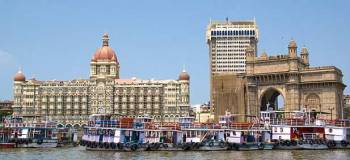
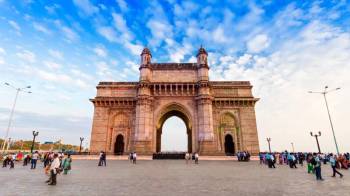
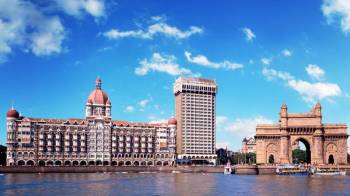
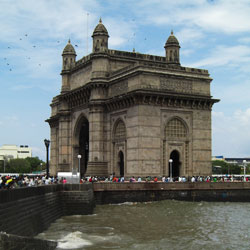
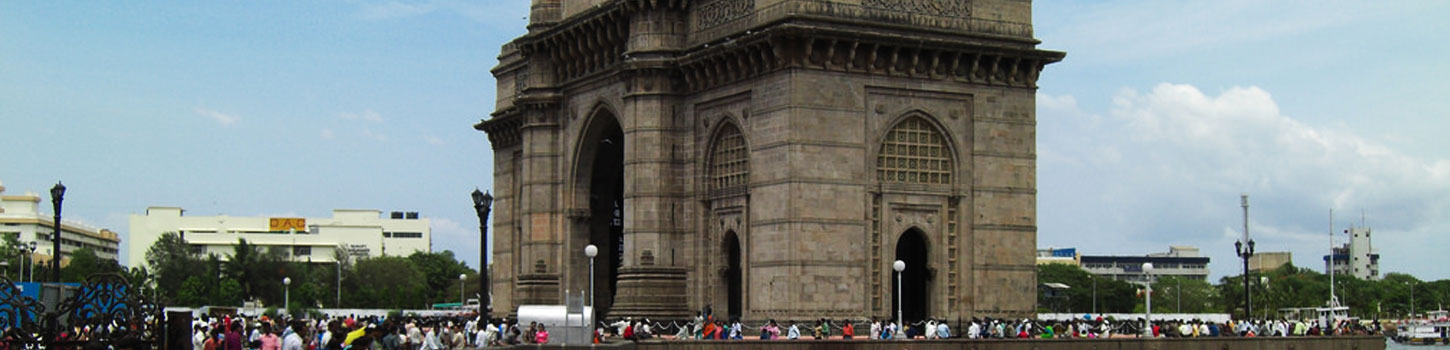
Gateway of India was built with yellow stone in Indo- Sarcenic style to commemorate the visit of King George V and Queen Mary to Bombay and since has become the Icon of Twentieth century Indian history. It is also remembered as the point from where the last British troops left the shores of independent India.
To commemorate King George and Queen Mary's visit to India in 1911, the Gateway of India was built at Apollo Bunder, a popular meeting place. The Gateway was built by the British and designed by the architect George Wittet. The first stone was laid by the then Governor of Bombay on March 31st, 1913. This triumphal arch was built at an astonishing cost of 21 lakhs, and was open to the public in 1924. A conventional Arch of Triumph inspires its 26 metre high archway. It is complete with four turrets and intricate latticework carved into the yellow basalt stone.
Ironically, when the British Raj ended in 1947, this colonial symbol also became a sort of epitaph: the last of the British ships that set sail for England left from the Gateway.
Influences of the 16th century Gujarati style are also evident in its architecture. Situated next to the Taj Mahal Intercontinental Hotel, it is the most enduring landmark of Mumbai.. Information for tourists : Behind the arch, there are steps leading down to the water where one can get onto one of the bobbing little motor launches, for a short cruise through Mumbai's splendid natural harbour. One can easily buy tickets for a short cruise on the motor launches from here.
From Colaba, the Gateway of India is barely ten minutes away by cab. Between 1915 and 1919, the land on which the Gateway was to be built was reclaimed from the sea and a new sea wall was built.
This monument is a rather lavish expression of imperial supremacy but is also an apt epitaph as the last of British troops, post independence in 1947, marched through the Gateway and onto the ships, which took them back to England. The structure itself is quite majestic and an unlikely hybrid of the Arc de Triomphe in Paris and a Moorish palace. Attractions around : Close by are the statues of the Maratha leader Shivaji astride his horse and of Swami Vivekananda, adding to the charm of this monument.
Both these statues are a recent addition to the Gateway landscape and stand in the middle of a formal front lawn, which is a popular gathering place for the public and tourists, especially on weekends.
The changing light of the rising and setting sun gives varied hues of gold, rust and pink to the imposing arch. Historically, the Gateway holds greater significance as the last of the British troops left Independent India by sea, marched through its portals. Appropriate beginning : It is the starting point for most tourists who want to explore the city. When a visitor comes to Mumbai by sea he sees a 26 m high
structure. This structure is the icon of Mumbai.
Today this symbol of colonialism has got Indianised, drawing droves of local tourists and citizens. TOP
|


|
General Post Office:
The General Post Office is an example of the Indo-Sarcenic style of architecture located just behind the Victoria Terminus. Its dome is built on the lines of Gol Gumbaz in Bijapur. High vaulted ceilings, sweeping staircases, marble topped tables make this building as a showcase of wealth and pomp of the British rulers.. Location : Just behind the Victoria Terminus. Worth a visit : John Begg designed the building. Worth taking a look are the old wooden counters and lofty arches of the three-storey high Rotunda Hall. Completed in 1872, the General Post Office features a vast central hall, rising through the height of the building to the dome. Built in local basalt with dressings of yellow stone from Kurla and white stone from Dhrangadra, this landmark of the 1930s is one of the important tourist attractions in the city.
Inside, the marble topped tables, the high vaulted ceilings, and the sweeping staircases are designed for an ostentatious show of the wealth and power of the last few decades of Imperial British rule in India. TOP
|


|
Haji Ali^s Mosque:
: Honoring the Muslim saint Haji Ali this mosque was built in the middle of the sea with only a narrow path leading to it giving it an ethereal look. As per the Muslim traditions separate praying rooms for ladies and gents are provided here to pay their respects.
It is set 500 yards into the sea and can be reached only in low tide. The Haji Ali mausoleum has an offshore location, opposite the Mahalakshmi racecourse. During high tide, the connecting causeway is submerged in water giving the impression that the mosque and tomb are floating out at sea in splendid isolation.
This is The Haji Ali Dargah, the floating tomb of a wealthy Mohammedan merchant who renounced his worldly ways before embarking on a pilgrimage to Mecca.. Special Attraction : The mosque can be reached only during low tide. The whitewashed mosque also has a cool courtyard generally full of people and refreshment stalls. The rocks exposed during low tide at the rare end of the mosque are a favourable spot to catch some cool sea breeze.
There's nothing somber about the building's cool courtyard, which is generally full of chattering families and refreshment stalls. The Structure : The structure is a slim solitary minaret.
It is linked to the mainland by a tenuous causeway, which is practically nonnegotiable during rough monsoon, tides. Behind the sculpted entrance, a marble courtyard contains the central shrine.
Hundreds of worshippers stoop to press their forehead against the richly brocaded red and green chaddar covering the tomb, lying in an exquisite silver frame supported by marble pillars and is decorated with artful mirror work: blue, green, yellow chips of glass arranged in kaleidoscopic patterns interspersed with Arabic patterns which spell the ninety-nine names of Allah.
Women sit behind carved partitions, their heads bent over the Koran. Every year, the tomb is washed with rose water, which is then distributed among the ailing for its healing properties and the faithful continue to tie red threads on wooden lattices to honor the soul of Haji Ali.
It is a handsome example of Indian Islamic architecture, associated with legends about doomed lovers; the dargah contains the tomb of Haji Ali. Information for tourists : The durgah is more or less shut for visitors and devotees during the monsoons, as the sea is very violent and there is a high risk in crossing the causeway.
Attached to Haji’s body was a note stating that his body should be buried wherever it lands. The body was found on the rocky island and the durgah was erected in his memory. Legend : The legend goes that Haji Ali died on a pilgrimage to Mecca and miraculously his casket floated back to these shores. The mosque is picturesque with a vast courtyard and refreshment stalls.
It contains the tomb of the Muslim saint Haji Ali. The saint is believed to have been a wealthy local businessman who renounced the material world and meditated on a nearby headland following a pilgrimage to Mecca.
His devotees built the mosque and the tomb in the early 19th century. Alternate version says that Haji Ali died while on his pilgrimage to Mecca and his casket surprisingly floated back to Mumbai (then Bombay). TOP
|


|
ISKCON Temple
ISKCON, Mumbai is a part of the series of temples built across the world to propagate the message of Bhagwat Gita nad raise the consciousness about Lord Krishna. ISKCON temples are not mere places of worship or places of aesthetic and architectural beauty. These are symbol of intellectual development and mediums of movement on higher plane-spiritual plane.. Belief : ISKCON belief is based upon the real God consciousness that does not depend on caste or church membership. They spread the chanting of the holy name as the method to enable anyone to become Krishna conscious.
It is a place for worship, meditation and spiritual knowledge, advocating the principles of Bhagwat Gita as taught by Lord Krishna.
The temple has a very soothing atmosphere and hence it is a popular place to meditate. Books on the religion are sold there too. When you are there… : For a peak into this fascinating world, drop in for lunch at the ISKCON restaurant, where pure vegetarian food, as prescribed by the Vedas, is served and eaten by these shaven, robed ascetics.
Later one can visit the serene marbled ISKCON temple and sit in for the evening aarti or prayer that reverberates with touching devotion. Attractions : Located on four acres of land in Mumbai’s picturesque Juhu Beach, the Hare Krishna Land includes a spacious marble temple, theater, restaurant, Bhaktivedanta Institute, and a twin-towered seven-storied hotel. The project cost more than $2 million dollars in 1976 and took nearly three years to build.
The Hare Krishna temple or the Sri Sri Radha Rasabihariji Mandir has now become a landmark in the suburb of Juhu. This temple is a part of a worldwide network of temples and devotees of Krishna.
The main Deities of the temple on the center altar are Radha-Rasabihari and the two gopis Lalita and Visakha. Rasabihari is a name for Krishna meaning "the enjoyer of the transcendental rasa dance". On the right altar are Sita-Rama, Hanuman, and Laksmana. On the left altar are Lord Nityananda and Lord Caitanya. At Their feet sit Srila Prabhupada, Founder-Acarya of the International Society for Krishna Consciousness, and his spiritual master, Srila Bhaktisiddhanta Sarasvati Thakur.
There is an excellent maha-prasada booth here. The temple in Hare Krishna Land, has an International Guest House "Govindas", which is pure vegetarian restaurant, a sweet stall, a gift shop, The Maha-Prasad Stall, a multimedia department and the Music Academy.
It is quite lavishly built both in terms of architecture and the various facilities it provides. There is a wonderful bookstore within the premises housing all the in-house publications, quite well written, and often much sought too.
Recently there is a new added attraction - Food Corner where one can find the choicest delicacies and sweets of India. TOP
|


|
Jehangir Art Gallery:
A prime art gallery in the city of Mumbai Jehangir Art Gallery caters to the artistic tastes of people. This is situated behind the museum and has four exhibition halls.
Facing Elphistone College and adjacent to the Prince of Wales Museum, this gallery situated at Kala Ghoda is the most prestigious and modern venue for Indian artists.
It was built in the year 1952. Managed by the Bombay Art Society, the entire cost of this beautiful mansion was donated by Cowasji Jehangir.
This gallery is one of the city's most highly visible art galleries and having to exhibit a work of art here is a great treat for artists. The unending list of applicants to have their work put up on the walls of this gallery speak for itself of the great importance and the media attention one attracts. Some might have to wait a couple of years to have their work put up here.. The Structure : In 1911 with a donation of Rs. 400,000 given by Sir Cowasji Jehangir, George Wittet built the Jehangir Hall, originally a part of the Institute Of Science.
In 1996, the hall was converted to a museum of modern art, with 20,000 square feet of exhibition area at a cost of Rs. 33,000,000. As a protected heritage structure, the external appearance of the building is not allowed to change; nor can structural alterations be made; in addition, changes are required to be reversible. Romi Khosla, the architect, erected new walls two feet inside the original, and laid a new marble flooring over the original black stone. The interior was completely restructured into four split-level galleries, a room for seminars and audio-visual presentations, and spaces for a bookshop and a cafe.
The National Gallery of Modern Art (NGMA), Delhi, administers the new museum. A section of the museum holds a permanent collection from the NGMA's possessions. Temporary exhibitions take up the rest of the space. Tourist Information : Open: On all Days
Timings: 1100 Hrs. to 1900 Hrs.
It is the uncrowned Mecca of Art in Mumbai City. It was built as a part of the grant given to Bombay University.
This gallery displays changing exhibits by well-known Indian artists. There's plenty of art to be seen outside as well, as the plaza in front of the building is full of artists offering their works for sale and their talents for commission assignments. TOP
|


|
Juhu
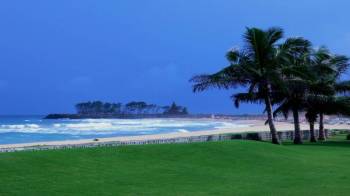
In Maharashtra Beach travelling pleasant throughout the year. In particular, the capital city of Mumbai is blessed with many beaches in its vicinity, that present a breather to the local population as well as act as attractive tourist option for those visiting from outside. One such beach site is Juhu, one of the largest and frequently visited beaches of India.. Interesting and entertaining : Juhu is one of the largest and frequently visited beaches of India. Located 18 km north of the city centre, it’s a beckoning beach on the shores of Arabian Sea and is one of the posh localities of Mumbai where one finds the bungalows of the famous film personalities. Many shootings are held here.
On the southern end of the Juhu beach one can find many Luxury hotels and apartments, which is regarded as a favourite haunt of Mumbai's movers and shakers.
However, this beach is not a very good place to swim, as it is crowded with choc-a-bloc Bhelpuri and Kulfi stalls. Others : On weekends we can take the pleasure of horse and donkey rides, dancing monkeys, acrobats, cricket matches, toy sellers and various types of Indian beach entertainment. Versova Beach is towards north of Juhu, which is a home to Mumbai's largest Koli fishing community. TOP
|


|
Kalbadevi
North of Crawford Market, are the narrow lanes of Kalbadevi a predominantly Muslim area hemmed in by laundry-draped chawls, which is home to a seething mass of people. It is a complete contrast to South Mumbai cleanliness and orderliness and is a different world in itself giving insight into the lives of people living in such chawls.
No visit to Mumbai is complete without a foray into the bazaars of Kalbadevi, north of Crawford Market. It is a perfect foil to the relative space, orderliness and modernity of South Mumbai.. Strange experience : These bazaars are both a spectacle to watch and a place to shop.
Entire streets are often devoted to a single product, which can be a strange experience as you suddenly encounter shop after shop selling bathroom fittings or copper pipes. The main areas are Zaveri Bazaar (jewellery), Mangaldas Market (cloth), Dhabu St (leather goods) and Chor Bazaar (Mumbai's 'thieves' market'). Mutton St in Chor Bazaar specializes in antiques, clever duplicates and assorted junk. The Best solution : It's best to venture into the bazaars without a clear destination in mind and wander aimlessly until you've had enough. TOP
|


|
Mahalaxmi Temple:
Goddesses Mahalaxmi, Mahakali and Maha Saraswathi are the presiding deities in this famous temple, which is constructed on the seashores attracting large number of devotees everyday.
The Mahalaxmi Temple located at the northern foot of the Malabar Hill; a part of it is now called Breach Candy in Mumbai, is a popular holy site. This is one of Mumbai's oldest temples dedicated to Mahakali. There are effigies of several Hindu gods here. Many devotees visit this temple.
A creek to the north separated the island of Mumbai from the Koli island of Worli. This creek was filled after the completion of the Hornby Vellard in 1784. Soon after, the modern temple of Mahalakshmi was built here.
Breach Candy is one of the posh areas of Bombay and boasts of swanky showrooms, expensive apartments and the Breach Candy Hospital.
The Temple complex is easily distinguished by the flock of grey pigeons pecking at grain in its courtyard. Beyond the ornate gate is the shrine wherein resides the buxom goddess of Lucre -- Laxmi. The compound of this temple is abuzz with stalls selling flower garlands and pious paraphernalia.. Location : It is located in Breach Candy. It is adjacent to the American consulate. Special Attraction : The Mahalakshmi Temple in Breach Candy is one of the most popular temples in the city and during Navarathi celebrations devotees stand for hours in long queues awaiting their turn to worship. Facts : Originally, three temples dedicated to the three deities Lakshmi, Saraswathi and Kali were situated to the North of Malabar Hill. Unfortunately, invaders destroyed them. The British sought to connect Mahalakshmi area to Worli but the efforts turned out to be fruitless as high tides swept across and destroyed the links. It was at this time that Ramji Shivji, a contractor had a dream where goddess Lakshmi appeared. Festivals : Navaratri festival is celebrated with special interest during which Hindus throng this temple in great numbers to offer coconut, flowers and sweets to the goddesses.
On weekends the queue to see the Deity can be very long. Idols : There are three beautiful images of Hindu goddesses, Mahalaksmi, Mahasaraswati and Mahakali in the temple made of gold. It is believed that these images of worship have been founded in the sea. All three images are adorned with nose rings, gold bangles and pearl necklaces and the image of Mahalaxmi is shown riding a tiger and a demon (Mahishasur) in tandem. Legend : Legend has it that in the 1890s, when a British engineer was constructing the adjoining causeway, the sea always troubled the project. Every time the foundation was laid, the sea would rush in and destroy it.
It is said that Goddess Laksmi appeared to the contractor in a dream and told him that unless he installed in a temple the Deity of her that would appear from the sea, the breach-wall would not hold. The next day a Laksmi Deity was found and this was done with due alacrity, and the causeway was ultimately completed. TOP
|


|
Marine Drive:
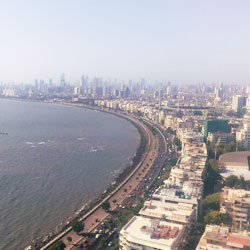
Marine Drive popularly known as the Queen Necklace is the most popular tourist spot giving an enchanting view of the sun set over the Arabian Sea. It glitters in the night with its beautifully lighted promenade along the shore.
Marine Drive was built on reclaimed land in 1920, and is one of the most famous promenades of the city. From Malabar Hill, past Chowpatty, onto the elite business centre of Nariman Point, the road glitters with streetlights at night. The curve of the road resembles a glowing pearl string.
Marine Drive located in the central Mumbai, on land reclaimed from the sea, is Mumbai's most famous thoroughfare. Recently it has come to known as Netaji Subhashchandra Bose Road with Nariman Point on one end to Babulnath, at the foot of Walkeshwar on the other.
This expanse of sand and sea is the place where pleasure seekers come to relax after dusk in the cool sea breeze.
One can see the statues of Lokmanya Tilak and Vithalbhai Patel. There is a huge line of stalls on the beach, selling 'Bhelpuri', 'Kulfi' and 'Paan'. There are also shooting galleries, snake charmers, monkey trainers, balloon sellers and even masseurs. Recently they have added a park called Nana-Nani Park for elderly people.
The 'Queen's Necklace', as it is also called, emerged as a magnificent avenue and has seen the changing of its glittering streetlights from 'diamonds' (white light) to 'Gold' (yellow lights).. Busy shores : Along the shoreline are hundreds of tetra pods, ungainly concrete structures which check the fury of the choppy tides during monsoon. The road is one of the busiest in Mumbai with vehicular traffic zipping continuously through out the day.
If you're feeling energetic, a stroll down Marine Drive is possibly the best way to discover the Mumbai Shaher. This is a windswept promenade, flanked by the sea and a row of art deco buildings. It is one of Mumbai's busiest roads, an important artery for the heavy suburban traffic heading downtown. TOP
|


|
Metro Cinema:
Interesting are the anecdotes of some of the landmarks of Mumbai like the Metro Cinema which was opened in 1938 and was screening only English movies from the house of MGM for a long time. It is supposed to be on a lease for 999 years with a rent of Re 1 per year.
The main architect was Thomas W. Lamb of New York, and D. W. Ditchburn of Bombay (Mumbai) was the associate architect.. Creation : The Art Deco cinema opened on June 8, 1938, and initially exhibited movies made by MGM. The interior, floors, walls, ceilings and furniture was in shades of red and pink. The marble foyer and staircases led up to murals executed by students of the J. J. School of Arts, under the director Charles Gerard. TOP
|


|
Mount Mary Church:
People of all faiths and religions flock this Mount Mary Church in Bandra where the week long fair takes place. One can watch the sun set and the sereneness of the Arabian Sea from this place.
Mount Mary Church is one of the most prominent churches in Mumbai, situated on a quiet hillock in suburban Bandra. As the name suggests, it is dedicated to the Mother of Christ. The Marathi speaking communities refer Mother Mary as - Math Mauli.
There is another statue of Mary installed outside the Church. People, of genuine faith, lit wax candles before the statue and pray for the welfare of their family. People strongly believe that Mount Mary fulfils their genuine wishes if prayers are made earnestly and faithfully.. Location : It is located in Bandra close to Bandstand and past Hill road. Special Attraction : If you are in search of some peace of mind then this is the place to be.
In September, the festival of the Virgin Mother culminates in a weeklong fair, popularly known as Bandra Fair, that has all the excitement of a small carnival. The Construction : The original chapel of Mount Mary was built around 1640, and was rebuilt in 1761. The Church Of Mt. Mary is familiar to almost every citizen of Mumbai, in other words almost everybody in Mumbai have paid his or her visit to Mt. Mary. Local belief is that the original chapel was destroyed during a Maratha raid in the year 1738. The statue of the virgin was later recovered from the sea by fishermen and installed in St. Andrews, before being permanently shifted to the rebuilt Mt. Mary. TOP
|


|
Mumbadevi Temple:
Koli Goddess Mumbadevi after whom the city was named is the presiding deity of this temple re-built in Bhuleshwar after it was destroyed in the year 1737. Tourists can take the city buses from any point of the city to reach this temple.
She is considered as Mumbai resident deity. The temple of Mumbadevi once stood on the site of the present Victoria Terminus in the central island.. Other idols : Beside the statue of the orange-faced goddess MumbaDevi also reside idols of Indra, Ganesh and Hanuman. The temple : The Mumbadevi temple is six centuries old. The first Mumbadevi temple built by Koli fishermen was situated at Bori Bunder. Legend : Walukeshwar Mandir is one of the Mumbai ancient Hindu Sites, dedicated to Walukeshwar (Lord Shiva) or Sand-Lord. According to the great epic Ramayana, it is believed that Rama paused here during his journey south to rescue Sita from the clutches of the evil Ravana, and created a lingam out of sand to worship Shiva.
Folk etymology derives the name Walkeshwar from the Sanskrit name for an idol made of sand-- Valuka Iswar.
The Banganga tank, unremarkable hemmed in by a towering wall of apartment blocks, is believed to have been created by an arrow fired from Rama's own fabled bow. Today it is a minor pilgrimage site, busy only on full moon and on amavasya (no moon) days of the month.
With the passing time the Walukeshwar shrine, became one of the western Indian coast's most important religious centres, venerated even by the marauding Malabar pirates who menaced the islands. The present temple was erected in 1715 after the Portuguese had destroyed the original temple.
The kings of the Silhara dynasty, who ruled Bombay from the 9th to the 13th century, originally built the Walkeshwar temple. Rama Kamath rebuilt the tank in 1715 out of a donation for the temple. The main temple has been reconstructed since then and is at present a reinforced concrete structure of recent vintage. Idol : The temple houses an image of the Goddess Mumbadevi dressed in a robe with a silver crown, a nose ring and a golden necklace. To the left is a stone figure of Annapurna seated on a peacock. In front of the shrine is a tiger, the carrier of the Goddess. The Goddess personifies Mother Earth and is still worshipped by descendants of the Dravidian population of western and southern India.
The MumbaDevi road is a narrow street lined with stalls selling a spectrum of objects associated with Hindu religion -- copper bracelets, rings, rudrakska malas, brass lingams, photographs of deities, incense, saffron and so on. Ochre clad sadhus flit along the street, their foreheads smeared with ash paste and vermilion.
Just outside the temple, are sold flowers: garlands of sweet smelling jasmine, orange marigolds and pink lotuses -- an offering, considered auspicious by the worshippers. The temple itself is not impressive but is an important landmark as it is dedicated to MumbaDevi, the city's patron deity. It is from her that Bombay (Mumbai) gets its local name Mumbai. TOP
|


|
Mumbai High Court:
High court of Mumbai is located in the erstwhile Fort of Mumbai. It is a hauntingly beautiful structure opposite the maidan which was formerly a bowling green during the British Raj where one can find many budding cricketers striking away at the ball and playing blissfully.. The grand structure : A splendid Gothic revival building designed by a General Fuller of the Royal engineers, the High Court was built with local black basalt during the late 19th century. The chambers are surrounded by Venetian style galleries decorated with exuberant carvings of monkeys with scales of justice, foxes wearing barristers' clothes, pigs, tigers and birds cavorting in petrified jungles. The stonemasons were unknown local artisans, who were given a free hand. Nearby attractions and the Grand Court : From the western side of Flora Fountain stretches the Veer Nariman Road. The pavements of this street are packed with roadside stalls selling books, old and new, classics and fiction, academic and porn literature. As one moves along, at the intersecting Bhaurao Patil Road is the Bhikha Behram Kuwa, an 18th century well, considered sacred by the Parsi community. Non-Parsis are not allowed to enter but peering through the flower-covered trellis, one can catch a glimpse of the Parsis wearing scarves and satin silk caps, some praying and others lighting the customary lamps.
Further down the road are the Western Railway Headquarters, the majestic building in grey stone facade and white plaster cupolas. Next to it is Churchgate Station, a sterile post-Independence building teeming with hundreds of commuters at any given time of the day. Here, if you backtrack to the Bhaurao Patil Road, you will confront an impressive Gothic structure in grey stone -- the High Court.
The four storeyed High Court was completed in 1878. This was the site of the Esplanade, a bowling green just outside the fort walls, which were struck down in the 1860s to make way for a row of public buildings.
On the fringes of what was once the walled Fort of Mumbai, stands the High Court, - hauntingly beautiful (some say haunted!) structure, in brooding black stone. Opposite it lies the Oval Maidan, formerly a large Bowling Green where English memsahibs came to "take in the air." Today, it is an important lung in a congested city, with aspiring young cricketers practicing their paces under the watchful eye of the High Court and the Mumbai University. TOP
|


|
Nehru Centre
It opened in 1986 and now houses the Discovery of India exhibition, an art gallery, theatre and restaurant. Inspired by Nehru's book of the same name, it seeks to explore 5000 years of history by investigating the geographical, social, culture and political forces at play in the subcontinent. It's highly informative in a school trip kind of way. But then it's best to concentrate on just a couple of the major themes, such as the detailed exhibits depicting Nehru's life and times. Other interesting topics include the Mauryan Empire, the impact of the west and the struggle for independence.
Children below five years of age not allowed into the Sky Theatre.
The Nehru Planetarium is closed on Mondays.
It was in 1972 that the Nehru Centre was conceived by the late Shri Rajni Patel and others as a living memorial to the maker of modern India, who symbolized the ideals of enlightened curiosity, scientific temper, secular values, a world view and above all, a faith in the people of India. The late Smt. Indira Gandhi laid the foundation stone of this magnificent dream on November 2, 1972 on a six-acre plot leased by the Government of Maharashtra.. TOP
|


|
Nehru Planetarium:
One of India finest architects J.M.Kadri designed this beautiful landmark building which houses Nehru Planetarium. Nehru Centre of Science is also located here.
8 Kms. from the city centre is located a centre telling about the universe. It unfolds the mysteries of the cosmos. They also screen regular film shows on the outer space, which are of particular interest for children. Close by is the Nehru Science centre, which is a science park, and permanent exhibits on intricacies of life. The antique models of Railway engines, aeroplanes, tramcar and steam lorry are exciting to see.
Nehru Planetarium is the only astronomical centre in Mumbai, which is also a concert cum movie auditorium. This is the place, recreating the image of the sky as seen from anywhere on the earth at any time. It exhibits collections of lunar and astronomical photographs.. Location : It is situated in Worli. The Structure : Nehru Planetarium is a large domed building, popular with the city's amateur astronomers. Inside, various cubicles estimate your weight on each of the nine planets of the Solar System while in the domed interior; daily shows uncover the timeless mysteries of the cosmos. Information for tourists : This place is usually packed with school children so make sure you buy your ticket in advance. Adjacent to the planetarium is the Nehru Centre, venue of numerous international trade fairs and local exhibitions. In the basement, the Nehru Auditorium usually boasts classical music and dance recitals, concerts and plays.
This planetarium is part of the Nehru Centre complex and an excellent place to bring children for educational programs. It holds regular audio-visual shows on astronomy. The Nehru Science Museum, also part of the complex, is an interesting experience as well.
Late Prime Minister Indira Gandhi in the memory of her late father and India’s first Prime Minister, Jawarharlal Nehru inaugurated the Nehru Planetarium.
Rated as one of the best in the country, this planetarium increases the scientific curiosity of a visitor. It is a popular place of interest amongst students. The planetarium recreates an image of the sky as seen from anywhere on the earth, at any time, past, present or future.
In the auditorium, a breathtaking 'Sky Show' captures the very essence of our outer space. Two hundred projectors are simultaneously trained onto a hemispherical ceiling made of aluminum, giving a realistic effect. The hemispherical ceiling is actually the dome that can be viewed from outside the building. TOP
|


|
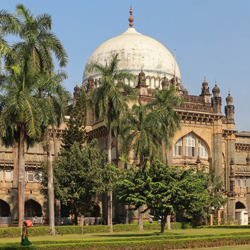
Prince Wales Museum:
George Wittet designed this Indo- Saracenic style building, which houses the Prince of Wales Museum. It also houses a priceless collection of art, sculpture, a fine collection of miniature paintings and much more.
Amid the hustle and bustle of Mumbai stand some stately buildings, remnants of the British Raj. Among them is the Prince of Wales Museum, named after Prince George (Later George V) who visited India in 1905 and laid the foundation stone of the building. Through the arch the Prince made his royal entrance to India as King George V for the Delhi Darbar in 1911.
This four-tiered goliath houses a priceless collection of over 2000 miniature paintings from various stylistic schools in India. Among other artifacts feature a sizeable number of relics of the Indus Valley Civilisation and instances of Tibetan and Nepalese art.. The Natural History Section : The Society houses spectrum of preserved flora and fauna. At a nominal fee, you can gain access to the old nature books in the Society library.
The Natural History Section was added to the museum from the collection of the Bombay Natural History Society. This section has a large selection of Indian birds, a low-tech but educational exhibit on snakes, and stuffed examples of the usual suspects ranging from rhinos to monkeys and lions to deer. The highlight is definitely the freakish 20-foot-long saw fish that must have shocked fishermen when they hauled it up in their nets in the waters off Government House in 1938. All the exhibits are well labeled. Timings : 10.15 a.m. to 6.00 p.m.
Closed On Mondays.
The dome was designed consciously to add to the variety of the skyline and to provide a landmark at ground level. Glass and Jade collections : The gallery on the second floor presents an extensive collection of art objects donated by Sir Ratan Tata and Sir Dorab Tata and its interesting for those interested in glass, jade and porcelain. The collection includes objects carved in rock crystal, metal ware and lacquered woodwork. There are samples of Indian jewelry and object in silver, enameled jars and hookah stands. Some jade objects and samples of Bidri work are also on display. Fine examples of elaborate ivory work from Japan, like the Cock on a Tree, with feathers of ivory are also seen. There is also a section devoted to porcelain and glassware-much of it from China.
It also contains two galleries of largely European oil paintings, including three murky Constables, a Bonnington and a Gainsborough. On entering this area it immediately becomes clear that European art historians dubbed Indian paintings 'miniatures' because they were familiar with. Rather charming are the two portraits of Lady Ratan Tata and Lady Dorabji Tata, which, if viewed from a distance look exactly like portraits of English ladies, complete with gloves and fans, dressed in the fashion of their British rulers.
On the mezzanine level, is a small gallery devoted to Indian prehistory and protohistory, consisting largely of primitive tools and ornaments excavated by Sir John Marshall in Mohenjodaro in 1922.
On the first floor central balcony of the museum are displayed objects of decorative art in ivory, silver and wood of the late 18th and the 19th centuries. Some paintings have also been displayed in this area, leading the visitor into the picture gallery. The paintings, donated by various patrons, from one of India's best public collections of work, representative of many styles and schools. At the entrance of the gallery, to the left, in the first cubicle, is an illustrated manuscript of the Kalpasutra and the Kalikacharyakatha of western India, dated to the end of the 15th century. History : This building was completed in 1914 and converted to a military hospital during World War I. Finally it was opened in 1923 by Lady Lloyd, the wife of then governor, Sir George Lloyd. Galleries : There's a lot to see in the Museum. It’s a disservice if one rushes to see it all in one go. To walk around the key gallery is like experiencing 5,000 years of Indian art in a capsule.
The plan of the Museum is simple, with a central hall from which the staircase leads to the two upper floors with galleries branching out on the right and left. An extension on the right-hand side of the main building houses the natural history section. The second floor houses the Indian miniature painting gallery-the pride of the museum, and next to it is galleries of decorative art and, to the left of the central well of the staircase, the gallery of Tibetan and Nepali art. Above, on the second floor are the European painting, armoury and textile galleries.
An excellent collection of Indian miniature paintings occupies much of the second floor. Some superb examples of the 19th century Pahari School of painting displayed in the museum are Shiva and Parvati (Kangra), Uma worshipping Shiva. One can see Shiva and Parvati, where Parvati is offering Shiva a garland of skulls. Krishna with the Cows Herds (Garhwal, 18th century) and the work drawing of the holi Festival shows Krishna and his friends throwing colour on Radha and her companions to celebrate the spring festival of Holi.
Other paintings of importance on display include Aurangzeb reading the Quran (Pahari, Jammu), the painting of Raja Balwant Deva with his Barber (Jammu, 18th century), one can almost read the barber's thoughts, the painting of the Lady with an Attendant and a Peacock (Pahari, Kangra, 1775) is remarkably beautiful and lyrical work. There are some typical examples of Deccani School of paintings having pale green, mineral-coloured backgrounds with figures placed squarely in the foreground. The collection of paintings from Bundi, of the 18th century, in this gallery deals with the theme of love.
This floor also has fine examples of Nepalese and Tibetan art, including a beautiful 12th century Maitreya, with his head surrounded by a halo, slightly inclined. The Tata family, a large industrial house with interests in the sciences and the arts, donated the collection displayed in The Nepal and Tibet gallery. The Buddhist and Hindu images in metal are gilded, and studded with gems. Statuettes of Tara-the Buddhist goddess of compassion, Vajradhara-Lord of the Thunderbolt, and of Lakshmi Narayana are studded with turquoise, ruby and diamond. The tiny Avalokitesvara from Nepal, of the 17th century is the most beautiful one. Architecture : The facing is done in yellow and blue stones quarried from the Mumbai region. The dome is modeled after the Gol Gumbaz in Bijapur - Karnataka. It incorporates a variety of details from different Indian styles; Saracenic arches with Muslim jalis as fillers, semi-open verandahs and Rajput jharokhas.
The structure forms a long rectangle of three storeys, raised in the centre to accommodate the entrance porch. Above the central arched entrance rises a huge dome, tiled in white and blue flecks, supported on a lotus-petal base. TOP
|


|
Rajabai Clock Tower:
Located in the gardens of Mumbai University, Rajabai Clock Tower consists of 5 elaborately decorated storeys. The tower is 280 ft. in height commanding a fine view of the city.
Next to the High Court, the Venetian -Gothic University has a Gothic clock tower that is curiously adorned with oriental figures. In the old days it used to play Rule Britannia, God Save the King and a Handel Symphony among sixteen tunes that changed four times a day; now the repertoire is limited to the wafting chimes of the Big Ben on the quarter hour.
The Clock Tower is named after the mother of a 19th century stockbroker, who contributed towards its construction. It has a spiral staircase, which is unfortunately closed to the visitors after several unhappy citizens hurled themselves from the top.
Under the clock tower is the magnificent University Library, with what are undoubtedly some of the most exquisite stained glass windows in Asia. These have recently been treated by British conservationists and restored to their pristine glory. Well worth a look.
Architects who spent most of their working years in the city designed most buildings in Mumbai. The buildings of the University in the fort campus are the exception-- the English architect Sir Gilbert Scott designed them. The ‘Cotton King’ and banker, Premchand Roychand, funded the library and the Rajabai clock tower, in memory of his mother Rajabai, with its marvelous sculpted figures. The convocation hall was funded by the man with the deepest pockets in Bombay-- Sir Cowasji Jehangir Readymoney.
One of Mumbai's outstanding landmarks, the Rajabai Clock Tower is situated in the gardens of Mumbai University. Inspired by Giotto's Companile in Florence, Gilbert Scott planned the structure. It was completed in the 1870's.. LOCATION : Rajabai Clock Tower is situated in the gardens of Mumbai University.
Time 1100 to 1700 Bus routes TOP
|


|
Siddhivinayak Temple:
200 years old historic temple of Siddhivinayak in Prabhadevi, Mumbai is the solace for thousands of devotees visiting this place daily. Lord Ganesha the presiding deity is carved in black stone and surprisingly the trunk of Lord Ganesha is turned rightwards as against the normal leftwards direction.
This Vinayak temple in Mumbai is one of the oldest temples of the city. On Tuesdays, the serpentine queue of worshippers is almost over 2kms long.
There are a lot of pujas performed in the temple, as the lord here is believed to remove obstacles in every ones way. Sankata Chathurhi, and Ganesh Chathurthi are celebrated with a lot of pomp here. An estimated 1.5-to 2-lakh people visit this temple every Tuesday.. The temple : The temple was first consecrated on Thursday 19'h November 1801. The idol made of black stone was placed in a small structure; the existing temple was rebuilt on the site of a 200-year old temple.
The narrow lane outside the temple is the 'Phool galli' lined with innumerable stalls selling tulsi flower garlands, coconuts, an array of sweets including the pear shaped favourite yellow sweet of Lord Ganesha, the 'modak', and a range of religious paraphernalia. Here beggar men women and children alike, abound.
The historic Temple has been fully renovated with a view to provide solace to thousands of devotees visiting daily. Deity Description : The idol of Ganpati has four arms therefore He is also called Chaturbhuj. A lotus is held in the upper right hand and a small axe in the upper left, holy beads are held in the lower right and a bowl full of Modaks (a delicacy which is a perennial favorite with Sri Siddhivinayak) in the lower left. Flanking the deity on both sides are Riddhi and Siddhi, goddesses signifying sanctity, fulfilment, prosperity and riches. On the forehead of the deity there is an eye, which resembles the third eye of Lord Shiva. Other offices : The office of the supervisor and his deputy are located on second floor, along with a monitor room housing a complete close-circuit video unit, a rest room for the priests and a kitchen where the Maha-Naivedya is prepared. The third floor houses, the Chairperson's chamber, the Trustee's chamber, office of the Executive officer, office of the Officer on special duty and the administrative offices of the temple trust. It also houses a conference room and the information technology section. The library on the fourth floor has a collection of over 8500 books, on a wide range subjects. There is also a reading room and study room for the students. Solar energy producing cells have also been installed on the temple to produce ele |
|