- By Theme
-
Destinations
-
Indian Destinations
-
International Destinations
-
- Best Places to Visit
- Packages
- Search Agents
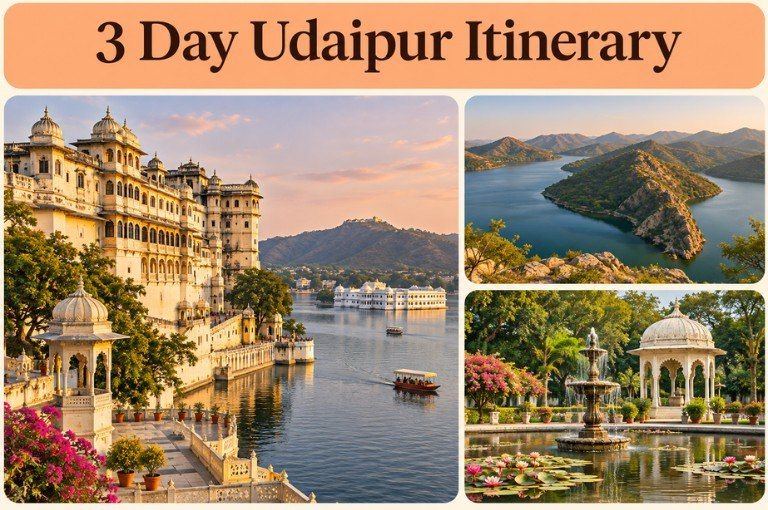
The right 3 day Udaipur itinerary lets you see the City Palace, sail on Lake Pichola at sunset, watch the sun go down from the Monsoon Palace and still squeeze in a day trip to Kumbhalgarh and Ranakpur, without rushing from one spot to another. Udaipur is compact, romantic and full of lakes, palaces and old-city lanes, which makes three days the sweet spot for first-time visitors.
If you only want the short version, here is the 3 day itinerary Udaipur travellers follow most often:
| Day | Theme | Main Place |
| Day 1 | Old City and Lake Pichola | City Palace, Jagdish Temple, Bagore Ki Haveli, Gangaur Ghat, sunset boat ride |
| Day 2 | Gardens, lakes and viewpoints | Saheliyon Ki Bari, Shilpgram or Vintage Car Museum, Fateh Sagar Lake, Moti Magri, Sajjangarh (Monsoon Palace) |
| Day 3 | Forts and temples | Kumbhalgarh Fort and Ranakpur Jain Temple, or Eklingji, Nagda, Haldighati and Nathdwara |
The plan works for couples, families and friends. Seniors and small children can swap the day trip for a lighter local day, which we explain below.
Yes. Udaipur's main sights sit close together around Lake Pichola and Fateh Sagar Lake, so two days cover the city itself and the third day goes to a fort or temple circuit outside town. One day is enough to see the headline spots, but it feels rushed. Four or five days suit travellers who want slow mornings, cooking classes, spa time or a trip to Chittorgarh.
Three days is also the length of most Udaipur trip plan for 3 days packages, so hotel, cab and sightseeing bookings are easy to find and compare.
October to March (best): Pleasant days, cool evenings and clear skies. Perfect for boat rides, rooftop dinners and fort visits. December and January mornings can be chilly, so carry a light jacket.
July to September (monsoon): The Aravalli hills turn green, the lakes fill up and the Monsoon Palace looks its best. Expect showers, so keep Day 3 flexible. Hotel rates are often lower.
April to June (summer): Hot, with afternoon temperatures that can cross 40°C. Plan sightseeing early morning and after 4 PM, and keep lunch hours for the hotel pool or a museum.
Wedding season (roughly November to February) and long weekends can push up room prices, so book stays and cabs early.
By air: Maharana Pratap Airport (Dabok) is about 22 km from the city and has regular flights from Delhi, Mumbai, Ahmedabad, Jaipur and other metros. A taxi to the old city takes around 40 minutes.
By train: Udaipur City railway station connects to Delhi, Jaipur, Ajmer, Chittorgarh and Ahmedabad. Trains such as the Mewar Express from Delhi are popular overnight choices.
By road: Udaipur is roughly 260 km from Ahmedabad, 250 km from Jodhpur, 400 km from Jaipur and 660 km from Delhi. The highways are good, so a self-drive or chauffeur-driven road trip is easy.
Tip: If you arrive in the morning, start Day 1 after check-in and a short rest. If you arrive late at night, begin Day 1 at noon and shift Bagore Ki Haveli to Day 2.
Your base decides how much time you spend in traffic, so choose the area before you choose the hotel.
Lake Pichola area (Lal Ghat, Gangaur Ghat, Jagdish Chowk): The best choice for first-timers. Most Day 1 sights are walkable, and lake-view rooftops are everywhere. Lanes are narrow, so check where your car can park.
Fateh Sagar side: Calmer and more modern, with good restaurants and views of the second lake. You will need a cab or auto for the old city.
Hiran Magri and Sukhadia Circle: Quieter residential areas with larger hotels, good for families who want parking and space.
Luxury palace hotels: Udaipur is known for heritage and palace stays such as Taj Lake Palace, The Oberoi Udaivilas and The Leela Palace. Many have lake views, spas and fine-dining restaurants.
For most budgets, a heritage haveli or boutique hotel near the ghats gives the best mix of atmosphere and location.
Day 1 is the classic Udaipur introduction. Everything is close together, so you can walk, take an auto for short hops and save energy for the sunset.
Start at the City Palace, a huge complex of palaces, courtyards and balconies built over several centuries by the Maharanas of Mewar on the banks of Lake Pichola. Allow two to two and a half hours. Highlights include Mor Chowk with its peacock mosaics, the Manak Mahal, the Krishna Vilas and the glass and mirror work of the Zenana Mahal. The upper terraces give wide views over the lake and the city.
Go as soon as it opens to avoid tour groups and the midday heat. An audio guide or a licensed guide helps because the palace has many rooms and each has a story. Entry tickets, camera charges and extra tickets for specific sections change from time to time, so check on the day.
A short walk from the palace gate, the Jagdish Temple was built in 1651 and is dedicated to Lord Vishnu. It is known for its Indo-Aryan architecture, carved pillars and the steep flight of steps leading up from the street. It is free to enter and takes about 30 minutes. Keep shoulders and knees covered and be ready to leave your footwear outside.
The lanes around Jagdish Chowk and Gangaur Ghat have many cafés and rooftop restaurants. Try a Rajasthani thali, dal baati churma or a simple sandwich-and-coffee break if the weather is hot.
Bagore Ki Haveli is an 18th-century mansion on Gangaur Ghat with more than a hundred rooms, painted walls, peacock-glass work and a small museum of costumes, turbans and household objects from old Mewar. Spent about an hour here.
Afterwards, walk through Gangaur Ghat and nearby Lal Ghat. This is where Udaipur feels local: women washing clothes, priests at the water, kids jumping into the lake and photographers waiting for the afternoon light. Pick up a chai and watch the boats.
Time your Lake Pichola boat ride for the last hour before sunset. Boats leave from the City Palace jetty (Bansi Ghat) and Lal Ghat and sail past Jag Mandir and the Taj Lake Palace. The island palaces glow orange as the light drops. Some rides include a stop at Jag Mandir for photos or a short break, so ask before you buy the ticket. Prices vary by boat type and route.
Catch the Dharohar folk dance show at Bagore Ki Haveli, which usually starts around 7 PM and includes Rajasthani dances such as Ghoomar, Terah Tali and puppet performances. It lasts about an hour. Follow it with dinner at a lakeside restaurant. Book a table in advance during peak season, especially if you want a window or rooftop seat facing the City Palace.
Day 2 widens the circle. You will see a royal garden, a craft village, a second lake and the best sunset viewpoint in the city. Hire a cab or a pre-booked car for the day because the stops are spread out.
Saheliyon Ki Bari, the Garden of the Maidens, was built in the early 18th century for the ladies of the royal household. It has fountains, marble kiosks, a lotus pool and shaded walkways. It is calm and cooler in the morning, so it is a great place to start Day 2. Plan about an hour.
Choose according to your interests:
Shilpgram is a rural arts and crafts village about 3 km from Fateh Sagar. It has traditional huts from different states, craft stalls, folk performances during festivals and a relaxed open-air feel. Good for families and shoppers.
Vintage and Classic Car Museum (near Gulab Bagh) displays old cars once used by the Mewar royal family. It is short, quirky and popular with photographers and car lovers.
If you move fast you can do both, but most travellers pick one and keep the rest of the day relaxed.
Head back toward Fateh Sagar or Sukhadia Circle for lunch. Rajasthani thali places, garden restaurants and cafés are all available. Take a short break because the afternoon is mostly outdoors.
Fateh Sagar Lake is Udaipur's second major lake, with a wide promenade, island parks and mountain views. Take the boat to Nehru Island Park or just walk along the Paal and enjoy street snacks such as corn, ice cream and fresh coconut water.
Nearby on Moti Magri hill, the Maharana Pratap Memorial has a bronze statue of Maharana Pratap on his horse Chetak. It tells the story of Mewar's resistance and offers a good view of the lake. It is a short climb, so wear comfortable shoes.
Drive up to Sajjangarh, the Monsoon Palace built in the 1880s by Maharana Sajjan Singh on a hill above the city. The palace itself is mostly empty, but the real draw is the view: Udaipur's lakes, the Aravalli ridges and the plains in warm sunset light. The road passes through the Sajjangarh Wildlife Sanctuary, so you may see deer, birds and other wildlife.
Arrive about an hour before sunset because there can be a queue for the vehicle entry and the final stretch. Carry a light jacket because the hilltop is windy.
Have dinner near Fateh Sagar or return to the old city for a rooftop meal. If you still have energy, the Bharatiya Lok Kala Mandal runs a short puppet and folk art show in the evening, but check timings as they change by season.
The third day is for something bigger than the city. The most rewarding option for most travellers is Kumbhalgarh Fort and Ranakpur Jain Temple. The route passes through the Aravalli hills and village landscapes, and the two stops pair well: a fort in the morning and a temple after noon.
A full-day taxi is the simplest way to do it. Budget around eight to nine hours including stops.
Kumbhalgarh is about 85 km from Udaipur and takes around two hours by road. Leaving early beats the heat and gives you time to explore properly.
Kumbhalgarh Fort is a UNESCO World Heritage Site, listed in 2013 as part of the Hill Forts of Rajasthan. It is the birthplace of Maharana Pratap and is known for its massive wall that stretches for roughly 36 km. Travellers often compare it to the Great Wall of China because it is one of the longest continuous walls in the world. Inside the complex there are temples, palaces and viewpoints. The climb involves stairs and slopes, so wear sturdy footwear.
Take lunch near Kumbhalgarh or on the way to Ranakpur. Options are mostly simple restaurants and resort dining rooms, so carry water and snacks.
Ranakpur is roughly 40 to 50 km from Kumbhalgarh. The Ranakpur Jain Temple, the Adinatha temple, was built in the 15th century and is famous for its marble carving and around 1,444 intricately carved pillars, no two of which look exactly alike. The light inside the main hall changes through the afternoon, which makes the place feel calm and almost glowing.
Non-Jain visitors are usually allowed in the afternoon (generally from around noon to evening), while the morning is reserved for worship, so plan the order of your stops accordingly. Dress modestly and remove leather items before entering.
Ranakpur is about 90 km from Udaipur, roughly two hours on the road. You will be back by early evening. Spend your last night shopping at Hathi Pole or Bada Bazaar, then have a slow farewell dinner at a lakeside restaurant.
If you prefer shorter drives, spiritual sights or travel with seniors, choose this circuit instead:
Eklingji and Nagda (about 22 km): The Eklingji temple complex is dedicated to Lord Shiva and has been the family deity of the Mewar rulers for centuries. Nearby, Nagda has the ruins of Sas-Bahu temples.
Haldighati (about 40 km): The site of the 1576 battle between Maharana Pratap and the Mughal army, with a memorial to his horse Chetak and a small museum. The region is known for rose products such as gulkand and rose sherbet.
Nathdwara (about 48 km): Home to the Shrinathji temple, a major Vaishnav pilgrimage centre and a centre for Pichwai paintings.
This plan is easier on the body, but it is more religious and historic than scenic. Choose it only if that matches your group.
The Udaipur trip cost for 3 days depends on three things: the hotel category, the season and how you travel. The table below gives an indicative per-person cost for two nights and three days, on twin sharing, excluding your travel to and from Udaipur.
| Expense | Budget | Mid-range | Luxury |
| Stay (2 nights) | 1,500–3,000 | 3,000–6,000 | 15,000–60,000+ |
| Food | 1,200–2,000 | 2,000–3,500 | 5,000–10,000 |
| Local transport | 1,500–2,500 | 3,000–4,500 | 6,000–9,000 |
| Entry tickets, boat rides and activities | 1,200–2,000 | 1,500–2,500 | 3,000–6,000 |
| Approximate total | 5,500–9,500 | 9,500–16,500 | 29,000–85,000+ |
Notes to keep in mind:
These are estimates and not fixed prices. Hotel rates and ticket fees change with season, festivals and weddings, so confirm before booking.
A full-day cab to Kumbhalgarh and Ranakpur is usually the biggest single local expense. Sharing it between four people cuts the per-person cost a lot.
Local autos and app-based cabs are fine for Day 1, but Day 2 and Day 3 are easier with a private car.
Peak-season weekends can push mid-range hotel rates well above the upper end of the range.
Travel between July and September or in early spring for lower room rates.
Stay slightly away from the ghats and use cabs for short rides.
Combine sights: Jagdish Temple, City Palace and Bagore Ki Haveli can all be done on foot.
Eat at local thali places for lunch and keep restaurant dinners for the sunset-view spots.
Book a package that bundles stay, cab and sightseeing, because bundled rates are often lower than separate bookings.
Most people searching for an Udaipur tour package or Udaipur 3 day package are not lazy. They simply want to avoid spending ten hours comparing hotels, cab rates and tickets. Here is how the two options compare
| Factor | Plan it yourself | Book a package |
| Time spent planning | Many hours of research | Quick enquiry and customisation |
| Hotel and cab quality | Needs checking reviews one by one | Pre-checked partners |
| Day 3 logistics | You arrange car, driver and timings | Vehicle and route fixed in advance |
| Cost control | Prices can differ across bookings | One quote with inclusions listed |
| Flexibility | Complete | Customisable with a good operator |
| Support during the trip | You solve problems yourself | Someone to call if plans change |
A package is worth it when you are travelling with family, visiting in peak season, short on time or unsure about road and taxi rates. DIY works well if you are a confident traveller with flexible dates.
Your 3 day Udaipur itinerary should include at least a few Mewari meals:
Dal baati churma: Baked wheat balls with lentils and sweet crumbled churma, the classic Rajasthani meal.
Laal maas (for meat eaters): A spicy red mutton curry.
Gatte ki sabzi and ker sangri: Traditional vegetarian dishes with gram flour dumplings and desert beans.
Mirchi vada and pyaaz kachori: Popular snacks, best eaten fresh in the morning.
Malpua and ghevar: Sweets that appear in many thali menus.
Rooftop dinners: Many restaurants around Lake Pichola serve Indian, continental and Italian food with a view of the City Palace.
Vegetarians will find it easy to eat well in Udaipur, and most places can adjust spice levels on request.
Miniature paintings and Pichwai art
Bandhani and leheriya dupattas and sarees
Mojari (Rajasthani leather footwear)
Silver and oxidised jewellery
Puppets, wooden toys and block-print textiles
Rose products from Haldighati
The main markets are Hathi Pole, Bada Bazaar and the lanes near Jagdish Temple. Bargaining is common, so start lower and stay polite.
Book key things ahead: Hotels, rooftop dinner tables and the cab for Day 3 sell out in peak season.
Start early: Morning light is better and crowds are smaller at the City Palace, Saheliyon Ki Bari and Kumbhalgarh.
Dress for temples: Cover shoulders and knees at Jagdish Temple, Ranakpur, Eklingji Temple and Nathdwara.
Carry cash: Some small shops, boat operators and ticket counters prefer cash or UPI, so keep both ready.
Check timings: Palaces, museums and temples change opening hours for festivals and holidays.
Footwear matters: You will climb stairs at the City Palace, Jagdish Temple, Moti Magri and Kumbhalgarh.
Pace yourself: Do not add every attraction. Udaipur is best enjoyed with time to sit by the lake.
Photography: Ask before photographing people at the ghats and respect no-photo signs inside temples.
Traveling with kids or seniors: Skip Moti Magri's climb, shorten Kumbhalgarh or choose the Eklingji–Nathdwara circuit for Day 3.
Udaipur rewards slow, well-planned travel. Spend Day 1 with the palaces and lake, Day 2 with gardens, Fateh Sagar and a Monsoon Palace sunset, and Day 3 at the grand forts and temples of Kumbhalgarh and Ranakpur. Add good food, a few hours of shopping and no rush, and you will leave with the kind of trip people talk about for years.
If you would rather not handle hotel comparisons, cab rates and timings yourself, TourTravelWorld can help. As an Indian online travel portal offering domestic and international tour packages, we can plan customized Udaipur 3 day package that can be customised to your budget, group size and travel dates, with stays, private-car sightseeing and the Day 3 trip organised in advance.
Ready to travel? Visit tourtravelworld.com, explore our Udaipur packages and send an enquiry for a customised quote. Tell us your dates and group, and our travel team will build the 3 day Udaipur itinerary around you.
Yes. Three days covers the City Palace, Lake Pichola, Fateh Sagar, Saheliyon Ki Bari, Sajjangarh and one day trip to Kumbhalgarh and Ranakpur, which is enough for most first-time visitors.
The best places are City Palace, Jagdish Temple, Bagore Ki Haveli, Lake Pichola, Saheliyon Ki Bari, Fateh Sagar Lake, Moti Magri, Sajjangarh (Monsoon Palace), and Kumbhalgarh with Ranakpur on Day 3.
As an indicative range, budget trips cost about 5,500–9,500 per person, mid-range trips about 9,500–16,500, and luxury trips from about 29,000 upward, excluding travel to Udaipur. Prices vary by season and hotel.
Two days cover the city, three days add a fort and temple day trip, and four to five days suit slower travellers who want spa time, cooking classes or Chittorgarh.
October to March is best for pleasant weather. July to September is good for green hills and full lakes. April to June is very hot.
The Lake Pichola area near Lal Ghat and Gangaur Ghat is best for first-timers because many sights are walkable. Choose Fateh Sagar or Hiran Magri for quieter, car-friendly stays.
Yes. Families enjoy boat rides, gardens, Shilpgram and the Monsoon Palace. Couples enjoy rooftop dinners, sunset cruises and lakeside heritage hotels.
Yes, it is a long but doable day trip of around eight to nine hours by private car. Start by 7:30 AM and visit Kumbhalgarh first, then Ranakpur after noon.
Walk in the old city, use autos or app cabs for short rides, and hire a private cab for Day 2 and Day 3 sightseeing.
Book a package if you want a fixed budget, pre-checked hotels, a private car and support during the trip. Plan on your own if you have flexible dates and enjoy researching.