- By Theme
-
Destinations
-
Indian Destinations
-
International Destinations
-
- Best Places to Visit
- Packages
- Search Agents
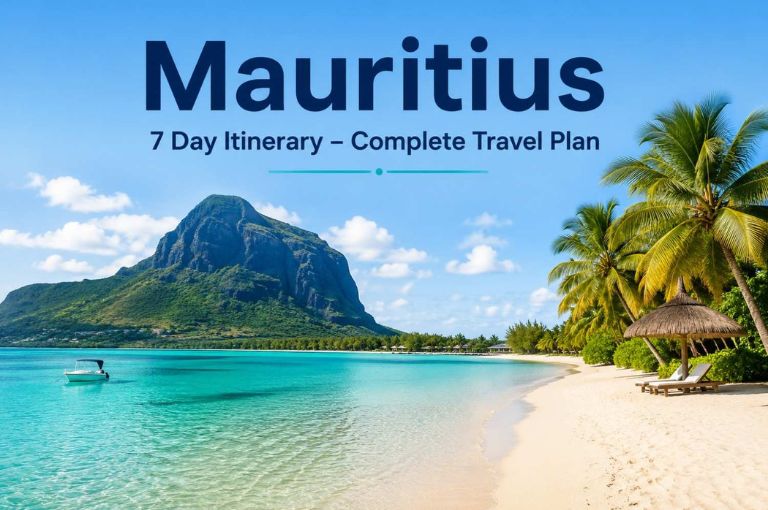
Planning a trip to Mauritius and not sure how to fit everything into one week? You are not alone. Mauritius is a small island, but it has a lot going on — beaches, mountains, waterfalls, history, local food, and water activities. Seven days is actually a good amount of time to see the main highlights without rushing.
This Mauritius 7 day itinerary is written for travelers who want a proper plan — not just a list of places. It covers where to go each day, what to do, what to eat, and a few practical tips to help your trip go smoothly. Whether you are traveling as a couple, with family, or on your own, this plan can be adjusted to suit your pace.
Before diving into the details, here is a quick look at how the 7 days are split:
Day 1 – Arrival and Port Louis
Day 2 – North Mauritius (Grand Baie & surroundings)
Day 3 – Île aux Cerfs and East Coast
Day 4 – South Coast (Chamarel & Blue Bay)
Day 5 – West Coast (Black River Gorges & Flic en Flac)
Day 6 – Central Plateau and Cultural Sights
Day 7 – Leisure, Shopping and Departure
Mauritius is a year-round destination, but the best time to visit is between May and December. During these months, the weather is dry and temperatures stay comfortable — usually between 20°C and 27°C. January to April is the cyclone season, and while storms are not guaranteed, there is a chance of heavy rain and rough seas.
If you are planning water activities like snorkeling, diving, or kite surfing, May to September is ideal. October and November are also good months with fewer tourists and lower hotel prices.
The easiest way to get around Mauritius is by renting a car. Roads are well-maintained, driving is on the left, and having your own vehicle gives you the freedom to explore at your own pace. Car rentals start from around USD 30 to 50 per day depending on the type of vehicle.
If you prefer not to drive, taxis are widely available. Always agree on the fare before you get in, as most taxis do not use meters. For day trips, hiring a taxi for a full day (usually USD 50 to 80) can actually work out well. Public buses are cheap but slow, and not always convenient for reaching tourist spots.
Most international flights land at Sir Seewoosagur Ramgoolam International Airport in the south of the island. Once you arrive, check into your hotel and give yourself time to settle in. If your flight lands in the morning or early afternoon, Port Louis — the capital city — is a great first stop.
Visit the Central Market – This is one of the oldest markets in Mauritius, selling spices, local snacks, clothes, and souvenirs. It gives you a real feel of everyday life in Mauritius.
Walk along the Caudan Waterfront – A modern area with shops, cafes, and a casino right by the harbor. Good for an evening walk.
Try local street food – Mauritius has a strong Indian and Chinese influence in its food. Look for dholl puri (a type of flatbread with lentils), samosas, and mine bouillie (noodle soup).
Blue Penny Museum – If you enjoy history, this small museum tells the story of Mauritius through stamps, maps, and artifacts.
Spend the evening near the waterfront, have dinner, and get an early night. You have a full week ahead.
The north of Mauritius is known for its clear lagoons, water sports, and a lively town called Grand Baie. Head up north after breakfast and spend the day exploring this part of the island.
Grand Baie Beach – A popular stretch of beach with calm water, ideal for swimming. There are plenty of water sports operators here offering jet skiing, parasailing, and glass-bottom boat rides.
Pereybere Beach – A quieter beach just a few minutes from Grand Baie.Smaller and more relaxed, with some good snorkeling close to the shore.
Cap Malheureux – A small fishing village in the northernmost tip of Mauritius. Famous for the red-roofed Notre Dame Auxiliatrice church, which sits right by the sea. One of the most photographed spots on the island.
Grand Baie Bazaar – A market area in Grand Baie town with local handicrafts, clothes, and souvenirs. Worth a browse in the evening.
If you want to take a catamaran cruise or do a dolphin watching tour, the north coast is the place to book it. These tours usually run in the morning and last 3 to 4 hours.
Today, head to the east coast for a full day on Île aux Cerfs — a small island accessible by a short boat ride from Mahébourg or Trou d'Eau Douce. This is one of the most popular day trips in Mauritius, and it is easy to see why.
The island has white sand beaches, clear turquoise water, and a relaxed atmosphere. You can rent a sunbed, go snorkeling in the lagoon, try water skiing or parasailing, or simply sit by the water. There are a few restaurants and food shacks on the island. Lunch here — usually grilled fish, seafood, or a simple rice dish — is worth trying.
Boat transfers to Île aux Cerfs are usually available from Trou d'Eau Douce jetty, and cost around USD 10 to 15 return. You can also book a full catamaran day trip that includes the island, snorkeling stops, and lunch on board.
On your way back, stop at Mahébourg — a quiet historic town on the south-east coast. The Mahébourg Waterfront offers a pleasant walk, and the nearby National History Museum tells the story of the Battle of Grand Port. It is a relaxed and unhurried part of Mauritius.
The south of Mauritius is very different from the north. It is greener, quieter, and has some of the island's most interesting natural sights. Plan an early start today as there is a lot to cover.
Chamarel is a small village in the south-west of the island, known for two things: the Seven Coloured Earths and the Chamarel Waterfall.
The Seven Coloured Earths is a patch of land where the soil has settled into natural shades of red, brown, violet, green, blue, and yellow. It is a strange and curious sight. Right next to it is the Chamarel Waterfall, which drops about 100 metres into a gorge below. Both are worth a visit.
Blue Bay is one of the best spots for snorkeling in Mauritius. It is a protected marine park with calm, shallow water and a lot of coral reef life. You can rent snorkeling equipment at the beach for a small fee. Glass-bottom boat rides are also available here if you prefer not to get in the water.
Spend the late afternoon at Blue Bay beach, then head back to your hotel. The drive through the south is scenic, so keep some time for unplanned stops.
The west coast has a more rugged feel than the rest of the island. The Black River Gorges National Park takes up a large part of the west, and the beach town of Flic en Flac is one of the most relaxed on the island.
This is the only national park in Mauritius and it covers about 6,700 hectares of native forest. If you enjoy walking or light hiking, there are several trails here. The viewpoints over the gorges are impressive, especially at the Black River Viewpoint and the Alexandra Falls.
The park is home to the pink pigeon and the echo parakeet — both birds that were once close to extinction and are now slowly recovering. Wildlife spotting is possible if you are patient and quiet on the trails.
Head to Flic en Flac in the afternoon. This is a long stretch of public beach with clear, calm water and a relaxed village atmosphere. It is less commercialized than Grand Baie and popular with locals on weekends. Good for swimming, watching the sunset, and finding a simple seafood dinner at one of the restaurants along the beach road.
Spend your second-to-last day exploring the interior of the island. The central plateau is cooler than the coast, and it has a different side of Mauritius — tea estates, colonial history, and craft villages.
Mauritius produces its own tea, and Bois Chéri is the most well-known estate. The estate tour takes you through the factory to see how tea is processed, followed by a tea tasting session. The views from the estate over the surrounding landscape are quite good. There is also a small museum about the history of tea in Mauritius.
Eureka House is a well-preserved colonial home built in the 1830s, surrounded by a large garden with a river running through it. It gives you a clear picture of how wealthy Creole families lived during the colonial period. You can take a guided tour of the house or simply walk through the grounds. Lunch is also available here.
Curepipe is the main town of the central plateau. Visit the Trou aux Cerfs — an extinct volcanic crater — for a view over the island. The walk around the rim takes about 20 minutes and is easy. On a clear day, you can see the coast on both sides of the island.
Your last day in Mauritius should be a slow one. Use the morning for any activity you missed or a place you want to revisit. If you are staying near a beach, spend a couple of hours there before you pack up.
Go back to your favourite beach for a final swim
Visit a local market for last-minute souvenirs — look for vanilla pods, rum, local tea, saffron, and handmade baskets
Try a dish you have not had yet — roti, biryani, or fresh tropical fruit
Take a short walk in a neighbourhood you found interesting earlier in the week
Flights from Mauritius often depart in the evening, so you usually have most of the day free. The airport is about an hour from most parts of the island — plan to leave your hotel at least 3 hours before your flight.
Indian passport holders can visit Mauritius without a visa for up to 60 days. Most European and Commonwealth passport holders also get visa-free or visa-on-arrival entry. Check your country's specific requirements before you travel.
The currency is the Mauritian Rupee (MUR). As of 2024, 1 USD is roughly 45 to 47 MUR. Credit cards are accepted in most hotels and restaurants, but carry some cash for markets, taxis, and smaller local eateries.
The official languages are English and French, but most people speak Mauritian Creole in daily life. English is widely understood at hotels, tourist attractions, and restaurants — you will not have any difficulty communicating.
Where you stay depends on what kind of trip you want. Grand Baie in the north is ideal if you like a lively atmosphere with bars, restaurants, and water sports at hand. Flic en Flac on the west coast is quieter and more local. Belle Mare on the east coast has some of the best resort beaches on the island. Port Louis is practical for business travellers but less relaxing for a holiday.
Budget guesthouses and small boutique hotels start from about USD 50 to 80 per night. Mid-range hotels cost USD 100 to 200, and luxury resorts can go from USD 300 upwards.
Dholl Puri – A thin flatbread stuffed with split yellow peas, served with curry and chutney. A Mauritian staple.
Rougaille – A tomato-based Creole sauce served with fish, meat, or sausages over rice.
Octopus Curry – Common on the south and east coast, particularly in Mahébourg.
Gateau Piment – Deep-fried lentil cakes with chilli. A popular street snack.
Fresh Coconut Water – Sold on many beaches. Inexpensive and refreshing.
Rum – Mauritius produces its own rum. Pink Pigeon and Chamarel are well-known brands. Rum punch is a popular local drink.
Mauritius can be done on different budgets. Here is a rough estimate for one person for 7 nights (excluding flights):
Budget traveller (guesthouses, local food, public transport): USD 400 to 600 total
Mid-range traveller (comfortable hotel, mix of eating out and hotel meals, car rental): USD 1,200 to 1,800 total
Luxury traveller (5-star resorts, tours, restaurant dining): USD 3,500 and above
Activities like catamaran cruises, quad biking, deep-sea fishing, or helicopter rides are add-ons and can range from USD 50 to USD 200 per activity.
Book accommodation in advance, especially during July–August (European summer) and December–January (Christmas holidays), when the island gets busiest.
Sunscreen is expensive in Mauritius. Bring your own, especially reef-safe sunscreen if you plan to snorkel or swim in marine protected areas.
Mosquitoes can be present in certain parts of the island, particularly in the south and interior. Carry a repellent.
Dress modestly when visiting temples, mosques, or churches. Mauritius is a multi-religious country and people appreciate respectful visitors.
Tap water is generally safe to drink in Mauritius, but bottled water is widely available and inexpensive if you prefer.
If you plan to do a lot of activities or rent a car, book ahead — especially during peak season.
Yes, absolutely. Seven days is a solid amount of time to see the island's main regions without cramming everything in. You will not be able to do everything — no week is long enough for that — but with this Mauritius one week itinerary, you will cover the north, east, south, west, and central parts of the island. That is a good representation of what Mauritius has to offer.
If you have more time, you could extend your stay with a few extra days on a quiet beach or do a side trip to Rodrigues Island — a smaller, more remote island belonging to Mauritius. But for a first visit, 7 days is well-suited.
Mauritius is one of those destinations that tends to surprise people. It looks beautiful in photos, but the island has a warmth and variety that you only understand once you are there — the mix of cultures, the food, the way the landscape changes as you drive from coast to coast.
Use this Mauritius 7 day itinerary as a starting point and adjust it to what interests you most. If you are a beach person, spend more time on the coast. If you enjoy history and culture, add more time in Port Louis and the central plateau. The island is small enough that you can always re-route without losing a full day.
If you need help planning your trip from India, TourTravelWorld offers a well-structured Mauritius tour package that covers accommodation, transfers, and key sightseeing — so you can focus on enjoying the island instead of managing the logistics.