- By Theme
-
Destinations
-
Indian Destinations
-
International Destinations
-
- Best Places to Visit
- Packages
- Search Agents
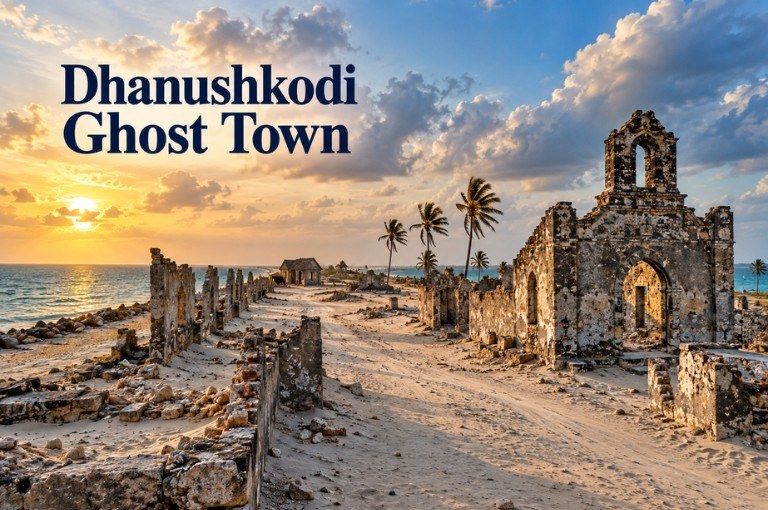
At the very tip of Rameswaram island, where the Bay of Bengal meets the Indian Ocean, lies a stretch of land that feels frozen in time. Dhanushkodi ghost town is one of India's most haunting and hauntingly beautiful destinations — a place where crumbling walls, endless dunes, and a dramatic coastal setting tell the story of a town wiped out in a single night. This guide covers everything you need to plan a memorable trip, from its tragic past to the best ways to explore it today.
Dhanushkodi was once a thriving port town at the southeastern tip of Rameswaram, connecting India to Sri Lanka through a regular ferry service and a functioning railway line. Before the disaster that changed everything, this small coastal town buzzed with activity: a railway station, a post office, schools, a church, temples, and homes for hundreds of families who depended on fishing and trade for their livelihood. Pilgrims heading to Sri Lanka's Talaimannar often passed through Dhanushkodi, making it a bustling transit hub along the ancient trade and pilgrimage route between the two countries.
The town's name itself carries mythological weight. According to the Ramayana, Dhanushkodi marks the point from where Lord Rama's Vanara army began building the Ram Setu, or Adam's Bridge, to cross over to Lanka and rescue Sita from Ravana. Legend also holds that after defeating Ravana, Rama used the tip of his bow — 'dhanush' — to break a portion of the bridge, which is how the town came to be called Dhanushkodi. This layer of legend adds a spiritual dimension to what is otherwise a story of natural disaster and resilience.
Everything changed on the night of 22 December 1964. A massive cyclone, accompanied by a tidal wave nearly seven metres high, struck the coast without warning in the early hours of the morning. The storm derailed the Pamban–Dhanushkodi Passenger train as it approached the town, killing everyone on board, and flattened almost the entire settlement within a matter of hours. Official estimates put the death toll at over 1,800 people, though many locals and historians believe the real number was far higher, since the town's exact population at the time was never fully recorded.
The devastation was so complete that the Tamil Nadu government declared Dhanushkodi unfit for human habitation shortly afterward, and the town was never rebuilt. Survivors and their descendants relocated to nearby villages and to Rameswaram, and for decades the ruins sat largely forgotten, visited only by the occasional pilgrim or curious local. It was only in more recent years, as road access improved and word spread about the site's haunting beauty, that Dhanushkodi ghost town re-emerged as a destination in its own right.
What remains today are the skeletal ruins of a railway station, a church, and scattered stone walls half-buried in sand — a haunting reminder of the disaster. Walking among these ruins, with the sound of waves crashing on both sides of the narrow strip of land, offers a rare, almost meditative encounter with history. This is exactly what draws curious travellers, photographers, and history enthusiasts to Dhanushkodi every year, eager to experience a place that time and nature so completely reclaimed.
In the decades since the cyclone, the Indian government has periodically discussed redevelopment plans for the region, ranging from eco-tourism proposals to improved road infrastructure. While some improvements, such as a better road up to the checkpoint near the ghost town, have gradually materialised, large-scale rebuilding has never taken place, largely due to the area's continued vulnerability to storms and its ecological sensitivity. This has, in a way, preserved Dhanushkodi's unique character as one of the few genuinely abandoned coastal settlements in India that remains accessible to visitors.
Dhanushkodi enjoys a tropical coastal climate, and the ideal window to visit runs from October to April, when the weather stays pleasant and humidity drops noticeably compared to the peak summer months.
October to February: This is the most comfortable stretch, with cool sea breezes and clear skies that make it easy to spend hours exploring the ruins and beaches.
March to April: Days grow warmer, but early mornings and evenings remain enjoyable, and the crowds thin out.
May to June: Summer brings intense heat and strong winds, making midday visits are uncomfortable, though sunrise trips are still manageable.
July to September: The southwest monsoon can bring rough seas and occasional travel restrictions, so it's best to check local advisories before planning a trip in this period.
Early morning is the best time of day to explore, as the sun rises dramatically over the meeting point of the Bay of Bengal and the Indian Ocean, and the ruins glow gold in the soft light before the heat sets in. Many travellers also time their visit around major festivals in Rameswaram, such as Maha Shivaratri, when the Ramanathaswamy Temple sees large crowds and a festive atmosphere spills over into the wider region, including day trips to Dhanushkodi.
Weekdays tend to be far less crowded than weekends and public holidays, which is worth keeping in mind if you prefer a quieter, more reflective experience among the ruins. Since the site has minimal shade, avoiding the harsh midday sun between roughly 11 a.m. and 3 p.m. also makes for a noticeably more comfortable visit, particularly between March and June.
A visit to Dhanushkodi ghost town offers a rare mix of history, adventure, and natural beauty packed into a small stretch of coastline.
Explore the ruined railway station and church, the two most photographed structures left standing after the 1964 cyclone.
Walk to Arichal Munai, the very tip of the peninsula, where two seas visibly meet and, on a clear day, the coastline of Sri Lanka appears faintly on the horizon.
Visit the legendary Ram Setu viewpoint, believed in Hindu mythology to be the starting point of the bridge Lord Rama's army built to reach Lanka.
Watch fishermen mend nets and haul in the day's catch along the shoreline, offering a glimpse of the resilient community that still lives near the ghost town.
Spend time birdwatching, as the coastal scrubland and dunes attract migratory seabirds during the winter months, making it a rewarding stop for casual nature enthusiasts as well as serious birders.
Visit the Kothandaramaswamy Temple, one of the few structures in the region believed to have survived the 1964 cyclone largely intact, and now an important stop for pilgrims retracing the Ramayana's route.
Beyond the well-known landmarks, Dhanushkodi rewards travellers who simply wander. The contrast between the calm, shallow waters of the Bay of Bengal on one side and the choppier Indian Ocean on the other is best appreciated on foot, and the changing textures of sand, shell, and ruin make every stretch of the walk feel a little different from the last.
Photographers in particular find Dhanushkodi endlessly rewarding. The stark silhouette of the ruined church against an open sky, the long shadows cast by broken railway carriages at sunrise, and the wide, empty beaches all lend themselves to striking compositions. Even travellers who don't consider themselves photography enthusiasts often end up taking far more pictures here than they expected, simply because the landscape offers so little clutter and so much raw texture.
Take a jeep or ATV safari across the sand dunes — the only practical way to reach the innermost stretch of the ghost town, since the terrain isn't suited for regular vehicles.
Photograph the sunrise and sunset from Arichal Munai, widely regarded as one of the most dramatic vantage points on India's coastline.
Sample fresh, locally caught seafood at the small stalls near the beach, prepared in traditional Tamil coastal style.
Collect seashells and driftwood along the untouched stretches of beach, away from the main ruins.
Spend a quiet hour simply sitting by the shore — many travellers say the The stillness of Dhanushkodi is as memorable as its history.
Strike up a conversation with the fishing families who still live near the outskirts of the ghost town — their stories about the region add a personal layer to the historical narrative that no plaque or guidebook can fully capture.
Because the site is compact, most of these experiences can comfortably fit into a half-day visit, which is why so many travellers pair Dhanushkodi with a broader Rameswaram itinerary rather than treating it as a standalone destination.
Since Dhanushkodi sits just 18 kilometres from Rameswaram, most travellers combine both destinations into a single trip. Rameswaram is home to the magnificent Ramanathaswamy Temple, one of the twelve Jyotirlinga shrines and famous for its long pillared corridors and sacred bathing wells, or theerthams, where pilgrims take ritual baths as part of their spiritual journey. Other highlights on a well-planned Rameswaram travel guide include Agnitheertham beach for a ritual dip in the sea, the Pamban Bridge — India's first sea bridge and an engineering landmark that still opens up to let ships pass through — the five-faced Hanuman Temple that houses a floating stone said to be part of the original Ram Setu, and the APJ Abdul Kalam Memorial at Peikarumbu, dedicated to India's beloved former President who was born and is laid to rest in Rameswaram.
A guided Rameswaram tour package makes it easy to cover both the spiritual sites of Rameswaram and the historic shores of Dhanushkodi in a single, well-organised itinerary, saving travellers the hassle of arranging local transport, jeep permits, and temple timings separately. Most well-designed packages also build in enough flexibility to catch the sunrise at Dhanushkodi and still make it back for the afternoon rituals at the Ramanathaswamy Temple, giving travellers the best of both the mythological and historical sides of the region in a single, comfortable trip.
Planning your travel to Dhanushkodi is straightforward once you know the route options, since the town itself has no independent transport hub and is accessed entirely through Rameswaram.
By Air: The nearest airport is Madurai International Airport, roughly 170 kilometres away, well connected to major Indian cities. From Madurai, travellers can hire a taxi or take a bus to Rameswaram and continue onward to Dhanushkodi.
By Train: Rameswaram Railway Station is the closest railhead, with direct trains from Chennai, Madurai, and other major Tamil Nadu cities. From the station, local transport covers the final stretch to Dhanushkodi.
By Road: Rameswaram connects well by road to Madurai, Chennai, and other southern cities via national highways. From Rameswaram town, only jeeps, ATVs, and government-run buses are permitted for the final 18-kilometre stretch to Dhanushkodi, since the sandy terrain and preserved ecosystem restrict private vehicle access beyond a certain point.
Most travellers base themselves in Rameswaram and take a half-day trip to Dhanushkodi, which works well since the two destinations are so close together. For those travelling from Chennai, a road trip along the East Coast Road offers scenic coastal views for most of the journey, while those flying in usually find Madurai the more convenient gateway thanks to its frequent flight connections.
It's worth noting that there is no direct public bus or train that runs the entire final stretch to Dhanushkodi from outside Tamil Nadu, so building in a night's stay at Rameswaram is the most practical approach for travel to Dhanushkodi, rather than attempting to see everything in a single rushed day trip from a farther city.
Understanding the Dhanushkodi Rameswaram map helps in planning the visit efficiently, since the ghost town lies along a narrow, elongated strip of land stretching south-east from Rameswaram towards Arichal Munai.
Rameswaram town serves as the starting point, with the Ramanathaswamy Temple and Pamban Bridge marking the entry to the island.
From Rameswaram, the road runs roughly 18 kilometres to reach the outskirts of Dhanushkodi, passing coastal scrubland and fishing hamlets along the way.
Regular vehicles can travel up to a checkpoint, beyond which only shared jeeps or ATVs continue towards the ruins and the final tip at Arichal Munai.
The entire stretch from Rameswaram to Arichal Munai runs along a single road with the Bay of Bengal on one side and the Indian Ocean on the other, making it one of the most scenic drives in Tamil Nadu.
Carrying an offline map or downloading the route in advance is a good idea, since mobile network connectivity can be patchy along the final stretch. Landmarks along the way — the Pamban Bridge, the Ramanathaswamy Temple, and the checkpoint where private vehicles must stop — make useful reference points even without a precise digital map, and most local jeep drivers know the route well enough to double as informal guides.
For travellers who prefer a printed reference, tourism offices in Rameswaram often provide a simple hand-drawn map showing the key stops between the town and Arichal Munai, which pairs well with a digital Dhanushkodi Rameswaram map for cross-checking distances and estimated travel time. Marking out the Ramanathaswamy Temple, the Pamban Bridge, the checkpoint, and Arichal Munai as four fixed points on any map makes it much easier to plan timings for the day, especially if you intend to catch both sunrise at Dhanushkodi and temple rituals back in Rameswaram.
Carry sufficient drinking water, as shops and stalls are limited once you move past Rameswaram town.
Wear comfortable, closed footwear suited for sand, and carry sunscreen, sunglasses, and a hat, since there is little shade along the route.
Start early in the morning to avoid the midday heat and to catch the best light for photography.
Book a shared or private jeep in advance during peak season, as availability can run tight on weekends and holidays.
Respect the fragile coastal ecosystem by avoiding littering and staying on marked paths near the dunes.
Keep some cash handy, as digital payment options are limited in the more remote stretches.
Check local weather advisories before travelling during the monsoon months, as sea conditions can change quickly.
Avoid swimming in the open sea near Arichal Munai, since the meeting point of the two seas creates unpredictable currents that can be dangerous even for confident swimmers.
Carry a light windbreaker or scarf, especially during winter mornings and evenings, as the coastal breeze can feel surprisingly sharp despite the generally warm climate.
Plan your visit around the jeep and ATV operating hours, which typically run only during daylight, since the route beyond the checkpoint is not accessible after dark.
Following these simple precautions goes a long way toward making a visit to Dhanushkodi ghost town both safe and genuinely enjoyable, letting you focus on the history and scenery rather than logistics.
Dhanushkodi ghost town remains one of the most evocative destinations in South India — a place where history, mythology, and natural beauty come together along a quiet, windswept coastline. Whether you're drawn by its tragic past, its mythological significance, or simply the promise of a stunning sunrise, a well-planned visit makes it an unforgettable stop on any South India itinerary. For a hassle-free trip that combines Dhanushkodi with the temples and landmarks of nearby Rameswaram, explore curated tour packages with TourTravelWorld and let the experts handle the planning while you enjoy the journey.
Ans: Dhanushkodi earned the name 'ghost town' after the devastating cyclone of 1964 destroyed the settlement and killed hundreds of residents, leading the government to declare it uninhabitable. The abandoned ruins that remain gave rise to its eerie, evocative nickname.
Ans: Dhanushkodi lies approximately 18 kilometres from Rameswaram town, connected by a single coastal road.
Private vehicles are allowed only up to a designated checkpoint. Beyond that, visitors must switch to shared jeeps, ATVs, or government buses to reach the ruins and Arichal Munai.
Ans: Yes, Dhanushkodi is safe for tourists during the day, though visitors are generally advised to avoid the area after dark and to stay updated on weather conditions during monsoon season.
Ans: Early morning is considered the best time, offering cooler temperatures, softer light for photography, and a stunning sunrise over the meeting point of the two seas.
Ans: Yes, a half-day trip from Rameswaram is enough to cover the main sights, including the railway station ruins, the church, and Arichal Munai, making it easy to combine with temple visits on the same day.
Ans: Network coverage is limited and often unreliable past the checkpoint leading into the ghost town, so it helps to download maps and inform someone of your plans before setting out.