- By Theme
-
Destinations
-
Indian Destinations
-
International Destinations
-
- Best Places to Visit
- Packages
- Search Agents
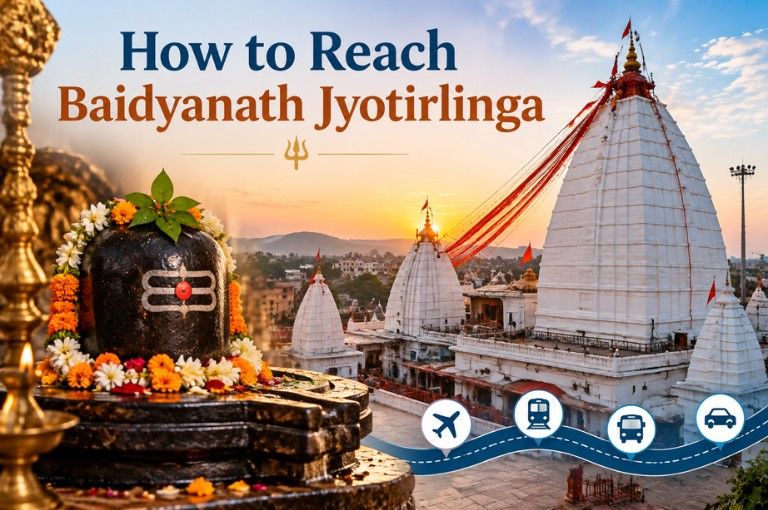
Baidyanath Jyotirlinga, also known as Baba Baidyanath Temple, is located in Deoghar, in the Indian state of Jharkhand, and is one of the twelve Jyotirlingas dedicated to Lord Shiva. This guide explains every route to reach it by air, train and road, along with local transport, timings and a Jharkhand tour package option for planning the full trip.
Key Takeaways
Nearest airport: Deoghar Airport, about 8 km from the temple.
Nearest railway station: Jasidih Junction, about 10 km from the temple.
Main highway: NH114A, connecting Deoghar to Bhagalpur, Dumka and Ranchi.
Distance from Ranchi: About 250 km, roughly 5 to 6 hours by road.
Best time to visit: October to March; the Shravani Mela runs in July-August.
You can reach the Baidyanath Jyotirlinga by air through Deoghar Airport (about 8 km away), by train through Jasidih Junction (about 10 km away), or by road via NH114A. From the airport or station, a taxi, auto-rickshaw or e-rickshaw covers the remaining distance to the temple in Deoghar.
Baidyanath Jyotirlinga refers to the shrine of Baba Baidyanath, one of the twelve Jyotirlingas in Hindu tradition, located in Deoghar. The town is also called Baidyanath Dham, so travellers searching for how to reach baidyanath dham or how to reach baidyanath are referring to this same temple town in Jharkhand.
The complex includes the main sanctum along with twenty-one smaller shrines around a shared courtyard, including one dedicated to Goddess Parvati. Local tradition associates the site with the demon king Ravana, who is said to have worshipped here.
| Location |
Deoghar, Jharkhand |
| Nearest airport | Deoghar Airport, about 8 km from the temple |
| Nearest railway station | Jasidih Junction, about 10 km from the temple |
| Distance from Ranchi | About 250 km (5–6 hours by road) |
| Distance from Patna | About 270 km (6 hours by road) |
| Distance from Kolkata | About 400 km (8–9 hours by road) |
| Main highway | NH114A |
| Best time to visit | October to March; Shravani Mela in July–August |
| Temple timings | Early morning to late evening, with a midday break for rituals |
The fastest route is by air, landing at Deoghar Airport, about 8 km from the temple.
Step 1: Book a flight to Deoghar Airport, which connects to several Indian cities.
Step 2: If no direct flight suits your schedule, fly into Ranchi's Birsa Munda Airport instead, about 250 km away.
Step 3: From Deoghar Airport, take a prepaid taxi or app-based cab to the temple, a ride of about 15 to 20 minutes.
Step 4: From Ranchi, continue by train, shared taxi or private cab, a journey of roughly 5 to 6 hours.
The railway is the most common route for pilgrims, arriving at Jasidih Junction, about 10 km from the temple.
Step 1: Book a train to Jasidih Junction, which sits on the main Howrah-Delhi line with connections from Kolkata, Delhi, Patna, Varanasi and Mumbai.
Step 2: Deoghar's own smaller railway station is an alternative, though Jasidih carries far more long-distance trains.
Step 3: From Jasidih Junction, take an auto, e-rickshaw or taxi to the temple, a ride of about 20 to 25 minutes.
Step 4: Book tickets well in advance during Shravan month and other major festival periods, when trains and waitlists fill quickly.
Deoghar connects to nearby states through NH114A and other state highways, making a road trip a flexible option.
From Ranchi: About 250 km, roughly 5 to 6 hours via NH114A.
From Patna: About 270 km, roughly 6 hours via NH20 and NH114A.
From Kolkata: About 400 km, roughly 8 to 9 hours via NH19 and NH114A.
From Bhagalpur: About 100 km, roughly 2 to 3 hours.
State transport buses, private buses and shared taxis run regularly between Deoghar and nearby cities, and a private cab suits families or elderly travellers best.
Auto-rickshaws: The most common way to move between the station, hotels and the temple.
E-rickshaws: Widely available and easy to flag near the main market.
Taxis: Best for day trips to Trikuta Parvat or Basukinath Temple.
Walking: Many hotels near Baba Mandir Road sit within walking distance of the temple entrance.
October to March brings cool, comfortable weather, ideal for sightseeing and shorter queues. Summers (April to June) turn hot and humid, so an early morning visit works best.
The Shravan month, usually July-August, brings the Shravani Mela, when lakhs of kanwariyas walk roughly 105 km from Sultanganj carrying Ganga water to offer at the shrine. This period draws the year's largest crowds and special traffic arrangements. Avoid it for a quieter visit, or plan carefully around it to witness one of India's largest religious gatherings.
The temple typically opens before sunrise and closes briefly around midday for rituals, reopening for afternoon and evening hours; exact timings shift with the season, so confirm locally on arrival.
The ritual offering usually involves water, milk, bel leaves and flowers poured over the Shivalinga, guided by priests. Photography is generally restricted inside the sanctum.
Near Baba Mandir Road: The most convenient area, close to the main entrance.
Near the railway station: Practical for an early departure, with a short auto ride to the shrine.
Dharamshalas and trust guesthouses: Budget-friendly rooms popular with pilgrim groups.
Book well ahead during Shravan and other major festival dates, since rooms fill quickly.
| October to February | Cool and pleasant, ideal for sightseeing |
| March to June | Hot and humid, visit early morning or evening |
| July to September | Monsoon and Shravani Mela, heavy crowds |
Basukinath Temple: About 42 km away, a popular Shiva temple often paired with this visit.
Trikuta Parvat: A hill with a ropeway ride and countryside views.
Naulakha Mandir: A striking early twentieth-century temple, known for its architecture.
Tapovan: A cluster of sage-linked caves among rocky hills nearby.
Arrive by flight, train or road and check into your stay near the temple, then take an evening walk around the market to see the temple's outer courtyard during aarti.
Reach the shrine early for the first darshan, explore the smaller shrines, then take a short drive to Basukinath Temple and return for the evening aarti.
Visit Trikuta Parvat for the ropeway ride and views, then complete last-minute shopping for prasad before your onward journey.
Extend this to five or six days with a wider Jharkhand tour package covering Ranchi, Netarhat or Betla National Park.
Arranging trains, road routes and local transport independently takes time, especially during Shravan when trains and hotels fill fast. A Baidyanath Dham tour package covers confirmed accommodation near the temple, a private vehicle for transfers and sightseeing, help with darshan timings, and a realistic day-by-day plan.
A typical package includes arrival by train or flight, a stay close to the shrine, guided visits to the main shrine and Basukinath Temple, and a trip to Trikuta Parvat. Many travellers extend this into a wider Jharkhand tour package, adding Ranchi's waterfalls, Betla National Park, Netarhat's hill views or the temple town of Parasnath, to see more of the state in one trip.
| Kolkata to Deoghar | About 400 km — 8–9 hrs by road, or overnight train to Jasidih Junction |
| Patna to Deoghar | About 270 km — 6 hrs by road, or direct train to Jasidih Junction |
| Ranchi to Deoghar | About 250 km — 5–6 hrs by road, or connecting train via Jasidih |
| Varanasi to Deoghar | About 340 km — 7 hrs by road, or direct train to Jasidih Junction |
Delhi to Deoghar | About 1,000 km — best reached by direct train or a flight via Ranchi |
Booking last-minute during Shravan: Trains and hotel rooms sell out weeks ahead of the peak month.
Skipping Jasidih for Deoghar station: Fewer long-distance trains stop at Deoghar station, so check the specific station your train serves before booking.
Carrying prohibited items: Cameras, phones and leather items are usually not allowed near the sanctum, so plan to leave them at your hotel or a locker facility.
Ignoring the midday closure: Arriving right at midday can mean a wait until the temple reopens for afternoon darshan.
Dress modestly: Cover shoulders and knees, and remove footwear before entering.
Carry minimal belongings: Cameras, large bags and leather items are usually restricted inside the sanctum.
Book ahead in Shravan: Trains, hotels and local fares change sharply during the peak month.
Stay hydrated: Queues run long, especially early morning and during festivals.
Keep cash handy: Small vendors and prasad stalls often prefer cash.
Reaching Baidyanath Jyotirlinga is straightforward: fly into Deoghar Airport, take a train to Jasidih Junction, or drive in via NH114A, then complete the last stretch by local taxi or auto. Plan around the Shravan crowds if you prefer a quieter visit, and consider a Jharkhand tour package to combine the pilgrimage with a wider trip across the state.
Ready to begin your journey? Explore How to Reach Baidyanath Jyotirlinga with TourTravelWorld, and let our team plan a Baidyanath Dham tour package with comfortable stays, private transfers and local support.
Ans: Jasidih Junction is the nearest major railway station, about 10 km from the temple, connecting to Kolkata, Delhi, Patna, Varanasi and other major cities.
Ans: Deoghar Airport is the closest, about 8 km away. Ranchi's airport, roughly 250 km away, is the main alternative for long-distance flights.
Ans: Deoghar is about 250 km from Ranchi, a drive of roughly 5 to 6 hours by road via NH114A.
Ans: Some trains stop at Deoghar station, but most long-distance trains stop at Jasidih Junction, about 10 km from the temple, which has wider connectivity.
Ans: October to March offers the most comfortable weather. The Shravan month, around July-August, draws the largest crowds for the Shravani Mela.
Ans: Autos, e-rickshaws and taxis wait outside Jasidih Junction and Deoghar station, taking about 20 to 25 minutes to reach the temple.
Ans: Yes. Basukinath Temple is about 42 km away, and most pilgrims combine both temples using a local taxi or a planned tour package.
Ans: Yes. Many travellers pair the pilgrimage with a wider circuit covering Ranchi, Netarhat, Betla National Park or Parasnath, arranged as a single multi-day tour.
Ans: Deoghar Airport operates a limited but growing set of routes, so check current schedules; Ranchi remains the more reliable option for long-distance connections.
Ans: A package suits travellers who want fixed accommodation, a private vehicle and local support, especially during the crowded Shravan season.