- By Theme
-
Destinations
-
Indian Destinations
-
International Destinations
-
- Best Places to Visit
- Packages
- Search Agents
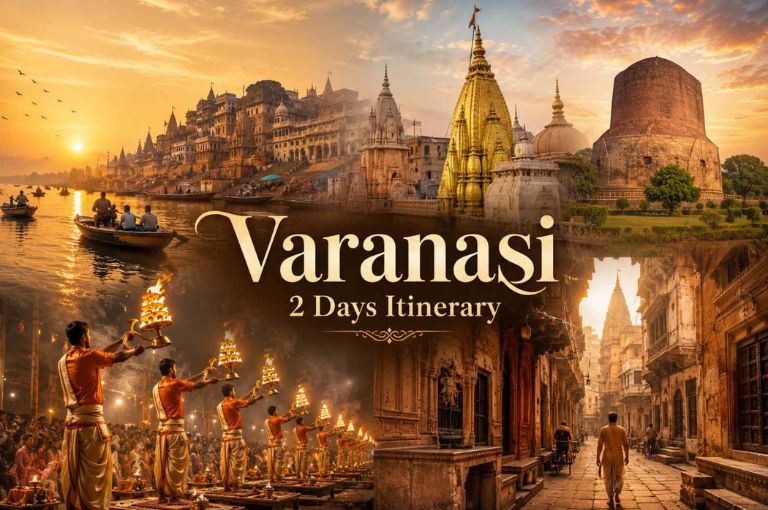
Varanasi is one of those cities that stays with you long after you leave. It sits on the banks of the Ganga River in Uttar Pradesh and is considered one of the oldest continuously inhabited cities in the world. People come here for many reasons — religious rituals, photography, history, food, or simply to experience something that feels unlike any other place in India.
Two days in Varanasi is a short window, but it is enough to see the heart of the city if you plan well. This Varanasi itinerary for 2 days is designed to help you move through the ghats, temples, and lanes at a comfortable pace without feeling rushed or overwhelmed. Whether you are visiting for the first time or coming back after years, these 48 hours will give you a real sense of what Varanasi is about. Before diving into the day-by-day plan, here is a quick overview of what to expect.
| Best Time to Visit |
October to March (pleasant weather, major festivals)
|
Nearest Airport | Lal Bahadur Shastri International Airport (VNS), ~26 km |
| Nearest Railway Station | Varanasi Junction (BSB) and Manduadih (MUV) |
| Currency | Indian Rupee (INR) |
| Language | Hindi,Bhojpuri; English understood at tourist areas
|
| Average Budget (2 Days) | 3,000– 8,000 per person (excluding flights)
|
| Trip Type | Cultural, Spiritual, Heritage |
Varanasi is well connected to most major Indian cities. Here are the most common ways to get there:
Lal Bahadur Shastri International Airport in Babatpur handles flights from Delhi, Mumbai, Bengaluru, Kolkata, and several other cities. The drive from the airport to the city takes around 45 minutes to 1 hour depending on traffic. Prepaid taxis and app-based cabs are available outside the terminal.
Varanasi Junction (BSB) is the main station and is connected to almost every major city in India. If you are coming from Delhi, trains like the Kashi Vishwanath Express and Vande Bharat Express are popular options. The journey from Delhi takes around 8 to 13 hours depending on the train.
If you are travelling from nearby cities like Allahabad (Prayagraj), Lucknow, or Ayodhya, road travel is a good option. Prayagraj is around 120 km away and takes about 2.5 to 3 hours by road. State buses and private vehicles are available.
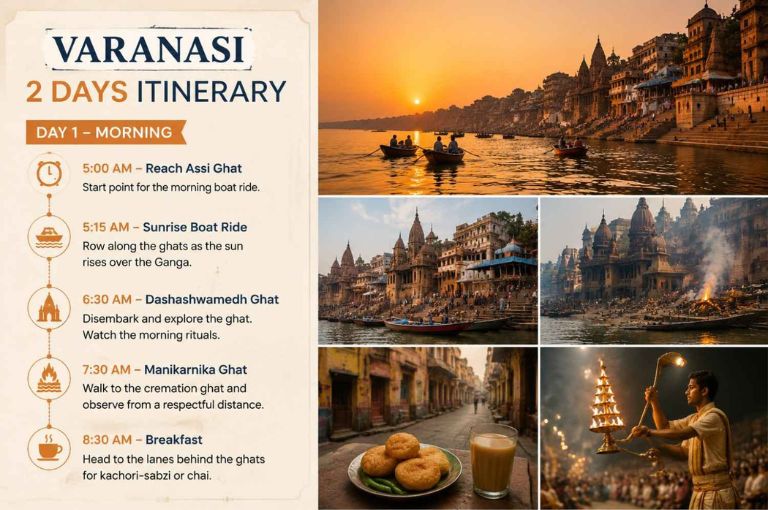
Your first day in Varanasi should start early. The city wakes up before sunrise, and the ghats are at their most atmospheric in the early morning hours. Crowds are thinner, the light is beautiful, and the rituals happening along the river give you a genuine sense of why this place has drawn people for centuries.
5:00 AM – Reach Assi Ghat
Start point for the morning boat ride.
5:15 AM – Sunrise Boat Ride
Row along the ghats as the sun rises over the Ganga.
6:30 AM – Dashashwamedh Ghat
Disembark and explore the ghat. Watch the morning rituals.
7:30 AM – Manikarnika Ghat
Walk to the cremation ghat and observe from a respectful distance.
8:30 AM – Breakfast
Head to the lanes behind the ghats for kachori-sabzi or chai.
Start your morning at famous ghats in varanasi that is Assi Ghat, one of the southernmost and most popular ghats in Varanasi. It is a place where both locals and tourists gather early in the morning for rituals, yoga, and a general sense of calm before the day picks up. From here, you can hire a small rowing boat to travel north along the ghats.
A one-hour boat ride from Assi Ghat to Manikarnika Ghat costs around 300 to 500 per person depending on the boatman. Negotiate before getting in. If you want the ghat all to yourselves, go earlier than 5 AM.
Varanasi has around 88 ghats along the river. You will pass most of the important ones during the boat ride:
Tulsi Ghat — named after the saint Tulsidas who is believed to have written parts of the Ramcharitmanas here
Kedar Ghat — one of the oldest ghats, with a temple dedicated to Lord Shiva
Harishchandra Ghat — the smaller of the two cremation ghats in the city
Dashashwamedh Ghat — the most famous and busiest ghat, where the nightly Ganga Aarti takes place
Manikarnika Ghat — the main cremation ghat; fires here are said to have been burning for thousands of years
Tips: Photography at Manikarnika Ghat is a sensitive matter. Do not photograph or video record the cremations. Some people will try to charge you money to go to rooftops for a view — you can decline politely.
After breakfast, make your way to the Kashi Vishwanath Temple, one of the twelve Jyotirlingas in India and among the most sacred Shiva temples in India. The new Kashi Vishwanath Corridor, completed in 2021, has made access much easier and cleaner. The complex now includes a direct view of the Ganga from within the temple precinct.
Entry is free, but you will need to deposit your phone and other electronic items at the counter outside. The queues can get long; arriving before 9 AM usually means shorter waits.
Note: Non-Hindus can visit the outer premises of the corridor, though entry to the inner sanctum is restricted to Hindus.
After lunch, spend your afternoon in the narrow lanes — called galis — that run behind the ghats. This is where the real texture of the city lives. You will find:
Small sweet shops selling malaiyo (a winter speciality), thandai, and banarasi paan
Silk weavers working on handlooms in narrow rooms
Temples at nearly every corner, some very old and not mentioned in guidebooks
Old havelis with carved wooden doors and faded frescos
The lanes around Vishwanath Gali, Thatheri Bazaar, and Godaulia Chowk are particularly worth exploring. Getting a little lost here is part of the experience — the lanes loop back and you will always find a way to the river.
The Ganga Aarti at Dashashwamedh Ghat is something most people who visit Varanasi remember for a long time. It happens every evening around sunset — typically starting between 6:00 PM and 7:00 PM depending on the time of year.
A group of priests perform a coordinated ritual using large brass lamps, incense, conch shells, and chanting. The crowd is always large, so arriving 30 to 45 minutes early is a good idea if you want a spot close to the river. You can also watch from a boat, which gives you a wider view.
After the aarti, walk along the ghat area and have dinner at one of the restaurants nearby. Baati Chokha, a Bihari-Bhojpuri staple, is something worth trying if you have not had it before.
Your second day is a good time to move at a slightly slower pace, visit Sarnath (which is just 10 km from the city), and explore some of the lesser-known parts of Varanasi that most visitors skip.
| Time | Activity | Details |
| 7:30 AM | Leave for Sarnath | Auto-rickshaw or cab from city; ~30 min drive |
| 8:00 AM | Dhamek Stupa | The main monument at Sarnath; Buddhist significance |
| 9:00 AM | Sarnath Museum |
One of the finest archaeological museums in India |
| 10:30AM | Return to Varanasi | Back to city for brunch |
Sarnath temple is where the Buddha gave his first sermon after attaining enlightenment. It is one of the four most important sites in Buddhism, drawing visitors from Japan, Sri Lanka, Thailand, Myanmar, and across the world. Even if you are not particularly interested in Buddhism, the site is historically significant and visually impressive.
Dhamek Stupa — a large cylindrical structure dating back to around 500 CE, built to mark the spot where the Buddha delivered his first teaching
Chaukhandi Stupa — an older structure where the Buddha reportedly met his first five disciples
Sarnath Archaeological Museum — houses the famous Lion Capital of Ashoka (the original), which became the national emblem of India; also has some exceptional Buddhist sculptures
Mulagandha Kuti Vihar — a modern Buddhist temple with paintings depicting the life of the Buddha
Budget Tips: The museum entry is very affordable (15 for Indian nationals, 200 for foreign nationals). Photography inside is not permitted. Plan at least 45 minutes for the museum.
Return to Varanasi by 11:00 AM and head to one of the areas known for Banarasi silk weaving. Varanasi has been producing silk sarees for hundreds of years, and the craft is still alive in localities like Madanpura, Lallapura, and Peeli Kothi.
You do not have to buy anything to visit. Several cooperative weaving centres allow visitors to watch weavers at work and understand the process. If you do want to buy, the government-run Handloom House near Dasashwamedh Road is a reliable place that avoids tourist markups.
Ramnagar Fort sits on the eastern bank of the Ganga, directly across from Tulsi Ghat, and has been the seat of the Maharajas of Varanasi for centuries. The Maharaja still lives here, and part of the complex is open to the public as a museum.
The museum inside the fort has a remarkable collection:
Vintage cars from the early 20th century
Royal palanquins and howdahs used for elephant rides
Antique weapons and armour
Ivory carvings and old clocks
To reach Ramnagar Fort, take a boat from Tulsi Ghat or Assi Ghat across the river, or drive around via the road bridge. The boat option is more interesting. Entry to the fort museum is around 15 for Indian visitors and 150 for foreign nationals.
Two more temples worth visiting on your second day are the Durga Temple (also called the Monkey Temple) and the Tulsi Manas Temple, which are close to each other in the Durgakund area.
The Durga Temple was built in the 18th century and is dedicated to Goddess Durga. The temple tank in front of it turns red in late afternoon light. It is called the Monkey Temple because of the large number of monkeys that live around it — keep your bags close and do not make eye contact with them if you are holding food.
Built in 1964, the Tulsi Manas Temple is dedicated to Lord Ram and is constructed on the site where Tulsidas is said to have written the Ramcharitmanas. The walls of the temple have verses from the text inscribed on white marble. There is also an interesting mechanical display of scenes from the Ramayana inside, which is popular with children and families.
Spend your last evening in Varanasi at whichever part of the city felt most like you on day one. If you enjoyed the ghats in the morning, go back and sit there as the day winds down. If the lanes drew you in, spend an hour walking without a destination.
For dinner, try one of the rooftop restaurants overlooking the Ganga. Many of them serve a mix of Indian, Tibetan, and continental food. The Banarasi thali — which includes litti chokha, chana dal, chawal, and a sweet — is worth having at least once if you want to eat local.
Food in Varanasi is a big part of the experience. The city has its own distinct food culture that is different from the rest of UP.
Banarasi Paan — the city's most famous export; a betel leaf preparation with various fillings
Kachori Sabzi — a deep-fried bread served with spiced potato curry; best eaten for breakfast
Thandai — a cold milk drink with nuts, spices, and sometimes bhang; widely available during festivals
Malaiyo — a light whipped milk dessert only available in winter months (November to February)
Baati Chokha — wheat dumplings roasted over fire, served with mashed brinjal and potato
Chaat — Varanasi's tamatar chaat and aloo tikki chaat are different from what you get in Delhi
Lassi — thick, cold, and often served in earthen cups from shops near the ghats
Godaulia Chowk — central and buzzing with snack stalls and small restaurants
Dashashwamedh Road — several sit-down restaurants with decent food and ghat views
Lanka Area — popular with BHU students; budget-friendly and diverse options
Assi Ghat — cafes and restaurants with a more relaxed, laid-back atmosphere
Accommodation in Varanasi ranges from budget guesthouses right on the ghats to mid-range hotels and a few luxury properties. Here is a quick breakdown by budget:
| Budget Range | Area / Type | Approx.Rate Per Night |
| Budget | Guesthouses near the ghats; hostels in Assi area | 500 – 1,500 |
| Mid-Range | Hotels in Godaulia, Cantonment area; some ghat-view rooms | 2,000 – 5,000 |
| Premium | Heritage properties, boutique hotels along the Ganga | 6,000 – 20,000+ |
Tip: Staying near the ghats gives you the best access to morning activities. The downside is that lanes are narrow, so getting luggage in and out can be a bit of a task. Budget for a porter if you are travelling with large bags.
Varanasi is not a large city, but the old part — near the ghats — has very narrow lanes where no vehicle can enter. Walking is the primary mode of transport in this area. For getting between the ghats and other parts of the city, here are your options:
Auto-rickshaws — most common and affordable; agree on price before boarding
E-rickshaws — widely available and cheaper than autos for short distances
Cycle rickshaws — for very short distances within congested areas
App-based cabs (Ola/Uber) — available and useful for longer distances like going to Sarnath or the airport
Boats — essential for getting between ghats; private boats can be hired by the hour
October to March is the most comfortable time to visit. Winters (November to February) are cool, and festivals like Dev Deepawali and Ganga Mahotsav happen during this period. Dev Deepawali, which falls on the full moon night of Kartik Purnima (usually in November), is when the entire ghat is lit with lakhs of diyas. If you can plan your trip around that date, it is worth it.
Summers (April to June) are very hot and humid. The monsoon (July to September) brings heavy rain and the Ganga can swell significantly.
Light cotton clothes for summer, warm layers for winter
Comfortable walking shoes or sandals — you will walk a lot
A small daypack for exploring the lanes
Cash — many smaller vendors and ghat services do not accept cards
A dupatta or shawl for visiting temples (also useful at dawn by the river)
Sunscreen and a water bottle
Keep an eye on your belongings in crowded areas, especially near the ghats and at the aarti
Be cautious of touts near temples who offer to take you to specific shops — politely decline and find shops on your own
Drink only packaged or filtered water; avoid street-side juices in summer
The ghats can be slippery early morning — wear footwear with grip
Dress modestly when entering temples — shoulders and knees covered is the general rule
Varanasi does not need hype. It is a city that speaks for itself — through the smell of incense at dawn, the sound of temple bells, the way the river light changes through the day, and the quiet in the lanes late at night. Forty-eight hours here will leave you with a lot to think about, and probably a reason to come back.
If you want help putting together a 2 day Varanasi itinerary or a longer trip, TourTravelWorld offers a Varanasi tour package that covers accommodation, transport, guided ghat walks, and Sarnath day trips — all in one plan. You can customize it based on your dates and budget. Come with an open mind, comfortable shoes, and no fixed expectations. Varanasi will do the rest.
Ans: Two days is enough to see the main highlights — the ghats, Kashi Vishwanath Temple, Sarnath, and the evening Ganga Aarti. If you want to go deeper into the weaving culture, more temples, or simply want to spend more time sitting by the river, three to four days is ideal.
Ans: Early morning between 5 AM and 7 AM is the best time. The light on the river is soft, the crowds are manageable, and you can see morning rituals happening without the chaos that builds up later in the day.
Ans: Sarnath is about 10 to 12 km from the Varanasi city centre. By auto-rickshaw, it takes around 30 minutes. You can also book a cab. Most drivers offer a Sarnath package that includes a few hours of waiting time.
Ans: Yes, Varanasi is generally safe for solo travellers including women. The main tourist areas near the ghats are well-known and relatively safe. Common sense — not going to isolated areas at night, being aware of your surroundings — applies as it would in any busy city.
Ans: You have two options: watch from the ghats (standing or seated) or watch from a boat on the river. The boat view gives you a wider perspective and is less crowded. If you watch from the ghats, arrive at least 30 to 45 minutes early to get a good spot.
Ans: The Kashi Vishwanath Temple is open to everyone. However, the inner sanctum of the temple itself is restricted to Hindu visitors. Non-Hindu visitors can walk through the corridor, see the temple structure, and access the Ganga viewing area within the complex.