- By Theme
-
Destinations
-
Indian Destinations
-
International Destinations
-
- Best Places to Visit
- Packages
- Search Agents
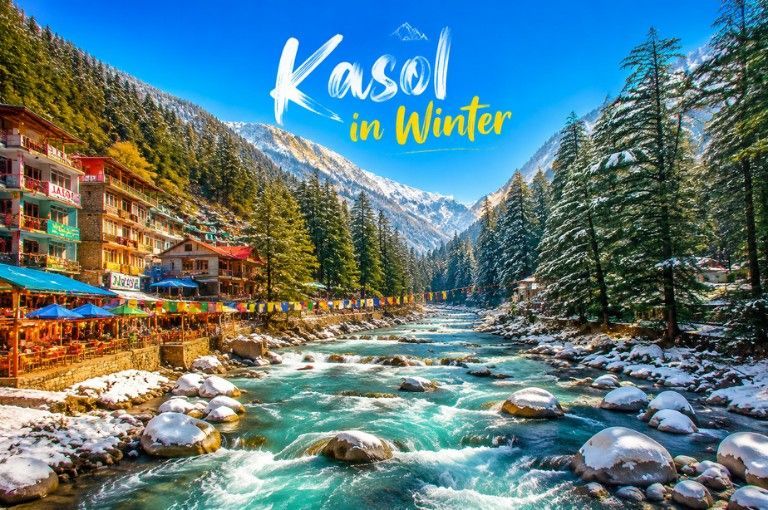
When the monsoon mist clears and the Parvati Valley's summer crowds thin out, Kasol slips into a quieter, snowier version of itself. Wooden rooftops turn white, the river runs colder and clearer against frosted banks, and the deodar forests around the village stand dusted in silver. For travelers who know it only as a monsoon backpacker hub buzzing with Israeli cafes and trance music, Kasol in winter comes as a pleasant surprise — a small Himalayan village wrapped in woodsmoke, bonfires, and a stillness that summer never allows. This guide walks you through everything you need to plan a winter trip to Kasol: the month-by-month weather, the best places to visit nearby, how to get there safely, the experiences that make the season special, the ideal time to go, practical timings, and answers to the questions most travelers ask before booking.
Tucked along the banks of the Parvati River in Himachal Pradesh's Kullu district, Kasol has long been known as a haven for backpackers, drawn originally by its cafe culture and easy access to Himalayan trails. What most seasonal visitors miss, however, is how different this same village feels once the tourist season winds down and the temperature starts to fall. The crowds of May and June give way to a handful of travelers who actually want the cold — trekkers chasing snow-covered trails, photographers after the perfect frosted-forest shot, and anyone who simply wants a slower, quieter kind of mountain trip. Roads are calmer, guesthouses are easier to book, and the valley's natural rhythms — wood fires lit early, hot meals lingered over, conversations that stretch late into cold nights — take center stage in a way the busier months never allow.
Winter in the Parvati Valley unfolds gradually, and the character of a trip here changes a great deal depending on which month you choose. Here is what to expect as the season deepens.
October is technically autumn, but it sets the stage for winter. Daytime temperatures hover between 15°C and 20°C under clear blue skies, while nights cool down to 5°C–8°C. There is no snowfall yet at village level, though the higher ridges around Kheerganga and Tosh may see an early dusting toward the month's end. The forests turn shades of gold and rust, river flow is at its clearest after the monsoon, and this is often the last month to trek comfortably without heavy cold-weather gear. Many travelers use October as a scouting trip, checking out the valley before deciding whether to return for the full snow experience later in the season.
By November, the valley's mood shifts noticeably. Daytime highs drop to around 10°C–15°C, and nights can fall close to freezing, between 0°C and 3°C. Higher settlements such as Tosh and Kheerganga often see their first proper snowfall this month, while Kasol village itself usually stays snow-free but frosty, with morning fog and frozen dew on rooftops and parked cars. Cafe owners begin setting up bonfires by mid-month, and the crowd thins out considerably compared to the busier autumn weekends, making it a good window for travelers who want a taste of winter without its harshest edge.
December brings the valley firmly into winter. Days average 5°C–10°C, and nights regularly dip below freezing, sometimes to -2°C or -3°C in the village. Kasol itself may receive light to moderate snowfall in a good year, particularly in the back half of the month, while Manikaran, Tosh, and Kheerganga see heavier and more reliable snow cover. This is also when Christmas and New Year travelers start arriving, giving the village a festive, bonfire-lit energy despite the cold, with guesthouses filling up faster around the last week of the month than at any other point in the winter.
January is peak winter and usually the coldest month of the year in the Parvati Valley. Daytime temperatures typically range from 2°C to 6°C, while nights can plunge to -5°C to -8°C, occasionally lower during a cold spell. Snowfall is at its heaviest and most frequent this month, often blanketing Kasol village itself for days at a stretch, with the Parvati River's edges icing over in shaded patches. Road conditions on the Bhuntar–Kasol stretch can be affected after heavy snow, so this month rewards travelers who plan with some flexibility and keep a spare day built into their itinerary. It is also, for the same reason, the month that delivers the most dramatic snow-covered scenery of the entire year.
February keeps much of January's chill, with days around 4°C–8°C and nights around -3°C to -5°C, but the snow that has already fallen tends to linger longer on rooftops, pine branches, and trekking trails, making it an excellent month for photography. Fresh snowfall is still common in the first half of the month, tapering off as the month progresses, and by the last week travelers often notice slightly longer daylight hours and a gentler bite to the cold compared to January's peak.
March marks the transition out of winter. Daytime temperatures climb back to 10°C–15°C, and nights settle around 2°C–5°C. Snow at village level melts quickly, though higher altitudes retain patches well into the month, especially in shaded corners of Tosh and along the upper Kheerganga trail. Rhododendrons begin to bloom lower down the valley, giving early March a rare mix of lingering snow and the first hints of spring, and it's a favorite window for travelers who want a milder trek without giving up the sight of snow entirely.
Kasol's real charm lies in how easily it connects to a cluster of villages and trails, each with its own winter personality.
Manikaran Sahib – A short drive from Kasol, this pilgrimage town is famous for its natural hot springs and gurudwara. In winter, steam rising off the hot water against a backdrop of snow-covered hills makes it one of the valley's most striking sights, and a dip in the warm waters is a welcome relief from the cold.
Tosh Village – Perched higher than Kasol, Tosh is where winter really shows off. Its wooden houses, terraced fields, and mountain backdrop are often blanketed in snow from November onward, and the short uphill walk into the village rewards visitors with sweeping valley views.
Kheerganga – This trek, usually done in a day from Barshaini, leads to a natural hot spring at the top. In winter it becomes a snow trek rather than a monsoon trail, with the final stretch often under a layer of snow — best attempted with proper shoes, a local guide, and an early start.
Malana – This Malana village is an isolated place, known for its distinct customs and old wooden architecture, sits across the valley and offers a glimpse of a way of life largely untouched by the tourist rush. Snow can make the approach road trickier in peak winter, so it's worth checking conditions before heading out.
Chalal – A gentle riverside walk from Kasol across a log bridge over the Parvati River leads to Chalal, a laid-back hamlet with a handful of cafes. It's an easy half-day outing even on a cold winter morning.
Pulga and Rasol – These offbeat hamlets beyond Tosh are quieter still, with terraced fields that turn into snow-covered steps in peak winter. They're ideal for travelers looking to get away from even Kasol's modest crowds.
Grahan Village – A less-visited trekking destination surrounded by dense forest, Grahan sees a genuine, remote kind of snowfall and is best suited to travelers comfortable with a longer, quieter trek.
Together, these villages form a loose network radiating out from Kasol, each reachable as a day trip or a short overnight stay, which is part of why the village works so well as a base for the whole valley rather than a single destination in itself. Even travelers with just three or four days can realistically combine two or three of these places with time to spare for simply relaxing by the river.
The nearest airport is Bhuntar (Kullu-Manali Airport), roughly 30–40 minutes from Kasol by road. Winter flight schedules here can be affected by fog and cloud cover, so it helps to keep a buffer day in your itinerary. If flights are disrupted, Chandigarh Airport, about 270 km away, serves as a reliable alternative with a longer onward road journey.
Kasol has no direct broad-gauge rail connection. The nearest major railheads are Chandigarh and Ambala, from where the rest of the journey continues by road. Travelers who enjoy scenic narrow-gauge routes sometimes combine this with the Kangra Valley line via Joginder Nagar, though this adds significant travel time.
Kasol is well connected by road from Delhi via the Chandigarh–Mandi–Bhuntar highway, a journey of roughly 12–14 hours covering about 530 km. HRTC state buses and private Volvo services run regularly to Bhuntar and Kasol, and self-drive travelers should carry warm layers, keep fuel topped up in remote stretches, and check road advisories after heavy snowfall, particularly in January when conditions near higher villages can turn slick. From Bhuntar, the final stretch to Kasol via Bhuntar–Manikaran road hugs the Parvati River and is generally kept clear even in winter, though the onward roads toward Tosh, Barshaini, and Malana are far more weather-dependent and can close temporarily after a heavy snowfall until local authorities clear them.
It's worth building in a little extra time either way, since winter daylight is shorter and mountain roads are best driven before dusk. Local taxi unions in Kasol and Bhuntar are usually the quickest source of same-day updates on which roads are open, and most guesthouse owners are happy to share the latest word from neighboring villages if you ask.
Warming up by a bonfire at a riverside cafe while the Parvati River rushes past in the dark
Sampling the valley's famous Israeli and continental menus — shakshuka, hummus platters, and hot ginger-lemon-honey tea are winter staples here
Taking on the Kheerganga snow trek and soaking in the natural hot spring at the top with snow-capped peaks all around
Photographing the deodar forests and wooden village rooftops under a fresh layer of snow, especially in the early morning light
Soaking in the hot springs at Manikaran after a cold day of sightseeing
Picking up handwoven Himachali shawls, caps, and woollens from local stalls in Kasol market
Stargazing on clear winter nights, when the valley's low light pollution and crisp air make for exceptional visibility
Swapping travel stories with backpackers from around the world at one of Kasol's many guesthouse common areas
For travelers who want the classic snow experience, December through February is the core window, with January delivering the heaviest and most consistent snowfall. Late December into early January also brings a festive energy, as many backpackers time their visit around Christmas and New Year. If you would rather avoid the risk of road disruptions that can follow the heaviest January snow, late November or late February to early March offer a good middle ground — enough snow on the higher villages and trails to feel like winter, with slightly easier travel conditions and milder daytime temperatures. Whichever month you choose, it helps to build a spare day or two into your plans in case snowfall affects onward travel to Tosh, Kheerganga, or Malana.
First-time visitors chasing a classic snow-and-bonfire holiday tend to do best with a December or January trip, while those who'd rather trek in slightly kinder weather without giving up the scenery often lean toward the shoulder weeks either side of peak winter.
Winter days are noticeably shorter in the valley. Sunrise typically falls between 7:15 and 7:30 AM, and sunset arrives early, usually between 5:30 and 6:00 PM, so outdoor plans need to work around a shorter daylight window than in summer. Late morning to early afternoon, roughly 10 AM to 3 PM, tends to be the warmest and most comfortable stretch for sightseeing and photography. Most cafes in Kasol open around 9 AM and stay lively until 9 or 10 PM, though some close earlier on the coldest nights.
The Manikaran Sahib gurudwara and its langar (community kitchen) generally welcome visitors through the day, with the hot spring baths best enjoyed in daylight hours. For treks such as Kheerganga, starting from Barshaini by 7 or 8 AM is strongly recommended in winter, since the trail is best covered before the afternoon light fades and temperatures drop again.
Winter travel in the Parvati Valley involves a few extra layers of planning compared to the monsoon season — checking road conditions toward Tosh and Malana, timing the Kheerganga trek around daylight hours, booking homestays that are properly heated, and knowing which villages are realistically reachable after fresh snowfall. Keep this Kasol travel guide bookmarked for the season, and pair it with a well-structured Kasol tour package that bundles stays, local transport, and guided treks — it takes the guesswork out of a winter visit, letting you focus on the experience itself rather than the logistics behind it.
Kasol earned its nickname as a 'mini Israel' from the wave of Israeli backpackers who settled into its cafe scene decades ago, and that influence is still visible in winter, when steaming bowls of shakshuka and fresh hummus platters share menu space with Himachali staples like siddu, rajma-chawal, and thukpa borrowed from the broader hill-state kitchen. Winter evenings in the village follow a familiar pattern: cafes along the river light their bonfires by late afternoon, guesthouses serve hot ginger tea on request, and conversation drifts easily between long-term travelers and first-time visitors swapping notes on which village had the better snow that week. Local Himachali families in and around Kasol also shift their own routines for the season — firewood is stacked early, livestock is moved to sheltered pens, and woolen shawls and caps, handwoven in nearby villages, appear at market stalls, doubling as both practical winter wear and a favorite souvenir for visitors.
Layering is the single most useful packing strategy for a winter trip here: a moisture-wicking base layer, a fleece or wool mid-layer, and a windproof, insulated outer jacket will cover most days, with an extra heavy jacket reserved for early mornings and treks like Kheerganga. Waterproof trekking shoes with good grip matter more than they might seem to, since packed snow on stone paths in Tosh or Chalal turns slippery fast, and thermal socks, gloves, and a woolen cap round out the essentials. A basic lip balm and moisturizer help with the dry mountain air, and a reusable water bottle with an insulated cover keeps water from freezing solid on longer treks.
For photographers, the valley rewards patience over gear. The hour just after sunrise, when frost still clings to rooftops and mist rises off the Parvati River, offers the softest light of the day, while late afternoon backlight through the deodar forest creates striking silhouettes. Villages like Tosh and Pulga, with their stacked wooden houses and terraced fields, photograph especially well after a fresh snowfall, and a short walk up from Kasol toward Chalal gives wide, uncluttered views of the valley without needing a full-day trek. Carrying spare batteries is worth remembering, since cold temperatures drain them noticeably faster than usual.
Ready to see the Parvati Valley under snow for yourself? Let Kasol in Winter tour packages from TourTravelWorld take care of the stays, local transport, and guided treks — so all you have to do is show up and watch your breath turn to fog against the Himalayas.
Ans: Yes. Winter transforms Kasol into a quieter, snow-dusted village with far fewer crowds than the monsoon season, along with easy access to snow treks, hot springs, and a cozy cafe culture built around bonfires and warm food.
Ans: Kasol village does receive snowfall most winters, particularly in December and January, though it tends to be lighter than at higher points like Tosh and Kheerganga, where snow is heavier and more consistent.
Ans: Thermal layers, a good down or padded jacket, woolen caps and gloves, warm socks, and waterproof trekking shoes are essential, along with a basic first-aid kit and lip balm or moisturizer for the dry mountain air.
Ans: Yes, the Kheerganga trek is doable in winter and is a popular snow trek, but the trail can be slippery under snow, so sturdy footwear, an early start, and ideally a local guide are recommended for safety.
Ans: December typically sees daytime highs of 5°C–10°C with nights dipping near or below freezing, while January is colder still, with days around 2°C–6°C and nights that can fall to -5°C to -8°C.
Ans: Kasol is generally considered safe for solo travelers year-round, including in winter, thanks to its established backpacker culture, though it's still wise to check weather and road advisories before heading to higher, more remote villages.
Ans: Malana can usually be reached in November and early December, but heavy snowfall in peak winter months can make the approach road difficult or temporarily closed, so it's best to confirm current access locally before planning a visit in January or February.
Ans: Most guesthouses and cafes in Kasol offer Wi-Fi, and mobile network coverage is reasonably reliable in the village itself, though connectivity becomes patchy or unavailable once you head toward higher villages like Tosh, Kheerganga, or Malana.