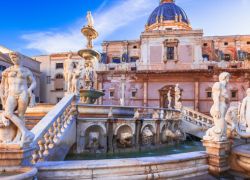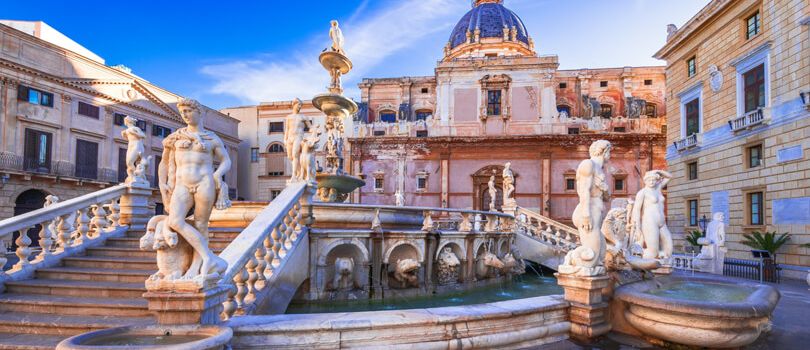
"Admire exquisite fountains and historical artistry."
Fontana Pretoria, also called the “Fountain of Shame” (Fontana della Vergogna), is a monumental Renaissance fountain located in Piazza Pretoria in central Palermo, Sicily. Created by Francesco Camilliani in 1554 and later reassembled here in 1574, the fountain dominates the square with its 12 m height, three concentric marble basins, and over 50 statues of gods, river deities, nymphs, animals and mythological creatures :contentReference[oaicite:1]{index=1}.
How to Reach Fontana Pretoria, Palermo
• On Foot: It lies at Piazza Pretoria, one block south of Piazza Quattro Canti. It's around a 5-minute stroll from Palermo Cathedral or Teatro Massimo :contentReference[oaicite:2]{index=2}.
• By Bus: Routes 101 or 102 from the railway station will take you to the ‘Piazza Pretoria’ stop nearby :contentReference[oaicite:3]{index=3}.
• By Car: Limited nearby parking; better to park near Prato della Valle or along Via Roma and walk in. Piazza Pretoria sits within a ZTL (restricted zone) :contentReference[oaicite:4]{index=4}.
Weather at Palermo
Palermo enjoys a Mediterranean climate with hot dry summers (up to 35 °C) and mild winters (0–15 °C). Spring and autumn offer the most pleasant weather—ideal for sightseeing and strolling the square.
Timing to Visit
Piazza Pretoria and its fountain are public and accessible 24 hours a day, year-round :contentReference[oaicite:5]{index=5}. Best times to visit are early morning or late afternoon for softer lighting and fewer crowds :contentReference[oaicite:6]{index=6}.
Why Famous?
Fontana Pretoria is famous for:
Entry & Visit Details
• Public Access: Free and open at all times—no tickets required.
• Guided Tours: Available via Palazzo delle Aquile concierge, including an underground tour of the fountain's hydraulic ducts—must be pre-booked :contentReference[oaicite:11]{index=11}.
• Photography: Allowed and popular; best light is early morning or late afternoon :contentReference[oaicite:12]{index=12}.
• Restoration: Surrounded by protective fencing since late 20th‑century restoration (1998–2003) :contentReference[oaicite:13]{index=13}.
History & Architecture
Florentine Origins (1554): Designed by Francesco Camilliani for Don Pedro Alvarez de Toledo’s villa in Florence, housing 48 marble statues and framed by an arbor of 90 wooden columns praised by Vasari as “unparalleled in Italy” :contentReference[oaicite:14]{index=14}.
Transfer to Palermo (1574–1581): Purchased by Palermo Senate from Luigi de Toledo for about 30,000 scudi. Transported in 644 pieces and reassembled by Camillo Camilliani, with additions by Michelangelo Naccherino. Adjustments were made to fit the city square, demolishing nearby buildings :contentReference[oaicite:15]{index=15}.
Restorations: The fountain underwent heavy repair after centuries of damage and vandalism; a major restoration project completed in 2003 returned it to full splendour :contentReference[oaicite:16]{index=16}.
Things to Do Nearby
Interesting Facts
Tips for Visiting
Palermo