India >> North Zone >> Rajasthan >> Jaipur


|
Bada Bagh
Bada Bagh is a fruitful oasis in the charming backdrop of a pretty rain fed lake and a dam in the middle of the plateau. Built by Maharaja Jai Singh II, much of the city's fruit and vegetables are grown here and above it are royal cenotaphs with elegantly carved ceiling and equestrian statues of former rulers.


The royal cremation grounds are set between the desert and a rain fed lake, built by Maharaja Jai Singh II. A wheat crop is planted as the lake dries up each year. Each of the memorial 'chattris' has a central column with a bas relief of its owner. Many are followed by figures- one for each wife or consort who committed 'sati' on his funeral pyre.
One can see a definite progression of style from the angular shapes of the early Hindu monuments at the back that are over 300 years old, to the round arches of later Moghal influence on architecture. Bada Bagh is an oasis at the bank of a man-made dam. It has greenery all around to provide respite, to the local people, from the unrelenting sun.
In the murky dusk, this is a popular place to watch the setting sun turn Jaisalmer into a beautiful golden brown land. Situated off the Ramgarh Road, the park is accessible any time, with no entry fee..
|


|
Mandore Garden
Mandore Gardens 9 km from Jodhpur, Mandore was once the capital of Marwar. The wide gardens with high rock terraces houses the ruins of the former capital along with the cenotaphs of Jodhpur rulers, the most remarkable being the memorial of Maharaja Ajit Singh. Its highlights comprise the graphic Hall of Heroes, a rock wall with high relief, bright paintings depicting scenes from the lofe of local heroes such as Pabuji and Chamunda and crowded current holy place of 30 crore gods.
Mandore Gardens also provide the perfect venue for the much-famed Marwar Festival. The highlight of the Mandore Gardens include the graphic Hall of Heroes, a rock wall with high release, brightly painted depictions of local heroes such as Pabuji and Chamunda and crowded modern shrine of 30 crore gods.
Fairs in Rajasthan are mythological in nature, relating to gods and goddesses. They are even celebrated to commemorate the brave deeds of medieval heroes. Mandore Gardens provide the perfect venue for The Marwar Festival, held in memory of the heroes of Rajasthan. The festival is celebrated in the Hindu month of Ashwin (Sept.-Oct.) in Jodhpur, the former capital of Marwar Province..
|


|
Ram Niwas Garden
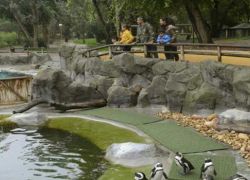
The last Maharaja Ram Singh II, as a food crisis relief project, laid out the popular Ram Niwas Gardens located in Jaipur in 1868. It houses a Zoo, an aviary, a greenhouse, a herbarium, a museum and several sports grounds.
The Albert Hall museum is especially noted for its Indo-Saracenic structure. Recently there have been some additions such as Rabindra Manch with an auditorium, a modern art gallery and an open-air theatre.
To provide open space and greenery to the citizens, this big garden with a zoo, an aviary, a greenhouse, a herbarium, a museum and several sports grounds was built during
the reign of Sawai Ram Singh II in 1868.
The good-looking Indo-Saracenic structure of the Albert Hall designed by Sir Swinton Jacob was opened in 1887 AD as a public museum. It contains a fine collection of sculptures, paintings, decorative objects, usual history specimens, an Egyptian mummy and the celebrated Persian garden carpet. Recently the Rabindra Manch with an auditorium, a modern art gallery and an open-air theatre has been added to promote cultural activities.
.
|


|
Sahelion Ki Bari
Saheliyon ki Bari in Udaipur recreates regal grandeur as you walk along marble pathways flanked by life size marble sculptures of elephants and lions spurting water into exotic water pools.
Fascinating Saheliyon-ki-Bari or the 'garden of maids' was designed and built under the express guidance of Maharana Sangram Singh II. It is believed that Saheliyon ki Bari was constructed for 48 maids who accompanied the Maharana's wife as dowry.
Designed as a pleasure park, Saheliyon ki Bari served as a place of frolic and enjoyment for the ladies of the household.
Later Maharana Bhopal Singhji constructed a pavilion of 'rain fountains' within the Saheliyon ki Bari. The idea was to create an illusion of rain dancing in rhythm with dancing maids.
The garden was constructed for forty-eight young ladies-in-waiting sent to the royal house, as part of the dowry. This small ornamental garden was a popular relaxing spot where royal ladies came for a stroll.
The garden has many fountains in its four delightful pools, sculpted kiosks and marble elephants Its manicured lawns display a marvellous range of bougan villea and five fountains release showers in tune with their titles namely, 'Welcome'; 'Raining Cats and Dogs'; 'Rains in Midnight', 'Rains without Clouds'; 'Gentle Shower in Mid Day'..
|


|
Sisodia Rani Ka Bagh
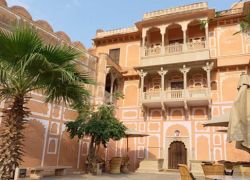
The terraced Sisodia Rani Ka Bagh (the Garden of Sisodia Queen) is situated at a distance of 10 kms. from Jaipur, which was produced by the queen of Jai Singh II, Sisodia Rani, as an escape from the court intrigues. It is a beautiful escape with landscaped gardens and murals of the life of Lord Krishna, decorating its interiors.
The garden is one of the many summer retreats built during the 17th and 18th centuries by Jaipur royals. Not far from here on the way to Galta are natural springs and temples of Lord Vishnu, Lord Shiva, and Lord Hanuman. It consists of a central room with galleries on three sides, around which are terraced gardens graced by fountains and pools. Their elegance further graced by magnificent pieces of sculptures.
The best-preserved one is Vidyadhar-ka-Bagh, constructed by Vidyadhar - the builder of the city, with shady trees, flowing water, an open pavilion and suites of living rooms.
The reason the Sisodia Rani ka Bagh garden is so captivating is because it not only displays the skill of a human hand but also the beauty of nature that very often goes unappreciated.
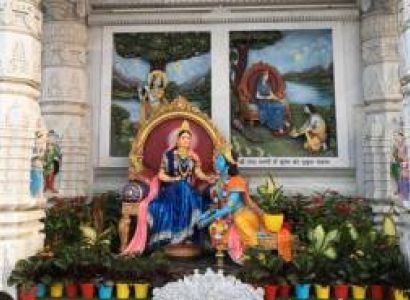
Its murals and paintings vividly depict the legends of Radha-Krishna and it has many scenes and murals that depict the frolicking Krishna in his youth and various hunting scenes. And of course, it has green grass, and various kinds of plants including many flowering and fragrant shrubs.
The garden may have been a summer retreat for the royalty and nobility in the 18th and 19th century but now we all can enjoy the refreshing air and fragrance of the garden.
If you are a city-dweller then this is truly a feast for the eyes, since such greenery and clean surroundings are hard to find in the cities. So, if you badly need a break and want to visit the Sisodia Rani ka Bagh, then come to Jaipur in Rajasthan and check out the beauty of the garden with your own eyes. You can also check out the natural springs that lie on the way to Galta and pay your respects at the temples of Lord Vishnu, Hanuman and Shiva.
.
|


|
Vidyadhars Garden
Situated 7 kms. east of Jaipur in a narrow valley, the garden, in memory of Vidyadhar, the architect of the Pink City, is surrounded by high hills. This newly renovated and enthrallingly beautiful place is former vineyard of the royalty. This is a terraced garden with fountains, pool and other features of a formal royal resort.
Vidyadhar Garden has been planned in a medieval style similar to that of Sisodia Garden. In the evening, well-shrouded lights at the base of the surrounding hills outline them against the darkening backdrop.
Vidhyadhar Bhattacharya designed the city of Jaipur using the principles of town planning as laid down in the Shilpa Shastra, an ancient Hindu treatise on architecture. He built the City Palace and the largest stone observatory in the world using the same principles. On the way to Galta, these gardens are laid out in tiers.
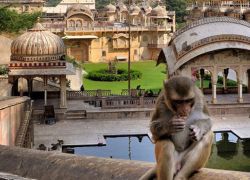
These house several galleries, pavilions and exquisite murals depicting scenes from the life of Lord Krishna, which is a visual delight. It's a perfect location for viewing peacocks and monkeys. .
|


|


Related Cities

|