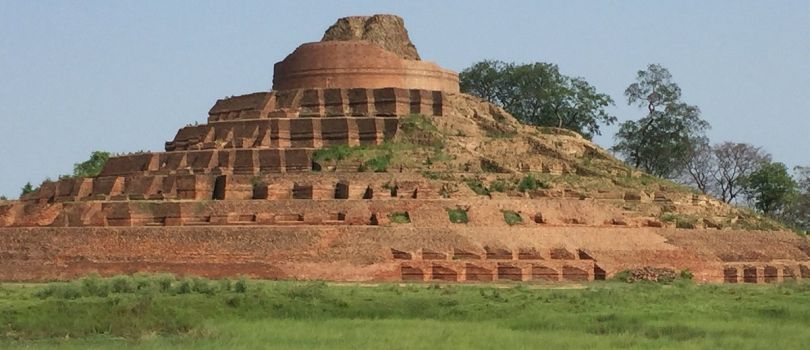
"Visit the largest Buddhist stupa in India."
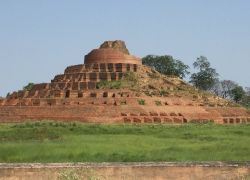
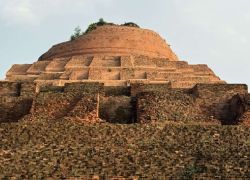
The Kesariya Buddha Stupa is an outstanding historical and religious monument located in the East Champaran district of Bihar, India. It is considered one of the tallest and most impressive Buddhist stupas in the world, standing at a present height of approximately 104 feet with a base circumference of nearly 400 feet. The stupa's size and ancient legacy make it an essential destination for pilgrims, history lovers, archaeologists, and travelers exploring India’s Buddhist Heritage Circuit. :contentReference[oaicite:0]{index=0}
History and Significance
The origin of Kesariya Stupa dates back to the 3rd century BCE during the Mauryan era, likely under the reign of Emperor Ashoka, who played a crucial role in spreading Buddhism across the Indian subcontinent. Later expansions took place during the Sunga-Kushana period and the Gupta era between the 2nd century BCE and around the 5th–6th century CE. :contentReference[oaicite:1]{index=1}
According to traditional Buddhist accounts, this site is believed to be where Lord Buddha offered his alms bowl to the Licchavis (people of Vaishali) during his final journey before attaining Nirvana. This act of generosity is an important symbolic event in Buddhist lore, representing Buddha’s compassionate spirit and final interactions with his followers. Excavations have revealed relics, statues, sculptures, and other ancient artifacts that confirm the site’s connection to the Buddha’s life and teachings. :contentReference[oaicite:2]{index=2}
Architecture and Layout
The structure of Kesariya Stupa is impressive for its time. Made primarily of fired clay bricks and lime mortar, the stupa follows a classical Buddhist monument design with a massive circular base and ascending terraces. The monument has multiple terraces, each traditionally used for ritual circumambulation (known as pradakshina), and a central dome that once contained relics. :contentReference[oaicite:3]{index=3}
Many experts note architectural parallels between Kesariya Stupa and the famous Borobudur Temple in Indonesia, both featuring a circular mandala design with layered terraces and Buddha figures. This similarity hints at historical exchanges of artistic and religious ideas between ancient Buddhist cultures. :contentReference[oaicite:4]{index=4}
How to Reach Kesariya Buddha Stupa
Reaching the Kesariya Buddha Stupa is relatively straightforward for travelers coming from different parts of India:
Weather and Best Time to Visit
The climate in East Champaran is typical of North Indian plains, with hot summers, a monsoon season, and cool winters. The best time to visit Kesariya Stupa is from September to April, when the weather is pleasant and ideal for outdoor exploration and sightseeing. Summers (April–June) can be hot, while the monsoon season (July–August) brings heavy rains that may make travel more challenging. :contentReference[oaicite:8]{index=8}
Timings, Entry, and Visit Details
Most visitors are welcome at the Kesariya Buddha Stupa site during the daytime, usually from early morning until late afternoon. Typical visiting hours are around 9:00 AM to 6:00 PM, though hours can vary slightly depending on local management and seasons. Entry to the stupa site is generally free, as it is a protected archaeological monument. :contentReference[oaicite:9]{index=9}
There are no strict formal entry fee barriers, but visitors are expected to respect the sanctity of the site. Photography and mobile phones are typically permitted, though climbing on fragile or unrestored parts of the stupa is discouraged. :contentReference[oaicite:10]{index=10}
Things to Do at Kesariya Stupa
Visiting the Kesariya Buddha Stupa offers a blend of spiritual, educational, and cultural experiences:
Interesting Facts
1. World’s Tallest Buddhist Stupa: Kesariya Stupa is recognized as one of the tallest Buddhist stupas still standing in the world today. :contentReference[oaicite:15]{index=15}
2. Excavations and Archaeology: The Archaeological Survey of India (ASI) conducted excavations in 1998, 2018–19, and resumed in 2024, uncovering significant relics, cells, and structural features that add depth to our understanding of the site. :contentReference[oaicite:16]{index=16}
3. Mandala Influence: The design of the stupa reflects mandala concepts central to Buddhist philosophy, representing the cosmos and stages of spiritual ascent. :contentReference[oaicite:17]{index=17}
Tips for Visitors
• Wear Comfortable Shoes: The site involves walking on earthen paths and uneven surfaces. :contentReference[oaicite:18]{index=18}
• Respect the Monument: As a protected archaeological site, visitors should avoid climbing on delicate structures or disturbing relics. :contentReference[oaicite:19]{index=19}
• Carry Water and Sun Protection: Especially in warmer months, bring water, hats, or sunscreen. :contentReference[oaicite:20]{index=20}
• Combine Nearby Sites: If time permits, visit other nearby heritage places in Bihar’s Buddhist circuit for a richer experience. :contentReference[oaicite:21]{index=21}
Note on “Church of Our Lady, Bruges”
Your request also mentioned “Church of Our Lady, Bruges, Champaran.” It’s important to clarify that *Church of Our Lady* typically refers to a famous church in Bruges, Belgium, and does not have any known historical or cultural connection to Champaran, Bihar, India. Therefore, this content focuses solely on the Indian Buddhist site Kesariya Buddha Stupa, which is a major heritage destination in Champaran. If you meant another local church in Champaran, please specify the correct name and location. (No web sources link a “Church of Our Lady” to Champaran in Bihar.)


Champaran
Champaran
Champaran
Champaran
Champaran
Champaran
Champaran
Champaran
Champaran