Highlights of the Tour Cross the spectacular Larkya La Pass (5,106m), one of Nepal's highest and most scenic trekking passes Explore the remote and less-crowded trails of the Manaslu region Enjoy breathtaking views of Mount Manaslu (8,163m), the world's eighth-highest mountain Walk through traditional Tibetan-influenced villages and experience authentic mountain culture Visit ancient Buddhist monasteries, mani walls, chortens, and prayer flags along the route Discover the beautiful alpine landscapes of Samagaun and Samdo Witness dramatic scenery ranging from lush forests and river gorges to high mountain deserts Experience panoramic views of Himalchuli, Ngadi Chuli, Ganesh Himal, Cheo Himal, and Annapurna II Trek through the protected Manaslu Conservation Area, rich in biodiversity and wildlife Spend nights in traditional teahouses and connect with local communities Follow the historic trade route that once connected Nepal and Tibet Enjoy a complete Himalayan adventure combining culture, wilderness, and high-altitude trekking experience 15 Nights/ 16 Days Max People : 30 MANASLU REGION The Manaslu Circuit Trek (16 Days) is one of Nepal’s most rewarding trekking adventures, taking you around Mount Manaslu (8,163m), the world’s eighth-highest mountain. Located in a restricted region of west-central Nepal, this trek offers a quieter and more authentic Himalayan experience compared to the country’s busier trekking routes. The trail passes through remote mountain villages, deep river gorges, dense forests, and high-altitude landscapes while showcasing the rich traditions of Tibetan-influenced communities. Over 16 days, the scenery changes dramatically as you ascend from the lush valleys of the Budi Gandaki River to the rugged alpine terrain near the Tibetan border. Along the way, you’ll encounter ancient monasteries, colorful prayer flags, traditional stone villages, and breathtaking mountain panoramas. The highlight of the journey is crossing Larkya La Pass (5,106m/16,752ft), where spectacular views of Manaslu, Himlung Himal, Cheo Himal, and surrounding peaks create one of the most memorable moments in the Himalayas. For trekkers seeking remote trails, rich culture, and genuine wilderness, the Manaslu Circuit remains one of Nepal’s finest trekking experiences. Manaslu Circuit Trek at a Glance Before planning the Manaslu Circuit Trek, it helps to understand some of the key facts that make this route one of Nepal’s most remarkable trekking adventures. These statistics highlight the scale, significance, and unique features of the Manaslu region. Quick Facts Mount Manaslu (8,163m) is the eighth-highest mountain on Earth. LarkyaLa Pass (5,106m) is one of Nepal’s most spectacular high-altitude trekking passes. The trek covers approximately 177 kilometers (110 miles) depending on the itinerary. The route passes through the Manaslu Conservation Area, one of Nepal’s most biodiverse protected regions. The conservation area protects 1,663 square kilometers of Himalayan ecosystems. Foreign trekkers were first allowed to visit the Manaslu region in 1991. The trek follows ancient trade routes historically used between Nepal and Tibet. Manaslu remains one of Nepal’s least crowded major trekking circuits due to its restricted-area status. A licensed trekking guide is mandatory for all foreign trekkers. The trail combines high mountain scenery, Tibetan Buddhist culture, remote villages, glaciers, and alpine wilderness into a single trekking experience. These facts make the Manaslu Circuit Trek one of the most diverse and culturally rich trekking routes in Nepal, offering a unique alternative to the more crowded Everest and Annapurna regions Best time to visit Manaslu Circuit Trek 16 Days The best time to visit the Manaslu Circuit Trek 16 Days is during the spring and autumn seasons. Spring runs from March to May, offering warm weather and beautiful blooming rhododendrons along the lower trail. The morning skies are usually clear, giving you perfect views of Mount Manaslu. Walking during these months makes the daily altitude gain feel comfortable and highly enjoyable for trekkers. Choosing the right season can significantly impact your trekking experience. Clear skies, comfortable temperatures, and reliable trail conditions make spring and autumn the preferred months for most trekkers. Winter and monsoon seasons present additional challenges due to heavy snowfall, landslides, and poor visibility in the higher sections of the route. Spring (March–May) Spring is one of the most beautiful seasons for the Manaslu Circuit Trek. Warmer temperatures, blooming rhododendron forests, and excellent mountain visibility create ideal trekking conditions throughout the region. During these months, trekkers enjoy clear morning views of Mount Manaslu (8,163m), comfortable daytime temperatures, and colorful landscapes at lower elevations. The combination of stable weather and vibrant scenery makes spring a favorite season for photographers and nature lovers. Why trek in spring? Pleasant temperatures and stable weather Blooming rhododendron forests Clear mountain views Excellent photography opportunities Comfortable trekking conditions Autumn (September–November) Autumn is widely considered the best season for the Manaslu Circuit Trek. After the monsoon rains clear the atmosphere, the mountains appear exceptionally sharp and visibility is often at its best. The trails are generally dry, temperatures remain comfortable, and weather conditions are highly favorable for crossing Larkya La Pass. Because of these advantages, autumn is also the busiest trekking season in the Manaslu region. Why trek in autumn? Best mountain visibility of the year Dry and stable trails Comfortable daytime temperatures Ideal conditions for Larkya La Pass Peak trekking season Seasons Not Recommended While trekking is technically possible during winter and monsoon, these seasons present additional risks and logistical challenges. Weather conditions can significantly affect trail safety, transportation, and overall trekking enjoyment. Trekkers planning the Manaslu Circuit generally avoid these periods unless they have extensive high-altitude trekking experience and are prepared for unpredictable mountain conditions. Wilderway Guide Recommendation According to Wilderway guides, October, November, April, and early May consistently offer the most reliable trekking conditions on the Manaslu Circuit Trek. These months provide the best balance of weather stability, mountain visibility, and safe trail conditions. For trekkers planning to cross Larkya La Pass (5,106m), choosing the best time to cross larkya la pass significantly improves the likelihood of clear views, safer trail conditions, and a more enjoyable overall trekking experience.For trekkers planning to cross Larkya La Pass (5,106m),choosing either spring or autumn significantly improves the likelihood of clear views, safer trail conditions, and a more enjoyable overall trekking experience. What to expect in Manaslu Circuit Trek 16 Days You can expect an off-the-beaten-path adventure on the Manaslu Circuit Trek (16 days). The trail takes you through a restricted region, offering a raw and untouched experience compared to other popular routes. You will walk five to seven hours daily, passing ancient Buddhist monasteries and traditional Tibetan villages. The itinerary includes a rest day to help your body adapt to the rising altitude safely. Evenings are spent in cozy teahouses, sharing meals with fellow hikers and experiencing local culture. The route transitions beautifully, showing you lush green valleys and arid high-altitude deserts. Your guide will arrange all the necessary restricted permits and ensure your pace is safe. While the facilities get basic as you go higher, the stunning starry skies near the Larkya La Pass make every night special. Why Is the Manaslu Region Restricted? The Manaslu region is classified as a restricted trekking area by the Nepal government to protect its strategic border location, unique cultural heritage, and fragile Himalayan environment. Unlike popular trekking regions that receive large numbers of visitors every year, Manaslu follows a controlled tourism model designed to preserve the area’s authenticity while ensuring sustainable development for local communities. Located Near the Nepal–Tibet Border: Much of the Manaslu trekking route lies close to the international border with Tibet. Due to its sensitive geographic location, the Nepal government regulates foreign access through special permits and mandatory guide requirements. This helps manage tourism activities and maintain security in remote border regions. Preservation of Ancient Tibetan Culture: The upper Manaslu region is home to communities whose traditions, language, architecture, and religious practices closely resemble those of Tibet. Villages such as Sama Gaun and Samdo have preserved their cultural identity for centuries. Controlled tourism helps protect these traditions from the rapid changes often associated with mass tourism. Protection of Historic Monasteries and Sacred Sites: The trail passes through important Buddhist monasteries, mani walls, chortens, and sacred pilgrimage sites. Restricting visitor numbers helps safeguard these cultural landmarks while allowing local communities to continue practicing their traditions without disruption. Environmental Conservation: The route traverses the Manaslu Conservation Area, which contains diverse ecosystems ranging from subtropical forests to alpine landscapes. The region supports wildlife such as snow leopards, Himalayan thar, musk deer, and numerous bird species. Permit regulations help fund conservation efforts and reduce environmental pressure on these fragile habitats. Controlled Tourism Development: Unlike Everest and Annapurna, which have extensive tourism infrastructure, Manaslu has intentionally developed at a slower pace. Limiting independent trekking and requiring organized travel helps prevent overcrowding, unmanaged construction, and excessive environmental impact. Support for Local Communities: The permit system ensures that tourism revenue benefits local residents through guide services, teahouses, transportation providers, and conservation projects. This creates sustainable economic opportunities while encouraging communities to preserve their natural and cultural heritage. Maintenance of a Remote Wilderness Experience: One of the biggest attractions of the Manaslu Circuit Trek is its sense of isolation and exploration. Restrictions help maintain quieter trails, uncrowded villages, and a genuine wilderness atmosphere that has become increasingly rare on Nepal’s more commercial trekking routes. Mandatory Guide and Agency System: To enter the restricted area, trekkers must travel with a licensed guide and arrange permits through a registered trekking agency. This system improves safety, ensures compliance with regulations, and provides trekkers with local expertise throughout the journey. The restricted status is one of the main reasons why the Manaslu Circuit Trek remains one of Nepal’s most authentic Himalayan adventures. While the permit requirements are more complex than other trekking regions, they help preserve the unique culture, environment, and remote character that make Manaslu so special. How difficult is Manaslu Circuit Trek 16 Days The Manaslu Circuit Trek (16 days)is considered a moderately challenging trek that is suitable for active and reasonably fit hikers. No technical climbing skills are required, but the combination of long trekking days, steep ascents, and high altitude makes good physical preparation important. Most days involve walking for 5–8 hours through varied terrain, including stone staircases, mountain trails, and high-altitude valleys. The most demanding section of the trek is crossing Larkya La Pass (5,106 m/16,752 ft), where lower oxygen levels can make even gradual climbs feel strenuous. While the challenge is significant, a well-paced itinerary, proper acclimatization, and guidance from an experienced trekking guide allow many first-time high-altitude trekkers to complete the route successfully. What Makes the Trek Challenging? Several factors contribute to the difficulty of the Manaslu Circuit Trek. Unlike shorter trekking routes, the journey involves continuous elevation gain over many days, requiring both physical endurance and mental resilience. Key challenges include: High altitude above 5,000m Long daily walking hours Steep ascents and descents Remote mountain terrain Basic facilities at higher elevations Unpredictable mountain weather Acclimatization and Altitude Management The itinerary includes an important acclimatization day in Sama Gaun (3,530m) to help trekkers adjust to increasing altitude before heading toward Samdo and Larkya La Pass. This gradual ascent significantly reduces the risk of altitude sickness and improves overall trekking safety. Even with acclimatization, trekkers should walk slowly, stay hydrated, and communicate any symptoms to their guide. Proper altitude management is often more important than physical fitness when trekking above 4,000 meters. Is the Manaslu Circuit Suitable for Beginners? Yes, motivated beginners with a good level of fitness can complete the Manaslu Circuit Trek. Previous trekking experience is helpful but not essential if you prepare properly before the trip and follow a realistic pace throughout the journey. A training program that includes hiking, stair climbing, cardiovascular exercise, and leg-strengthening workouts for several weeks before departure can make the trek considerably more comfortable. With the right preparation, permits, guide support, and determination, most trekkers find the challenge both achievable and highly rewarding. What to pack for Manaslu Circuit Trek 16 Days Packing the right gear for the Manaslu Circuit Trek 16 Days is essential because the trek takes you from lower subtropical valleys to the high-altitude Larkya La Pass (5,106 m), where temperatures can drop below freezing. A proper layering system helps you stay comfortable throughout the journey. Your clothing should include moisture-wicking base layers, an insulating mid-layer, and a waterproof outer shell to handle changing weather conditions. Well-fitted trekking boots are equally important, as the trail involves long days of walking on uneven and rocky terrain. Besides clothing, carrying the right trekking accessories can significantly improve your experience and safety in the mountains. Items such as trekking poles, a warm sleeping bag, UV-protection sunglasses, and water purification tablets help you cope with high-altitude conditions. Packing only essential items while keeping your backpack light will make the trek more comfortable and enjoyable. Essential Clothing Thermal base layers (top and bottom) Fleece jacket or mid-layer Insulated down jacket Waterproof and windproof jacket Waterproof trekking pants Quick-dry trekking shirts Comfortable trekking pants Warm hat or beanie Neck gaiter or buff Insulated gloves Multiple pairs of trekking socks Footwear Broken-in trekking boots with ankle support Lightweight camp shoes or sandals Gaiters (optional during snowy conditions) Trekking Equipment Trekking poles Sleeping bag rated to -10°C to -15°C Daypack with rain cover Duffel bag (if using porter service) Headlamp with spare batteries Microspikes (seasonal requirement) Health and Safety Items Basic first-aid kit Personal medications Water purification tablets or filter Sunscreen (SPF 50+) Lip balm with UV protection Hand sanitizer Wet wipes Electronics and Documents Power bank Charging cables Camera or smartphone Passport copies Travel insurance documents Trekking permits Personal Essentials Reusable water bottles or hydration bladder Snacks and energy bars Toiletries Quick-dry towel Sunglasses with UV protection Small amount of cash for teahouses and personal expenses This Manaslu Circuit Trek packing list covers the essential gear needed for varying weather conditions, high-altitude trekking, and a comfortable crossing of the challenging Larkya La Pass. Manaslu Circuit Trek Cost Breakdown The cost of the Manaslu Circuit Trek typically ranges between USD 1,150–1,900 per person for a standard 16-day itinerary. The final price depends on factors such as group size, guide and porter services, accommodation standards, transportation choices, and the trekking season. Compared to many other trekking routes in Nepal, the Manaslu Circuit Trek is generally more expensive because it lies within a restricted trekking region. Mandatory guide requirements, special permits, and remote logistics contribute to the overall cost, but many trekkers consider the quieter trails and authentic mountain experience well worth the additional expense. Why Is Manaslu More Expensive Than Annapurna? The Manaslu Circuit Trek costs more than the Annapurna Circuit Trek primarily because of its restricted-area status and remote location. Trekkers must obtain special permits and hire a licensed guide, both of which add to the overall trip cost. Several factors contribute to the higher price: Restricted Area Permit requirements Mandatory licensed guide Remote mountain logistics Fewer teahouses and supply points Smaller trekking groups Longer transportation arrangements Despite the higher cost, the Manaslu Circuit Trek offers a significantly less crowded experience than Annapurna. Trekkers enjoy remote Himalayan valleys, authentic Tibetan-influenced culture, and a stronger sense of wilderness, making it one of Nepal’s most rewarding trekking adventures for those seeking a quieter trail. Manaslu Circuit Trek Permit Cost 2026 The Manaslu Circuit Trek requires three separate permits because the route passes through a restricted trekking region and two protected conservation areas. Every foreign trekker must obtain the required permits before starting the trek and must travel with a licensed guide as required by Nepal government regulations. Permit costs vary depending on the season and the duration of your trek. Most trekkers complete the Manaslu Circuit in 14–18 days, making the Restricted Area Permit (RAP) the largest permit expense. These fees contribute to conservation efforts, trail maintenance, and management of the restricted border region. Why Are Three Permits Required? Three permits are required because the Manaslu Circuit Trek crosses a government-controlled restricted area as well as two protected conservation zones. The Restricted Area Permit regulates access to the sensitive border region near Tibet, while the MCAP and ACAP support conservation and tourism management efforts. These permit requirements help preserve the region’s unique cultural heritage, biodiversity, and natural environment. Trekkers should ensure all permits are arranged before departure, as permit checks are conducted at multiple checkpoints along the route. Is a Guide Mandatory? Yes, a licensed trekking guide is mandatory for all foreign trekkers on the Manaslu Circuit Trek. Independent trekking is not permitted in the restricted Manaslu region under current Nepal government regulations. To obtain a Manaslu Restricted Area Permit, trekkers must: Trek with a licensed trekking guide Apply through a registered trekking agency Have a minimum of two trekkers listed on the permit application Carry valid permits throughout the trek Most trekking agencies arrange all required permits, documentation, and guide services as part of a Manaslu Circuit Trek package, making the permit process straightforward for international visitors. Photography Guide: Best Photography Spots on the Manaslu Circuit Trek The Manaslu Circuit Trek is one of Nepal’s most photogenic trekking routes, offering everything from traditional mountain villages and ancient monasteries to turquoise lakes, glaciers, and dramatic Himalayan panoramas. Unlike busier trekking regions, Manaslu provides opportunities to capture authentic local life alongside spectacular mountain scenery. Whether you’re carrying a professional camera or simply using a smartphone, knowing where to stop can make a huge difference to your photography collection. The best light is usually during sunrise and sunset, when the surrounding peaks glow with golden Himalayan alpenglow. Lho: Best Sunrise Views of Manaslu Lho is widely considered one of the finest photography locations on the entire Manaslu Circuit Trek. Early morning offers breathtaking views of Mount Manaslu (8,163m) illuminated by the first sunlight of the day. The village itself adds depth to landscape photographs, allowing trekkers to combine traditional Himalayan architecture, local people, and towering mountain backdrops in a single frame. Sama Gaun: Authentic Himalayan Village Life Sama Gaun is one of the cultural highlights of the Manaslu region and an excellent location for documentary-style photography. Stone houses, yak caravans, prayer wheels, and daily village activities create countless opportunities for storytelling images. Photographers should always ask permission before taking close-up portraits. Respectful interactions often lead to more authentic and memorable photographs. Birendra Lake: Reflection Photography Located near Sama Gaun, Birendra Lake is one of the most beautiful natural attractions on the trek. The turquoise glacial water often creates stunning reflections of surrounding mountains, particularly during calm morning conditions. Wide-angle lenses work exceptionally well here, helping capture both the lake and the dramatic Himalayan backdrop in a single composition. Larkya La Pass: Dramatic High-Altitude Landscapes Larkya La Pass (5,106m) is the highest point of the trek and one of its most rewarding photography locations. Snow-covered peaks, colorful prayer flags, and expansive mountain views create classic Himalayan images. Weather conditions can change rapidly at the pass, so trekkers should keep cameras easily accessible and protect equipment from wind, snow, and cold temperatures. Bimthang: Glaciers and Mountain Wilderness Bimthang offers some of the most dramatic alpine scenery on the Manaslu Circuit Trek. The valley opens into a spectacular landscape of glaciers, rugged peaks, and wide mountain meadows that look completely different from the lower sections of the trail. Sunrise and late-afternoon light often provide the best conditions for photography, with long shadows adding depth and texture to the surrounding landscape. Photography Tips From Wilderway Guides Experienced guides recommend carrying spare batteries, as cold temperatures can drain camera power quickly at higher elevations. Keeping batteries inside your jacket during the day helps preserve their charge. For the best images, focus on three key moments throughout the trek: Early-morning mountain light in Lho Cultural photography around Sama Gaun Sunrise views near Larkya La Pass These locations consistently produce some of the most memorable photographs from the Manaslu Circuit Trek and are often the images trekkers remember long after the journey ends. Accommodation Guide by Village Accommodation on the Manaslu Circuit Trek varies significantly as you gain altitude. Lower villages offer comfortable teahouses with private rooms and attached bathrooms, while higher settlements provide more basic facilities due to their remote location and challenging mountain environment. Understanding what facilities are available in each village helps trekkers set realistic expectations and pack accordingly. Services such as WiFi, hot showers, and charging stations become more limited and expensive as you approach Larkya La Pass. What Are Manaslu Teahouses Like? Most accommodation on the Manaslu Circuit consists of traditional teahouses run by local families. Rooms are generally simple, with twin beds, blankets, and shared dining areas where trekkers gather for meals and warmth during the evenings. Lower-elevation villages offer better infrastructure and more amenities, while higher settlements focus on providing basic shelter and food. Trekkers should expect facilities to become more limited above Samdo and Dharamsala. Where Are the Best Teahouses on the Manaslu Circuit? Sama Gaun and Namrung generally offer some of the best accommodation facilities on the Manaslu Circuit Trek. These villages have larger lodges, more comfortable rooms, reliable meal options, and better access to services such as WiFi and hot showers. Many trekkers spend an acclimatization day in Sama Gaun, making accommodation quality particularly important. Booking through an experienced trekking agency helps secure better lodging during peak trekking seasons. Is WiFi Available on the Manaslu Circuit Trek? WiFi is available in many villages along the Manaslu Circuit, but the connection quality can be inconsistent due to the region’s remote location. Lower villages generally offer more reliable internet access than higher settlements closer to Larkya La Pass. Trekkers should not rely on constant connectivity throughout the journey. Internet speeds are often slow, and some lodges charge additional fees for WiFi access, particularly in higher-altitude villages. Are Hot Showers and Charging Available? Hot showers and charging facilities are available in most lower and mid-altitude villages, although they may require an additional payment. As you move higher into the mountains, these services become less reliable and more expensive. Dharamsala, the final overnight stop before crossing Larkya La Pass, has very limited facilities. Carrying a power bank and preparing for basic accommodation in higher villages helps ensure a more comfortable trekking experience. Food Guide: What to Eat on the Manaslu Circuit Trek Food on the Manaslu Circuit Trek is one of the pleasant surprises for many trekkers. Despite the remote Himalayan setting, teahouses serve a variety of freshly prepared meals that provide the energy needed for long trekking days. Menus are generally consistent throughout the route, although choices become more limited as you gain altitude. Most meals focus on carbohydrates, protein, and warm drinks that help maintain energy levels and support acclimatization. While international dishes are available in many villages, local Nepali meals are often the most nutritious, affordable, and satisfying option on the trail. Breakfast on the Manaslu Circuit Trek Breakfast is usually served early in the morning before trekkers begin hiking. Most teahouses offer simple but filling meals designed to provide steady energy for several hours on the trail. Popular breakfast choices include traditional Tibetan bread served with honey or jam, freshly made chapati, fried or boiled eggs, warm porridge, and pancakes. Many trekkers pair their meal with tea or coffee before setting off for the day. Lunch and Dinner on the Trail Lunch and dinner menus remain fairly similar throughout the trek, with local teahouses serving a combination of Nepali, Tibetan, and simple international dishes. Portions are generally generous, especially at lower elevations where supplies are easier to transport. Trekkers can expect to find meals such as Dal Bhat, fried rice, noodle dishes, momos, vegetable soups, pasta, chow mein, and potato-based dishes. These meals provide the calories needed to recover after several hours of walking in the mountains. Dal Bhat: The Fuel of the Himalayas Dal Bhat is the most popular meal on the Manaslu Circuit Trek and is often recommended by experienced guides. This traditional Nepali dish combines steamed rice, lentil soup, seasonal vegetables, and pickles to create a balanced and nutritious meal. Many teahouses also offer free refills, making Dal Bhat one of the best-value meals on the trail. Because it provides a reliable mix of carbohydrates and protein, many trekkers choose it repeatedly throughout the journey. Drinks Available Along the Route Hot drinks become increasingly important as temperatures drop at higher elevations. Most teahouses serve a variety of warm beverages that help trekkers stay hydrated and comfortable during cold mornings and evenings. The most commonly available drinks include ginger tea, lemon tea, black tea, milk tea, black coffee, and hot chocolate. Garlic soup is also widely available and is often consumed by trekkers as part of their altitude acclimatization routine. What Do Local Guides Recommend? Wilderway guides generally encourage trekkers to focus on freshly cooked meals rather than packaged snacks or imported foods. Freshly prepared dishes are often safer, more nutritious, and better suited to the demands of high-altitude trekking. For sustained energy throughout the trek, many guides recommend starting the day with porridge or eggs, eating Dal Bhat for the main meal, and regularly drinking warm fluids such as ginger tea or lemon tea to maintain hydration and support acclimatization. Altitude Sickness on Manaslu Circuit Trek Altitude sickness is one of the biggest challenges on the Manaslu Circuit Trek because the route crosses Larkya La Pass (5,106m/16,752ft). As trekkers gain elevation above 3,000 meters, the risk of Acute Mountain Sickness (AMS) increases, making proper acclimatization essential for a safe and successful trek. Most trekkers who experience altitude sickness develop mild symptoms that improve with rest and proper acclimatization. However, ignoring symptoms can lead to serious complications. Understanding the warning signs and following a gradual ascent profile significantly reduces the risk of altitude-related problems on the trail. Common Symptoms of Altitude Sickness The most common signs of altitude sickness usually begin above 2,500–3,000 meters and can vary from person to person. Even experienced trekkers can develop symptoms regardless of age or fitness level. Common symptoms include: Headache Loss of appetite Nausea Fatigue Difficulty sleeping Shortness of breath Dizziness Reduced energy levels How to Prevent Altitude Sickness Preventing altitude sickness starts with proper acclimatization and responsible trekking habits. A slow and steady ascent allows the body to adapt naturally to reduced oxygen levels at higher elevations. Follow these altitude safety practices: Follow a gradual ascent profile Spend an acclimatization day in Sama Gaun Drink 3–4 liters of water daily Avoid alcohol and smoking at altitude Walk at a steady pace Eat regular meals and stay hydrated Inform your guide immediately if symptoms appear When Should You Descend? Descending is the most effective treatment for worsening altitude sickness. Mild symptoms may improve with rest, but severe symptoms should never be ignored, especially at higher elevations near Larkya La Pass. Immediate descent is recommended if you experience: Severe or persistent headache Vomiting Loss of coordination Confusion Difficulty breathing while resting Inability to walk normally Extreme fatigue that worsens Manaslu Circuit Trek vs Annapurna Circuit Trek The Manaslu Circuit Trek and Annapurna Circuit Trek are two of Nepal’s best long-distance trekking adventures, but they offer very different experiences. Manaslu is known for its remote wilderness, Tibetan-influenced culture, and fewer crowds, while Annapurna Circuit provides greater landscape diversity, better infrastructure, and easier logistics. If you are looking for a quieter and more adventurous Himalayan journey, the Manaslu Circuit Trek is often the better choice. If you prefer comfortable teahouses, flexible itineraries, and a classic trekking experience, the Annapurna Circuit Trek remains one of Nepal’s most popular routes. Which Trek Should You Choose? The Manaslu Circuit Trek is ideal for trekkers seeking a more remote and authentic Himalayan experience. The route passes through isolated mountain villages, deep river gorges, and traditional Tibetan-influenced communities while offering stunning views of Mount Manaslu (8,163m). With fewer trekkers on the trail, it provides a stronger sense of wilderness and exploration. Choose the Manaslu Circuit Trek if you want: Fewer trekkers and quieter trails Remote Himalayan landscapes Authentic Tibetan culture A true wilderness experience A more adventurous trekking route The Annapurna Circuit Trekis better suited to trekkers who value comfort, flexibility, and diverse scenery. The route offers excellent teahouse infrastructure, easier transportation options, and a wider variety of cultural and natural landscapes ranging from subtropical valleys to high-altitude deserts. Choose the Annapurna Circuit Trek if you want: Better trekking infrastructure More accommodation choices Easier logistics and transportation Greater landscape diversity More side-trip opportunities around Manang and Mustang For most first-time visitors to Nepal, the Annapurna Circuit Trek is the easier choice due to its established facilities and flexible itinerary options. However, experienced trekkers looking for a quieter and more immersive mountain adventure often consider the Manaslu Circuit Trek one of the finest trekking experiences in the Himalayas. Why travel with Wilderway Trekking Expert Local Guides: Our certified guides specialize in restricted area treks, ensuring your safe crossing of the Larkya La Pass. Permit Specialists: We handle the complex paperwork for the Restricted Area Permit so you do not have to worry about the regulations. Smooth Logistics: We manage all private jeep transfers, teahouse bookings, and meals for a completely stress-free experience. Health Focused: Our itinerary includes proper acclimatization days, and our guides actively monitor your health in this remote region. Fair Pricing: We offer clear, transparent costs with no hidden fees for permits or logistics. Embarking on the Manaslu Circuit Trek 16 Days is a transformative journey that takes you into the hidden heart of the Nepali Himalayas. From the lush green canyons to the windswept crossing of the mighty Larkya La Pass, every step reveals a new and breathtaking landscape. The physical demands of this restricted trail are high, but the reward is a profound sense of peace and deep personal accomplishment. Walking through ancient Tibetan villages untouched by modern crowds brings a rare spiritual connection to the mountains. Choosing an affordable company for Manaslu Circuit Trek 16 Days ensures you can focus purely on this epic experience without any worry. Plan your great adventure today, explore the majestic trails, and start the journey of a lifetime
The trek starts from a drive from Kathmandu on Prithvi Highway that follows the Trishuli River. The views on the road are unlike anything you have ever seen -traditional villages, terraced fields, white water rivers, lush forests, giant mountains - including Annapurna, Manaslu, Langtang, and Ganesh Himal. We will continue our bus ride until we reach Soti Khola. Soti Khola is the gateway to the Manaslu trek. We will be spending our first night in the trek region at Soti Khola.
Activities : Trekking
This will be the first day on the trails. We wake up at Soti Khola, prepare for a long day trek, and head to Maccha Khola. The path itself is stunning, with waterfalls crossing our way. You need to be careful as the path has sharp ascents and descents. We will also be passing through Sal forests, walking by the side of towering cliffs, and at times you might encounter mules on the path. Our path will take us through Khursani village and to Lububesi Gurung settlement and finally to Machha Khola.
Activities : Trekking
We have not gained much height, which you can tell from the sub-tropical vegetations lying around the trek. However, be prepared to traverse some ups and downs. You will be crossing two major rivers- Tharo Khola and Machha Khola. After crossing Machha Khola on a suspension bridge, we will be entering Tatopani, but we continue on our path that passes through forests and finally to Doban. Doban means the confluence of two rivers in Nepal, and sure enough, Doban lies at the confluence of Shari Khola and Sarpu Khola. Hills
Activities : Trekking
After breakfast at Doban, we continue through our journey to reach Philim by the end of the day. The trek starts with a sharp climb to Louri and continues until Thado Bharyang below Jagat. Then we cross a river to reach Jagat - a Tibetan-style settlement, and we cross another river to reach Philim - another Gurung village.
Activities : Trekking
We continue our trek northwards through terraced millet fields eventually reaching Ekle Bhatti. Our path becomes steeper, passing through sharp gorges and crossing Budhi Gandaki River. We continue on the banks of Budhi Gandaki and then through bamboo forests that lead to the Deng Khola river. Then, we cross this river to reach Deng - our destination.
Activities : Trekking
Our journey continues after a hearty breakfast intending to reach Ghap. The route takes us through Bihi Phedi and Bihi, but it starts as a short descend followed by a sharp ascend that leads to Rana Bridge. We continue further through the pine forest and cross a bridge to reach Bihi Phedi. As soon as you cross the bridge, you will realize that you have entered a Buddhist region by seeing Mani walls and other portraits of different gods and goddesses. You will cross another suspension bridge before you finally make it to Ghap.
Activities : Trekking
From Ghap, our next destination will be Namrung. The route takes us through dense fir, rhododendron, oaks, and bamboo forest, past steep ascends, suspension bridges, and stone stairs to Namrung. Around Namrung, you will get to see large barley fields.
Activities : Trekking
We continue on our journey after having breakfast, intending to reach Lho. Our path takes us through the beautiful Lihi village, and then we will cross a stream that originates from Lindanda Glacier to reach Sho while enjoying the views of Simnang Himal (6251m). However, we will be pressing ourselves ahead to reach Lho - a culturally rich village adorned in prayer flags, Mani Walls, Chortens, and other stupas.
Activities : Trekking
From Lho, we start the trek early morning and head to Samagaun. Our path passes through a forest and reaches Shyala village. The Shyala village sits surrounded by agricultural fields and has several wooden resting places. As we move ahead, we will be crossing a small stream that drains the Punggen glacier and reach a flat village called Samagaun. Samaguan is the closest village to Manaslu Base Camp.
Activities : Trekking
During this trek, we acclimatize at Samagaon to adjust to the thin air as we would have reached a higher elevation. We will not stay idle but will explore Samagaun. Sure enough, you will be noticing the lifestyles of the locals and experiencing their culture. Moreover, there are other options such as a hike to Manaslu Base Camp or Birendra Lake or visiting Pungyen Monastery. Pungen Monastery lies in the south of Samagaon and is about two and a half hours hike away. It is hidden behind the ridge in front of Manaslu and provides tremendous views of the glaciers. Birendra Tal is a glacial lake at 3,450m where ice blocks tumble into the lake with thunderous displays. Samagaon is indeed an interesting place for acclimatization.
Activities : Trekking
The trek today is comparatively more interesting and pleasant. We will be crossing the pasture areas and ascending to the valley. The trail leads us to forests with juniper and birch. As we reach down the Budhi Gandaki river, we will cross the wooden bridge over Budhi Gandaki and climb up steeply across the river. We will be getting amazing views of mountains, especially Manaslu, as we reach Samdo - a Tibetan refugee village. Upon reaching Samdo, we will also explore this village and the surrounding hills.
Activities : Trekking
We walk down the Samdo edge through fields and old Mani walls, crossing the wooden bridge over the Budhi Gandaki River. We will walk past Athahra Saya River and then along the Larke River. You will be noticing the Mani walls, and the prayer flags hung on the route, signifying the closeness of the Larkya La Pass. Then comes Larkya Glacier, which is unquestionably magnificent. As we enjoy the view, we further trek around the valley of Salkha Khola and climb up again to reach the stone guest house (4,450m). The stone guest house is not a lodge, but it is a kind of community dormitory better known as Dharamsala or Larkya La Phedi. This day would be a great day as we will get amazing views of the Larkya Glacier and Mt. Manaslu.
Activities : Trekking
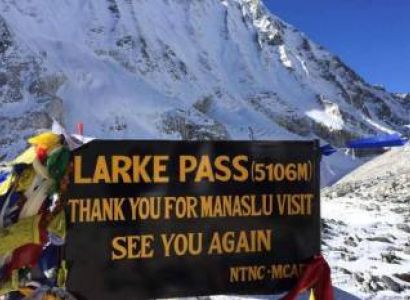
The exciting part of the journey awaits us, as we will be trekking around the Manaslu circuit, crossing the Larkya La Pass (5,100m). After early morning breakfast, we will leave Dharamsala as it will be a long trek. The weather is the most important factor as the weather decides if the trek becomes more challenging due to strong winds or storms. We begin by crossing the moraine, and descending to a small lake. The trail begins to be rough and unclear as we cross the south of a steep grassy slope. Our route stays on the moraine to an edge, marked by two landmarks. The prayer flags mark the route giving us a sense of trek direction. We descend carefully to four frozen lakes, then finally climb a steep trail to the Larkya La Pass. From the pass, you can enjoy the panoramic views of Himlung Himal, Cheo Himal, Kang Guru, and the great Annapurna II. The marvelous trail takes us to the top of the moraine, heads west, and makes steep, rough bends. We further cross the moraine then descend gently to another grassy moraine at 4,450m. As we descend, the trail becomes easier to walk in, as we arrive at a small meadow. The valley begins to widen as we near the large meadow, Mani walls, and small houses that indicate we have reached Bhimtang.
Activities : Trekking
Last day's trek must have been tough, but you can wake up assured that today's trek will not be very taxing. You start by descending to Budhi Gandaki River and cross it to enter the rhododendron forest that opens to Karche - a cultivated area near the top of Budhi Gandaki valley. You continue along the river bank to reach Gho.
Activities : Trekking
This will be the last day on the trails. After waking up at Gho, we head to Dharapani. The route descends so the trek should be easy. You will be trekking through many fields and pastures and arrive at Tilje - a large Gurung settlement. This village is famous for brandy. However, we continue forward passing several Mani walls to reach Thonje village and then enter Dharapani village.
Activities : Trekking
Today will be your last day on the road. After early morning breakfast, we leave Dharapani to Besishar on a local bus, which will take about six to seven hours. The drive will be scenic as we will pass many villages, Marsyangdi River, Bhulbhule town, and Khudi. We will reach Besisahar before 3 pm to catch the last bus to Kathmandu. If we are late, we will have to extend a day in the itinerary. After catching a bus to Kathmandu, on our way, you will see the Marsyagdi River meeting the Trishuli River, as we head east on the Prithivi Highway. The drive allows you to appreciate beautiful and natural scenery - including the terraced lands and high peaks.
Activities : Trekking
* 20% Advance Percentage of total booking amount
* Upon cancellation, refund will be made after deducting the Retention Amount.
Wilderway trekking & Expedition Pvt Ltd, based in Kathmandu, offers a wide range of tour programs across India, specializing in customized holiday packages at affordable prices. Whether you're planning a heritage tour, pilgrimage trip, beach holiday, Know more..
Kathmandu & Mount Kailash & Lake Manasarovar 16 Days Budget Tour Package
Kathmandu - Mount Kailash - Lake Manasarovar
16 Days / 15 Nights
45 Days Kathmandu & Shigatse & Lhasa & Tingri Budget Tour Package
Kathmandu - Shigatse - Lhasa - Tingri
45 Days / 44 Nights
Kathmandu & Lukla & Solukhumbu 27 Days Budget Holiday Package
Kathmandu - Lukla - Solukhumbu
27 Days / 26 Nights
15 Days Kathmandu & Lukla & Solukhumbu Tour Package Budget
Kathmandu - Lukla - Solukhumbu
15 Days / 14 Nights
Kathmandu & Lukla & Solukhumbu 30 Days Budget Tour Package
Kathmandu - Lukla - Solukhumbu
30 Days / 29 Nights
Agra & Bikaner Tour Package - 16 Days Luxury
New Delhi - Bikaner - Jaisalmer - Jodhpur - Ranakpur - Jaipur - Agra - Mandawa - Ti..
16 Days / 15 Nights
Amritsar & Kinnaur 16 Days Standard Tour Package
Shimla - Kinnaur - Manali - Amritsar - Kullu - Sangla
16 Days / 15 Nights
Ajmer & Bikaner 16 Days Standard Holiday Package
Bikaner - Jodhpur - Jaisalmer - Mount Abu - Chittorgarh - Pushkar - Ajmer - Jaipur ..
16 Days / 15 Nights
16 Days Badami & Bagalkot Budget Tour Package
Mumbai - Goa City - Belgaum - Bagalkot - Badami - Hassan - Mysore - Bangalore - Hos..
16 Days / 15 Nights

16 Days Agra & Haridwar Budget Holiday
New Delhi - Agra - Jaipur - Rishikesh - Haridwar
16 Days / 15 Nights
12 Days Standard Ayodhya & Gorkha Tour Package
Prayagraj - Varanasi - Ayodhya - Kathmandu - Pokhara - Lumbini - Gorkha - Mustang -..
12 Days / 11 Nights
12 Days Ayodhya & Gorkha Standard Tour Package
Prayagraj - Varanasi - Ayodhya - Kathmandu - Pokhara - Lumbini - Gorkha - Mustang -..
12 Days / 11 Nights
Ayodhya & Gorkha 12D/11N Standard Travel Package
Prayagraj - Varanasi - Ayodhya - Kathmandu - Pokhara - Lumbini - Gorkha - Mustang -..
12 Days / 11 Nights
6 Days Chitwan & Gorkha Tour Package Luxury
Chitwan - Kathmandu - Gorkha - Swyambhunath Stupa - Patan Durbar Square - Trishuli ..
6 Days / 5 Nights
8 Days Chitwan & Gorkha Tour Package Budget
Kathmandu - Lumbini - Chitwan - Gorkha - Pokhara - Patan Durbar Square - Jal Naraya..
8 Days / 7 Nights
10 Days Jomsom & Manang Luxury Holiday
Jomsom - Manang - Pokhara - Mustang - tilicho - khangsar - siri kharka
10 Days / 9 Nights
6 Days Luxury Gorkha & Jomsom Tour Package
Kathmandu - Jomsom - Gorkha - Pokhara - Mustang
6 Days / 5 Nights