Upon arrival at the airport, welcome by our representative & transfer to the Hotel. At the hotel briefing about the program by our representative. Post afternoon visit Boudhanath: Boudhanath is among the largest stupas in South Asia, and it has become the focal point of Tibetan Buddhism in Nepal. The white mound looms thirty-six meters overhead. The stupa is located on the ancient trade route to Tibet, and Tibetan merchants rested and offered prayers here for many centuries. When refugees entered Nepal from Tibet in the 1950s, many of them decided to live around Bouddhanath. They established many gompas, and the "Little Tibet" of Nepal was born. This "Little Tibet" is still the best place in the Valley to observe Tibetan lifestyle. Monks walk about in maroon robes. Tibetans walk with prayer wheels in their hands, and the rituals of prostration are presented to the Buddha as worshippers circumambulate the stupa on their hands and knees, bowing down to their lord. Many people believe that Bouddhanath was constructed in the fifth century, but definite proof is lacking. The stupa is said to entomb the remains of a Kasyap sage who is venerable both to Buddhists and Hindus. One legend has it that a woman requested a Valley king for the donation of ground required to build a stupa. She said she needed land covered by one buffalo's skin and her wish was granted by the King. She cut a buffalo skin into thin strips and circled off a fairly large clearing. The king had no choice but to give her the land. The Bouddha area is a visual feast. Colorful thangkas, Tibetan jewellery, hand-woven carpets, masks, and khukuri knives are sold in the surrounding stalls. Smaller stupas are located at the base. Gompa monasteries, curio shops, and restaurants surround Bouddhanath. Conveniently situated restaurants with roof-top patios provide good food and excellent views of Bouddhanath. Pashupatinath Pashupatinath is the holiest Hindu pilgrimage destination in Nepal. There are linga images of Shiva along with statues, shrines, and temples dedicated to other deities in the complex. A temple dedicated to Shiva existed at this site in AD 879. However, the present temple was built by King Bhupatindra Malla in 1697. A gold-plated roof, silver doors, and woodcarvings of the finest quality decorate the pagoda construction. Guheswari Temple, restored in AD 1653, represents the female "force". It is dedicated to Satidevi, Shiva's first wife, who gave up her life in the flames of her father's fire ritual. A circuit of the Pashupati area takes visitors past a sixth-century statue of the Buddha, an eighth-century statue of Brahma the creator and numerous other temples. Some other places to visit are Rajrajeswari Temple, built in 1407, Kailas with lingas more than 1,400 years old, Gorakhnath temple, and the courtyard of Biswarup. There are rows of Shiva shrines and Hindu pilgrims from all over South Asia offering puja worship to Shiva, tile Lord of Destruction. The Bagmati River flows close by and the Arya Ghat cremation grounds are here. We strongly advise photographers not to take photos of cremations and of bereaved families. Sadhus, sages who follow the lifestyle of Shiva, may be seen covered in ashes and loin-cloths. They ask for money in case you want to take their photos. The main Pashupatinath courtyard may be entered by those of Hindu faith only. In the evening, enjoy optional traditional Nepalese Dance with Dinner at Nepali Chulo/similar kind of local restaurant. Rest day at leisure. Overnight stay in Kathmandu
Activities : Sightseeing
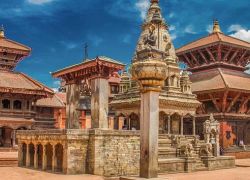
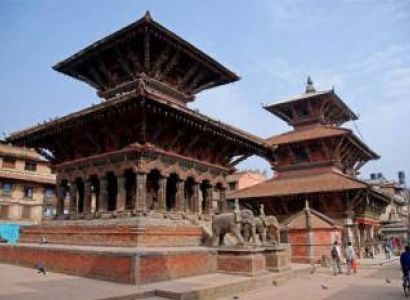
Early morning, enjoy optional Mountain Flight for an hour by fixed wing aircraft, the flight shall give you an ariel view of Mt. Everest and other Himalayan Peaks. Morning post breakfast proceed to Chandragiri Hills (10 Km from Kathmandu city ) & here you can enjoy the cable car ( directly payable) & enchanting view of kathmandu valley. Later return back to kathmandu. Patan City: Patan Durbar Square: Patan Durbar Square is an enchanting mélange of Palace buildings, artistic courtyards and graceful pagoda temples. Listed as a World Heritage Site, the former Royal Palace complex is the center of Patan's religious and social life, and houses a museum containing an array of bronze statues and religious monuments. One remarkable monument here is 17th century temple dedicated to the Hindu god Krishna, built entirely of stone. Tibetan Refugee Camp: This camp was set up in 1960 under the initiative of the International Red Cross & the Swiss Development Corporation in corporation with HMG of Nepal. Its main objective is to help the Tibetan Refugees to do something nice & support themselves & some carpet industries & handicrafts have been operating. Swoyambhunath: The four seeing eyes of Swoyambhunath Stupa watch over the valley from the top of 77-m high hillock on western side. This most glorious Stupa in the world, is one of the holiest Buddhist sites in Nepal and its establishment is linked to the creation of Kathmandu valley out of a primordial lake. The surroundings of the Swoyambhunath are covered with small Chaityas & monasteries as well as some Hindu temples. The National Museum and the Museum of Natural History are situated at the foot of the hill. Rest day at leisure. Overnight stay in Kathmandu
Activities : Sightseeing
After breakfast, drive to Chitwan, about 5-hrs drive. Upon arrival at the Lodge welcome & briefing by the naturalist.. After Lunch, either canoe or elephant ride. Overnight stay in Chitwan.
Activities : Elephant Safari
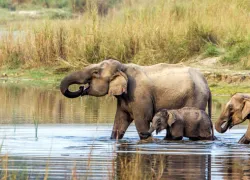
Whole day full of jungle activities including Jungle walk, elephant ride, canoe ride, Elephant briefing OR Elephant batthing , Village visit OR Tharu Dance etc. Chitwan National Park is the most famous national park in Nepal. Which offers 450 species of birds including four species of deer, leopard, sloth bear, wild boar & many other wildlife. This park is well known for one horned Rhinoceros & it is a shelter for few Royal Bengal Tigers. Besides this, Chitwan also supports a great variety of flora & fauna. (Exact program in Chitwan can only be confirmed upon guest’s arrival at the resort as itinerary shall depend upon the occupancy in the resort and guest’s arrival / departure time)
Activities : Elephant Safari

Early in the morning, after/tea coffee; set for the Jungle walk & bird watching. After breakfast, drive to Kathmandu. The drive from Chitwan to Pokhara takes about 6 hours. Upon arrival at Pokhara transfer to the hotel and your rest of the day is free. If Kathmandu is the cultural hub of Nepal, Pokhara is its center of adventure. An enchanting city nestled in a tranquil valley, it is the starting point for many of Nepal's most popular trekking and rafting destinations. The atmosphere on the shore of Phewa Lake is one of excited vitality as hipster backpackers crowd the many bars and restaurants exchanging recommendations on guest houses and viewpoints, both by the lake and above the clouds. Pokhara is a place of remarkable natural beauty. The serenity of Phewa Lake and the magnificence of the fishtailed summit of Machhapuchhre (6,977 m) rising behind it create an ambience of peace and magic. At an elevation lower than Kathmandu, it has a much more tropical feel to it, a fact well appreciated by the beautiful diversity of flowers which prosper in its environs. Indeed, the valley surrounding Pokhara is home to thick forests, gushing rivers, emerald lakes, and of course, the world famous views of the Himalaya. The powerful rule of the old kings of Kathmandu, the Lichhavis and the Mallas, held sway over this valley for some time. As these dynasties fell prey to their own troubles, Pokhara Valley and the surrounding hills disintegrated into small kingdoms, frequently at war with each other. These were called the Chaubise Rajya or the Twenty-four Kingdoms. It was among these that Kulmandan Shah established his kingdom. His descendant Drabya Shah was the first to establish Gorkha, home of the legendary Gurkha warriors. Finally, Pokhara is part of a once vibrant trade route extending between India and Tibet. To this day, mule trains can be seen camped on the outskirts of the town, bringing goods to trade from remote regions of the Himalaya. This is the land of the Magars and Gurungs, hardworking farmers and valorous warriors who have earned world-wide fame as Gurkha soldiers. The Thakalis, another important ethnic group here, are known for their entrepreneurship.
Activities : Sightseeing


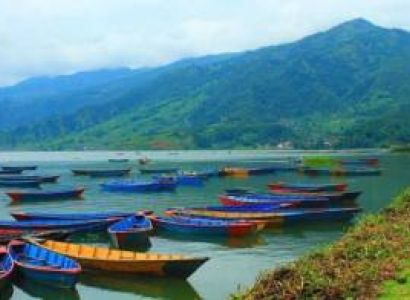
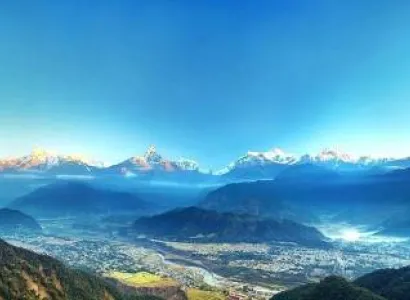
Early morning, take drive to Sarangkot to have a bird’s eye view of Pokhara City and witness sunrise over the Annapurna range. Sarangkot (1592 m):A former Kaski fort lying atop a hill to the west of Pokhara. The panoramic view of the Himalaya seen from this point is superb. Mountain Views Clearly the most stunning of Pokhara's sights is the spectacular panorama of the Annapurna range which forms its backdrop. Stretching from east to west, the Annapurna massif includes Annapurna 1 to IV and Annapurna South. Although the highest among them is Annapurna 1 (8,091 m), it is Machhapuchhre which dominates all others in this neighbourhood. Boastfully levitating in the skyline, the fish-tailed pinnacle is the archetypal snow-capped, needle-pointed mountain. Afternoon half day sightseeing tour of Pokhara city. Phewa Lake-Phewa Lake, the second largest lake in the Kingdom, is the center of all attraction in Pokhara. It is the largest and most enchanting of the three lakes that add to the resplendence of Pokhara. Here, one can sail or row a hired boat across to the water or visit the island temple in its middle. The eastern shore, popularly known as lakeside or Baidam, is the favorite home base for travellers and is where most of the hotels, restaurants and handicraft shops are located. Seti Gandaki-Another of Pokhara's natural wonders that unfailingly interests visitors is the Seti Gandaki river. Flowing right through the city, the boisterous river runs completely underground at places. Amazingly, at certain points the river appears hardly two meters wide. But its depth is quite beyond imagination over 20 meters! Mahendra Pul, a small bridge near the old Mission Hospital, provides a perfect view of the river's dreadful rush and the deep gorge made by its powerful flow. Barahi Temple-The Barahi temple is the most important monument in Pokhara. Built almost in the center of Phewa Lake, this two-storyed pagoda is dedicated to the boar manifestation of' Ajima, the protesters deity representing- the female force Shakti. Devotees can be seen, especially on Saturdays, carrying male animals and fowl across the lake to be sacrificed to the deity. The Old Bazaar-Pokhara's traditional bazaar is colorful and so are its ethnically diverse traders. In its temples and monuments can be seen ties to the Newar architecture of the Kathmandu Valley. Located about four km from Lakeside, the market's original charm is alive and well. This area strewn with shops selling commodities ranging from edibles and cloth to cosmetics and gold is a pleasant and shady spot to stroll around. The old bazaar is also home to one of Pokhara's most important shrines'. Locally called the Bindhyabasini Mandir, this white dome-like structure dominates a spacious stone-paved courtyard built atop a shady hillock. It is dedicated to Goddess Bhagwati, yet another manifestation of Shakti. The park-like grounds offer a fine picnic area, and on Saturdays and Tuesdays when devotees flock there to offer sacrifices, it takes on a festive local flavour.
Activities : Sightseeing
Morning post breakfast drive to Kathmandu enroute visit Manokamna temple (cable car directly payable). Upon arrival Kathmandu. Day free their own to explore the city or shopping. Overnight stay in Hotel.
Activities : Sightseeing
After breakfast, in time transfer to board your onward flight for onward journeys
Activities : Sightseeing
* 20% Advance Percentage of total booking amount
* Upon cancellation, refund will be made after deducting the Retention Amount.
Aspa Reisen Private Limited, based in New Delhi, Delhi, offers a wide range of tour programs across India, specializing in customized holiday packages at affordable prices. Whether you're planning a heritage tour, pilgrimage trip, beach holiday, adve Know more..

Vietnam Classic 07 Days - 06 Nights Tour
Da Nang - Phu Quoc Island - Hoi An - Ha Long - Hanoi
7 Days / 6 Nights
Best Of South India - Architecture - Wildlife Tour 11 Nights - 12 Days
Kochi - Alleppey - Chennai - Chidambaram - Kanchipuram - Kumbakonam - Mahabalipuram..
12 Days / 11 Nights
Romantic Getaways 6 Nights - 7 Days Tour
Port Blair - Neil Island - Havelock - South Andaman
7 Days / 6 Nights
The Fort And Palaces With Wildlife 12 Nights - 13 Days Tour
New Delhi - Bikaner - Jaipur - Jaisalmer - Jodhpur - Pushkar - Ranthambore - Agra -..
13 Days / 12 Nights
Spiti Valley Tour Itinerary 7 Nights - 8 Days
Manali - Shimla - Lahaul & Spiti - Kalpa - Kaza
8 Days / 7 Nights
Munnar - Thekkady - Alleppey - Kovalam - Kanyakumari
8 Days / 7 Nights

Delhi Shimla Manali Honymoon Package
New Delhi - Shimla - Manali - Chandigarh City - Kullu
8 Days / 7 Nights
11 Nights - 12 Days Nepal Tour From Gorakhpur
Prayagraj - Gorakhpur - Varanasi - Ayodhya - Kathmandu - Pokhara - Chitwan - janakp..
12 Days / 11 Nights
11 Nights - 12 Days Nepal Tour Package - 2
Prayagraj - Gorakhpur - Varanasi - Ayodhya - Kathmandu - Pokhara - Chitwan - janakp..
12 Days / 11 Nights
11 Nights - 12 Days Nepal Tour From Gorakhpur
Prayagraj - Gorakhpur - Varanasi - Ayodhya - Kathmandu - Pokhara - Chitwan - janakp..
12 Days / 11 Nights
8D Kathmandu - Chitwan - Pokhara - Lumbini - Janakpur Tour
Kathmandu - Pokhara - Lumbini - Chitwan - janakpur
8 Days / 7 Nights
Kailash Mansarovar Yatra by Helicopter for 10 Nights and 11 Days
Kathmandu - Nepalgunj - Simikot - Purang - Mansarovar - Darchen - Dirapuk - Zuthulp..
11 Days / 10 Nights
Kathmandu - Pokhara - Lumbini - Chitwan
8 Days / 7 Nights
Teerath Yatra 2 Ayodhya - Kathmandu 5 Nights - 6 Days
Ayodhya - Lucknow - Kathmandu
6 Days / 5 Nights