"Step back in time at ancient Roman ruins."
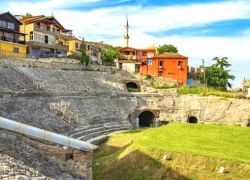
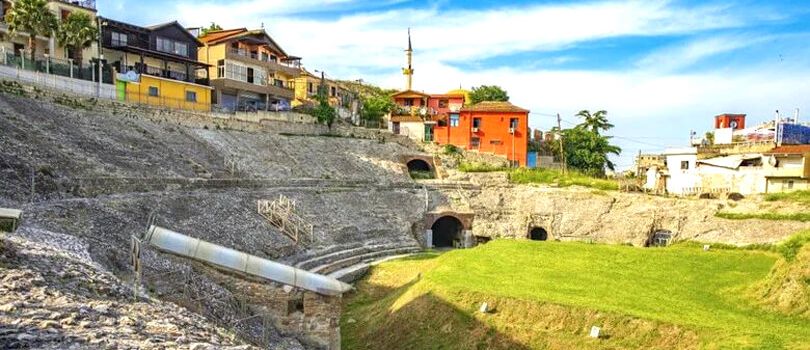
The Durrës Amphitheatre (Albanian: Amfiteatri i Durrësit) sits in the heart of Durrës, Albania’s principal port on the Adriatic Sea. Built during the Roman Imperial period, this elliptical amphitheatre is the largest known Roman amphitheatre on the Balkan Peninsula and remains one of Durrës’s most important archaeological attractions. It provides a rare, close-in glimpse into the urban and social life of Roman Dyrrachium and today functions as both a ruin to explore and a small archaeological museum site. :contentReference[oaicite:0]{index=0}
How to reach Durrës Amphitheatre
Durrës is about 30–40 km west of Tirana (the capital). From Tirana, regular buses and minibuses depart for Durrës from the central bus terminals and the airport area; the ride usually takes around 30–45 minutes depending on traffic. Taxis or private transfers are also common and take roughly the same time but cost more. If you are already in Durrës, the amphitheatre is centrally located and easily reached on foot from the seafront promenade and the main central streets. :contentReference[oaicite:1]{index=1}
Weather and best time to visit
Durrës enjoys a Mediterranean climate — hot, dry summers and mild, wetter winters. The best time to visit the amphitheatre for comfortable walking and photos is in spring (April–June) and autumn (September–October) when temperatures are warm but not scorching and crowds are smaller than midsummer. If you visit during July–August, plan for early morning or late afternoon when the light is softer and heat is less intense.
Opening hours and entry (practical details)
Practical opening hours and ticketing can sometimes vary by season and by local museum management. Many visitor reports and local guides list the amphitheatre as having daytime opening hours (roughly 9:00–16:00 or 9:00–19:00 depending on the season), with a modest entry fee — frequently reported around a few euros (for example ~300 Lek / €2–€4). Occasionally the hours differ by weekday/weekend, and in some periods the site may have restricted access for restoration work or archaeological work, so check locally when you arrive in Durrës. The amphitheatre is often ticketed together with the adjacent Archaeological Museum. :contentReference[oaicite:2]{index=2}
Why the Durrës Amphitheatre is famous
The amphitheatre’s fame stems from several factors: its sheer scale for the region (historically holding thousands of spectators), its central urban setting that reveals layers of occupation (Roman, early Christian, medieval), and the survival of rare early-Christian remains such as chapel mosaics and fresco fragments inside the structure. Its unusual situation — partly excavated, partly built over by later housing, and surrounded by modern city — makes it a striking example of living-heritage tensions and visible urban archaeology. :contentReference[oaicite:3]{index=3}
History and architecture
Construction began in the 2nd century AD, likely under the reign of Trajan or during that general imperial period, when Dyrrachium (the Roman name for Durrës) was a major Adriatic port and provincial centre. The amphitheatre is elliptical with axes reported at roughly 132 by 113 metres; the arena itself measures approximately 61 by 42 metres, and the structure once reached heights of around 20 metres in places. In its heyday it could accommodate many thousands of spectators — some estimates range up to 15,000–20,000 — and it staged spectacles and public events typical of Roman urban life. :contentReference[oaicite:4]{index=4}
Over the centuries the amphitheatre suffered earthquake damage (notably in late antiquity), was repurposed in the early Christian era (a chapel and mosaics date to the 4th–6th centuries), and later was partially covered and incorporated into the medieval and Ottoman urban fabric. Systematic archaeological excavation began in the mid-20th century and continued in phases; conservation and rehabilitation efforts have taken place in recent decades with international cooperation to stabilise and restore vulnerable elements. Despite conservation work, parts of the amphitheatre remain threatened by urban pressure and earlier neglect. :contentReference[oaicite:5]{index=5}
Things to do at and around the site
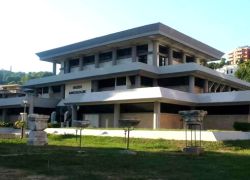
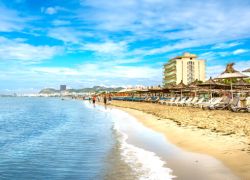
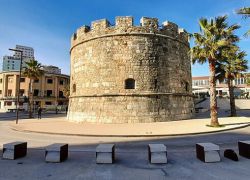
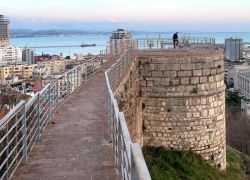
• Walk the rim and terraces: even though only part of the seating is exposed, you can follow the ancient stairways and imagine the original layout. • See the chapel mosaics: inside the amphitheatre there are preserved early-Christian mosaics and traces of frescoes; these are small but historically important. • Visit the nearby Archaeological Museum: many finds from Durrës and the amphitheatre are showcased in the museum, often on the same ticket. • Combine with a seaside stroll: Durrës’s promenade and beaches are minutes away, making it easy to pair culture and beach. • Guided walking tours: local guides and walking tours often include the amphitheatre plus other city highlights (castle, Venetian tower, mosaic floors). These guided options are useful for historical context and for seeing less obvious details. :contentReference[oaicite:6]{index=6}
Facts and quick reference
• Period: Built in the 2nd century AD (Roman). :contentReference[oaicite:7]{index=7}
• Size: Elliptical plan, axes ~132 × 113 m; arena ~61 × 42 m. :contentReference[oaicite:8]{index=8}
• Capacity (historic): Estimates vary widely but often quoted in the tens of thousands (historical estimates around 15,000–20,000). :contentReference[oaicite:9]{index=9}
• Present status: Partially excavated and conserved; functions as a protected archaeological site and visitor attraction. Conservation campaigns and rehabilitation projects have been carried out in recent decades.
Practical tips for visitors
1. Check current opening hours and combined-ticket options with the Archaeological Museum — local kiosks, official tourism offices in Durrës or your hotel can confirm up-to-date times and prices. :contentReference[oaicite:11]{index=11}
2. Wear sensible shoes — the stone seating, steps and uneven surfaces require good walking footwear.
3. Sun protection — limited shade inside the arena; bring a hat and water in summer.
4. Photography — great for wide-angle shots that juxtapose ancient stonework with modern cityscape; early morning or late afternoon gives best light.
5. Respect restricted areas — parts of the site may be closed off for conservation or excavation; obey signs and local staff. :contentReference[oaicite:12]{index=12}
Conclusion
The Durrës Amphitheatre is a compact but powerful encounter with Albania’s Roman past right in the modern city centre. Whether you are a history buff, a casual visitor pairing culture with a beach day, or a photographer hunting for unusual urban-archaeological scenes, the amphitheatre rewards a careful visit. Allow time to combine it with the Archaeological Museum and a stroll along Durrës’s lively waterfront for the full experience.