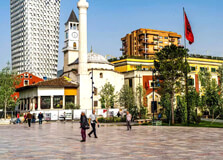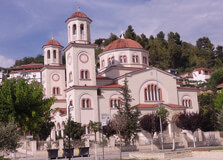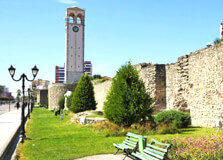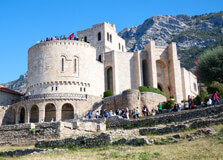
"Discover ancient artifacts in Albania's historic city."
The Archaeological Museum of Durrës is the largest and one of the most important archaeological museums in Albania. Established in 1951, the museum showcases the historical depth and cultural layers of the ancient city — originally known as Dyrrachium — spanning prehistoric, Illyrian, Greek, Hellenistic, Roman and later periods. :contentReference[oaicite:3]{index=3} Located near the coast and close to Durrës’ city centre, it offers visitors an insightful journey through thousands of years of history, through its extensive collection of artifacts. :contentReference[oaicite:4]{index=4}
How to reach Durrës Archaeological Museum
The museum is centrally located on Rruga Taulantia (Taulantia Street), close to the beachfront and the main promenade of Durrës. :contentReference[oaicite:5]{index=5} If you are arriving by bus or from other parts of the city, local buses frequently serve routes toward the city centre/beach area — you can ask to be dropped near Taulantia Street for the museum. :contentReference[oaicite:6]{index=6} From the port or central square, the museum is within easy walking distance: often a 10–15 minute walk depending on your starting point. :contentReference[oaicite:7]{index=7} Taxis are also commonly available throughout the city; a short taxi ride from central Durrës or the port will get you there quickly. :contentReference[oaicite:8]{index=8}
Weather & Best Time to Visit
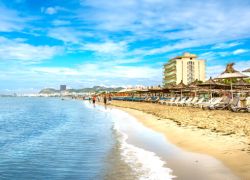
Durrës lies on the Adriatic coast and enjoys a Mediterranean climate: generally warm summers and mild winters. Because many of the museum’s artifacts are indoors, visiting is not heavily dependent on weather — but pleasant weather helps if you plan to combine the museum visit with a seaside stroll or other outdoor exploration. Visiting in the morning or early afternoon tends to be more comfortable, especially if summer heat is intense or if you wish to avoid crowds. Local travel guides often recommend a visit earlier in the day. :contentReference[oaicite:9]{index=9}
Timing & Entry (Practical Visit Details)
Historically, the museum has been open most days of the week except Mondays. :contentReference[oaicite:10]{index=10} Typical published opening hours are from about 9:00 AM to 3:00 PM (or 4:00 PM depending on seasonal variation). :contentReference[oaicite:11]{index=11} Entry fee is modest. Local guides and travel sources mention around €3 (or in Albanian Lek) for adults. :contentReference[oaicite:12]{index=12} Usually a visit takes around 1 to 1.5 hours to view the main exhibits; for more detailed viewing or if combining with other nearby sites, you might spend up to two hours. :contentReference[oaicite:13]{index=13} However — as of recent reports — the museum underwent restoration and has remained closed for some time, which may affect accessibility. :contentReference[oaicite:14]{index=14}
Why the Archaeological Museum of Durrës is Famous
The museum is famous because it preserves a large and important collection of artifacts from ancient Dyrrachium (the predecessor of modern Durrës), reflecting the city’s long and layered history — from prehistoric settlements to Roman prominence and later periods. :contentReference[oaicite:15]{index=15} With over 3,200 artifacts, including Roman funerary steles, stone sarcophagi, ancient coins, statues — even miniature busts of deities such as Venus — the museum captures the cosmopolitan and multi-era identity of the region. :contentReference[oaicite:16]{index=16} Because Durrës was a major port and trade hub in antiquity, the museum’s collections also reflect trade, cultural exchange, and the evolution of the city through Greek, Hellenistic, Roman, Byzantine and later influences. :contentReference[oaicite:17]{index=17} This makes the museum a crucial place to understand not only local history but also the broader heritage of the Adriatic and Mediterranean region.
History & Architecture of the Museum
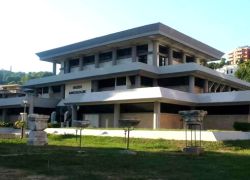
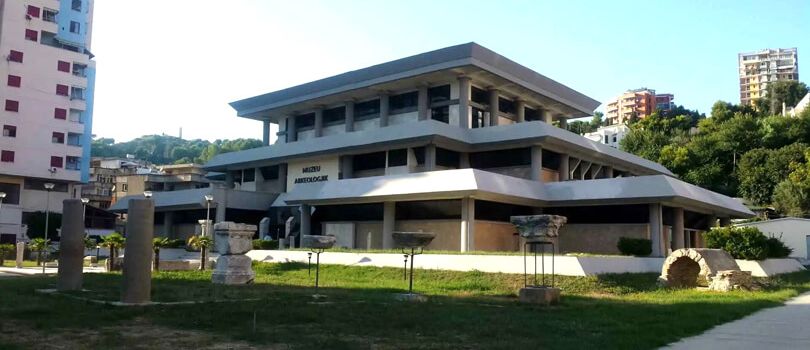
The first archaeological museum in Durrës was founded in 1951 under the direction of the archaeologist Vangjel Toçi. :contentReference[oaicite:19]{index=19} Over time, as more excavations revealed new artifacts and as the city’s archaeological heritage expanded, the museum’s collections grew. Eventually a newer building was constructed to accommodate the expanded holdings. The new museum building — whose construction began in the 1980s — received the archaeological collections in 1999. :contentReference[oaicite:20]{index=20} Architecturally, the museum is a purpose-built facility (rather than an ancient monument repurposed). It is designed to display thousands of objects from various eras, with gallery space, display cases, and — historically — amenities for visitors. :contentReference[oaicite:21]{index=21} However, the museum’s proximity to the sea and coastal climate has posed challenges: salt air, humidity, and weathering have been cited as risks to artifact preservation — a factor that motivated renovation efforts. :contentReference[oaicite:22]{index=22} The museum has been managed by regional cultural heritage authorities, with plans at times to upgrade its status, facilities, and scientific support. :contentReference[oaicite:23]{index=23}
Things to Do / What to See
• Explore the prehistoric and Illyrian exhibits: The museum’s earliest sections cover prehistoric settlements and the autochthonous populations around Durrës, with tools, pottery and early artifacts that document human presence long before classical times. :contentReference[oaicite:24]{index=24}
• View Greek, Hellenistic and Roman collections: Ceramics, statues, Roman funerary steles, stone sarcophagi, coins, and miniature busts give a vivid picture of daily life, religious practices, trade and burial rites in ancient Dyrrachium. :contentReference[oaicite:25]{index=25}
• See evidence of Byzantine and later periods: Because the city remained inhabited through Byzantine, medieval, and later periods, the museum’s collection includes artifacts that show the historical continuity and changes over time. :contentReference[oaicite:26]{index=26}
• Learn about ancient trade and maritime links: Some exhibits include objects — such as amphorae and other trade-related finds — that reflect Durrës’s ancient role as a port city, connecting the Adriatic coast to Mediterranean trade networks. :contentReference[oaicite:27]{index=27}
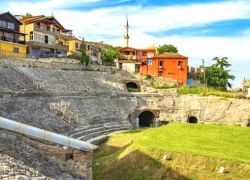
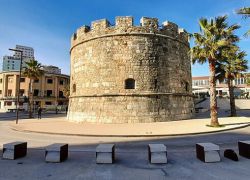
• Combine visit with nearby sites: Given the museum’s central location, many visitors pair a museum visit with a walk along the seafront, a visit to ancient ruins or the old town area, or to nearby historical landmarks — making for a full day of cultural exploration. :contentReference[oaicite:28]{index=28}
Facts & Highlights
• Number of artifacts: ~3,204 objects — making it the largest archaeological collection in Albania outside the national collection. :contentReference[oaicite:29]{index=29}
• Periods covered: Prehistoric, Illyrian, Ancient Greek, Hellenistic, Roman, Byzantine, and subsequent periods — reflecting a continuous human presence and cultural layering. :contentReference[oaicite:30]{index=30}
• Key artifact types: Roman funerary steles, stone sarcophagi, miniature busts (e.g. of venus and other deities), ancient coins, pottery, ceramics, statues, tools and bronze items from prehistory. :contentReference[oaicite:31]{index=31}
• Significance: The museum preserves the legacy of ancient Dyrrachium — a city that was a major Adriatic port and a crossroads of civilizations. Its collections provide evidence for trade, cultural exchange, religious practices, and urban life across centuries.
• Accessibility: For many visitors, the museum remains one of the few concentrated places where Albania’s ancient heritage is presented systematically in one location — rather than scattered ruins. :contentReference[oaicite:32]{index=32}
Practical Tips for Visitors
1. Before visiting, check for reopening status — the museum has been undergoing restoration and at times has been closed. Recent local reporting suggests that as of 2025 the museum remains closed, while restoration work and reorganization of exhibits continue. :contentReference[oaicite:33]{index=33}
2. If it is open, aim to visit in the morning (shortly after opening) or early afternoon to avoid crowds and to have the best light for photos (many galleries use natural or soft lighting). :contentReference[oaicite:34]{index=34}
3. Allocate at least 1 to 1.5 hours for a proper visit. If you are especially interested in ancient coins, funerary objects or Roman period artifacts, you may want a longer visit. :contentReference[oaicite:35]{index=35}
4. Combine the museum visit with a walk along the seaside promenade or other nearby historical sites (ancient ruins, old town, port) — Durrës is compact and many attractions lie close to each other. :contentReference[oaicite:36]{index=36}
5. Respect the displays: as many artifacts are fragile and centuries old, avoid touching exhibits or leaning on display cases. Use photography only where permitted, and avoid flash if possible.
6. For those with limited mobility: The museum building tends to have galleries and display halls (rather than ruins requiring walking over uneven ground), which makes it more accessible than many archaeological sites — though availability of ramps or elevators may depend on current state after renovation. :contentReference[oaicite:37]{index=37}
Caution: Current Status & Restoration
It is important to highlight that as of mid-2025, the museum has been reported as still closed — more than 18 months after a scheduled restoration completion deadline. :contentReference[oaicite:38]{index=38} While physical restoration is reportedly nearly complete (some sources claim about 93 %), essential tasks such as reinstalling display cases, reorganizing exhibits, and re-exhibiting objects remain ongoing. :contentReference[oaicite:39]{index=39} Consequently, there is no firm confirmed reopening date currently available. This uncertainty means that visitors should check local tourism information or contact local authorities in Durrës for the latest updates before planning a visit. :contentReference[oaicite:40]{index=40}
Conclusion
The Archaeological Museum of Durrës stands as a crucial repository of Albania’s ancient heritage — offering a glimpse into millennia of human civilization, from prehistoric settlers to Roman, Byzantine and later eras. Its curated collection helps visitors understand how Durrës (ancient Dyrrachium) evolved from a small settlement to a significant port and cultural hub on the Adriatic coast. If reopened, a visit to the museum — combined with a walk around the old city and seafront — gives a rich, layered experience of history, culture and the sea-facing life of Durrës. Until then, it remains a symbol of Albania’s ongoing efforts to preserve and showcase its archaeological and cultural legacy.