|
|
| Main Languages |
: |
Hindi, Urdu, Marathi and English |
| Population |
: |
Approx. 9 lakhs |
| Area |
: |
289.85 sq.kms |
|
|
|
|
| |
:: About Gwalior
Gwalior is named after a saint who cured the local chieftain Suraj Sen from leprosy. It is also the home of the famous, royal and incredibly rich Scindia family. The magnificent mementoes of a glorious past give Gwalior a unique and timeless appeal, with warrior kings, poets, musicians and saints contributing in making Gwalior the city it is. Today, the city is famous for many educational institutions attracting students from every nook and corner of the country. |
|
:: Attraction In and Around
 | Art Galleries and Museums
The Scindia Museum situated in the Jai Vilas Palace, has a collection ranging from sculptures, bronzes, miniature paintings, manuscripts and coins. The Gujari Mahal Archaeological Museum houses rare antiquities. The old ancestral house of the legendary Ustad Hafiz Ali Khan has been converted into 'Sarod Ghar' - Museum of Music by the Ustad Hafiz Ali Khan Memorial Trust. The Municipal Corporation Museum has a very fine natural history section. |
 | Chanderi
The town dominated the trade routes of Central India on the borders of Malwa and Bundelkhand and became an important military outpost. Today it is a well-preserved medieval town famed for the craft of sari weaving, with beautiful structures executed in the Bundelkhandi style.
|
 | Daita: (69 Km)
Daita is known for its seven-storied palace of Raja Bir Singh Deo built atop a hill. This unique structure was known in Mahabharata as Daityavakra. The other interesting sights are Gopeshwar Temple and the tantric peeth of Pitambara Devi. |
 | Dholpur
Between Gwalior and Agra, in a part of Rajasthan that separates Madhya Pradesh and Uttar Pradesh, Dholpur was the scene of a pitched battle between Aurangzeb's sons for inheritance of the emperor's throne. There is a very old fort called Shergarh Fort, which is now in ruins. |
 | Gwalior Fort The city's most renowned landmark stands on a steep mass of sandstone dominating the city and the fort hill is around 3 kms in length. Its glorious history dates back to more than a thousand years. Emperor Babar who was inspired by this imposing structure described it "the pearl amongst the fortresses of Hind." |
 | Gwalior Zoo Gwalior Zoo has some rare species of Indian wildlife kept in natural surroundings. |
 | Jai Vilas Palace
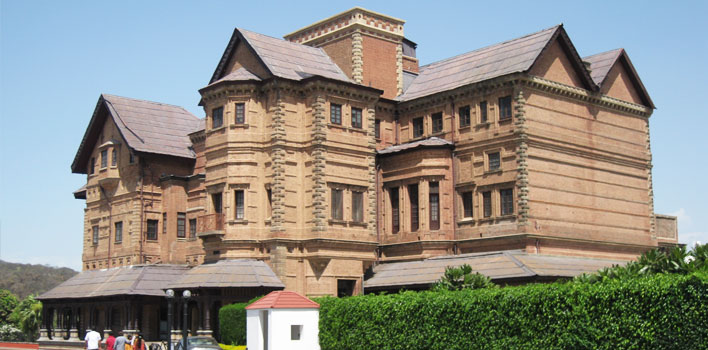
Jai Vilas Palace, the current residence of the Scindia family is an Italianate structure combining the Tuscan and Corinthian architectural modes. About 35 of the rooms have been converted into the Scindia Museum. The main durbar hall is impressive. |
 | Kala Vithika The Kala Vithika is another treasure house of the arts. It remains closed on Sundays and public holidays. |
 | Mausoleum of Ghaus Mohammed The sandstone mausoleum of the Afghan prince, Ghaus Mohammed, is designed on early Mughal lines and the sheer beauty of the tomb is breathtaking. |
 | Narwar
Narwar or Narbar is a tahsil located at a distance of 43 kms from Shivpuri, the district head quarters. It is remarkable for its medieval fortress atop a hill. Narwar was the one-time capital of Raja Nal of Naisadha, and his consort Damayanti. |
 | Orchha
Lying on the road to Khajuraho, Orchha is famous for its palaces and temples built in the 17th and 18th centuries and was once the capital of the Bundela Rajputs. The Jehangir Mahal, the Chaturbhuj Mandir and the Laxmi Mandir are worth visiting. |
 | Pawaya Pawaya is some 68 kms from Gwalior where the life-size statue of Chaksha Manibhadra was found. The ruins of the medieval fort built by the Parmars and the nearby Dhoomeshwar Mahadeo temple are other attractions. |
 | Sas-Bahu-ka-Mandir Another architectural gem is the Sas Bahu ka Mandir dedicated to Lord Vishnu. Mahipala, the Kachchwah king, built it in the early 11th century. |
 | Sun Temple Located near the Residency at Morar, the newly constructed Sun Temple dedicated to Sun God takes its inspiration from the famous Sun Temple in Orissa. |
 | Teli ka Mandir
The 9th century edifice towering 100 ft. high is a Pratihara Vishnu temple with a unique blend of Muslim and Hindu architecture sporting a peculiar layout plan and design. A figure of Garuda crowns the high doorway, which is the highest structure in the fort. |
 | Tigra Dam Tigra Dam is another beautiful spot away from the main city and an ideal picnic spot, which is 23 kms from the city. |
 | Tomb of Tansen
A pillar of Hindustani classical music, the great Tansen, the musician extraordinaire of Akbar's Court, lies buried in Gwalior. The beautiful garden, in which the tomb is located, is the venue of the annual music festival held during November-December. |
 | Shivpuri
Shivpuri remained with the Kachhawaha Rajputs upto 1804 when it was taken over by Scindia's. It was captured by the English in 1817 but returned to Scindia's next year and it continued to be a part of Gwalior state since then. In 1859 it is said that the great Indian leader Tatya Tope was hanged near the present Collectorate. Maharaja Madhav Rao Scindia paid much attention towards the development of Shivpuri. He constructed a big palace and also developed the city. It was the summer capital of Gwalior State and government offices were shifted here in summer months. |
|
| |
:: Getting in, Around & Away
| AIR : | Gwalior Airport (8 kms from the main city) is connected by Indian Airlines to Bombay, Bhopal, Indore, and Delhi. The services are operational three days a week. |
| RAIL : | Gwalior is on the Central Railway's main Delhi-Mumbai and Delhi-Chennai lines. It iis connected with all major cities in India.
|
| BUS : | Gwalior is connected by regular bus services to many small and big towns of India. |
|
| |
:: When to Visit
| BEST TIME TO VISIT : |
October to March |
| TEMPERATURE (in celcius): |
Summer - Max: 46 Min: 21 Winter - Max: 22 Min: 6 |
| CLIMATE : |
Gwalior has extreme climate. The summers are very hot and winters are cold. There have been frequent death reports due to heat wave during the summers. |
|
| |
:: Tourist Information Center
Regional Office, M.P State tourism Development Corporation, Hotel Tansen, Gandhi Road, Gwalior, Madhya Pradesh (India). Tel. - +(91)-0751-340370 / 342606. Fax: +(91)-0751-340371 Tourist information Center M.P State Tourism Development Corporation, Railway Station, Platform No. 1 Gwalior, Madhya Pradesh, (India). Tel. - +(91)-0751-345379 Madhya Pradesh State Tourism Development Corporation Ltd. Gangotri, 4th floor, T.T. Nagar, Bhopal- 462 003 Madhya Pradesh, India. Tel. - +(91)-0755-774340 / 774342 / 774343; Fax - +(91)-0755-772384,
|
|
|
|