India >> North Zone >> Uttar Pradesh >> Mathura
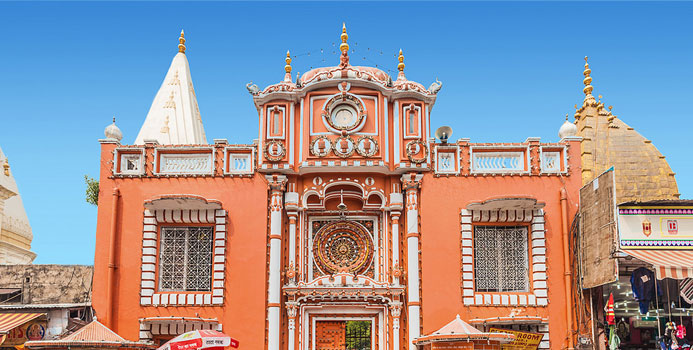
About Mathura According to Hindu Puranas, it is believed that Lord Krishna was born in a prison cell of King Kansa. Katra Keshav Deo is believed to be that place where he was actually born. Aurangzeb’s red stone mosque stands on the same site. Later, excavations at this site revealed many interesting old statues, which are now displayed in the Government museum. Presently a beautiful temple stands at this site dedicated to Lord Krishna.
| Mathura-Vrindavan: | It has often been said that it is easier to count the number of dust particles on the surface of the earth than to count the number of holy places in Mathura.
Mathura-Vrindavan, it is difficult to know the dividing line between reality and myth.
The region is richly interwoven with the legend of Krishna, kept alive today by millions of devotees who look upon him as the most endearing incarnation of Lord Vishnu
Lord Krishna was born in a prison cell in Mathura. His father Vasudev aided by several celestial forces stole him out of Mathura, across the raging river Yamuna and into the house of Nand in Gokul. Krishna spent his early childhood here and revealed the first signs of his divinity. His uncle Kansa's murderous attempts forced Krishna to leave Gokul and move to Nandgaon, a more secure home high up on a hill. From here, the adolescent Krishna, the cowherd, would wander into the Vrindavan forests to play with his friends and Radha, his ladylove. Vrindavan is still a transcendental world, a place of Krishna's Leela, (play), of deep eroticism and an archetypal connection to nature. Each tree in the area speaks, as it were, of the love of the divine couple.
|
| The parikrama: | The parikrama starts by taking bath in Manasi Ganga. One then takes the darshan of Harideva, Manasi Devi and Brahma Kunda. Rinamochana Kunda is near the Govardhana power station and according to a legend if one bathes in this kunda they are freed from all vices.
There are several important places in the vicinity of Govardhana Hill, which are not visited on the normal parikrama. Many of these places are close to Govardhana Hill (within 5 km) and can be visited by taxi.
|
| Govardhanaa hill pooja: | During Dwapara Yuga, Lord Krishna convinced the cowherd men to worship Govardhana, instead of doing a sacrifice to please Lord Indra, the king of heaven, who is in charge of the rain.
His reasons for discouraging the sacrificial ceremony to please Lord Indra were twofold. First, as stated in the Bhagavad-gita there was no need to worship the demigods for any material advancement. Secondly, whatever temporary result one derives is actually granted by the permission of the Supreme Personality of Godhead.
But then this act angered Lord Indra and in return he sent torrents of rain upon Vrindavan. The residents approached Lord Krishna for help. Krishna then lifted Govardhana Hill and held it over the residents like an umbrella.
Seeing extraordinary mystic power of Krishna, Indra, was thunderstruck and immediately called for all the clouds and asked them to desist. He then worshipped Lord Krishna.
Since Lord Krishna is worshipped, His Land Vrindavan and Govardhana Hill also need to be worshipped. Since then, Govardhana puja has been going on. In all the temples of Vrindavana huge quantities of food are prepared in this ceremony and are distributed to general public.
According to the Vedic scriptures Giri Govardhan is greater than even the transcendental kingdom of Vaikuntha, the eternal abode of Lord Vishnu.
|
| A belief: | Rinamochana Kunda is near the Govardhana power station. Usually only after it rains will there is water in this kunda and it is believed that if one bathes in this kunda they are freed from all vices.
Nearby is Papamochana Kunda. It is said that anyone who bathes here has all his offenses removed.
After this normally onew returns to the road to Mathura and then goes in the direction of Mathura, passing the government bus stand on the right. Here is a small hill on the right and next to this hill is a small pond - Indra-dhwaja Tila. This is where the cowherd men would normally worship Indra.
| It is believed that Lord Krishna lifted “Govardhana Giri” (a huge hill) with his little finger, and gave shelter to people under that huge hill from a big squall. A Parikrama (going around the hill) is a sacred ritual performed by many believers. It is a 24-mile Parikrama.
Govardhana is set along the edge of a large masonry tank known as the “Manasi Ganga”, believed to have been brought into existence by the operation of the divine will. Close by is the famous red sandstone temple of Haridev and the Kusum Sarovar.
Along the banks of River Yamuna, about 56 kms from Agra, lies Mathura. Popularly known as Braj Bhoomi, this is the main pilgrim centre for Hindus and also the birthplace of Lord Krishna. It is also one of the seven sacred cities in India. The history of Mathura dates back to 600 BC and this land has been in the limelight during the Mauryan era, and under the great Emperor Ashoka, and later under Kushanas too.
| Area: | 9.37 sq.kms
|
| Best Time to Visit: | Between October and March
|
| Climate: | The climate is extreme and tropical. Summers are extremely hot and winters cold and foggy.
|
| Main Languages: | Brajbhasha, Hindi and English
|
| Population: | Approx. 455251
|
| Temperature: | Summer - Max: 45 Min: 21.9 Winter - Max: 31.7 Min: 14
|

|


Related Cities

|