|
|
|
|
|
 Lakshmana Temple
|
| |
| About Lakshmana Temple
|
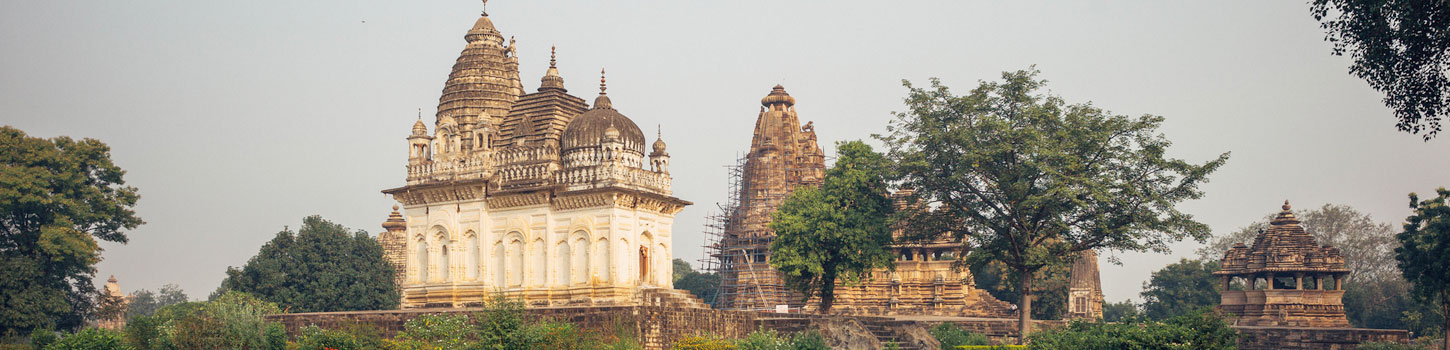
This is one of the oldest and most impressively designed temples of the western group of temples dedicated to Lord Vishnu. The lintel over the entrance of this beautiful Vaishnavite temple shows the trinity of Brahma, Vishnu and Shiva with Lakshmi, Vishnu's consort. The finely carved sanctum has a three-headed idol of Vishnu’s incarnations, Narsimha and Varaha.
Emperor Lakshavarma is credited with building the Lakshmana-Chaturbhuja temple at Khajuraho. The image enshrined is said originally to be from Tibet and was gifted to Lakshavarma by the Pratihara ruler Devapala.
|
| The temple plan
|
The plan of the temple has the main shrines at the centre surrounded by four subsidiary shrines at the four corners. Each of the corner shrines is complete in itself with a garbhgriha and an ardh mandap supported by two pillars. A flight of steps leads to a high terrace that opens to the east. This terrace is profusely ornamented showing scenes of everyday life.
Around the base of the temple is a continuous frieze with scenes of battles, hunting and processions. Inside, one enters through a simple Makara-Toran flanked on either side by gladiators. The circular ceiling of the porch is carved in the design of a Lotus in four concentric circles. The raised platform in the hall is used as a dance floor or for rituals. The pillars on each corner depict Apsaras on carved brackets and among the finest of sculptures, these eight figures, on each column, represent each sect of the Tantras. The Pancha-Ratha has a three heads and four arms as Lord Vishnu at Vaikuntha, apart from 10 incarnations and 14 forms of Vishnu.
|
| The Best Preserved Structure
|
Built during the reign of Yasovarman, this temple dedicated to the Vaikuntha form of Vishnu, stands in the heart of a large cluster of ancient temples, situated to the west of the present Khajuraho village. The deity of the temple is variously known as Lakshmana, Ramachandra or Chaturbhuja attesting its Vaishnava dedication.
|
| Significance
|
Lakshmana Temple is the earliest, best preserved and most typical of the evolved variety of Khajuraho temples. This is the only temple, which preserved the subsidiary shrines and the platform terrace (jagati) with their essential features and decorations intact.
This is the only temple, which has conserved bits of the parapet wall of the platform, representing ornate balustrade and linking all the subsidiary shrines in a common enclosure, with a conspicuous projection in front. This temple is a 'panchayatana' - a complex of five shrines.
Architecturally, this temple has some remarkable features. The roofs of its 'maha-mandapa', 'mandapa' and the entrance porch are of the 'phamsana' type and show a pyramidal superstructure of a straight contour, which is crowned by a prominent chime.
Only two temples at Khajuraho, namely the Lakshmana and the Parsvanath, display on the door-lintel two bold sculptured friezes, of which one represents the Nine Planets with a large figure of Rahu.
|
| Location
|
It is situated to the west of the present Khajuraho village.
|
|