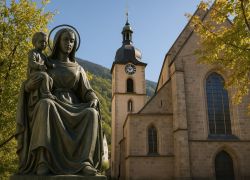
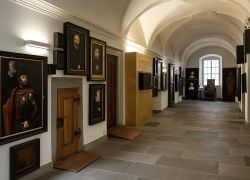
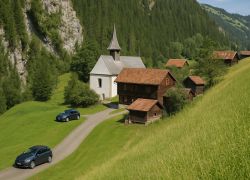
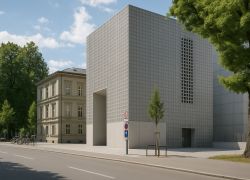
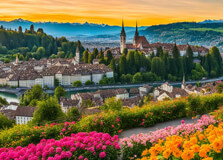
St Martin’s Church—or Martinskirche—is one of the most historically significant and architecturally impressive landmarks in Chur, Switzerland. Dominating the Old Town skyline, it is the largest late‑Gothic church in the canton of Graubünden and serves as a vivid emblem of religious, civic, and cultural transformation in the region :contentReference[oaicite:0]{index=0}.
How to Reach St Martin’s Church, Chur
The church is centrally located and easy to reach:
- By foot: A short 10–15 minute walk uphill from Chur railway station or Old Town brings you directly to St Martinsplatz :contentReference[oaicite:1]{index=1}.
- By bus or car: Local buses stop near Martinsplatz. Drivers can use nearby public parking (e.g., Stadtbaumgarten) and walk a few minutes uphill :contentReference[oaicite:2]{index=2}.
Weather at St Martin’s Church, Chur
Chur has an Alpine climate, and visiting the church is ideal year-round:
- Spring (Mar–May): Mild temperatures (10–18 °C), perfect for walking and sightseeing.
- Summer (Jun–Aug): Pleasant and warm (20–28 °C); good for relaxed exploration.
- Autumn (Sep–Nov): Crisp, colorful season with cooler days.
- Winter (Dec–Feb): Cold (0–5 °C), snow creates scenic beauty—but paths may be icy :contentReference[oaicite:3]{index=3}.
Timing
The church is open year-round, though hours may shift slightly with services:
- Generally open from 10:00 AM to 5:00 PM, Tuesday through Sunday :contentReference[oaicite:4]{index=4}.
- Closed briefly on Mondays and during certain services—best to check timing before visiting :contentReference[oaicite:5]{index=5}.
Why Famous for St Martin’s Church, Chur?
St Martin’s Church is famous for several reasons:
- It is the largest late-Gothic church in Graubünden and among the most important Protestant churches in eastern Switzerland :contentReference[oaicite:6]{index=6}.
- Originally a Romanesque structure consecrated in 769 AD, it was rebuilt into its current Gothic form by 1491 after the 1464 fire :contentReference[oaicite:7]{index=7}.
- It played a central role in Chur’s Reformation from 1523 onward :contentReference[oaicite:8]{index=8}.
- The three stained-glass windows by Augusto Giacometti, added in 1918–19, depict the Nativity and Christmas story :contentReference[oaicite:9]{index=9}.
Entry and Visit Details
Visiting the church is free, although guided tours are available:
- Entry: Free for individual visitors; donations appreciated :contentReference[oaicite:10]{index=10}.
- Guided Tours: Options in multiple languages; typically around CHF 100 + CHF 4 per person :contentReference[oaicite:11]{index=11}.
- Photography: Allowed without flash.
- Accessibility: Mostly accessible, though tower and crypt involve stairs and are challenging for mobility-impaired visitors.
History & Architecture
- Founded as a Romanesque hall church around the 8th century; first mentioned in 769 AD and confirmed in charters by Otto I in 928 :contentReference[oaicite:12]{index=12}.
- Heavily damaged in the city fire of 1464; rebuilt in late Gothic style between 1464 and 1491 under master-builder Stefan Klain :contentReference[oaicite:13]{index=13}.
- Features include a three-aisled nave, polygonal choir, and exceptional stonework including the tower added in 1533 with a watchman’s lodging :contentReference[oaicite:14]{index=14}.
- The 82 m tower was topped with a neo-Gothic spire in 1917, and a porch was added in 1918 to enhance the entrance :contentReference[oaicite:15]{index=15}.
- Giacometti’s 1918–19 windows—Nativity, Annunciation, and Adoration of Magi—are celebrated for their color and symbolism :contentReference[oaicite:16]{index=16}.
- The interior includes a 1558 wooden pulpit, 1665 baptismal font, and a historically significant organ originally installed in 1613 and updated in 1992 :contentReference[oaicite:17]{index=17}.
Things to Do
- Admire the Giacometti stained-glass windows and Gothic stone detailing.
- Attend worship services or organ concerts—acoustics are renowned :contentReference[oaicite:18]{index=18}.
- Explore the crypt and view medieval frescoes and preserved Romanesque masonry :contentReference[oaicite:19]{index=19}.
- Climb the bell tower (when open) for panoramic views across Chur and the Alps :contentReference[oaicite:20]{index=20}.
- Visit the surrounding St Martinsplatz, featuring the historic 1716 zodiac fountain :contentReference[oaicite:21]{index=21}.
- Join a guided tour with historical or architectural focus :contentReference[oaicite:22]{index=22}.
- Combine your visit with a stroll through Chur’s Old Town, Rätisches Museum, and nearby Cathedral to complete a rich cultural half-day :contentReference[oaicite:23]{index=23}.
Facts & Tips
- The bell tower houses five harmonically tuned bells cast in 1898 :contentReference[oaicite:24]{index=24}.
- The 82-meter spire, added in 1917, is a key landmark visible throughout the city :contentReference[oaicite:25]{index=25}.
- Bring sturdy footwear—cobbled lanes and steps to the tower can be steep.
- Best light for photography is early morning or late afternoon :contentReference[oaicite:26]{index=26}.
- Attending a midday or early morning service offers a quieter experience.
- Entrance donations support preservation; consider contributing €3–5.
- Visit during organ recitals or choir performances—check local listings :contentReference[oaicite:27]{index=27}.
- Staying nearby is easy—Chur boasts many accommodations and the church is walkable from city hotels.