Home Login Register Inquiry Sitemap

Travel Packages | India Tours | Hotels & Motels | Travel Agents | Advertisment


India >> West Zone >> Madhya Pradesh >> Bhopal

About Bhopal

Situated on the 11th century city, Bhojapal, founded by Raja Bhoja, Bhopal is the capital city of Madhya Pradesh. It is situated in the Malwa region and like Rome is built on seven hills. It presents a multi-faceted profile and is a culturally active city. Apart from its natural beauty, Bhopal is famous for its mosques. But is also known, sadly, for the largest industrial disaster or the Gas Tragedy, struck it in 1984.

Area: 284.9 sq km
Best Time to Visit: October-March
Climate: The climate is moderate in Bhopal. The summers are hot and winters cold. But it does not face extreme weather conditions. It rains moderately during rainy season with pleasant weather through out the year.
Main Languages: Hindi, Urdu, Chhatisgarhi (a local dialect) and English
Population: 1.06 million
Temperature: Summer - Max: 41 Min: 26

Winter - Max: 26 Min: 10

Attractions In & Around

Bharat Bhawan

It is a multi art centre without parallel in India housing a museum of the arts, an art gallery, a workshop for fine arts, a repertory theater, indoor and outdoor auditoria, rehearsal room, and libraries of Indian poetry, classical and folk music..

Timings: : Open from 2 pm to 8 pm every day except Mondays.
Vagarth - A Centre of Indian Poetry : Vagarth, has a library of more than 7,000 books of poetry in 14 Indian languages and recordings and video-cassettes of major poets.

This centre provides an excellent platform to the writers for interaction through lecture, recitation, translation and publication.
Rangmandal - A Repertory : Rangmandal is a professional repertory to create a sustained theatre movement that becomes a way of life rather than spasmodic activity. Numerous plays and stage shows are held here. It has at its disposal an indoor Theatre - Antrang and an outdoor Theatre - Bahirang.

It also has a rich library and play museum.
Roopankar - Museum of Fine Arts : Roopankar has been established with a view to set up a historic collection of urban, folk and tribal art and is the only Museum of Arts in India housing both contemporary urban and folk and tribal art.

The museum has contemporary urban, folk and art of aboriginals, a ceramic workshop, litho workshop and facilities for stone craft and metal casting.
Anhad - A Library of Classical and Folk Music : It is a center for Indian classical and folk music organising programmes of top musicians.
Ashram : A Residence for Guest Artists.
Location : Bharat Bhawan is in the Shamla Hills.

It is an independent trust created by the Legislature of Madhya Pradesh and consists of the following units:
Multi-arts complex : Established in 1982, Bharat Bhavan is no doubt a centre for innovative creativity, pursuit of classics and tradition and wide participation in a new cultural upsurge.

One of the most unique national institutes in India, Bharat Bhawan is a center for the performing and visual arts. Designed by the renowned architect Charles Correa, its contours merge in exquisite harmony with the landscape creating a visual impact of spacious and national elegance.

It is a multi-arts complex providing interactive proximity to the verbal, visual and performing arts. It is a place for contemporary articulation, exploration, reflection and innovation.

The multi-art complex is a unique cultural hub that is renowned countrywide, with its art gallery displaying a permanent exhibition of the works of a number of contemporary Indian artists and sculptors apart from a tribal museum displaying the rich cultural heritage of Madhya Pradesh. No doubt, it is a must-visit for art connoisseurs. Many eminent artistes have performed here and its directors include many of leading artistes of the country.

TOP

Gohar Mahal

The Mahal is a magnificent expression of the fusion of Hindu and Mughal architecture, situated behind Shaukat Mahal on the banks of the Upper Lake. It is an architectural gem built by Kudsia Begum, also known as Gohar Begum.

It was built in 1820..

Information for tourists (Indian National Trust fo : The Gohar Mahal is a very significant historical building in dilapidated state. On an invitation from the Ministry of Textiles and Madhya Pradesh Handloom and Handicrafts Vikas Nigam (MPHHVN), INTACH has worked out a restoration and reuse proposal for the complex. To convert it into an Urban Haat, the palace will be restored maintaining the original fabric and construction details of the buildings and finally insert new functions.

TOP

Indira Gandhi Rashtriya Manav Sangrahalaya (A Post Colonial

The Indira Gandhi Rashtriya Manav Sangrahalaya (National Museum of Mankind) is a unique Museum, on the Shamla Hills on the Upper Lake front. It is a postcolonial museum of communities rather than objects.

A road leading to Van Vihar branches off uphill to Manav Sangrahalaya - an anthropological institution housing a vast repertoire of tribal and folk arts from across India.

Situated on the hill by the side of the Upper Lake, surprisingly an entire fishing village has been replicated towards the lakeside with a black, sleek snake boat from Kerala catching immediate attention. Even its shelter has been designed in an ethnic fashion.

Most of it is now covered in wild grass medicinal plants used by the tribals in traditional system of medicine.

It is a unique museum spread over 200 acres of undulating land, situated in a prehistoric site and may be the only museum in the world strewn with numerous prehistoric painted rock shelters. It is engaged in recollection rather than collection. This has been curated directly by the folk and tribal communities, camping at site, to create a miniature presentation of Indian folk ways through display of ecospecific habitations and subsistence practices in the tribal, coastal, desert, and Himalayan habitats.

The tribals themselves built a hilltop village resembling a tribal hamlet with each shack unique to a tribe from one part of the country or the other with original material. This part of the museum has been put together painstakingly over the years by inviting one tribe at a time.

The library, audio-visual archive, computerized documentation and the collection of ethnographic specimens in the Museum, though modest in size are among the best in the world..

Location : It is situated on the Shamla Hills on the Upper Lake front.

TOP

Laxmi Narayan Temple

Also known as Birla Mandir, this beautiful temple on the Arera Hills has a museum attached to it, housing a collection of sculptures from Raisen, Sehore, Mandsour and Shahdol districts of Madhya Pradesh..

Timings : The museum is open from 9 am to 5 pm everyday except Mondays.

This is a beautiful Vaishnavite temple and there are good views over the lakes to the old town from this temple. The museum is excellent, containing a small but very selective collection of local sculptures dating mainly from the Paramana period. The stone sculptures are mainly of Vishnu, Siva and their respective consorts and incarnations.

There is also a small selection of terracotta exhibits from Kausambi and a reconstruction of the Zoo Rock Shelter from Bhimbetka.

TOP

Regional Science Centre

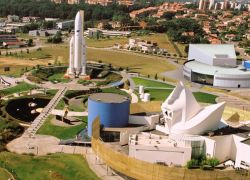
Basically a science museum, located on the picturesque Shamla Hills, this centre houses about 300 participatory exhibits distributed equally in Invention & Fun Science galleries, and a Taranmandal (Planetarium)..

Timings : From 10.30 am to 6.30 pm on all days except Mondays.

TOP

Taj-ul-Masjid

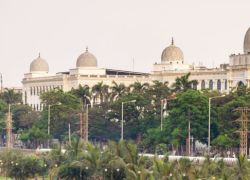
Said to be the largest mosque in the country, the building of this towering edifice was begun by Shah Jehan Begum (1868-1901) but was completed after her death. It a huge pink mosque with two massive white-domed minarets and three white domes over the main building. A three-day Ijtima congregation held here annually draws people from all over the country..

The Grand Structure : The Taj-ul-Masjid is one of the largest mosques in Asia, around a courtyard with a large tank in the centre and with an imposing double storeyed gateway with 4 recessed archways and 9 imposing cusped multifold openings in the main prayer hall. The Quibla wall in the prayer hall is carved with 11 recessed arches.
The structure is enlivened by the limpid expanse of water in the tank outside the northern wall. The monumentality of this structure was much greater originally when it faced the towering bastions of the Fatehgarh Fort.
The great queen, Bhopal's eighth ruler, left many monuments and to her goes the credit for postal system, railways, and waterworks in the city.

The massive pillars in the hall create 27 ceilings through squinted arches of which 16 ceilings are decorated with ornate petalled designs. Some of the remarkable features of this great mosque are the 18 storey high octagonal minars, onion shaped marble dooms and the gossamer fine screens of trellis work in the prayer hall.

TOP

The upper lake and The Lower Lake:

The Upper Lake is divided from the Lower by an over bridge and is 6 sq. kms. in area. Madhya Pradesh Tourism Yacht Club on the Upper and Lower Lakes provide facilities for exciting trips by sail, paddle and motorboats. These two beautiful lakes have given Bhopal its title as the "City of Lakes".

The Upper and Lower lakes (designated as Bhoj Wetland) are urban water bodies. Upper lake is a major source of potable water for the people of the city of Bhopal, Madhya Pradesh, India.

Raja Bhoj created the Upper Lake in the 11th Century by constructing an earthen dam across the Kolans River. Lower lake was constructed much later on the down stream of the dam of Upper Lake. The Lower Lake is surrounded from all sides by human settlements..

Lower Lake : The quality of water in the Lower Lake is worse than that of the Upper Lake. Surrounded by the congested city on all sides, the Lower Lake receives its water mainly from eight nallas (drains) carrying untreated wastewater from the human settlements in various parts of the city. Washing bays or laundry houses exist along the periphery of the lake in large numbers and as a result, besides the domestic and human wastes coming from these dwellings, soap, caustic soda and detergents etc. used for washing of clothes adds to the pollution problem.
Upper Lake : Over the year the quality of water in the Upper Lake has deteriorated due to inflow of wastes and sewage from human settlements and siltation. The causes of siltation are manifold, namely agricultural residues, soil erosion, human activities in catchment area, inflow of silt and waste etc. The gradual increase in pollution of the lake has become noticeable not only from the visible changes but also from the water quality tests. Natural phenomena such as soil erosion and siltation cultural activities such as immersion of idols and Tajias during festivals and inflow of untreated sewage and wastewater from the human settlements etc. have led to the deterioration of this once beautiful lake.
Lake History : The name of the city Bhopal has been derived from Bhojpal or the bund of King Bhoj. King Bhoj (who is said to have) had a great talent and interest in city planning and architecture also created several other large reservoirs with a view to provide his subjects with abundant water throughout the year as well as to create an aesthetic environment. A beautiful royal garden (Kamla Park) was laid on this bund. The natural surface drainage of Kolans river which originates near the town of Sehore, used to flow from southeast to east and pass through the valley formed by hills namely Shamla and Idgah and subsequently Patra drain and finally join the river Halali, which runs a course of about 50 Km up to Kamla Park. In Bhopal, topography is generally flat but there are several hills scattered around the lake and the highest of them is in Singarcholy near Lalghati, which rises to nearly 625m.

TOP

Tribal Habitat (Museum of Man):

The Tribal Habitat, an open-air exhibition on Shamla Hills provides a picture of the tribal cultures of India. It is a presentation of actual-size dwellings typical of contemporary tribal cultures in various states of India..

Timings : Open every day except on Mondays and national holidays, from 10 am to 6 pm.

Architectural features are presented with elaborately displayed interiors with the matching surroundings reconstructed to match some of the interesting environmental features of tribal villages.

The surroundings have been reconstructed to match some of the interesting environmental features of tribal villages.

TOP

Van Vihar:

This safari park is located on a hill adjacent to the Upper Lake. Wildlife watchers can view a variety of herbivorous and carnivorous species, in these natural surroundings..

Timings : Open everyday, except Tuesday, from 7-11 am and 3-5.30 pm.
This 445 hectares park is more of a zoo than a safari park, despite the promise of 'natural surroundings'. Luckily, if you are in the north during the monsoon, when all the national parks are closed, it's good to know you don't have to completely miss out on tigers, lions and crocodiles.

TOP